AQA GCSE Chemistry Year 10: Hydrocarbons
 Call Kai
 Learn
Learn Practice Test
 Spaced Repetition
 Match
Match Flashcards
 Knowt Play
1/44

There's no tags or description
Looks like no tags are added yet.
Name | Mastery | Learn | Test | Matching | Spaced | Call with Kai | Chat |
|---|
No analytics yet
Send a link to your students to track their progress
45 Terms
What are hydrocarbons?
Molecules made up of hydrogen and carbon atoms ONLY
What is crude oil?
. Finite resource found in rocks
. Remains of an ancient biomass consisting mainly of plankton that was buried in mud
What is crude oil made up of?
. Mixture of very large number of compounds
. Most of these are hydrocarbons
. Of the hydrocarbons, most are alkanes
What does the prefix of a hydrocarbon tell you?
How many carbons the compound contains
What is the prefix for 1 carbon?
meth-
What is the prefix for 2 carbons?
eth-
What is the prefix for 3 carbons?
prop-
What is the prefix for 4 carbons?
but-
What does the suffix of a hydrocarbon tell you?
Which homologous series the compound belongs to (-ane and -ene)
What is the general formula for the homologous series of alkanes?
CnH2n+2
What are alkanes?
Hydrocarbons that contain only single bonds (saturated)
What is the process by which you would separate crude oil?
fractional distillation
Describe the process of fractional distillation
. Heat crude oil to turn it into gas before going into the fractionating column
. Fractionating column is hot at the bottom and cold at the top
. Gases rise until they reach fraction which is their boiling point, where they condense and are collected
. Big molecules have a higher boiling point so are collected lower down
What are some properties of smaller-sized hydrocarbon molecules?
. Short carbon-chain lengths
. Low boiling points
. Low viscosity (easily flows)
. High flammability (ignites and burns easily)
What are some materials produced by the petrochemical (crude oil) industry?
. Solvents
. Lubricants
. Polymers
. Detergents
Why is there such a vast array of carbon compounds?
Due to the ability of carbon atoms to form families of similar compounds
What has to be true of a hydrocarbon for it to combust?
Must be gaseous
What will the complete combustion (reaction with oxygen releasing heat) of a hydrocarbon produce?
(Carbon and hydrogen in fuels are oxidised)
. Carbon dioxide
. Water
What will the incomplete combustion (reaction with oxygen releasing heat) of a hydrocarbon produce?
. Carbon monoxide
. Carbon
. Water
Why is incomplete combustion less desirable than complete combustion?
. Waste of fuel
. Waste products are more harmful
When will complete combustion happen?
In plentiful oxygen
Why do we combust hydrocarbons?
They release energy
What is cracking?
. Breaking down hydrocarbons to produce smaller, more useful molecules
. Involves heating the hydrocarbons to vaporise them
. Vapour is either passed over hot catalyst or mixed with steam
. Heated to a very high temperature so that thermal decomposition reactions then occur
What are the products of cracking?
Alkanes and alkenes
What is more reactive, alkanes or alkenes?
Alkenes
How do you test if something contains alkenes or alkanes?
Alkenes can be reacted with bromine water, turning it from orange to colourless
Why can cracking be useful?
There's a high demand for fuels with small molecules
What are alkenes used for?
. To produce polymers
. As starting material for the production of many other chemicals
What is the general formula for the homologous series of alkenes?
CnH2n
What are alkenes?
Hydrocarbons with a double carbon-carbon bond
Are alkenes saturated or unsaturated? Why?
. Unsaturated
. Contain 2 fewer hydrogen atoms than the alkane with the same number of carbon atoms
How do alkenes combust?
. In same way as other hydrocarbons
. But tend to burn in air with smoky flames because of incomplete combustion
What is an addition reaction of alkenes?
. Involves breaking half the double bond
. Each carbon atom forms a new covalent bond with whatever the alkene is being reacted with
. Double bond becomes single C-C bond
. Only 1 product
What happens in the addition of hydrogen gas to an alkene?
. Takes place in presence of a catalyst
. Produces the corresponding alkane (saturated)
What happens in the addition of water to an alkene?
. Takes place by reaction with steam in the presence of a catalyst
. Produces an alcohol
What happens in the addition of a halogen to an alkene?
Produces a saturated compound with 2 halogen atoms in the molecule
What does bromine react with ethene to form?
dibromoethane
What is the process by which alkenes are made into polymers (e.g polyethene)
Addition polymerisation
What happens in addition polymerisation?
Many small molecules (monomers) join together to form very large molecules (polymers)
What should you remember when drawing addition polymers?
. Only single C-C bond
. 'Trailing' bonds that go ACROSS brackets
. 'n' to show there are many
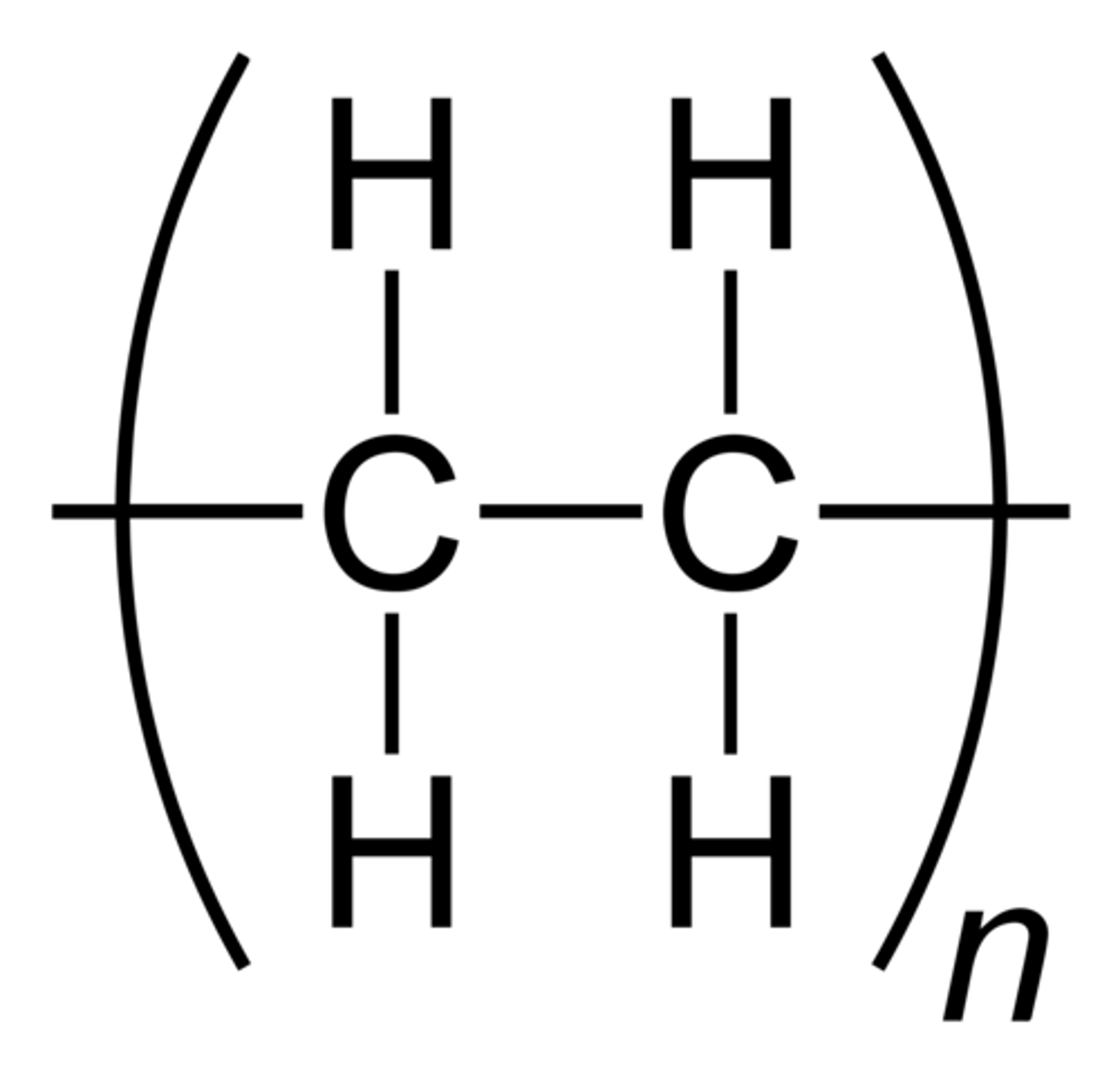
What do the properties of polymers depend on?
. What monomers they're made from
. Conditions under which they're made
What do you call polymers that melt when heated?
Thermosoftening polymers
What do you call polymers that don't melt when heated?
Thermosetting polymers
What is the difference between high and low density polyethene? (HDPE and LDPE)
. LD has a structure in which polymer chains are branched so molecules are arranged randomly
. HD has less branching so molecules line up much more closely
. HD also has more atoms per unit volume
What is the difference in the structure of thermosoftening and thermosetting polymers?
Thermosoftening don't have covalent bonds between neighbouring polymer molecules, thermosetting polymers do