Antibodies, monoclonal antibodies and vaccination
 Call Kai
 Learn
Learn Practice Test
 Spaced Repetition
 Match
Match Flashcards
 Knowt Play
1/8

There's no tags or description
Looks like no tags are added yet.
Name | Mastery | Learn | Test | Matching | Spaced | Call with Kai | Chat |
|---|
No analytics yet
Send a link to your students to track their progress
9 Terms
What is an antibody?
Proteins with specific binding sites synthesised by B cells which reacts with a specific, complementory antigen
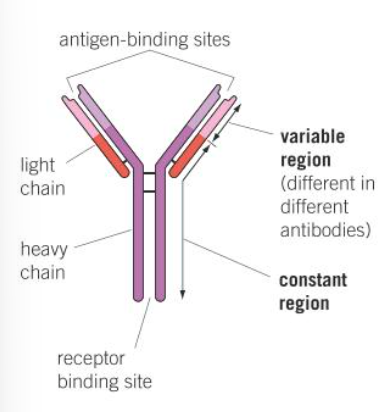
Structure of an antibody
four polypeptide chains
the chains of one pair are long and called heavy chains
chains of the other pair are shorter and called light chains
has a specific binding site that fits with a specific antigen - antigen-antibody complex
binding site is different on different antibodies so is called the variable region
rest of antibody is known as constant region
How does an antibody lead to the destruction of an antigen
Antibodies do not destroy antigens directly but prepare antigen for destruction:
cause agglutination of bacterial cells - clumps of bacterial cells are formed making it easier for phagocytes to locate them
serve as markers that stimulates phagocytes to engulf the bacterial cells to which they are attached
Monoclonal antibodies
antibodies that are produced outside the body (in a lab)
Functions of monoclonal antibodies
targeting medication to specific cell types by attaching a therapeutic drug to an antibody
medical diagnosis
pregnancy testing
Passive immunity
produced by introduction of antibodies into individuals from an outside source
immunity is acquired immediately
no memory cells formed so no lasting immunity
e.g. anti-venom given to victims of snake bites
Active immunity
Produced by stimulating the production of antibodies by the individuals’ own immune system so direct contact with the pathogen is necessary
natural active immunity - results from an individual becoming infected with a disease under normal circumstances - body produces its own antibodies
artificial active immunity - forms the basis of vaccination. involves inducing an immune response to an individual without them suffering the symptoms of the disease
What is vaccination?
The introduction of the appropriate disease antigens into the body, either by injection of by mouth to stimulate an immune response against a particular disease
response is slight however memory cells are produced
allow more immediate, greater response to a future infection with the pathogen
Herd immunity
arises when a sufficiently large proportion of the population has been vaccinated to make it difficult for a pathogen to spread within that population