4.2-4.3 - Prokaryotic & Eukaryotic Cells
 Call Kai
 Learn
Learn Practice Test
 Spaced Repetition
 Match
Match Flashcards
 Knowt Play
1/26

There's no tags or description
Looks like no tags are added yet.
Name | Mastery | Learn | Test | Matching | Spaced | Call with Kai | Chat |
|---|
No analytics yet
Send a link to your students to track their progress
27 Terms
cell componenets
regardless of if they are prokaryotic or eukaryotic all cells contain: (1) a plasma membrane, the outer covering of the cell protecting it from the environ, (2) cytoplasm, a gel-like substance where cellular components are found, (3) DNA, (4) ribosomes, which synthesize proteins. eukaryotic also have nucleus.
cell wall
rigid cell covering made of various molecules that protects the cell, provides structural support, and gives shape to the cell: in prokaryotic cells, it is primarily composed of peptidoglycan, while in plants, it is made of cellulose.
central vacuole
large plant cell organelle that regulates the cell’s storage compartment, holds water, and plays a significant role in cell growth as the site of macromolecule degradation.
centrosome
region in animal cells made of two centrioles: organizes the microtubules and is useful for cell division.
chloroplast
plant cell organelle that carries out photosynthesis: contains chlorophyll to absorb light energy and converts carbon dioxide and water into glucose and oxygen.
chromatin
protein-DNA complex that serves as the building material of chromosomes: found in the cell nucleus and plays a key role in gene regulation and DNA replication.
chromosome
structure within the nucleus that is made up of chromatin that contains DNA, the hereditary material.
cytoplasm
entire region between the plasma membrane and the nuclear envelope, consisting of organelles suspended in the gel-like cytosol, the cytoskeleton, and various chemicals: site for many cellular processes and provides structural support to the cell.
cytoskeleton
network of protein fibers that collectively maintain the shaper of the cell, secure some organelles in specific positions, allow cytoplasm and vesicles to move within the cell, and enable unicellular organisms to move independently.
cytosol
gel-like material of the cytoplasm in which cell structures are suspended.
endoplasmic reticulum (ER)
series of interconnected membranous structures within eukaryotic cells that collectively modify proteins (rough ER) and synthesize lipids (smooth ER).
eukaryotic cell
cell that has a membrane-bound nucleus and several other membrane-bound compartments or sacs: these cells are typically larger than prokaryotic cells and include organisms such as plants, animals, and fungi.
golgi apparatus
eukaryotic organelle made up of a series of stacked membranes that sorts, tags, and packages lipids and proteins for distribution: modifies proteins received from the endoplasmic reticulum before they are sent to their final destinations.
lysosome
organelle in an animal cell that functions as the cell’s digestive component: it breaks down proteins, polysaccharides, lipids, nucleic acids, and even worn-out organelles: play a key role in cellular waste disposal and recycling.
mitochondria (mitochondrion)
cellular organelles responsible for carrying out cellular respiration, resulting the production of ATP, the cell’s main energy-carrying molecule.
nuclear envelope
double-membrane structure that constitutes the outermost portion of the nucleus: separates the contents of the nucleus from the cytoplasm and regulates the passage of materials in and out of the nucleus.
nucleoid
central part of a prokaryotic cell in which the chromosome is found: not membrane-bound and contains the genetic material of the cell, typically organized in a single circular chromosome.
nucleolus
“command center”: cell organelle that houses the cell’s DNA and directs the synthesis of ribosomes and proteins: found within the nucleus and is essential for ribosome production and assembly.
nucleoplasm
semi-solid fluid inside the nucleus that contains the chromatin and nucleolus.
nucleus
cell organelle that houses the cell’s DNA and directs the synthesis of ribosomes and proteins: it is membrane-bound and plays a crucial role in cell division and gene expression.
organelle
compartment or sac within a cell.
peroxisome
small, round organelle that contains hydrogen peroxide, oxidizes fatty acids and amino acids, and detoxifies many poisons.
plasma membrane
phospholipid bilayer with embedded (integral) or attached (peripheral) proteins, and separates the internal content of the cell from its surrounding environment: regulates the movement of substances in and out of the cell.
prokaryote
unicellular organism that lacks a nucleus or any other membrane-bound organelle: typically bacteria and archaea, and their DNA is found in a nucleoid region.
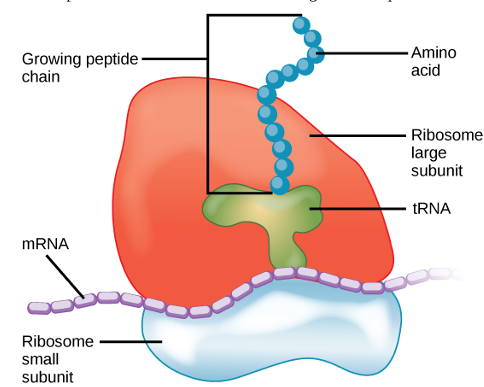
ribosomes
cellular structure that carries out protein synthesis: translate messenger RNA into polypeptide chains, forming proteins essential for cellular functions, found in almost all living cells.
vacuole
membrane-bound sac, somewhat larger than a vesicle, which functions in cellular storage and transport.
vesicle
small, membrane-bound sac that functions in cellular storage and transport: its membrane is capable of fusing with the plasma membrane and the membranes of the endoplasmic reticulum and Golgi apparatus: play a crucial role in transporting materials within cells and can also aid in the secretion of substances.