Biology Exam 1
 Call Kai
 Learn
Learn Practice Test
 Spaced Repetition
 Match
Match Flashcards
 Knowt Play
1/230

There's no tags or description
Looks like no tags are added yet.
Name | Mastery | Learn | Test | Matching | Spaced | Call with Kai | Chat |
|---|
No analytics yet
Send a link to your students to track their progress
231 Terms
Theoretical physicist who received the 1933 Nobel Prize for his work on quantum mechanics
Erwin Schrödinger
Asked what kind of molecule a gene must be and offered a potential physical explanation
Erwin Schrödinger
1. Physics gets its regularity from huge numbers, averages over trillions of atoms. Order from disorder.
2. But a gene is a handful of atoms, and it copies itself faithfully for generations. That needs order from order.
3. So, the gene must be a solid whose units do not repeat: an aperiodic crystal carrying a code-script.
He expected it to be a protein. He was wrong about that — and right about everything else.
Erwin Schrödinger
1. Physics gets its ____________ from huge numbers, averages over trillions of atoms. Order from disorder.
2. But a gene is a handful of atoms, and it copies itself faithfully for generations. That needs order from order.
3. So, the gene must be a solid whose units do not repeat: an aperiodic crystal carrying a code-script.
He expected it to be a protein. He was wrong about that — and right about everything else.
regularity
1. Physics gets its regularity from huge numbers, averages over trillions of ___________. Order from disorder.
2. But a gene is a handful of atoms, and it copies itself faithfully for generations. That needs order from order.
3. So, the gene must be a solid whose units do not repeat: an aperiodic crystal carrying a code-script.
He expected it to be a protein. He was wrong about that — and right about everything else.
atoms
1. Physics gets its regularity from huge numbers, averages over trillions of atoms. _____________ from disorder.
2. But a gene is a handful of atoms, and it copies itself faithfully for generations. That needs order from order.
3. So, the gene must be a solid whose units do not repeat: an aperiodic crystal carrying a code-script.
He expected it to be a protein. He was wrong about that — and right about everything else.
order
1. Physics gets its regularity from huge numbers, averages over trillions of atoms. Order from disorder.
2. But a ____________ is a handful of atoms, and it copies itself faithfully for generations. That needs order from order.
3. So, the gene must be a solid whose units do not repeat: an aperiodic crystal carrying a code-script.
He expected it to be a protein. He was wrong about that — and right about everything else.
gene
1. Physics gets its regularity from huge numbers, averages over trillions of atoms. Order from disorder.
2. But a gene is a handful of atoms, and it ____________ itself faithfully for generations. That needs order from order.
3. So, the gene must be a solid whose units do not repeat: an aperiodic crystal carrying a code-script.
He expected it to be a protein. He was wrong about that — and right about everything else.
copies
1. Physics gets its regularity from huge numbers, averages over trillions of atoms. Order from disorder.
2. But a gene is a handful of atoms, and it copies itself faithfully for generations. That needs ______________ from order.
3. So, the gene must be a solid whose units do not repeat: an aperiodic crystal carrying a code-script.
He expected it to be a protein. He was wrong about that — and right about everything else.
order
1. Physics gets its regularity from huge numbers, averages over trillions of atoms. Order from disorder.
2. But a gene is a handful of atoms, and it copies itself faithfully for generations. That needs order from order.
3. So, the gene must be a ______________ whose units do not repeat: an aperiodic crystal carrying a code-script.
He expected it to be a protein. He was wrong about that — and right about everything else.
solid
1. Physics gets its regularity from huge numbers, averages over trillions of atoms. Order from disorder.
2. But a gene is a handful of atoms, and it copies itself faithfully for generations. That needs order from order.
3. So, the gene must be a solid whose units do not ______________: an aperiodic crystal carrying a code-script.
He expected it to be a protein. He was wrong about that — and right about everything else.
repeat
1. Physics gets its regularity from huge numbers, averages over trillions of atoms. Order from disorder.
2. But a gene is a handful of atoms, and it copies itself faithfully for generations. That needs order from order.
3. So, the gene must be a solid whose units do not repeat: an ______________ crystal carrying a code-script.
He expected it to be a protein. He was wrong about that — and right about everything else.
aperiodic
1. Physics gets its regularity from huge numbers, averages over trillions of atoms. Order from disorder.
2. But a gene is a handful of atoms, and it copies itself faithfully for generations. That needs order from order.
3. So, the gene must be a solid whose units do not repeat: an aperiodic crystal carrying a code-script.
He expected it to be a _______________. He was wrong about that — and right about everything else.
protein
_______________ has produced an astounding diversity of lifeforms on Earth.
Evolution
Evolution has produced an astounding ______________ of lifeforms on Earth.
diversity
There is a _____________ unity of life.
cellular
There is a cellular ____________ of life.
unity
There is a ______________ unity of life.
molecular
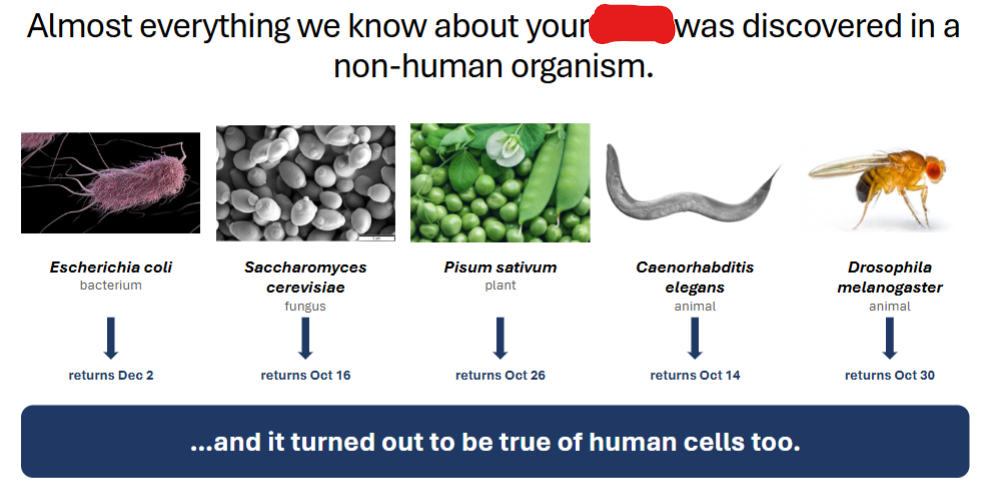
cells
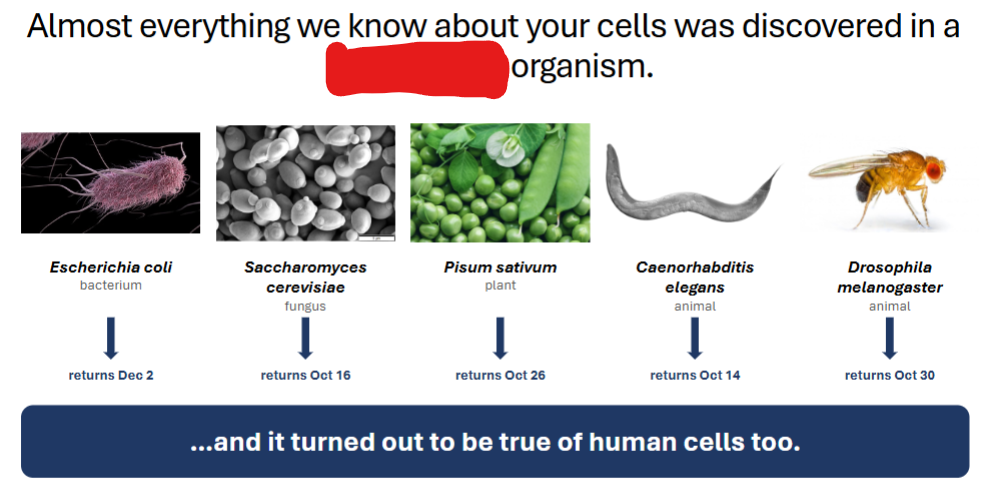
non-human
Life is diverse in form but ____________ in it’s cellular and molecular organization.
unified
Life is diverse in form but unified in it’s _____________ and molecular organization.
cellular
Life is diverse in form but unified in it’s cellular and ____________ organization.
molecular
All ____________ consists of cells, either single cells or collections of cells.
life
All ____________ things contain DNA as their genetic material.
living
All living things contain DNA as their _____________ material.
genetic
Model organisms are informative because biological mechanisms are ____________. That is why yeast cell-cycle genes can tell us a lot about human cancer.
conserved
Model organisms are informative because biological ______________ are conserved. That is why yeast cell-cycle genes can tell us a lot about human cancer.
mechanisms
Model organisms are informative because biological mechanisms are conserved. That is why _______________ cell-cycle genes can tell us a lot about human cancer.
yeast
Weak chemical bonds such as hydrogen bonds form when a hydrogen atom that is __________________ bonded to an electronegative atom like oxygen or nitrogen is attracted to another electronegative atom
covalently
Weak chemical bonds such as hydrogen bonds form when a hydrogen atom that is covalently bonded to an ____________ atom like oxygen or nitrogen is attracted to another electronegative atom
electronegative
Weak chemical bonds such as hydrogen bonds form when a hydrogen atom that is covalently bonded to an electronegative atom like oxygen or nitrogen is _____________ to another electronegative atom
attracted
When a very ______________ atom strips a valence electron away from its partner, ions form.
electronegative
When a very electronegative atom strips a _______________ electron away from its partner, ions form.
valence
When a very electronegative atom strips a valence electron away from its partner, ________________ form.
ions
When the ______________ number and electron number are unequal, the atom or molecule is an ion.
proton
When the proton number and _____________ number are unequal, the atom or molecule is an ion.
electron
When the proton number and electron number are ______________, the atom or molecule is an ion.
unequal
When the proton number and electron number are unequal, the atom or molecule is an _______________.
ion
______________ of an element will always differ in atomic mass.
Isotopes
Isotopes of an element will always differ in atomic ____________.
mass
______________ are best described as a three-dimensional space where an electron spends most of its time with no more than 1 other electron, forming a pair.
Orbitals
Orbitals are best described as a three-dimensional space where an ______________ spends most of its time with no more than 1 other electron, forming a pair.
electron
Orbitals are best described as a three-dimensional space where an electron spends most of its time with no more than 1 other electron, forming a ______________.
pair
________________ tracers are important tools in biological research and medicine.
Radioactive
Matter consists of __________________ elements
chemical
Matter is made up of _____________, which cannot be broken down into other substances by chemical reactions.
elements
Matter is made up of elements, which cannot be ______________ down into other substances by chemical reactions.
broken
Matter is made up of elements, which cannot be broken down into other ________________ by chemical reactions.
substances
Matter is made up of elements, which cannot be broken down into other substances by _______________ reactions.
chemical
There are 118 chemical _____________, ~90 of which occur naturally on Earth.
elements
There are 118 chemical elements, ~90 of which occur ________________ on Earth.
naturally
There are 118 chemical elements, about 20-25 of the naturally occurring elements are ____________ to life.
essential
~96% of _______________ matter consists of just four:
Carbon
Hydrogen
Oxygen
Nitrogen.
living
The _____________ 4% of living matter is mostly:
Calcium
Phosphorus
Potassium
Sulfur
Sodium
Chlorine
Magnesium
remaining
Required in tiny amounts, but a deficiency is still lethal
Iron
Iodine
Manganese
Selenium
etc
Trace elements
Matter consists of chemical elements in ____________ form or in chemical compounds.
pure
Matter consists of chemical elements in pure form or in chemical _____________.
compounds
Assembly of two or more atoms linked by chemical bonds that behaves as a single entity
Molecule
A molecule consisting of two or more different elements in a fixed ratio
Compound
A compound’s characteristics differ from those of its _______________ elements.
constituent
Sodium is a soft metal that reacts violently with water. Chlorine is a toxic green gas. Combined, they make sodium chloride— table salt. Which statement best accounts for this?
A compound’s properties differ from those of the elements that compose it
The smallest unit of matter that retains the properties of an element
Subatomic particles— 3 largest:
Protons
Neutrons
Electrons
Atom
Electrons carry a ____________ charge
negative
Protons carry a _________________ charge
positive
We _____________ atoms based on atomic number and mass number
classify
Number of protons
Atomic number
Protons + neutrons
Mass number
Subtracting atomic number from the mass number
Neutrons
An element’s chemical properties depend on its ______________ structure
atomic
The # of electrons in an atom’s ________________ shell determines its chemical properties
outermost
The outermost shell of electrons is called the _____________ shell.
valence
Electrons in the outermost shell are called ___________ electrons
valence
Atoms with fully occupied valence shells are ______________ (inert)
unreactive
Atoms without fully occupied valence shells can ____________ electrons with other atoms with incompletely filled valence shells to form covalent chemical bonds
share
Atoms without fully occupied valence shells can share electrons with other atoms with _______________ filled valence shells to form covalent chemical bonds
incompletely
Atoms without fully occupied valence shells can share electrons with other atoms with incompletely filled _____________ shells to form covalent chemical bonds
valence
Atoms without fully occupied valence shells can share electrons with other atoms with incompletely filled valence shells to form ____________ chemical bonds
covalent
Atoms can also transfer electrons to other atoms to form ____________ compounds
ionic
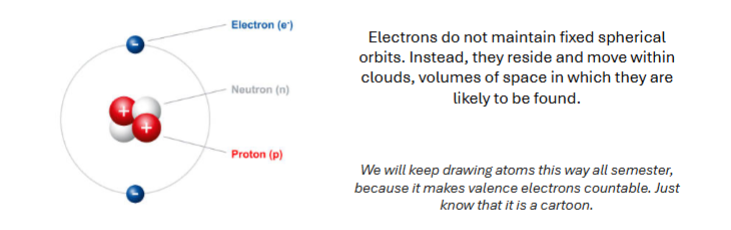
The ___________ model is a useful simplification, not a picture of reality
Bohr
An ______________ has almost no mass compared with a proton.
electron
Electrons have much ___________ mass than a proton. This is why electron mass isn’t part of the atomic mass number.
less
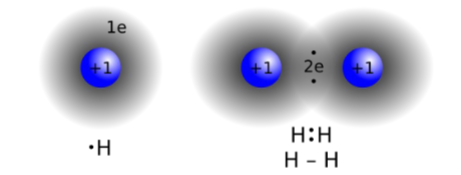
A ______________ bond is two nuclei attracted to the same shared pair of electrons.
covalent
In a ______________ bond, neither atoms own the pair. Both nuclei pull on it, and that shared attraction is the nature of the bond.
covalent
In a covalent bond, neither atoms __________ the pair. Both nuclei pull on it, and that shared attraction is the nature of the bond.
own
In a covalent bond, neither atoms own the pair. Both nuclei pull on it, and that shared ______________ is the nature of the bond.
attraction
Covalent bonds are the ___________ chemical bonds in molecules
strongest
The _____________ capacity of an atom is typically determined by the number of electrons required to complete its valence shell.
bonding
The bonding capacity of an atom is typically determined by the number of ______________ required to complete its valence shell.
electrons
The bonding capacity of an atom is typically determined by the number of electrons required to complete its _______________ shell.
valence
The bonding capacity of an atom
Valence
The relationship between the # of ______________ missing from the valence shell & bonding capacity is straightforward for hydrogen (1), oxygen (2), and carbon (4)
electrons

_____________ covalent bonds share electrons unequally, resulting in partial positive & negative charges
Polar
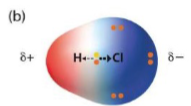
Polar covalent bonds share electrons _____________, resulting in partial positive & negative charges
unequally

_________________ covalent bonds involve bonding electrons shared equally between 2 atoms. There are no charges on atoms.
Nonpolar

Nonpolar covalent bonds involve ____________ electrons shared equally between 2 atoms. There are no charges on atoms.
bonding
The attraction of a particular atom for the electrons of a covalent bond
Electronegativity
When 2 bonded ___________ differ, the shared electrons sit closer to one of them, leaving partial charges— written as −δ and δ+.
atoms
When 2 bonded atoms differ, the ____________ electrons sit closer to one of them, leaving partial charges— written as −δ and δ+.
shared
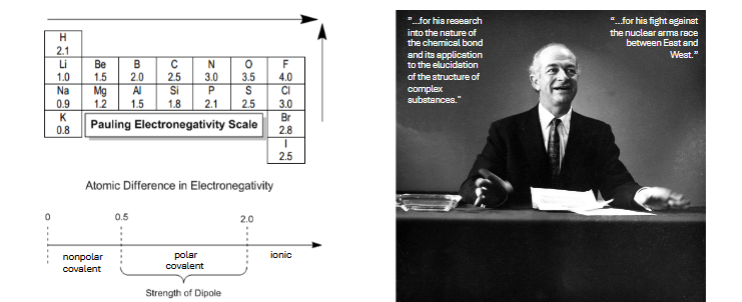
Relative electronegativity determines the nature of ______________ between atoms
bonds