Biochemistry Exam 1
 Call Kai
 Learn
Learn Practice Test
 Spaced Repetition
 Match
Match Flashcards
 Knowt Play
1/179

There's no tags or description
Looks like no tags are added yet.
Name | Mastery | Learn | Test | Matching | Spaced | Call with Kai | Chat |
|---|
No analytics yet
Send a link to your students to track their progress
180 Terms
Define biochemistry.
the study of biomolecules and systems of molecular levels, often in-vitro (outside of cellular environment)
List 4 applications of biochemistry.
medications/pharmaceuticals
agriculture
information about pathogens/disease
commercial products
List the 4 most abundant elements in the human body.
carbon
hydrogen
oxygen
nitrogen
What percentage of the human body consists of H2O?
70%
What are trace elements?
elements that are, in small amounts, required for life and used as co-factors in proteins
List 5 examples of trace elements.
Zn
Fe
Mn
Co
Cu
What are essential ions important for?
cell-signaling and neurophysiology
List 5 examples of essential ions.
Na+
K+
Mg2+
Ca2+
U-
Identify the functional group.

carbonyl
Identify the functional group.
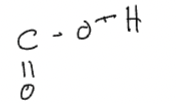
carboxyl
Identify the functional group.
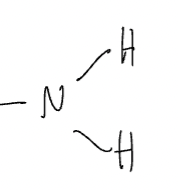
amine
Identify the functional group.

sulphydryl
Order the elements from elements to ecosystem.
elements/functional groups
biomolecules
macromolecules
metabolism
cells
organisms
ecosystem
Specify biomolecules v.s. macromolecules.
biomolecules: amino acids, simple sugars (ie: glucose), fatty acids, nucleotides
macromolecules: proteins, carbohydrates, lipids, DNA/RNA
Define the central dogma.
how information is transferred between DNA, RNA, and proteins
What is the process that converts DNA to RNA?
transcription
List the 5 types of RNA.
mRNA (messenger RNA)
rRNA (ribosomal RNA)
tRNA (transfer RNA)
miRNA (micro RNA)
snRNA (small nuclear RNA)
What process is each type of RNA involved in?
mRNA - protein synthesis (template)
rRNA - protein synthesis
tRNA - protein synthesis
miRNA - gene expression, protein synthesis, and RNA regulation
snRNA - RNA processing
What is the process that converts RNA to proteins.
translation
Define genome.
complete set of DNA of an organism
Define transcriptome.
collection of RNA products produced by DNA transcription
Define proteome.
collection of proteins produced from mRNA translation
Define metabolome.
collection of metabolites
Describe the nature and location of non-covalent interactions.
weak and take place in aqueous environments
What is the function of non-covalent interactions?
plays an important role in structure and function
List the examples of non-covalent interactions.
hydrogen bonding
ionic interactions
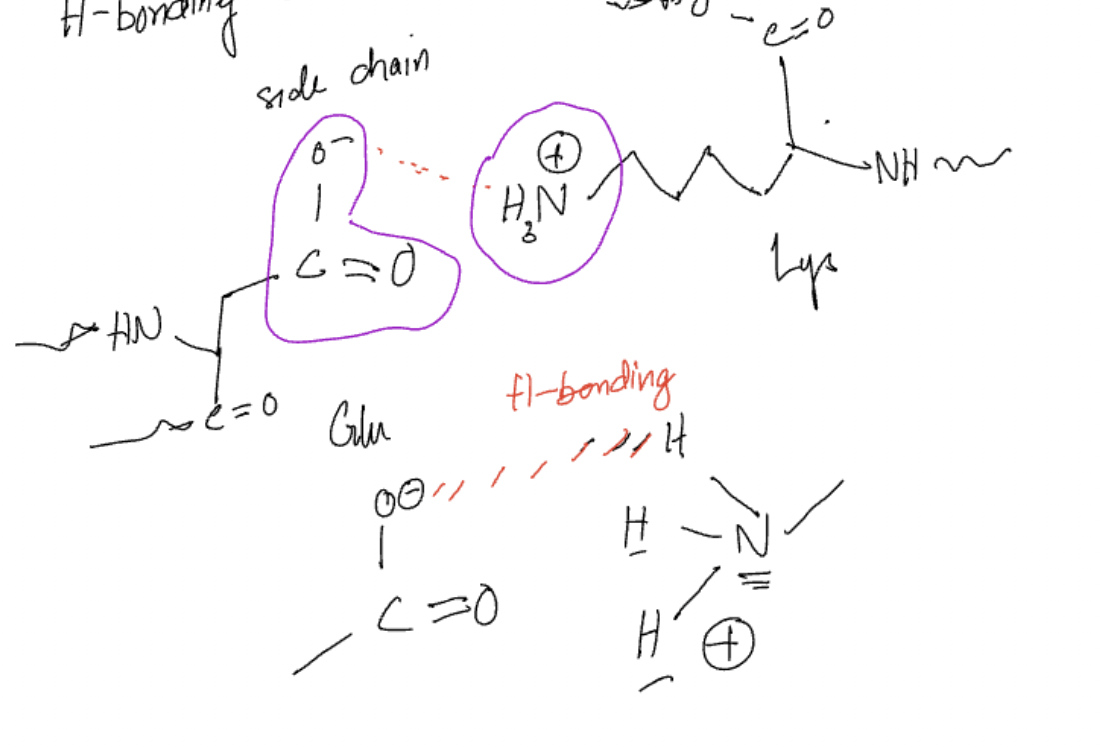
salt bridges
van der waals
hydrophobic interactions
What is hydrogen bonding?
a hydrogen covalently bonded to an electronegative atom (O or N) that is then close in proximity to another electronegative atom which then undergoes hydrogen bonding
What is the purpose of hydrogen bonding of H2O with proteins?
critical role in enzyme active site
What are ionic interactions?
interactions between oppositely charged species
What is the hydration layer that forms due to ionic interactions?
a group of water molecules that surround and stabilize an ion
Draw the hydration layers for cations and anions.
Define crystal lattice.
an arrangement of repeating positive and negative ions held together by ionic bonding
Define salt bridges.
combinations of hydrogen bonding and ionic interactions
Define Van der Waals interactions.
attractions caused by temporary partial charges that form when electrons are unevenly distributed around atoms (they are in constant motion even in nonpolar molecules)
Explain the distance factors of Van der Waals interactions.
too far: weak attraction
optimal: van der waals interactions
too close: strong repulsion
Draw the graph corresponding to potential energy and distance of atoms involved.
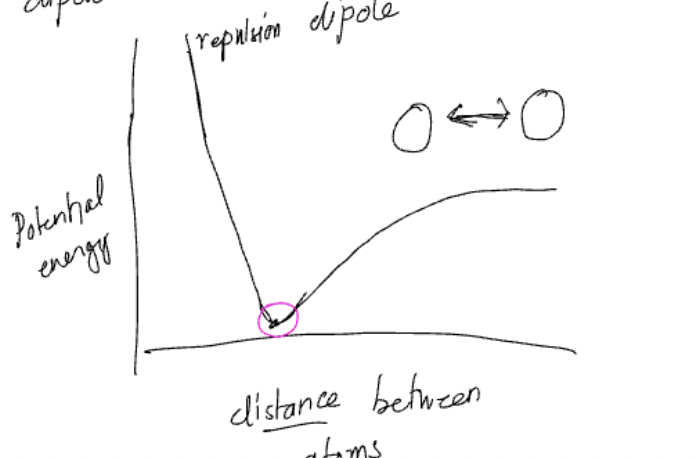
What is the relationship between potential energy and stability?
the lower the potential energy, the more stable
Quantify the optimal Van der Waals distance.
slightly greater than the length of a covalent bond
Define the hydrophobic effect.
the tendency of nonpolar molecules or nonpolar regions of molecules to cluster away from water
What is the purpose of the hydrophobic effect?
energetically favorable because of reduced surface area

Identify each layer’s non-covalent interaction.
salt bridge (ionic interaction + hydrogen bonding)
hydrogen bonding
hydrophobic effect (C-H is nonpolar)
hydrogen bonding
salt bridge
What is Keq? What is the equation?
the equilibrium constant which tells you the relative amounts of reactants and products during equilibrium
Keq = [products]/[reactants]
What is Kw? What is the equation?
the ionization constant of water which tells you the relationship between H+ and OH- in water at equilibrium
Kw = [H+][OH-]
What is the standard value for Kw?
@ 25 C, Kw = 1×10-14 M2
Explain how you determine that the pH of water is 7.
if Kw = 1×10-14- and the concentrations of H+ and OH- are the same as seen in the reaction H2O < - > H+ + OH-, then the concentration of H+ is sq rt of 1×10-14 and pH is -log(concentration of H+)
What is the pH equation in reference to H+ concentration?
pH = -log[H+]
What is pH?
the concentration of hydrogen ions (H+)
What does pH measure?
acidity of a solution
What is the pOH equation?
pOH = -log[OH-]
What are the equations (log version and nonlog version) that relate pH and pOH?
log: -log[H+] + -log[OH-] = -log(10-14)
non-log: pH + pOH = 14
Differentiate between acids and bases.
acids: donate protons
bases: accept protons
Describe strong acids and bases.
dissolve fully in H2O
List an example of each.
strong acid: HCl → H+ + Cl-
strong base: NaOH → Na+ + OH-
Find the concentration of H+ and OH- in .02 M NaOH
[OH-] = 2×10⁻² M
[H+] = 5×10-13
Calculate the concentration of H+ and OH- in .02 M HCl. What is the pH?
[OH-] = 5×10-13
pH = 1.70
Describe solutions >7 and <7.
>7 = basic solutions
<7 = acidic solutions
Describe biological systems.
contain weak acids and bases
pH = 7
can form buffer systems
Describe weak acids and bases.
no full disassociation
What is Ka? What is the equation for Ka?
the acid disassociation constant which describes the affinity of the acid for dissociable H+
Ka = [H+][A-]/[HA]
What is the pKa equation?
pKa = -log(Ka)
Describe the relationship between Ka, pKa and strength of an acid.
high Ka, low pKa, strong acid
low Ka, high pKa, weak acid
When can we use the Henderson-Hasslebach equation?
when we want to calculate pKa of a weak acid of a particular pH if the concentrations of the weak acid (HA) and its conjugate base (A-) are experimentally determined
What is the Henderson-Hasslebach equation?
pH = pKa + log[A-]/[HA]
What is the relationship between pH and pKa if the concentrations of the weak acid (HA) and its conjugate base (A-) are the same?
pH = pKa because the log of 1 is 0
Draw a titration graph.

What is the buffering region?
the horizontal point of the titration curve which is where there is substantial amounts of both HA and A-
Describe where a buffer works most effectively.
within ± 1 pKa, so if pKa is 5, the buffering region is 4-6

List the relevant percentages at points A-E.
A: 100% H3PO4
B: 50% H3PO4, 50% H2PO4-
C: 50% H2PO4-, 50% HPO42-
D: 50% HPO42- , 50% PO43-
100% PO43-
Calculate the concentration of lactic acid is pH of solution is 5.1, lactate concentration is 0.2 M and pKa of lactic acid is 3.9.
.013 M
Define proteins.
polymers/assemblies of amino acids
Briefly describe how proteins are built.
amino acids bond covalently through amide/peptide bonds to form proteins
How large is a peptide?
less than 40 amino acids in length
How many amino acids are found in nature?
20
Draw the general structure of an amino acid.
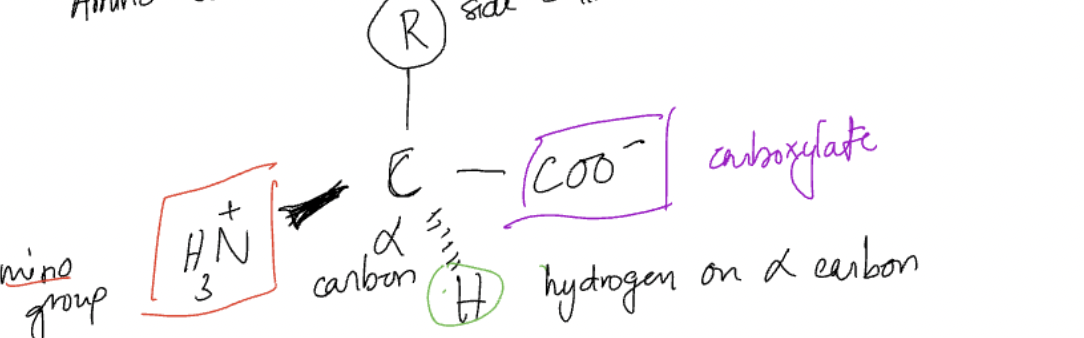
What differentiates the 20 amino acids?
the R group or side chain
Describe the chirality of amino acids.
all amino acids are chiral except for glycine because its r group is just another H
List the four categories of amino acids.
nonpolar, hydrophobic, aliphatic
polar, uncharged
aromatic
charged
positive
negative
List the 7 amino acids that are in the nonpolar, hydrophobic, aliphatic category
glycine
alanine
proline
valine
leucine
isoleucine
methionine
What do newly synthesized proteins always begin with?
methionine

glycine

alanine

proline

valine

leucine

isoleucine
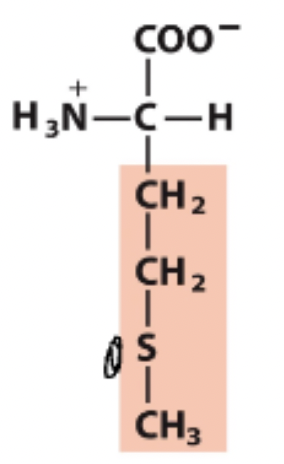
methionine
List the 5 amino acids in the polar, uncharged category.
serine
cystine
threonine
aspargine
glutamine

serine

threonine
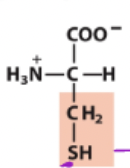
cysteine

asparagine
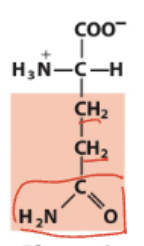
glutamine
What are serine and threonine often involved in?
hydrogen binding with each other and water
Where are serine and threonine often found and why?
on the surface of proteins where they can interact w/ water
What amino acids undergo phosphorylation?
serine and threonine
What enzymes perform phosphorylation?
kinases
How do kinases add a phosphate group (phosphorylation)?
by converting ATP into ADP
Where is the phosphate group added onto serine and threonine?
replaces the H on the OH which is then donated to the surrounding solution
What enzyme removes the phosphate group?
phosphatase
What does phosphatase release?
inorganic phosphate (Pi)