Anatomy 2300 Unit 2: Muscles of the Hip and Thigh
 Call Kai
 Learn
Learn Practice Test
 Spaced Repetition
 Match
Match Flashcards
 Knowt Play
1/40

There's no tags or description
Looks like no tags are added yet.
Name | Mastery | Learn | Test | Matching | Spaced | Call with Kai | Chat |
|---|
No analytics yet
Send a link to your students to track their progress
41 Terms
Dermis
The deeper layer of the skin located underneath the epidermis. It is made of connective tissue and contains blood vessels, nerves, sensory receptors, glands, and hair follicles.

Hypodermis/Superficial fascia of Thigh
The layer of connective tissue and fat located deep to the dermis. In the thigh, it contains white adipose tissue and helps insulate the body, store energy, and cushion underlying structures.

Fascia Lata
A thick layer of deep connective tissue that surrounds the muscles of the thigh. It helps support, separate, and hold the thigh muscles in place.

Iliotibial Tract
A thickened strip of fascia on the lateral side of the thigh that runs from the hip to the tibia. It helps stabilize the hip and knee, especially during movement.
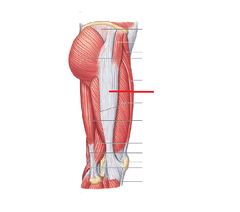
Gluteus Maximus
- Action & Innervation?
Definition: The large muscle that forms most of the buttocks. It primarily extends and laterally rotates the thigh at the hip; it also helps stabilize the hip and pelvis.
- Action: Extend hip (thigh); Laterally rotate hip (thigh)
- Innervation: Inferior gluteal nerve
- Part of the superficial layer of the gluteal muscles.
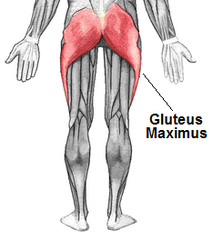
Gluteus Medius
- Action & Innervation?
Definition: A broad, fan-shaped muscle located on the lateral surface of the hip, deep to the gluteus maximus. It is important for moving the thigh and stabilizing the pelvis, especially when standing or walking.
- Action: Abduct hip (thigh)
- Innervation: Superior gluteal nerve
- Part of the superficial layer of the gluteal muscles.

Gluteus minimus
- Action & Innervation?
Definition: A small, fan-shaped muscle located deep to the gluteus medius on the lateral surface of the hip. It helps move the thigh and stabilize the pelvis during standing and walking.
- Action: Abduct hip (thigh)
- Innervation: Superior gluteal nerve
- Part of the superficial layer of the gluteal muscles.

Tensor fascia latae
- Action & Innervation?
Definition: A small, narrow muscle located on the lateral (outer) side of the hip. It connects to the iliotibial (IT) band and helps stabilize the hip and knee during standing and walking.
- Action: Flex hip (thigh); Abduct hip (thigh)
- Innervation: Superior gluteal nerve
- Part of the superficial layer of the gluteal muscles.

Piriformis
- Action & Innervation?
Definition: A small, narrow muscle located on the lateral (outer) side of the hip. It connects to the iliotibial (IT) band and helps stabilize the hip and knee during standing and walking.
- Action: Laterally rotate hip (thigh)
- Innervation: Nerve to piriformis
- Part of the deep layer of the gluteal muscles.
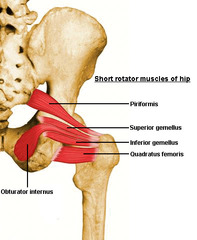
Iliopsoas
- Action & Innervation?
Definition: A powerful hip flexor located deep in the front of the hip. It is made up of two muscles: the iliacus and psoas major, which join together and attach to the femur. It is important for bringing the thigh toward the trunk and for maintaining proper posture.
- Action: Flex hip (thigh); Flex trunk
- Innervation: Lumbar spinal nerves OR Femoral nerve

Iliacus
- Action & Innervation?
Definition: A large, fan-shaped muscle located deep in the front of the hip, filling the iliac fossa of the pelvis. It joins with the psoas major to form the iliopsoas, the main hip-flexor muscle group
- Action: Flex hip (thigh); Flex trunk
- Innervation: Femoral nerve

Psoas major
- Action & Innervation?
Definition: A long, powerful muscle located deep in the lower back and pelvis that runs from the lumbar vertebrae to the femur.. It joins with the iliacus to form the iliopsoas, which is the primary hip-flexor muscle group.
- Action: Flex hip (thigh); Flex trunk
- Innervation: Lumbar spinal nerves

quadriceps femoris
A large group of four muscles on the front of the thigh that work together to extend (straighten) the knee.
The four muscles are rectus femoris, vastus lateralis, vastus medialis, and vastus intermedius.

Rectus femoris
- Action & Innervation?
Definition: A muscle on the front of the thigh that helps extend (straighten) the knee and flex (bend) the hip.
It is the only quadriceps muscle that crosses both the hip and knee joints.
- Action: Flex hip (thigh); Extend knee (leg)
- Innervation: Femoral nerve

Vastus lateralis
- Action & Innervation?
Definition: A muscle on the outer (lateral) side of the thigh that helps extend (straighten) the knee. It is one of the four quadriceps muscles and does not cross the hip joint.
- Action: Extend knee (leg)
- Innervation: Femoral nerve

Vastus medialis
- Action & Innervation?
Definition: an extensor muscle located on the inner front part of the thigh that helps straighten the leg and keep the kneecap stable.
* Teardrop muscle
- Action: Extend knee (leg)
- Innervation: Femoral nerve

Vastus intermedius
- Action & Innervation?
Definition: A muscle located deep beneath the rectus femoris in the front of the thigh that helps extend (straighten) the knee. It is one of the four quadriceps muscles.
- Action: Extend knee (leg)
- Innervation: Femoral nerve

Sartorius
- Action & Innervation?
Definition: A long, thin muscle that runs diagonally across the front of the thigh and helps flex, abduct, laterally rotate the hip and flex the knee.
- Action: Flex hip (thigh); Flex knee (leg)
- Innervation: Femoral nerve

Gracilis
- Action & Innervation?
Definition: A long, thin muscle located on the inner (medial) thigh. It helps adduct the thigh (move the leg toward the body's midline) and flex the knee (bend the knee). It is part of the medial thigh muscle group.
- Action: Adduct hip (thigh); Flex knee (leg)
- Innervation: Obturator nerve
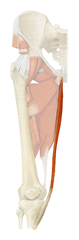
Pectineus m.
- Action & Innervation?
Definition: A short, flat muscle located in the Superior inner (medial) thigh. It helps adduct the thigh (move it toward the body's midline) and flex the hip (bring the thigh forward).
- Action: Adduct hip (thigh); Flex hip (thigh)
- Innervation: Femoral nerve; Obturator nerve

Adductor longus
- Action & Innervation?
Definition: A long, triangular muscle located on the inner (medial) thigh. It primarily adducts the thigh (moves it toward the body's midline). It is one of the main muscles of the medial thigh.
- Action: Adduct hip (thigh)
- Innervation: Obturator nerve

Adductor brevis
Definition: A short, triangular muscle located in the upper inner (medial) thigh. It primarily adducts the thigh (moves it toward the body's midline). It lies deep to the pectineus and adductor longus. (C)
- Action: Adduct hip (thigh)
- Innervation: Obturator nerve
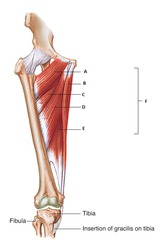
Adductor magnus
- Action & Innervation?
Definition: The largest muscle of the medial (inner) thigh, located deep to the other adductor muscles. It primarily adducts the thigh (moves it toward the body's midline). It has two parts: an adductor part and a hamstring part.
- Action: Adduct hip (thigh)
- Innervation: Obturator nerve
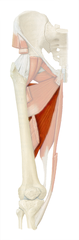
Adductor Hiatus
- Action & Innervation?
An opening near the lower end of the adductor magnus muscle that allows the femoral artery and femoral vein to pass from the thigh into the popliteal fossa behind the knee.

Semitendinosus
- Action & Innervation?
Definition: A superficial hamstring muscle on the inner posterior thigh. It helps extend the hip (move the thigh backward), and flex the knee (bend the knee).
- Action: Extend hip (thigh); Flex knee (leg)
- Innervation: Tibial nerve

Semimembranosus
- Action & Innervation?
Definition: A deep inner hamstring muscle on the posterior thigh. It helps extend the hip, and flex the knee. It lies deep to the semitendinosus.
- Action: Extend hip (thigh); Flex knee (leg)
- Innervation: Tibial nerve

Biceps Femoris
- Action & Innervation?
A large hamstring muscle on the back (posterior) thigh, located on the lateral (outer) side of the thigh.
It helps extend the hip, flex the knee, and extend the hip. It has two heads: long head and short head.

Long head of Biceps Femoris
- Action & Innervation?
Definition: A large hamstring muscle on the back (posterior) thigh, located on the lateral (outer) side of the thigh. It helps extend the hip and flex the knee.
- Action: Extend hip (thigh); Flex knee (leg)
- Innervation: Tibial nerve
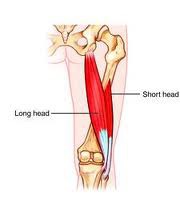
Short head of Biceps Femoris
- Action & Innervation?
Definition: A short muscle located on the back (posterior) thigh, on the lateral (outer) side, forming part of the hamstring group. It helps flex the knee.
Unlike the long head, it does not cross the hip joint, so it does not extend the hip.
- Action: Flex knee (leg)
- Innervation: Common fibular nerve

Pes Anserine
A common tendon attachment on the inner (medial) side of the upper tibia, just below the knee, formed by the sartorius, gracilis, and semitendinosus.
These muscles work together to flex the knee and help stabilize the knee joint.

inguinal ligament
A strong band of connective tissue that runs from the anterior superior iliac spine (ASIS) of the hip bone to the pubic tubercle. It forms the lower border of the abdominal wall and separates the abdomen from the thigh.
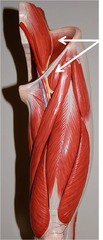
Innervation
The distribution or supply of nerves to a particular body part, muscle, or region.

Lumbar Plexus
Supplies nerve signals to control muscles and provide sensation. For the anterior and medial thigh, it refers to nerves that control the muscles of these regions.

Femoral Nerve
A major nerve that supplies motor control to the anterior thigh muscles, especially the quadriceps, allowing knee extension. It also provides sensation to the skin of the anterior thigh and medial leg.

Obturator Nerve
A major nerve that supplies motor control to the medial thigh muscles, especially the adductors, allowing adduction of the thigh (moving the leg toward the body's midline). It also provides sensation to a small area of skin on the medial thigh.

Sacral Plexus
A network of nerves in the lower back and pelvic region that supplies the buttocks, posterior thigh, most of the leg, and foot. It provides motor control to muscles and sensation to skin in these areas. It gives rise to major nerves such as the sciatic nerve.

Superior Gluteal Nerve
A nerve from the sacral plexus that supplies the gluteus medius, gluteus minimus, and tensor fasciae latae. It helps abduct the thigh (move the leg away from the body's midline) and stabilize the pelvis during walking.
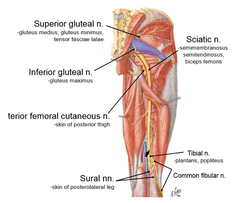
Inferior Gluteal Nerve
A nerve from the sacral plexus that supplies the gluteus maximus muscle. It helps extend the hip (move the thigh backward) and assists with lateral rotation of the thigh.

Sciatic Nerve
The largest nerve in the body, arising from the sacral plexus and running through the buttock and posterior thigh. It supplies the hamstrings and most of the leg and foot, then divides into the tibial and common fibular nerves.

common fibular nerves
A branch of the sciatic nerve that runs along the outer (lateral) side of the knee and leg. It supplies muscles that help extend the foot and toes such as the Biceps femoris short head.

Tibial Nerve
A branch of the sciatic nerve that runs down the posterior thigh and posterior leg. It innervates the hamstrings of the posterior thigh and muscles that plantarflex the foot and flex the toes.
