Dental Anatomy - Maxillary First Premolars
 Call Kai
 Learn
Learn Practice Test
 Spaced Repetition
 Match
Match Flashcards
 Knowt Play
1/66

There's no tags or description
Looks like no tags are added yet.
Name | Mastery | Learn | Test | Matching | Spaced | Call with Kai | Chat |
|---|
No analytics yet
Send a link to your students to track their progress
67 Terms
Maxillary Premolars
- 8 in the permanent dentition
- 4 per arch, 2 per quadrant
- 4th and 5th teeth from the midline
- arcane term is bicuspid
- only succedaneous teeth to have a different name than the deciduous teeth they replace
premolars replace deciduous
molars
The premolars supplement the
grinding of the molars during mastication
the premolars still function to
tear and pierce like canines
premolars contribute to
esthetics and phonetics, but less than anterior teeth and more than molars
major structural changes in premolars compared to canines
- increased number of cusps
- marginal ridge location
- root structure
- presence of an occlusal surface
general characteristics of maxillary first and second premolars
- more similar than mandibular premolars
- maxillary first is larger than the second
- wider buccolingually than mesiodistally
- 2 cusps of approximately equal size
from the proximal view, the crown profile of the maxillary first premolars shows virtually no
lingual inclination
the maxillary first premolar is the only premolar which normally exhibits
two root branches
evidence of calcification of maxillary first premolars
1.5 years
enamel completion of maxillary first premolars
5-6 years
eruption of maxillary first premolars
10-11 years
root completion of maxillary first premolars
12-13 years
on the buccal aspect of maxillary first premolars, the crown shape is
pentagonal
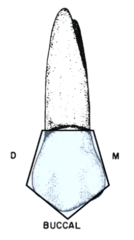
on the buccal aspect of maxillary first premolars, they are similar to
the maxillary canine and second premolar
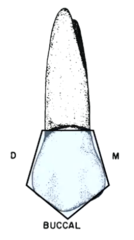
the crown on the buccal aspect of maxillary first premolars is (larger/smaller) than the maxillary canine
smaller
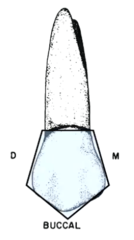
the cusp tip on the buccal aspect of maxillary first premolars (more/less) prominent
less
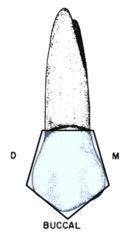
from the occlusocervical dimension, maxillary first premolars are less than that of an _________ tooth and greater than that of the _______ ________ or any molar
anterior, second premolar
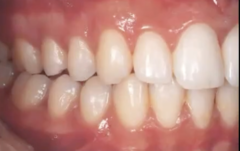
from the buccal aspect on the mesial outline of maxillary first premolars
- mesio-occlusal angle is obtuse
- cervical half is shallow and concave and is a great place for calculus
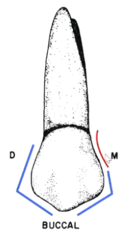
from the buccal aspect on the distal outline of maxillary first premolars
- similar to the mesial
- disto-occlusal angle is less prominent
- cervical concavity is not as deep
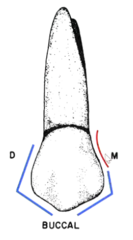
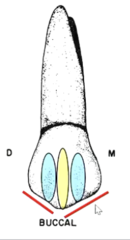
on the buccal aspect, the occlusal outline of maxillary first premolars has
- mesial cusp ridge longer and straighter than the distal cusp ridge (in red)
- cusp tip offset to the distal
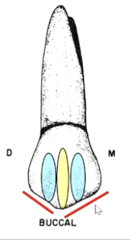
on the buccal aspect, the buccal ridge (yellow) of the maxillary first premolars
- extends halfway down the buccal surface
- developmental depressions on either side (blue)
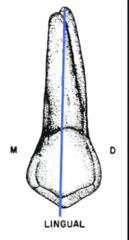
on the lingual aspect of maxillary first premolars, the lingual surface is
- smoothly convex
- smaller than the buccal cusp
- lingual ridge is not well defined
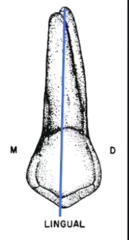
on the lingual aspect of maxillary first premolars, the lingual cusp tip is
- offset to the mesial
- shorter than the buccal cusp
- shortest of the four maxillary premolar cusps
on the mesial aspect of maxillary first premolars, it is ___________ in shape
trapezoidal
on the mesial aspect, the buccal outline of maxillary first premolars is
- convex
- HOC (red) in the cervical 1/3
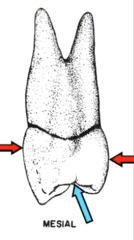
on the mesial aspect, the lingual outline of maxillary first premolars is
- convex
- HOC (red) is in middle 1/3
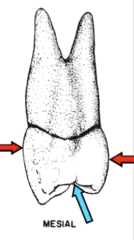
on the mesial aspect of maxillary first premolars, the occlusal margin is
- concave
- has a mesial marginal groove (blue)
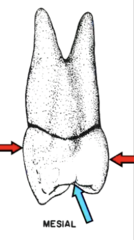
on the mesial aspect of the maxillary first premolars, the mesial concavity (blue) is
- in the middle portion of the cervical third of the crown
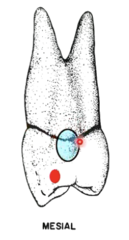
on the mesial aspect of maxillary first premolars, the contact area (red) is
- circular
- buccal offset
- near the junction of the occlusal and middle 1/3
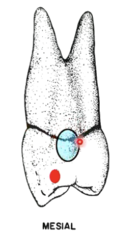
on the distal aspect of the maxillary first premolars, the distal marginal ridge is
- more cervical level (more towards the cervical)
- has no marginal groove
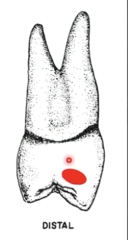
on the distal aspect of maxillary first premolars, the contact area is
- larger
- ovoid
- at the junction of the occlusal and middle 1/3
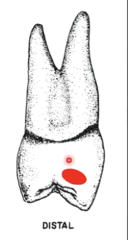
when determining right versus left, you can see more of the occlusal surface from the
distal
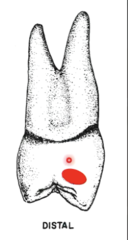
looking at the occlusal aspect of maxillary first premolars, it is ______________ in shape
hexagonal
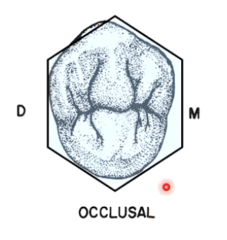
on the occlusal aspect of maxillary first premolars, it is (wider/narrower) buccolingually than mesiodistally
wider
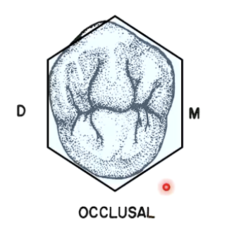
from the occlusal aspect of maxillary first premolars, the buccal outline has
- a prominent buccal ridge
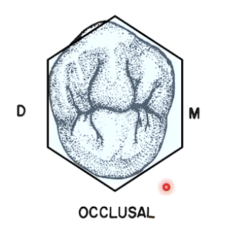
from the occlusal aspect of maxillary first premolars, the lingual outline is an
- evenly convex semicircle
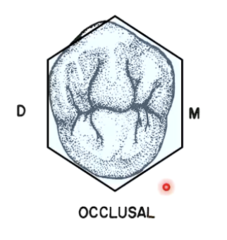
from the occlusal aspect of maxillary first premolars, the proximal outlines are
- straight
- have slight lingual convergence
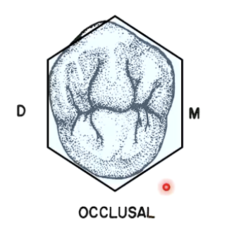
on the occlusal aspect of maxillary first premolars, the occlusal surface is bounded by
- marginal ridges (M and D)
- buccal and lingual cusp ridges
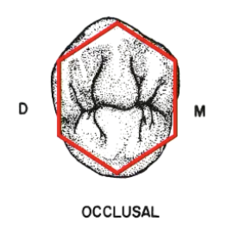
maxillary first premolars have 4 ________ _______ per cusp
incline planes
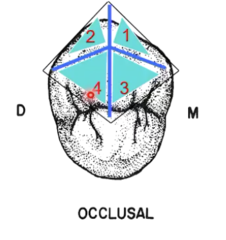
the incline planes on maxillary first premolars are
- confided by cusp ridges (blue line)
- named by cusp ridges
mesiobuccal (1)
distobuccal (2)
mesiolingual (3)
distolingual (4)
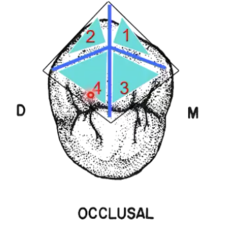
on the occlusal aspect of maxillary first premolars, the buccal triangular ridge (red) is located
on the lingual ridge of the buccal cusp
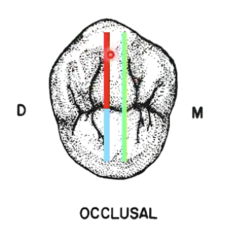
on the occlusal aspect of maxillary first premolars, the lingual triangular ridge (blue) is located
on the buccal ridge of the lingual cusp
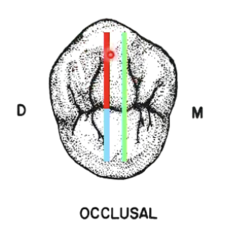
on the occlusal aspect of maxillary first premolars, the transverse ridge (green) is
combined buccal and lingual triangular ridges
directly across from each other
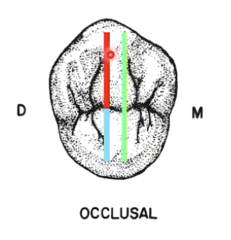
on the occlusal aspect of maxillary first premolars, there are 3 primary developmental grooves (red)
- central grooves
- triangular grooves
- mesial marginal ridge groove
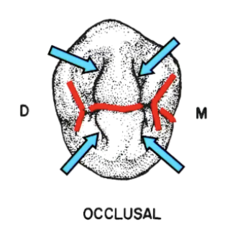
on the occlusal aspect of maxillary first premolars, the secondary grooves (blue)
- branch from primary grooves
- outline the M and D borders of triangular ridges
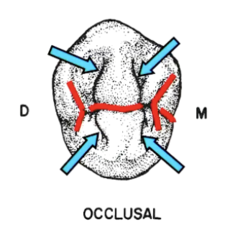
on the occlusal aspect of maxillary first premolars, the fossa
- general depression of the occlusal surface
- funnel shaped (pit at the deepest point)
- mesial (triangular) fossa
- distal (triangular) fossa
- secondary grooves border these fossas
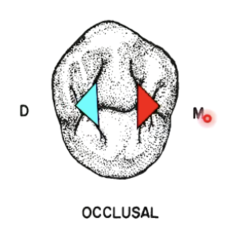
on the occlusal aspect of maxillary first premolars, the buccal cusp tip is
- sharper, longer, bulkier
- distal offset
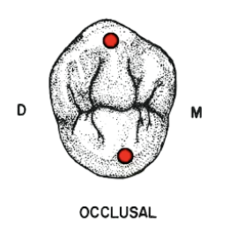
on the occlusal aspect of maxillary first premolars, the lingual cusp is
- rounder
- mesial offset
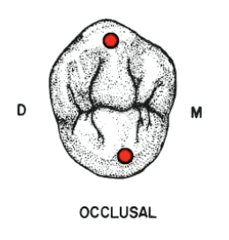
Supporting cusps
- cusps that crush food into the opposing fossae and/or between the marginal ridges
- lingual of maxillary
- buccal of mandibular
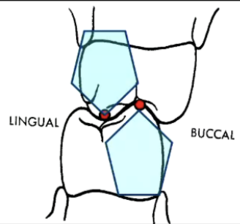
Non-supporting cusps
- cusps that overlap and in some instances guide the supporting cusps into occlusion
- buccal of the maxillary
- lingual of the mandibular
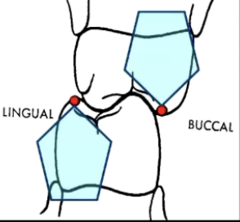
functional incline planes of supporting cusps
the inner and outer planes of a supporting cusp
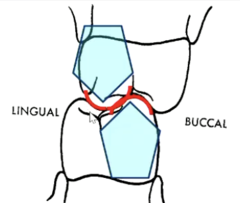
supporting cusps normally have ___ functional inclined planes with the exception of the ____________ (yellow) plane of the maxillary first premolar, which is not considered functional
4, mesiolingual
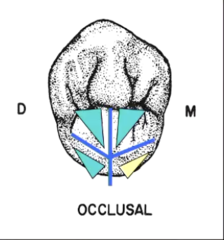
the mesiolingual plane of the maxillary first premolar opposes the small lingual cusp of the __________ ______ ________
mandibular first premolar
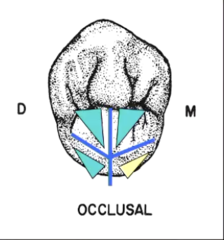
functional inclined planes of non-supporting cusps
- inner inclined planes of non-supporting cusps are also functional inclined planes
- non-supporting cusp normally has 2 functional inclined planes
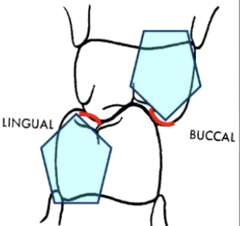
non-functional inclined planes of non-supporting cusps
- outer inclines of the maxillary buccal cusps oppose the cheek
- outer inclines of the mandibular lingual cusps oppose the tongue
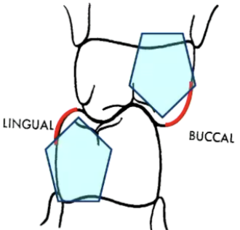
Functional and Non-functional inclined planes
Functional and Non-functional inclined planes
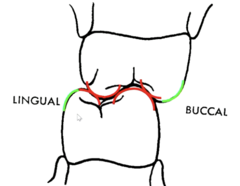
Maxillary First Premolars - Root Structure
- 3 identifiable types
Type I: Single (40%)
Type II: Bifurcated (60%)
Type III: Laminated (type of bifurcation)
a laminated birucation is a
thin connection between the main portions of the root structure
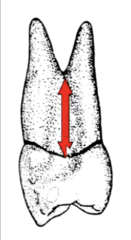
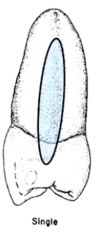
Type I single root
- straight
- blunt apex
- mesial root concavity (longitudinal groove)
- distal root concavity (less pronounced)
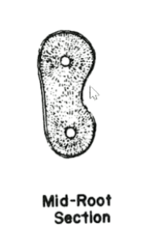
Type I single root mid root cross section
- outline form is kidney shaped
- buccal and lingual outlines are convex
- deep mesial surface indentation
- distal surface flat to slightly concave
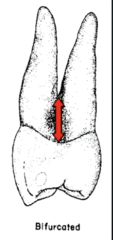
Type II bifurcated root
- root trunk with Buccal and Lingual root branch
- root trunk is between the cervical line and the point of furcation or branching
- bifurcated for about half its length
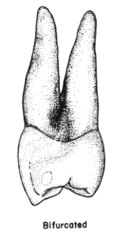
Root branches on Type II bifurcated root
- convex
- taper to sharp apices
- buccal root branch is normally larger
Type II bifurcated root mid root cross section
- both root branches are more or less round in outline
- buccal root outline is slightly greater in circumference
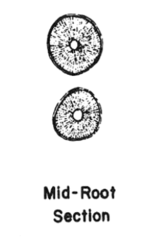
Type III laminated root
- similar to type II
- buccal and lingual branches are joined by a lamination
- many variations found
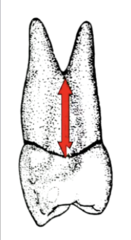
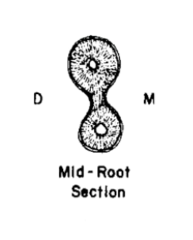
Type III laminated root mid root cross section
- similar to type I with deep depressions
- thin lamination connects the buccal and lingual
Maxillary First Premolars Variations and Anomalies
- variable mesial concavity depth
- deflected roots
- three roots
- roots may penetrate the antrum or anterior portion of the maxillary sinus