Food tests and heart biology
 Call Kai
 Learn
Learn Practice Test
 Spaced Repetition
 Match
Match Flashcards
 Knowt Play
1/19

Earn XP
Description and Tags
Name | Mastery | Learn | Test | Matching | Spaced | Call with Kai |
|---|
No analytics yet
Send a link to your students to track their progress
20 Terms
Test for Starch
Reagent used: Iodine solution
Method: Add a few drops of iodine solution to the food sample.
Positive Result: Blue-black colour
Test for glucose
Reagent Used: Benedict’s solution
Method: Add Benedict’s solution to the food sample and heat in a water bath at 80°C for 5 minutes.
Positive Result: Colour change from blue—>brick-red (depending on sugar concentration).
Test for Protein
Reagent Used: Biuret solution (a mixture of sodium hydroxide and copper(II) sulfate)
Method: Add Biuret solution to the food sample.
Positive Result: Color changes from blue to purple/lilac
Test for Lipids
Reagent Used: Ethanol and water
Method:
Add ethanol to the food sample and shake well.
Pour the mixture into water.
Positive Result: A milky-white emulsion
Function of blood vessels in heart
Pulmonary means anything relating to the lungs.
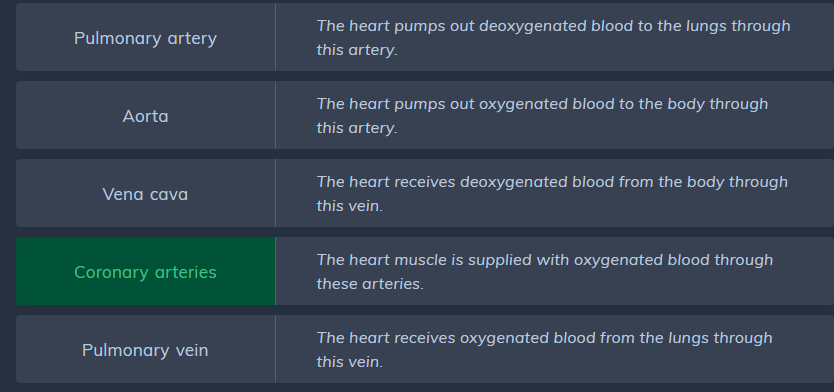
Arteries
narrow lumen
withstands high pressure blood flow
thick, elastic walls made of muscle
NO VALVES
typically carry oxygenated blood
Veins
walls are thinner than in arteries as the blood is at a lower pressure
low pressure hinders blood flow, so they have a wider cross-section through which blood can flow
HAVE VALVES TO PREVENT BACKFLOW OF BLOOD
generally carry de-oxygenated blood
Heart chambers and function
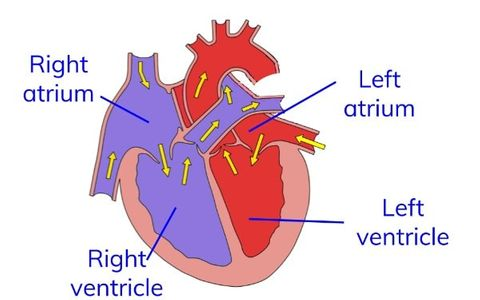
Blood enters the heart via the atria.
Once filled with blood, the atria contract, forcing blood down into the ventricles below.
When the ventricles contract, they force blood to exit the heart.
A group of cells in the right atrium act as a pacemaker, controlling the pumping of the heart.
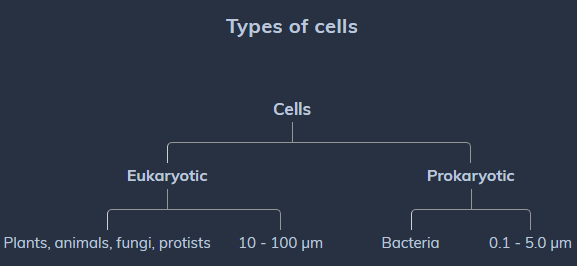
key difference between eu- and prokaryotic cells
eukaryotic HAVE NUCLEUS
prokaryotic DO NOT HAVE NUCLEUS
prokaryotic cells
Prokaryotic cells do NOT contain mitochondria (where respiration takes place) or chloroplasts (where photosynthesis takes place).
Prokaryotic cells do not have a nucleus (where DNA is stored).
Instead, most of their genetic material is stored in a single DNA loop in the cytoplasm (watery jelly that fills the cell).
Some prokaryotic cells contain small rings of DNA called plasmids.
These plasmids can replicate and move between cells so that genetic information can be shared.
Eukaryotic cells
contain cell membrane, cytoplasm and NUCLEUS
animal cell
The cell membrane separates the interior (inside) of the cell from the environment outside.
This membrane is selectively permeable. This means that it has control over which substances enter and exit the cell.
The nucleus contains chromosomes (which contain the cell's genetic material).
Ribosomes are responsible for making proteins.
Mitochondria is where aerobic respiration takes place.
Aerobic respiration is a process which uses glucose and oxygen to release energy.
Cytoplasm is a jelly-like fluid that fills the cell.
It is where most of the cell’s chemical reactions take place.
some include:
Skin Cells
Muscle Cells
Blood Cells
Nerve Cells
Fat Cells
plant cell
A permanent vacuole is a fluid-filled sac that stores water.
It is enclosed in a membrane (a wall that substances can pass through).
It can make up as much as 90% of a plant cell’s volume.
Chloroplasts contain chlorophyll needed for photosynthesis.
The cell wall surrounds the cell and is made of cellulose.
The cell wall increases the structural strength of the cell.
differences between animal and plant cell
Many plant cells can differentiate throughout their lives.
This means that plants are always able to create new tissues.
Most animal cells differentiate early on in their development.
In mature animals, cells mostly divide (one cell splits to create two cells) to replace cells and repair tissues that are already present.
New tissues are rarely created by cell differentiation.
bacterial cells
cytoplasm, plasmids, can have flagella (whip-like structures used for movement), membrane and a cell wall, which provides structure.
layers of a vascular plant cell
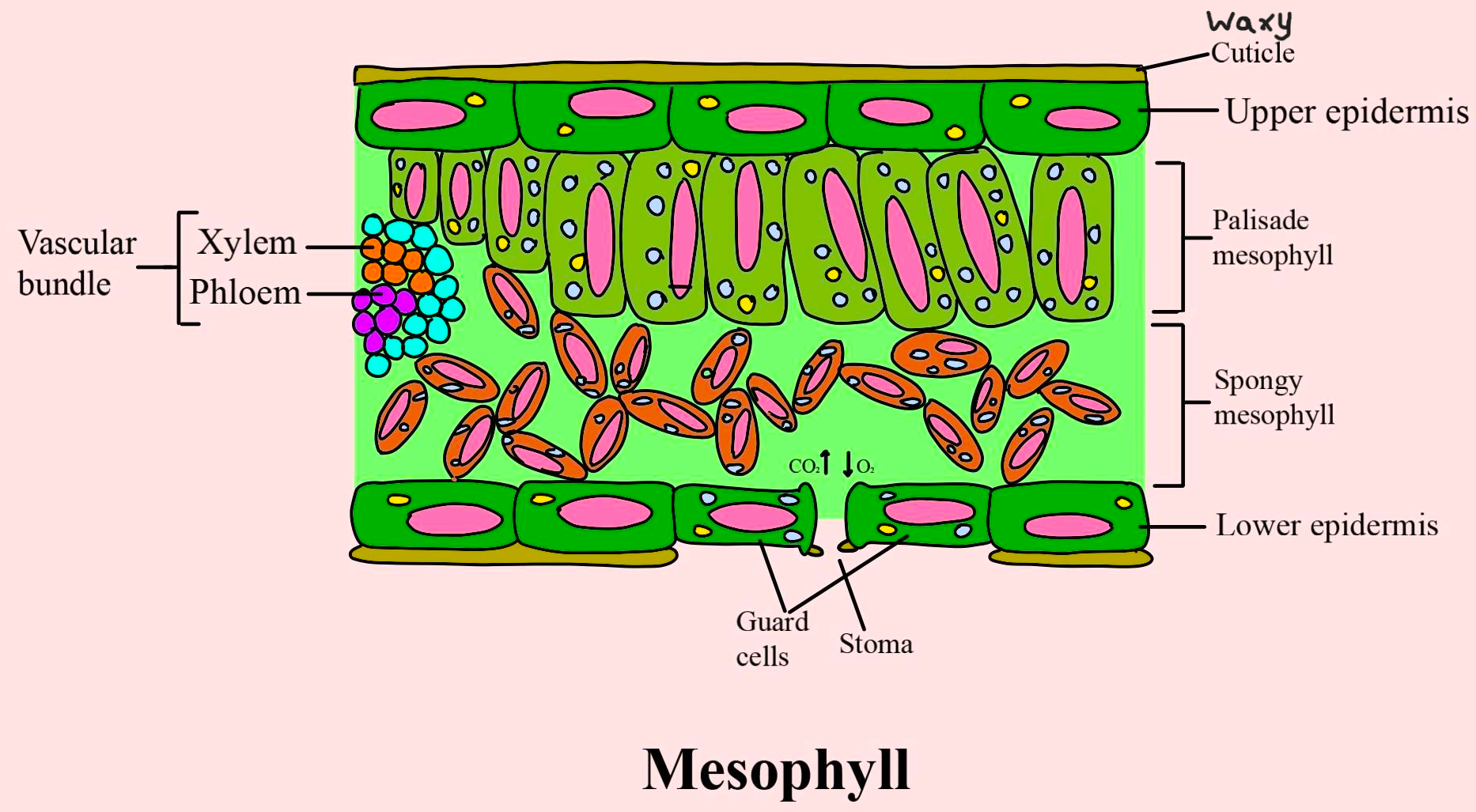
xylem and phloem cell functions
xylem’s main job is to transport water and minerals from the roots to the leaf
phloem's main function is to distribute nutrients, such as sugars and organic compounds, produced in photosynthetic tissues to various parts of the plant.
Diffusion
Substances move from a high to a low concentration down a concentration gradient
Carbon dioxide, oxygen, water, food substances, wastes, eg urea are transported
no energy required
Osmosis
Water moves from a high to a low concentration across a partially permeable membrane and down a concentration gradient
no energy required
Active transport
Substances move against a concentration gradient
Mineral ions into plant roots, glucose from the gut into intestinal cells, from where it moves into the blood are transported
energy is required and it is produced during respiration