Chapter 6 - Cell Division
 Call Kai
 Learn
Learn Practice Test
 Spaced Repetition
 Match
Match Flashcards
 Knowt Play
1/105

Earn XP
Description and Tags
Name | Mastery | Learn | Test | Matching | Spaced | Call with Kai | Chat |
|---|
No analytics yet
Send a link to your students to track their progress
106 Terms
True or false? cells can divide continuously
false - new cells have to mature before dividing again
True of false? all cells have cell cycles of the same length of time
false - specialised cells usually take longer to divide
True or false? All cells can divide
false - some highly specialised cells e.g. nerve cells, loose the ability to divide altogether
What are the chemicals and the gene that trigger the movement from one phase to another in the cell cycle?
cyclins and tumour suppressor genes
What are the 2 main phases of the cell cycle?
interphase and the mitotic phase
In which phase of the cell cycle does a cell spend most of its time?
interphase
What are the 4 stages found within interphase?
G1, S phase, G2 and G0
Choose the correct words and fill in the blanks: The ‘_____’ phase where cells are/are not actively dividing. However there are still high/low levels of activity, as the cell carries out all its major functions.
resting, are not, high
What happens in the first growth phase (G1)?
cell increases in size, proteins from which organelles are synthesised are produced and organelles replicate, transcription of genes to make RNA
Fill in the blanks: In S (_____) phase, the chromosomes unwind so every molecule of DNA can be replicated, so that each once consists of a pair of identical ____ ____
synthesis, sister chromatids
In S phase there is a specific sequence in which the DNA replication is carried out. Do active or inactive genes get replicated first?
active
Why does S phase happen very quickly?
to reduce the chance of mutations occurring, as exposed DNA base pairs are more susceptible to mutagenic agents
What happens in G2?
cell continues to grow in size, energy stores increased, duplicated DNA is checked for errors, chemicals ensure the cell is ready for mitosis by stimulating the proteins involved in condensing chromosomes and in the formation of the spindle
What is the G0 phase?
when cells leave the cell cycle permanently or temporarily
State the 3 reasons why cells enter G0?
differentiation, DNA damage, senescence
What term describes programmed cell death, where cells permanently enter G0 to prevent mutations?
apoptosis
What is senescence?
the process by which a cell ages and permanently stops dividing (most cells can only divide a finite number of times) but doesn’t die (it can still function)
Give an example of a cell that only enters G0 temporarily?
lymphocytes
What are the 2 stages of the mitotic phase?
mitosis and cytokinesis
Fill in the blanks: in eukaryotic cells the DNA that makes up chromosomes is wrapped around ____ proteins to form ____
histone, chromatin
Fill in the blanks: when DNA is replicated the chromosomes uncoil and the DNA replicates producing a pair of ___ ____ held together by a ___
sister chromatids, centromere
How many chromosomes do human have?
46
How is the eukaryotic cell cycle regulated?
checkpoints
What are the 2 main checkpoints called?
G1/S (restriction point) and G2/M
Why are checkpoints needed?
To ensure a cell only divides when it is the correct size, the replicated DNA is error free and the chromosomes are in their correct position
True or false? checkpoints ensure that DNA is only replicated once and is replicated correctly reducing the risk of uncontrolled division that would lead to tumours
true
What type of molecules are checkpoints usually made from?
enzymes
What 3 things could happen to a cell if the checkpoints detect errors?
the errors are repaired, the cell is sent to G0 or the cell destroys itself to prevent passing on mutations
What is the process called by which prokaryotic cells divide?
binary fission
Describe what happens in binary fission
DNA is replicated and the two new loops are pulled to opposite ends of the cell, which grows to the limit of its size and splits in two, developing a new cell wall
Which 2 components of eukaryotic cells divide by binary fission?
mitochondria and chloroplasts
What is the name of the checkpoint found in the mitotic phase of the cell cycle?
spindle assembly checkpoint / metaphase checkpoint
What does the spindle assembly checkpoint check for?
the correct attachment and alignement of chromosomes to spindle fibres
What is an erythrocyte?
red blood cell
What is a neutrophil?
white blood cell
What is the scientific name for a sperm cell?
spermatozoa
How are erythrocytes adapted to their function?
Function: transport of oxygen in blood
large SA:V ratio due to biconcave shape (increase SA for oxygen to be absorbed)
small size (7um), flexible, elastic membrane and cytoskeleton (fit through capillaries)
no nucleus and few organelles/cytoplasm (increase spaced for haemoglobin)
How are neutrophils adapted to their function?
Function: destroy pathogens by phagocytosis and secretion of enzymes
flexible multi lobed nucleus (fit in small spaces)
flexible membrane (can form pseudopodia (cytoplasmic projections) that engulf pathogens)
attracted to pathogens by chemotaxis
cytoplasm contains lysosomes
How are spermatozoa adapted to their function?
Function: male gametes that fertilise an egg in reproduction
haploid nucleus (transfer genetic material)
acrosome (specialised lysosome) contains digestive enzymes (to digest ovum membrane to allow penetration)
many mitochondria (for movement)
small, long streamlined shape
How are palisade cells adapted to their function?
Function: carry out photosynthesis
large number of chloroplasts
tall, longer rectangular shape (for dense packing)
thin cell walls (increase rate of diffusion of CO2)
large vacuole to maintain turgor pressure (so chloroplasts are pushed to edges of cell where CO2 is accessed faster)
How are root hair cells adapted to their function?
Function: absorption of water and mineral ions from soil
root hair increases SA
many mitochondria (provide ATP for active transport of mineral ions)
then cell wall (shorter diffusion distance)
large vacuole containing cell sap which is more concentrated then water (so maintains water potential gradient)
How are guard cells adapted to their function?
Function: control the opening of stomata to regulate water loss through transpiration
inner cell walls (facing outside of leaf) are thicker than outer cell walls (facing adjacent epidermal cells) which causes the cells to bend when turgid
light energy is used to produce APT which actively transports potassium ions into the guard cells, lowing their water potential so water moves in by osmosis
What is epidermal tissue?
tissue that is used to cover plant surfaces
How is epidermal tissue adapted to its function?
closely packed and flatten to act as protection
covered by a hydrophobic cuticle to reduce water loss
contain stomata
How is xylem tissue adapted to its function?
Function: transports water and dissolved mineral ions from the roots to the leaves
elongated dead cells, with wide lumens and no organelles or cytoplasm (allows free movement of water)
no end walls between cells (creates continuous column of water)
walls strengthened with waterproof lignin
How is phloem tissue adapted to its function?
Function: transports dissolved assimilates
columns of sieve tube cells are separated by perforated sieve plates
contain few sub cellular structures
cells are living and supported by companion cells
How is epithelial tissue adapted to its function?
cells are closely bound
no blood vessels as cells rely on diffusion
short cell cycles to quickly replace damaged tissue
specialise in 2 ways: squamous and ciliated
How is squamous epithelium tissue adapted to its function?
Function: provides a surface covering for structures such as alveoli and blood vessels
permeable (allows for diffusions of gases)
single layer of cells (shorter diffusion pathway)
What is epithelial tissue?
a living tissue used to cover internal and external body surfaces such as skin, heart chambers and airways
How is ciliated epithelium tissue adapted to its function?
Function: moves substances across the surface of a tissue
cells contain cilia which beat in a coordinated manner to move material
goblet cells secrete mucus to trap unwanted particles to prevent infection
What is cartilage?
a firm, flexible connective tissue containing elastin and collagen composed of chondrocytes cells embedded in an extracellular matrix
What are the 3 types of cartilage and where are they found?
hyaline cartilage - C-shaped rings in trachea
fibrous cartilage - occurs in discs in the spine and knee joints
elastic cartilage - found in pinna (outer ear)
How is muscle tissue adapted to its function?
well vascularised (contain many blood vessels) and have many mitochondria to provide energy for contraction
elongated protein fibres called myofilaments allow tissue to contract
cells are multinucleated to contract in unison
What are the 3 types of muscle tissue?
skeletal muscle
cardiac muscle
smooth muscle
Fill in the blanks: ___ is the process of cell becoming specialised and is caused by ___ ____ (certain genes being ‘___ __’)
differentiation, gene expression, switched on
Fill in the blanks: stem cells are ____ cells that divide by ___ to provide more cells that differentiate into specialised cells for growth and tissue repair
undifferentiated, mitosis
Correct the mistake: once stem cells have become specialised the lose the ability to divide and enter G1 of the cell cycle
G1 → G0
List the 3 sources of stem cells and state where these can be found
embryonic - present in blastocyst (early embryo)
adult/tissue - developed tissue, bone marrow, umbilical cord, blood
meristematic (meristems) - areas of growth in plants (roots and shoots tops) and vascular bundles
What is stem cell potency?
the ability of the stem cell to differentiate into different cell types. The greater the number of cell types it can differentiate into the greater the potency
List the 4 potencies of stem cell from the highest to lowest
totipotent, pluripotent, multipotent, unipotent
Where are totipotent stem cells found?
zygotes
Where are pluripotent stem cells found?
embryos
Where are multipotent stem cells found?
umbilical cord and adult blood
What are induced pluripotent stem cells (iPS)?
pluripotent stem cells produced from genetically altered unipotent cells in lab
Give 2 potential uses of stem cells in research and medicine
drug research and testing
treating human disorders and terminal diseases or damaged tissue
iPS cells can be produced from adult cells to create a persons own pluripotent stem cell that will reduce the risk of infection
Why are some people again embryonic stem cell use?
using discarded embryos is destroying the potential for human life and there is a lack of consent from the embryo
Give 2 examples of human cells that can/could be produced from stem cells?
heart muscle cells
nerve cells
blood cells
retinal cells
Fill in the blanks: mitosis is the process of ___ division by which ___ (number) ___ ___ (describes genetic material) ___ nuclei are produced from a ___ cell
nuclear, 2, genetically identical, daughter, parent
Why do all living organisms need to produce cells by mitosis?
growth, repair and for some organisms asexual reproduction
Fill in the blanks: during interphase, DNA is in the form of ___, which appears as a dark mass in the nucleus, before it is replicated into __ ____ ____, held together by a ____
chromatin, 2 sister chromatids, centromere
Describe in detail what happens in prophase?
the chromatin fibres (made of proteins, RNA and DNA) begin to coil and condense into chromosomes. The centrioles move to opposite poles of the cell and begin to organise the formation of microtubules that will from the spindle. The nuclear envelope begins to break down into vesicles and the nucleolus disappears
Fill in the blanks: spindle fibres develop from the ____ and are made from ___ threads that are formed in the ___
centrioles, tublin, cytoplasm
Why does the nuclear envelope break down in prophase and what does it break down into?
it breaks down into vesicles so that it is easier to move the chromosomes
Fill in the blanks: in metaphase, ____ of the spindle fibres attach to the ____ from either side and pull in _____ direction. This causes the chromatids to line up at the equator of the cell, often called the ____ ___.
microtubules, centromeres, opposite, metaphase plate
What happens during anaphase?
the centromere of each pair of chromatids splits as the spindle fibres contract and pull the individual chromatids apart and towards opposite poles, which create a V-shape
How do the spindle fibres contract during anaphase?
motor proteins ‘walk’ along the tubulin threads
How do the spindle fibres get their energy to contract?
the energy comes from ATP (from aerobic respiration) in mitochondria which gather around the fibres
What happens in telophase?
The separated chromosomes reach opposite poles and new nuclear membranes from around them, as well as new nucleolus. The chromosomes begin to decondense and uncoil, and the spindle fibres break down.
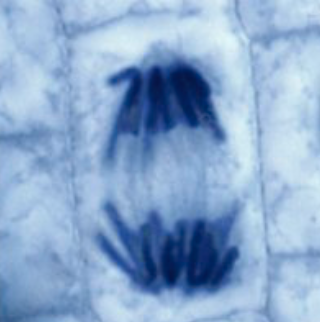
What stage of mitosis does this image show?
anaphase
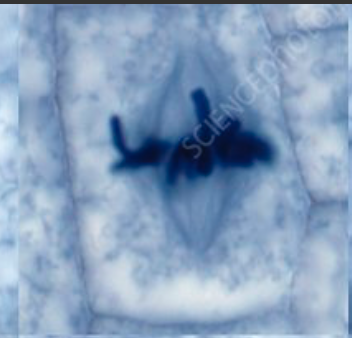
What stage of mitosis does this image show?
metaphase
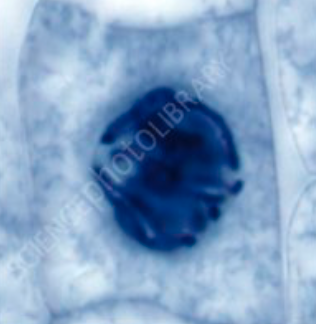
What stage of mitosis does this image show?
prophase
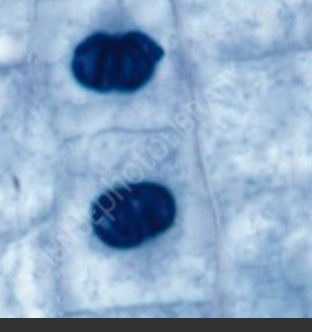
What stage of mitosis does this image show?
telophase
What is cytokinesis?
the division of the cytoplasm to create two daughter cells
Describe the process of cytokinesis in animal cells
Fill in the blanks: a ____ ____ forms in the middle of the cell as the ___ ___ is pulled inwards by the cytoplasm. When the plasma membranes from each side of the cell are in close proximity they fuse. Contractile proteins called ____ are found along the equator of the cell which cause the membranes to separate.
cleavage furrow, cell-surface/plasma membrane, actins
Why can’t cytokinesis in plant cells happen the same way it does in animal cells?
as plants have cell walls, a cleavage furrow cannot be formed
Describe the process of cytokinesis in animal cells
Fill in the blanks: ___ assemble along the ___ and fuse with each other, forming connecting channels - ____ - which fuse with the plasma membrane, dividing the cells into two. New section of cell __ form along the new membrane.
vesicles, equator, plasmodesmata, wall
Give 3 advantages of asexual reproduction
only 1 parent required (saves time + energy)
genetically identical offspring (successful adaptations passed on)
quick dispersal and spread/colonisation
rapid multiplication
What is the main disadvantage of asexual reproduction?
the lack of genetic variation in offspring (unless mutations occur) so evolution by natural selection cannot happen and organisms cannot adapt to changing environments
Fill in the blanks: meiosis is a form of ___ cell division in which _ (number) genetically ___ daughter cells are produced through _ (number) divisions
nuclear, 4, different, 2
What is mean by a pair of homologous chromosomes?
A pair of chromosomes, one maternal and one paternal, that contain that same genes at the same loci, but may contain different alleles
What is a karyotype and what are they used for?
a visual map of the complete set of chromosomes in an organism, which can be used to detect genetic conditions by spotting abnormalities in chromosome count or arrangement
Describe what happens in prophase I of meiosis
chromosomes condense and coil
nuclear envelope breaks down
spindle fibres begin forming from the centriole
chromosomes pair up in their homologous pairs, forming bivalents
crossing over of non-sister chromatids may occur - this point is called the chiasma
Describe what happens in metaphase I of meiosis
the bivalents randomly line up along the equator/metaphase plate (independent assortment)
spindle fibres attach to the centromeres
Describe what happens in anaphase I of meiosis
each pair of homologous chromosomes is pulled apart
the crossed over areas of DNA separate forming recombinant chromatids
Describe what happens in telophase I of meiosis
chromosomes assemble at each pole and uncoil, and the nuclear envelope reforms
cell undergoes cytokinesis
After meiosis I, are the daughter cells produced haploid or diploid?
haploid
True or false? Telophase I of meiosis doesn't occur in plant cells
true
Describe what happens in prophase II of meiosis
chromosomes coil and condense
nuclear envelope breaks down
spindle formation begins but at a right angle to the previous formation
Describe what happens in metaphase II of meiosis
chromosomes arrange randomly on the metaphase plate (independent assortment)
chromosomes may cross over again
Describe what happens in anaphase II of meiosis
centromeres divide and the individual chromatids are pulled to opposite poles