Biomes
 Note
Note Call Kai
 Learn
Learn Practice Test
 Spaced Repetition
 Match
Match Flashcards
 Knowt Play
1/16

There's no tags or description
Looks like no tags are added yet.
Name | Mastery | Learn | Test | Matching | Spaced | Call with Kai | Chat |
|---|
No analytics yet
Send a link to your students to track their progress
17 Terms
What defines a biome?
A large community of plants and animals that has developed as a result of environmental factors.
What are the two main abiotic factors that determine the distribution of terrestrial biomes?
Earth temperature and annual rainfall.
How do regions with similar abiotic factors relate to biomes?
Regions that experience similar abiotic factors will contain the same biome.
What will the ecosystems found in equivalent biomes contain?
similar communities due to shared abiotic factors and resultant convergent evolution
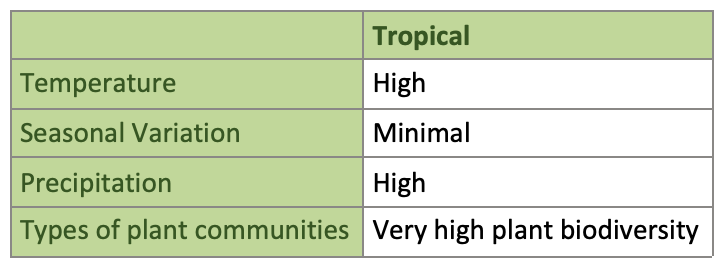
Tropical
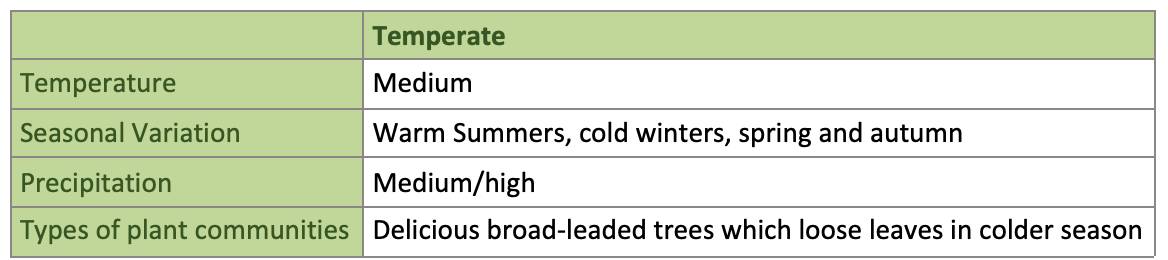
Temperate
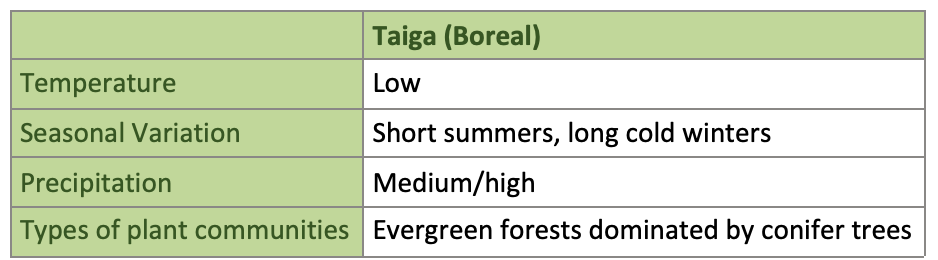
Taiga (Boreal)
Desert

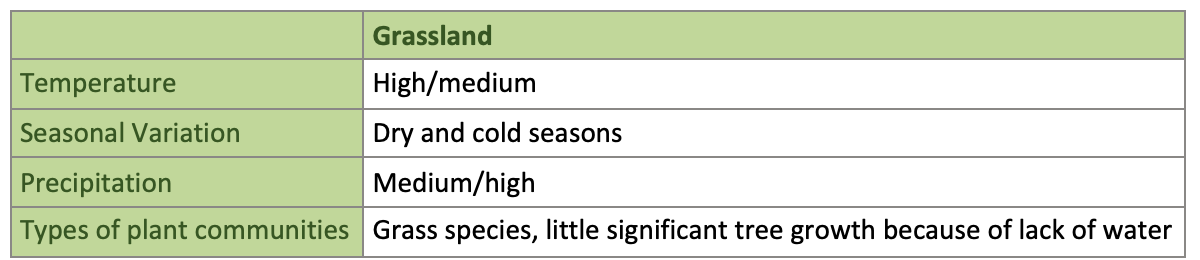
Grassland
Tundral

What are adaptations in biomes?
Traits that increase survival chances in a specific environment, coming about through natural selection.
What are the temperature characteristics of a hot desert?
Very high daytime temperatures and very low nighttime temperatures.
What is the water availability in a hot desert?
Little water availability due to low annual rainfall.
Give an example of a plant adapted to hot deserts and its features.
Saguaro cactus
stem has thick waxy cuticle, reduces water loss (evaporation)
spines instead of leaves, reduces the SA of which water can be lost
cells in the stem expand to store water
a deep tap root to access water underground
shallow surface roots to absorbs water from rainfall
What adaptation does the kangaroo rat have to survive in its biome?
spend daylight hours underground to avoid daytime temperatures
extracts enough water from diet to survive
What unique growth feature does the kapok tree have?
rapid growth to absorb enough sunlight.
wide buttress roots to support growth with a sturdy base
What adaptation does the orchid mantis have?
appearance similar to an orchid flower to attract insects
small and plain to camouflage amongst stems and branches