23.4/23.5/23.6 Gauss' Law with Various Symmetries
 Call Kai
 Learn
Learn Practice Test
 Spaced Repetition
 Match
Match Flashcards
 Knowt Play
1/9

There's no tags or description
Looks like no tags are added yet.
Name | Mastery | Learn | Test | Matching | Spaced | Call with Kai | Chat |
|---|
No analytics yet
Send a link to your students to track their progress
10 Terms
Gauss’ Law Application
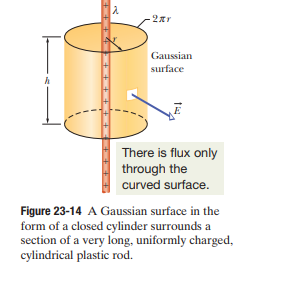
Imagine that we have an infinitely long rod that has a uniform charge density y; we define the charge density to be put the amount of charge per unit of area. Furthermore, we define the rod’s charge to be of the positive polarity, so the electric field lines will point radially away from the rod itself.
Since the electric field line will point radially away from the rod, it would be best practice to assign a Gaussian surface which is compatible with the rod: a cylinder. We let the cylinder extend far out as the radial distance at which we want to find the magnitude of the electric field line.
Say that we wanted to find the magnitude of the electric field line at a distance of 5 meters away from the rod; those 5 meters WOULD be our radial distance and thus the point whose electric field magnitude we’d compute.
Gauss’ Law Application (Part 2)
We only need to find the flux going through the curved part of the cylinder due to the fact that there is no net flux at the caps. This is due to the fact that the electric field vector points radially away from the rod whereas the area vector points perpendicular to it (recall that the area vector will ALWAYS point away from its unit of area as necessary). Thus, because theta = pi/2, we have that the total flux = 0 at the caps themselves.
From there, we apply Gauss’ law by realizing that we need to take the product of the electric field magnitude and the area. The area for the curved part of the cylinder is just 2(pi)(h)(R).
We can also define the charge as being nothing more than the charge density multiplied by the height; recall that the charge density is the charge per unit length of rod, so density * length = total amount of charge.

Gauss’ Law: Planar Symmetry
We now take the case of a thin, infinite, and nonconducting sheet with a uniform and positive surface charge density y. We want to compute the magnitude of the electric field at a distance r from the sheet.
We must enclose a cylinder that extends from the thin sheet all the way to the distance r (the point of analysis); from here, we define the radial length to be the same as the length of the cylinder.
We then compute the electric flux through the two ends ONLY since there would be no flux on the curved portions. No flux exists at the curves because the electric field vector points radially outwards and the curved area points upwards, which creates a perpendicular intersection and thus cos(pi/2) = 0.

Gauss’ Law: Planar Symmetry (Part 2)
Since we need to compute the flux for the two caps of the cylinder, we have to add both areas to obtain the final flux.
The total charge, qenc, is given by the density of the charge per unit area multiplied by the total area of the caps themselves. Recall that density x area = total amount of material (in this instance, electric charge)

Gauss’ Law: Planar Symmetry (Part 3)

Gauss’ Law: Spherical Symmetry (Part 1)
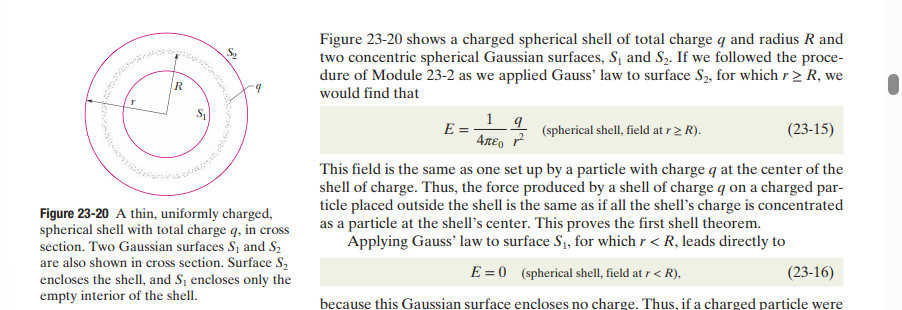
Imagine that we have a shell of electric charge, q, that is surrounded by two concentric Gaussian surface shells called S1 and S2. We let r be the radius from the center to S2 and let R be the radius from the center to the shell of electric charges themselves (concentric, remember).
From there, we can compute the magnitude of the electric field at the distance r as:
This is, in essence, the total electric field magnitude for the sphere that encloses a charge.
Gauss’ Law: Spherical Symmetry (Part 2)
If we, however, decide to apply Gauss’ Law to surface S1 (which houses no charge), then we realize that the magnitude of the electric field is 0. Since charge and electric magnitude are closely related, it makes sense that one of them being 0 necessarily results in the other also being 0.
Gauss’ Law: Spherical Symmetry (Part 3)
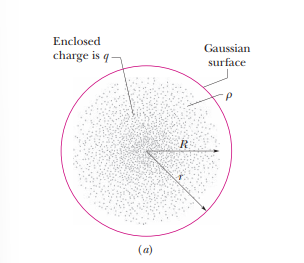
In general, if we are able to hold an enclosed charge, q, within a given Gaussian surface, then the magnitude of the electric field is always given by

Gauss’ Law: Spherical Symmetry (Part 4)
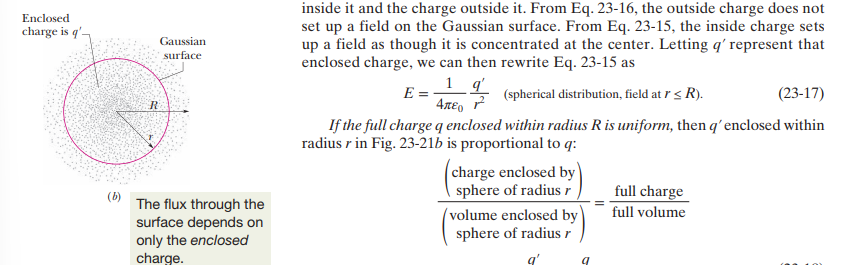
However, if we have a total charge q and a Gaussian surface only covers a portion of that charge, q’, then we can also compute the magnitude of the electric field that way as well.
Recall that the electric field line will only exert a field within the Gaussian surface, so we omit all charges outside the surface. We obtain a net electric field magnitude of:
Gauss’ Law: Spherical Symmetry (Part 5)
If a full charge, q, is enclosed within a circle of radius R and the charge is uniform, then q’ enclosed within the radius is proportional to q itself:
(small charge enclosed by the small sphere)/(small volume of the tiny sphere) = (total charge)/(total volume)
This allows us to compute the magnitude of the electric field by utilizing the entire net charge, rather than the q’ which is sectioned off by the tiny sphere itself — which is MUCH harder to compute.
