Microbiology Ch 1
 Call Kai
 Learn
Learn Practice Test
 Spaced Repetition
 Match
Match Flashcards
 Knowt Play
1/39

Earn XP
Description and Tags
Chapter 1 : Introduction to Microbiology
Name | Mastery | Learn | Test | Matching | Spaced | Call with Kai | Chat |
|---|
No analytics yet
Send a link to your students to track their progress
40 Terms
What are microorganisms?
Organisms that are so small you need a microscope to see them.
What are some examples of microorganisms?
Bacteria, Archaea, Protozoa, Fungi, Helminths (worms), noncellular organisms, Viruses, and Prions
How are some microorganisms beneficial? (part 1)
They decompose dead organisms (decomposition), make nitrogen available for plants and provide oxygen (recycle nutrients) and are important for the food chain
How are some microorganisms beneficial? (part 1)
Aid in digestion for animals (cows), make beer, yarn, and wine, they degrade environmental pollutants (bioremediation) provide antibiotics, used in genetic engineering
How are microorganisms harmful to us?
they cause deadly infections and disease. Like COVID 19, respiratory diseases, and influenza and pneumonia
What does Prokaryotes mean?
No nucleus, has DNA in the cytoplasm, no membrane bound organelles. Has one circular chromosome, smaller, Always Unicellular, Asexual reproduction
What does Eukaryotes mean?
Has membrane bound organelles and Nucleus, has multiple linear chromosomes, larger, Unicellular or multicellular, Sexual or Asexual reproduction
Examples of Prokaryotes
Bacteria and Archaea
Examples of Eukaryotes
Fungi, Protozoa, and Helminths
Examples of Acellular
Viruses and Prions
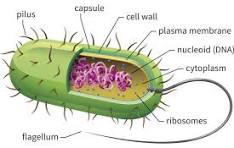
What is this picture showing?
Prokaryote Cell

What is this picture showing?
Eukaryote Cell
Describe Bacteria (Prokaryotes)
Single Celled, lack cell nucleus, lack membrane bound organelles, multiply by Binary Fission, obtain nutrients by absorption or photosynthesis
Describe Fungi (Eukaryotes)
Single celled or multicellular, include molds and yeasts, have cell nucleus, cellular organelles, obtain nutrients through absorption of organic material
Describe Protozoa (Eukaryotes)
Single Celled, contains nucleus, cellular organelles, some can be seen with the naked eye, obtain nutrients by ingestion and ingulf
Describe Helminths (Eukaryotes)
Multicellular, contain nucleus, cellular organelles, Adults seen with naked eye, eggs are microscopic, obtain nutrients through absorption
Describe Viruses (Acellular)
Acellular, nucleic acid surrounded by protein coat, invade human cells and cause diseases, Intracellular Obligate Parasites- they must ‘live’ inside a host cell to live
Describe Prions (acellular)
infectious protein particle, cause human disease
Describe Viroids (Acellular)
simpler than viruses, short piece of nucleic acid (usually RNA) without a coat, infect plants
What did Robert Hooke do?
1st to describe cellular structures and made a single-lens microscope (1660s)
What did Antoine Van Leeuwenhoek do?
Made first microscope at 100-300 times in 1673
What is Germ Theory?
Microorganisms can invade other organisms and cause disease
What is Spontaneous Generation ?
microorganism arises from nonliving things
What experiments disproved Spontaneous Generation?
Redi’s Experiment (1668) and Louis Pasteur Experiments (1800s)
What’s Pasteurization?
Heating substances to 56c in the absence of oxygen for 30 minutes to kill microorganisms
What did John Tyndall do?
found that some bacteria could survive 5 hours of boiling (endospores)
What is an endospore?
Heat resistant Bacteria
What did Robert Koch do?
Discover the bacterium that causes anthrax, tuberculosis, and how to grow bacteria in pure culture
What is Aseptic Technique?
procedures used to minimize chances that cultures will be contaminated by organisms from the environment
What did Semmelweis do?
connected autopsies and childbed fever due to doctors not washing their hands between autopsies and examining women in labor (nervous breakdown)
What did Lister do?
worked to sterilize bandages and instruments to reduce infection during surgery
What did Edward Jenner do?
discovered the smallpox vaccine, he inoculated his own son with cowpox then smallpox, child remained safe
What did Alexander Flemming do?
Discovered Penicillin accidentally. Found that Penicillium mold contaminating a culture of Staphylococcus bacteria had prevented the growth
What’s the Binomial System?
a two name system
What’s Taxonomy
the science of classification, classified according to characteristics, created by Linnaeus. Goes from broad to most specific.
What are the 3 domains of taxonomy?
Bacteria, Archaea, and Eukarya
What are 5 kingdoms of Taxonomy?
Plants, Animals, Protista (protozoa), Monera, and Fungi
What’s the Hierarchy of Taxonomic Ranks?
Domain, Kingdom, Phylum, Class, Order, Family, Genus, Species.
How would you write the name of a bacteria using Genus and Species?
you capitalize Genus and lowercase species
What’s the correct format for Staphylococcus Epidermis
Staphylococcus epidermis