1.4 Nutrient Absorption
 Call Kai
 Learn
Learn Practice Test
 Spaced Repetition
 Match
Match Flashcards
 Knowt Play
1/28

There's no tags or description
Looks like no tags are added yet.
Name | Mastery | Learn | Test | Matching | Spaced | Call with Kai | Chat |
|---|
No analytics yet
Send a link to your students to track their progress
29 Terms
Enterocytes
Cells that line the inner surface of the small intestine
form a physical barrier and absorptive surface between the gut lumen and the body
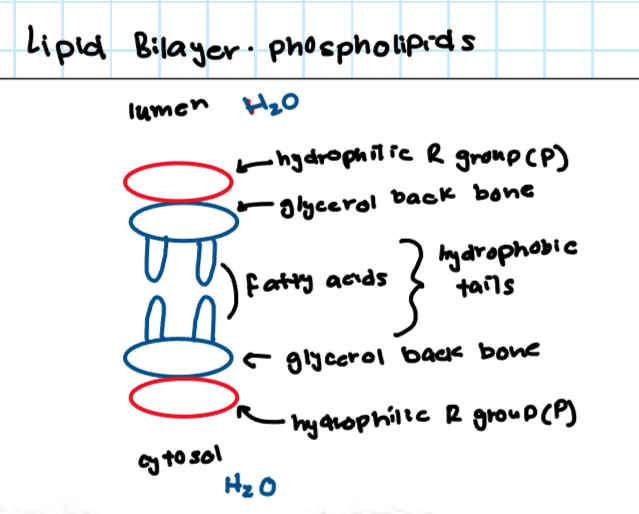
How is the lipid bilayer formed?
One end points towards the lumen
On the outside, there are hydrophilic R groups
In the middle, there is a glycerol backbone
Inside, there are fatty acids (hydrophobic tails)
Then repeat
One end is the cytosolic side of the lipid bilayer, which is the inner layer of a cell membrane that faces the watery fluid (cytosol) inside the cell
Types of diffusion
Passive diffusion
Facilitated diffusion
Active transport
Passive diffusion (Draw and explain)
With the concentration gradient (higher concentration in lumen; lower concentration in cytosol)
Requires no energy
Requires no transporter

Facilitated diffusion (draw and explain)
With the concentration gradient (higher concentration in lumen; lower concentration in cytosol)
Requires no energy
Has a transporter

Active transport (draw and explain)
Can go against the concentration gradient (higher concentration in the cytosol; lower concentration in the lumen)
Has a transporter
ATP/Energy

Where does diffusion occur?
All happen at the lipid bilayer
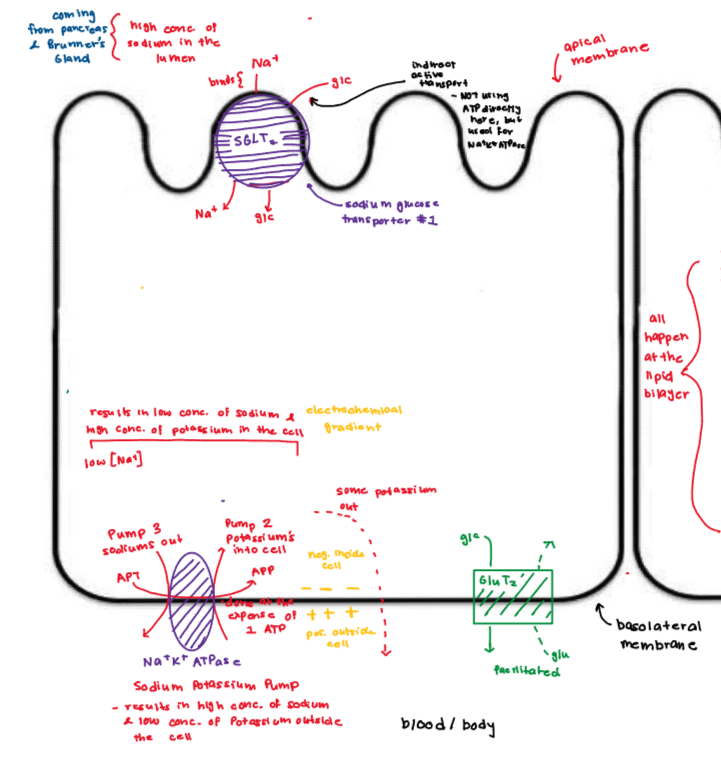
Sodium Potassium Pump
Results in a high concentration of sodium and a low concentration of potassium outside the cell
What is another name for the Sodium Potassium Pump?
Na+K+ATPase
How many sodium’s are pumped out of the cell?
3
How many potassium’s are pumped into the cell?
2
What energy does the Sodium Potassium pump require
Requires 1 ATP
Turns ATP (adenosine triphosphate) into ADP (adenosine diphosphate)
What is the charge inside of a cell?
Negative
What is the charge outside of the cell?
Positive
Electrochemical gradient
As molecules move in and out, the charge inside the cell can become more positive or negative
Basolateral membrane
Part of a cell membrane that faces away from the inside of the organ/cavity and toward the blood or surrounding tissue.
Apical membrane
The apical membrane is the part of a cell membrane that faces the inside of a hollow organ or the outside environment
faces the lumen
SGLT1
Sodium glucose transporter #1
Function of sodium-glucose transporter #1
The sodium-glucose transporter (SGLT) helps intestinal cells absorb glucose from food into the cell.
It uses sodium (Na⁺) to “pull” glucose into the cell.
Sodium moves into the cell.
Glucose gets brought into the cell along with it.
Then glucose can leave the cell on the basolateral side and enter the blood.
Is there a high or low concentration of sodium in the lumen? Where does this concentration come from?
There is a high concentration of sodium in the lumen
Sodium comes from the pancreas and Brunner’s gland
What kind of transport does SGLT1 use?
Indirect active transport
NOT using ATP directly, but ATP is used for the sodium-potassium pump
A Na⁺/K⁺ pump uses ATP to pump sodium out of the cell.
This creates a high Na⁺ concentration outside the cell.
Na⁺ wants to move back into the cell.
SGLT lets Na⁺ move into the cell, and glucose comes along with it, even if glucose is moving against its gradient.
GluT2
Glucose Transporter 2
Glucose Transporter 2
A glucose transporter that helps glucose leave an intestinal cell and enter the blood.
SGLT1: brings glucose into the intestinal cell (with sodium)
GLUT2: lets glucose out of the intestinal cell and into the blood
What kind of diffusion does GluT2 use?
Facilitated diffusion
What kind of diffusion does the sodium-potassium pump use?
Active transport

Indirect Active Transport
uses the energy from one molecule moving down its concentration gradient to move another molecule against its concentration gradient
Aerobic Respiration
autoenzymatic digestion; involves oxygen
Anaerobic Respiration
fermentation; alloenzymatic digestion; no oxygen involved