Lecture 30: Research II
 Call Kai
 Learn
Learn Practice Test
 Spaced Repetition
 Match
Match Flashcards
 Knowt Play
1/29

There's no tags or description
Looks like no tags are added yet.
Name | Mastery | Learn | Test | Matching | Spaced | Call with Kai | Chat |
|---|
No analytics yet
Send a link to your students to track their progress
30 Terms
Type 1 error
false positive
Type 2 error
false negative
A physical therapist is evaluating the sensitivity of a balance test in a group of older adults. Which of the following results indicates a true positive finding?
A. Patients with a history of falls test negatively.
B. Patients with a history of falls test positively.
C. Patients with no history of falls test negatively.
D. Patients with no history of falls test positively.
B
Sensitivity equation
TP/(TP+FN)
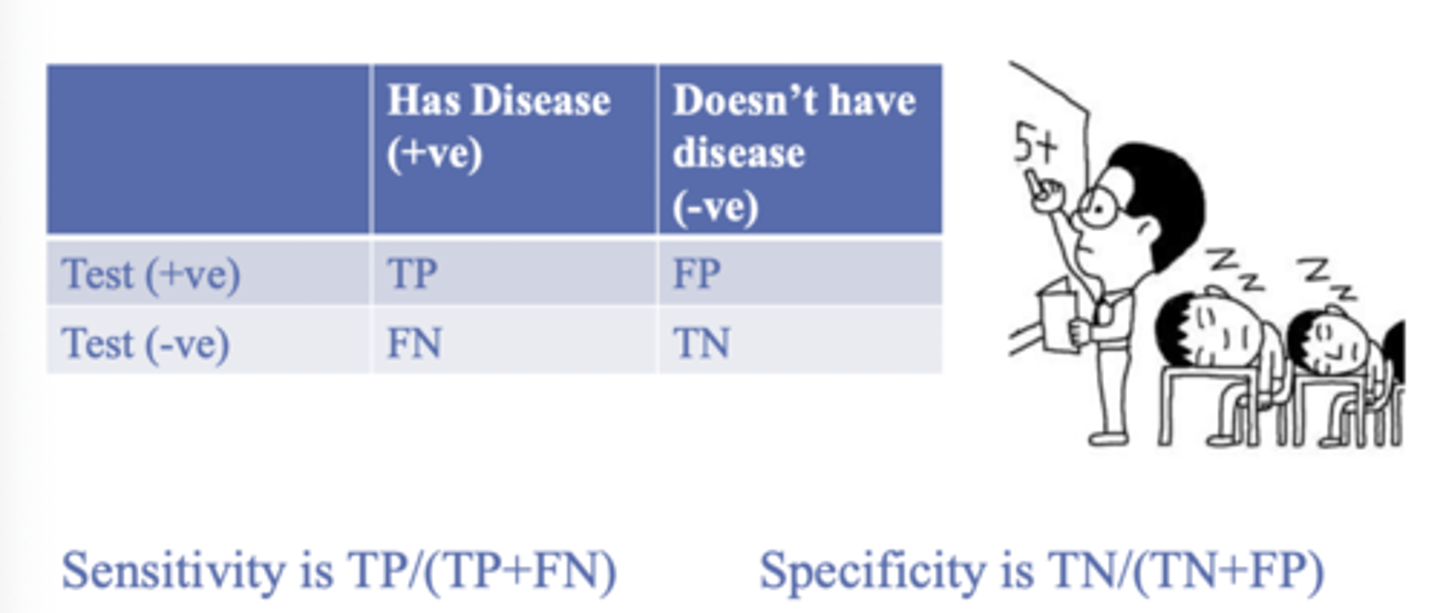
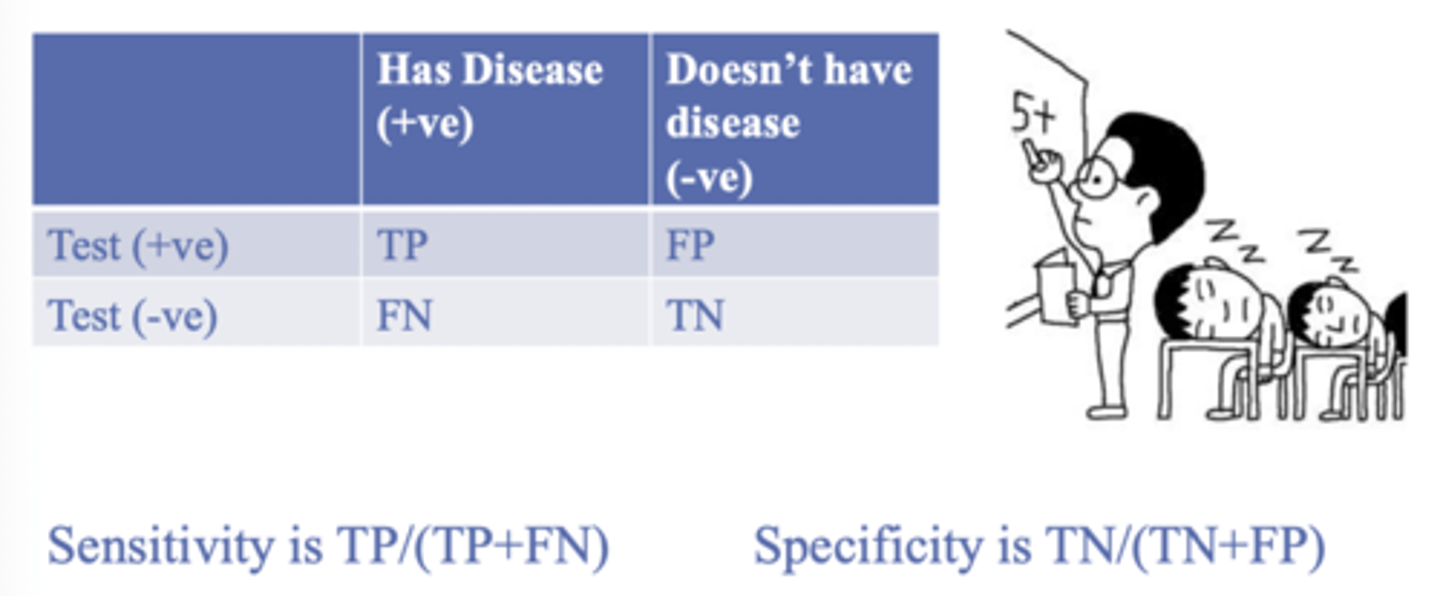
Specificity equation
TN/(TN+FP)
A researcher is collecting data on 100 tennis players with overhead injuries. Out of the 100 patients with rotator cuff injuries, 60 patients had a positive special test, and 40 had a negative special test. What is the sensitivity of the special test?
A. 20%
B. 80%
C. 40%
D. 60%
D
What are clinical predicting rules
tools designed to improve decision making in clinical practice by assisting practitioners in making a particular diagnosis, establishing a prognosis, or matching patients to optimal interventions based on a parsimonious subset of predictor variables from the history and physical examination.
A 67-year-old patient had total hip replacement 1 week ago reports a new onset of calf pain. Which of the following findings should be reported to the physician immediately in suspicion of DVT?
A. Bed ridden for more than 3 days, history of DVT, calf swelling more than 3mm on asymptomatic side and active cancer
B. History of hip arthritis, swelling around the hip joint
C. B/L pitting edema and painful straight leg raises
D. Trochanteric bursitis, painful hip internal rotation and swelling on lateral side of hip
A
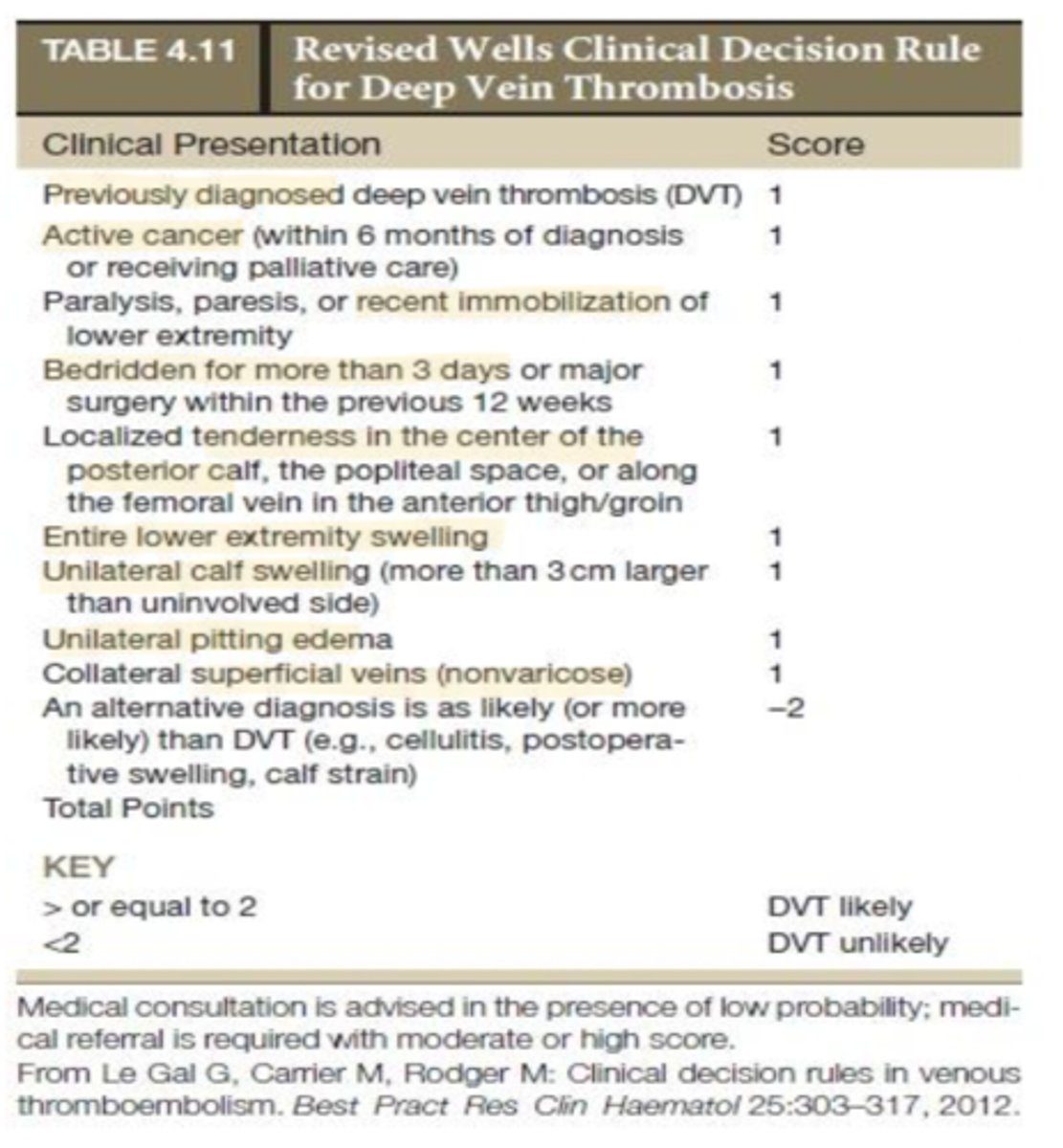
WELLS CLINICAL DECISION RULE FOR DEEP VEIN THROMBOSIS
- Previous DVT
- Active cancer
- Recent immobilization or paralysis
- Bedridden > 3 days
- Calf, popliteal, femoral vein tenderness
- Entire LE swelling
- Unilateral calf swelling
- Unilateral pitting edema
- Collateral superficial veins (non varicose)
- Subtract 2 if alt diagnosis is just as likely
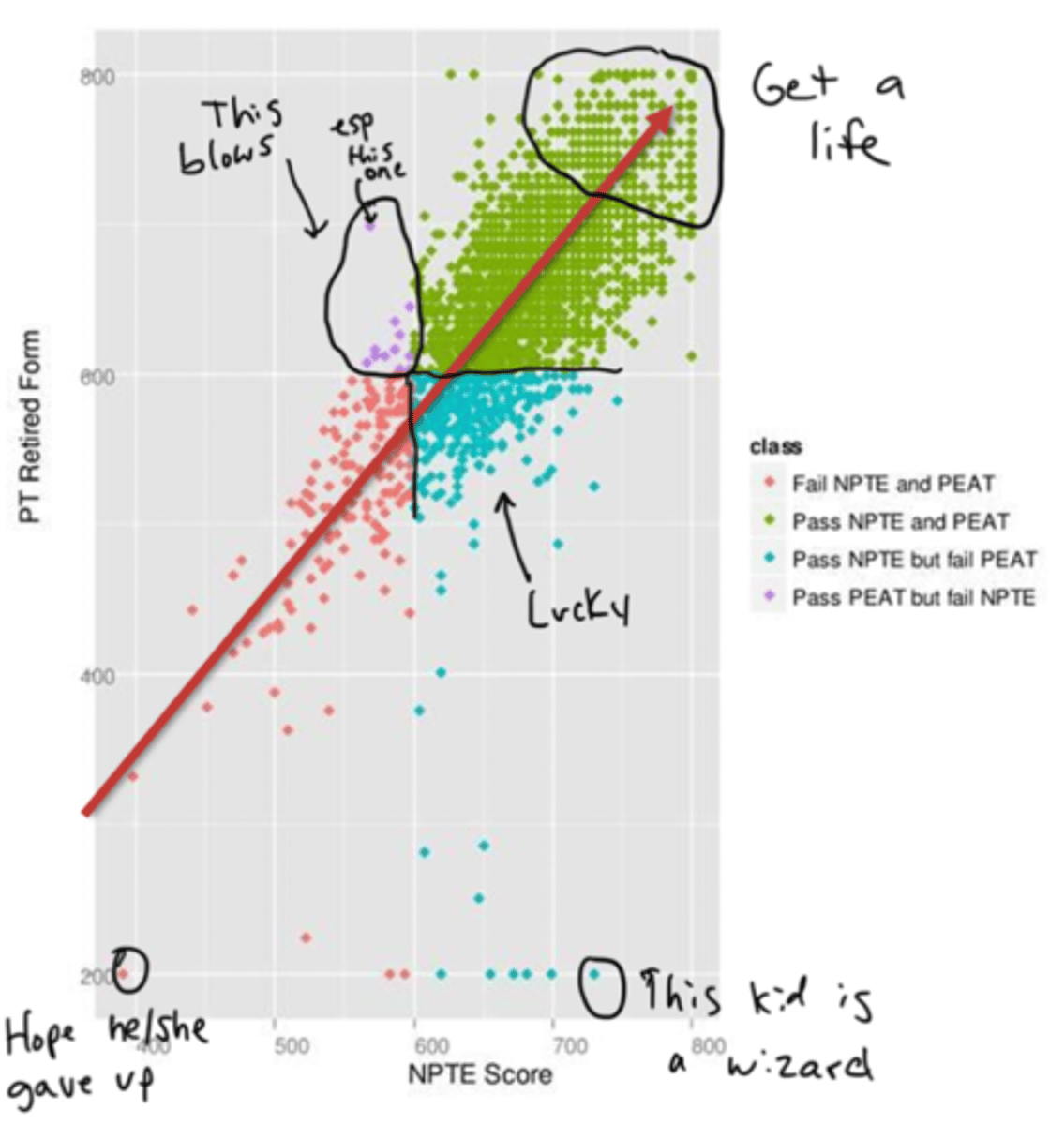
A PT collected data on THA patients and plotted the relationship of trunk flexion with waist circumference. The regression plot showed a R square value of 0.64 (See picture). What is the best way to describe the slope?
A. Weak positive slope
B. Weak negative slope
C. Strong positive slope
D. Strong negative slope
D
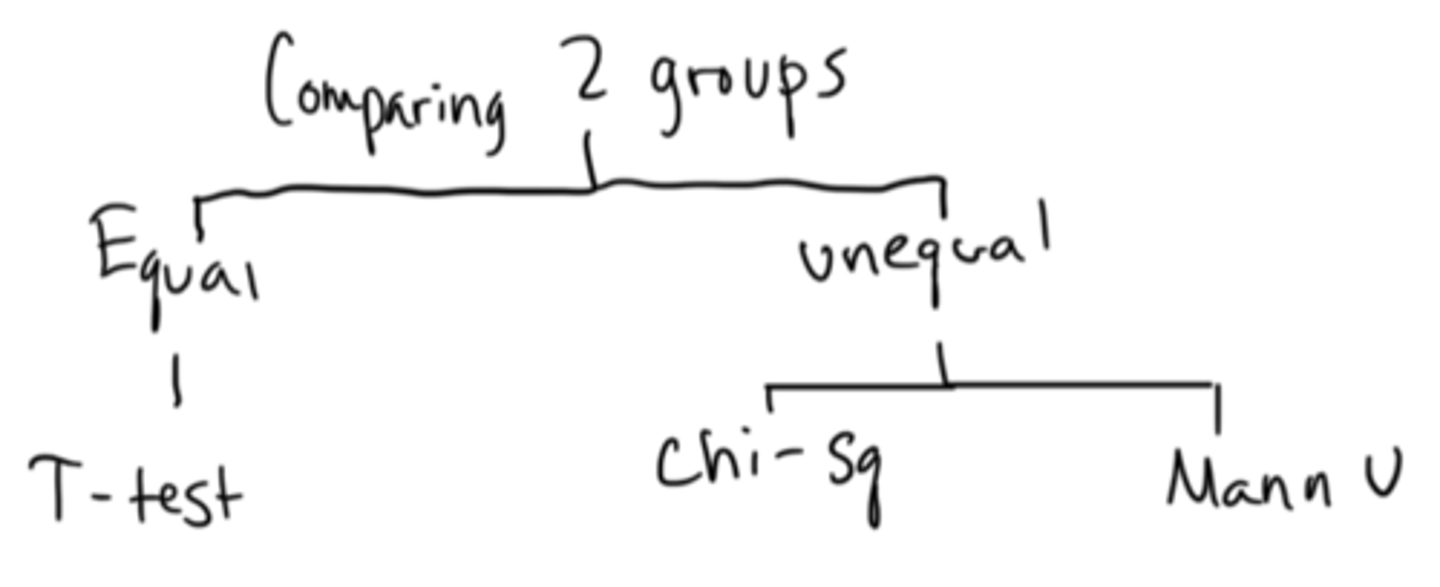
Tests to compare 2 groups
T-test: equal groups
Chi-Square: unequal groups, nominal
Mann-U Whitney: unequal groups, ordinal
Independent samples t-test
Compares 2 independent groups
Paired t-test
Compares 2 matched samples
1 tailed paired t test
Compares 2 matched samples with a directional hypothesis
2 tailed paired t test
Compares 2 matched samples with a non-directional hypothesis
A PT is looking at squat activity in 20 obese and 20 normal weight females. Both groups performed 10 bilateral squats at 100-degrees of knee flexion. The PT hypothesizes that knee moments will be higher in obese. Which is the MOST appropriate test?
A. Chi-Square test
B. Mann Whitney U. test
C. One tailed t-test
D. Two tailed t-test
C
Tests to compare 3 groups
Equal groups: ANOVA
Unequal groups: Kruskal Wallis test
Analysis of Variance (ANOVA)
analysis of variance test used for designs with three or more sample means
One-way ANOVA
2 or more independent groups compared on 1 intervention
Two-way ANOVA
2 or more independent variables compared on 2 intervention
Repeated Measures ANOVA
individuals measured over time
ANCOVA
Compare 2 or more treatment groups while controlling effects of variables (covariates)
Self selected speed is measured on a continuous scale in 2 groups of professional and amateur individuals. The data shows markedly skewed distribution. Which of the tests is MOST appropriate to find significant difference in gait speed between two groups?
A. Mann-Whitney U test
B. Analysis of variance
C. T-test
D. Kruskal-Wallis test
A
A study is looking at effects of different exercise options for a patient with knee OA. The study compared pool exercise, treadmill walking, and ankle weights on knee pain in 3 equal groups of 30 adults each. An appropriate statistical test to assess the effectiveness of treatment in three groups is:
A. Spearman's rho
B. Two paired t-tests
C. ANOVA
D. Chi square
C
Correlation statistics
Relationship between 2 variables
Direct vs inverse relationship
Direct relation 0 - 1.00
Inverse relation -1.00 - 0
Strength of relationships using (Pearson or Rho) correlation
Low 0 - .25
Fair .26 - .50
Mod .51 - .75
High .76 - 1.0
What is regression analysis?
a statistical process for estimating the relationships among variables
What regression (R square value) is considered strong?
> 0.5
Correlation (r) vs Regression (R)
r squared = R