Anatomy and Path of Adrenal gland
 Call Kai
 Learn
Learn Practice Test
 Spaced Repetition
 Match
Match Flashcards
 Knowt Play
1/97

There's no tags or description
Looks like no tags are added yet.
Name | Mastery | Learn | Test | Matching | Spaced | Call with Kai | Chat |
|---|
No analytics yet
Send a link to your students to track their progress
98 Terms
Adrenal glands are located in the ___________ space
Perirenal
Adrenal gland
1/3 size of the kidney
Situated on the medial upper poles of the kidneys
Endocrine glands - produce substances transported by the circulatory system
Adrenal glands are surrounded by:
Gerota fascia
Right adrenal gland
Triangle shaped
Medial to the right lobe of the liver
Posterior to IVC
Superomedial anterior aspect of the upper pole of kidney
Lateral and anterior to the diaphragm
Left adrenal gland
Crescent shaped
Medial to spleen
Posterior to the pancreas tail and stomach
Lateral to Ao
Lateral and anterior to the diaphragm
Splenic artery and vein course between the:
Pancreas and left adrenal gland
Left adrenal mass can cause:
Anterior displacement of the pancreatic tail and splenic vessels
Right adrenal mass can cause anterior displacement of:
IVC
Adrenal mass can cause ________ displacement of the associated kidney
Inferior
Adrenal cortex
Outer layer of tissue of adrenal gland
Composes 90% of the gland
Controlled by the pituitary gland and adrenocorticotropic hormone (ACTH)
ACTH stimulates the cortex to increase adrenal function
Increased adrenal function slows the pituitary production of ACTH
Zona glomerulosa, fasciculata, reticularis
Endocrine function of the adrenal gland
Synthesizes cortisol, androgens, estrogen, progesterone and aldosterone
Zona glomerulosa
Produces mineralocorticoids when stimulated by aldosterone, responsible for fluid and electrolyte regulation
Zona fasciculata
Cortisol regulation, responsible for metabolism regulation
Zona reticularis
Secretes estrogens and androgens; promotes reproductive organ development
Medulla of adrenal gland
Synthesizes catecholamines (epinephrine and norepinephrine) in the chromaffin cells
Responsible for fight and flight mechanism
Epinephrine
AKA adrenaline
Increases heart rate and blood pressure
Released in response to stress
Redirects blood from GI tract and skin to muscles
Norepinephrine
Increases heart rate and blood pressure
Continuously release to control blood pressure
Causes vasodilation
Arteries that supply adrenal glands
Superior suprarenal artery originates from the inferior phrenic artery
Middle suprarenal artery originates from the abdominal aorta
Inferior suprarenal artery originates from the renal artery
Right suprarenal vein drains into the …
IVC
Left suprarenal vein drains into the left renal vein or
Left inferior phrenic vein
ACTH - Adrenocorticotrophic hormone
Produced by the pituitary gland
Increased ACTH released with decreased adrenal function
Serum levels increase with Addison disease, Cushing disease, adrenal insufficiency, adrenal tumors, pituitary tumors
Serum levels decrease with adrenal hyperfunction
Aldosterone
Serum levels used to assess adrenal function
Secreted by the adrenal cortex
Regulates sodium and water levels to control systemic bp
Levels tested in the blood or urine
Increases with adrenal adenoma, adrenal adenocarcinoma, bilateral adrenal hyperplasia, Conn syndrome, renovascular HTN
Decreases with Addison disease
Cortisol
Secreted by the adrenal cortex
Estrogen, testosterone
Aids in glucose metabolism, inflammatory response, systemic blood pressure regulation
Increases with pituitary tumor, hyperpituitarism, Cushing syndrome, Cushing disease, adrenal hyperplasia
Androgens
Secreted by adrenal cortex
Estrogen and testosterone
DHEA-S is secreted by the adrenal glands and the body turns it into testosterone
Used to eval pts with suspected congenital adrenal hyperplasia, infertility, delayed or early puberty, Cushing disease or adrenal tumor
Increases with Cushing syndrome, PCOS, and abnormal adrenal function
USA Adrenal glands
Difficult to see in adults
Cortex is more hypoechoic than the medulla and surrounding fat
Medullar appears as echogenic linear structure within gland
Gland is flat, triangular or cone shaped
Right adrenal gland is best visualized __________ at the midaxillary or anterior axillary line; use the liver as an acoustic window
Intercostally
The left adrenal gland is tougher to visualize but can be evaluated from the __________ or intercostally at the midaxillary or posterior axillary line; use the spleen as an acoustic window
Epigastrium
Indications for US of adrenal gland
Decreased hematocrit
Systemic HTN
Virilism
Hirsutism
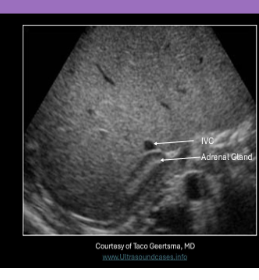
Adrenal gland
Wolman disease
Autosomal recessive disorder
Causes excessive lipid storage in liver, spleen and adrenal glands
Usually fatal in the first 6 months
Wolman disease USA
Hepatosplenomegaly
Massive adrenal gland enlargement
Adrenal hemorrhage
Most commonly occurs in newborns; caused by birthing process
In adults its related to trauma
Adrenal glands are highly vascular
Associated with jaundice and anemia
Usually affects right side
Resolves spontaneously
Labs adrenal hemorrhage
Decreased hematocrit
USA Adrenal hemorrhage
Mass with varied echogenicity with age of thrombus
Use color Doppler to aid in differentiation from adrenal mass
NO FLOW IN HEMORRHAGE
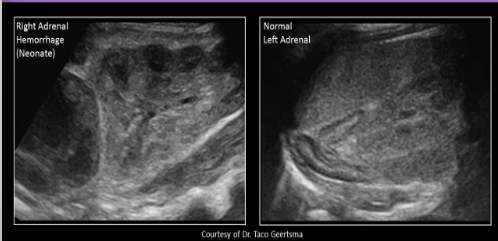
Adrenal hemorrhage
Pheochromocytoma is most commonly _________
Benign
Pheochromocytoma is most commonly hyperfunctioning with
Increased production of catecholamines
Pheochromocytoma is composed of what cells
Chromaffin
Pheochromocytoma
Originates in the medulla tissue
Average size: 5-6cm
Right is more commonly affected
Associated with MEN syndrome, Von Hippel Landau disease and tuberous sclerosis
Pheochromocytoma Labs
Increased secretion of dopamine, epinephrine and norepinephrine
Pheochromocytoma symptoms
Uncontrolled HTN, anxiety, headache, N/V, sweating, tachycardia, palpations, weight loss
Pheochromocytoma USA
Usually an echogenic or hypoechoic mass
Highly vascular
Demonstrates attenuation/propagation speed artifact due to fat content of lesion
May see calcs
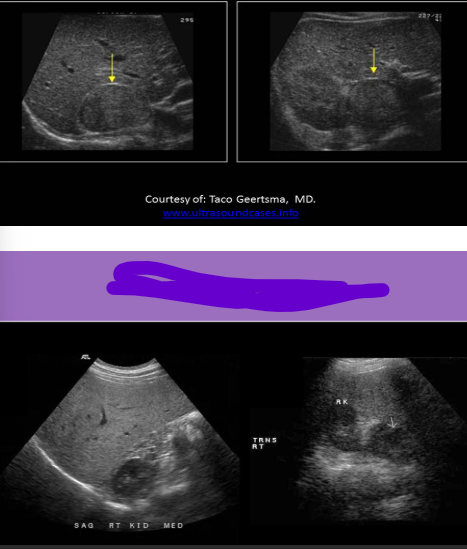
Pheochromocytoma
Adrenal hyperplasia
Adrenogenital syndrome
ACTH elevation causes hyperplasia of adrenal tissues as they try to (unsuccessfully) produce more cortisol
Associated with Hirsutism
Can lead to ambiguous external genitalia in female fetus
Adrenal hyperplasia labs
Impaired cortisol synthesis causes increased ACTH production
Adrenal hyperplasia USA
Bilateral, diffuse gland enlargement
May see nodule formation that can be solid, cystic or complex
Adrenal myelolipoma
Originate in adrenal medulla
Contain bony and fatty elements
Adrenal myelolipoma USA
Hyperechoic, may blend into perirenal fat
Attenuation artifact demonstrated
May see diaphragm disruption due to propagation speed artifact; the decrease in the speed of sound in fatty tissue can cause the portion of the diaphragm that is posterior to the mass placed more posterior on image
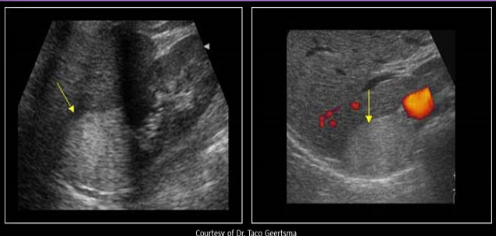
Adrenal myelolipoma
Addison disease
Adrenocortical insufficiency, low aldosterone and cortisol production
High levels of potassium (hyperkalemia) and low sodium levels will reduce urine output and increase blood volume in body
Glands enlarged in acute stages
Decreased gland size in chronic stages
Addison disease is most commonly associated with
Autoimmune disorders
Addison disease is caused by
Hypersecretion of adrenocortical hormones from the pituitary gland (high ACTH levels) as it keeps trying to stimulate the adrenal gland to produce more corticosteroids
Addison disease symptoms
Fever, fatigue, hypotension, GI tract distress, weight loss, hyperpigmentation of the skin (skin has brownish discoloration)
Cushing Disease is caused by
Excessive secretion of ACTH by the pituitary gland which leads to the overproduction of cortisol
FROM PITUITARY TUMOR
Labs for Cushing Disease
Hypersecretion of ACTH by pituitary gland causes increased cortisol production by the adrenal gland which then leads to increased glucose production (blood sugar)
Cushing Disease
Characterized by truncal obesity, hirsutism, amenorrhea, HTN, fatigue, hyperglycemia
Glands can be diffusely enlarged with areas of necrosis/hemorrhage
Can lead to Cushing syndrome
Cushing syndrome are most commonly caused by
Steroid based medications, such as prednisone
Cushing syndrome caused by excessive
Cortisol secretion due to adrenal hyperplasia, adenoma, or carcinoma
Cushing syndrome labs
High cortisol levels with normal ACTH levels, hypophosphatemia
Cushing syndrome caused by Cushing disease: __________
Cushing syndrome caused by steroid use or adrenal tumor: ___________
Elevated ACTH and cortisol; elevated cortisol only
Cushing syndrome
Body responds to chronic high levels with normal ACTH levels, hypophosphatasia
Characterized by truncal obesity, purple stretch marks on sides and lower abdomen (striae), hirsutism, amenorrhea, HTN, fatigue, hyperglycemia
Other related findings include diabetes, HTN, edema, cardiomegaly, adrenal rest tumors (scrotal tumors)
Glands can be diffusely enlarged with areas of necrosis/hemorrhage
Conn syndrome is caused by
Aldosterone-producing adrenal tumor; aldosteronoma
Conn syndrome
Labs: increased levels of aldosterone, elevated serum levels of sodium, decreased serum levels of potassium, will increase urine output and reduce blood volume in the body
Glands can be diffusely enlarged with areas of necrosis/hemorrhage
Most common adrenal tumor
Adenoma
Most common adrenal incidental finding
Adenoma
Most common type of adenoma
Non-functional
Does not require treatment
Adenoma
Unilateral mass
Usually <3cm
Functional or non-functional
Larger lesions are more likely to be functional and may cause Cushing syndrome or Conn syndrome
May be part of multiple endocrine neoplasia syndrome
Rapid contrast washout on multiphase CT exam can help differentiate from adrenal malignancy
Functional adenoma
Causes increased adrenal function and requires treatment/surgery
USA Adenoma
Hypoechoic solid mass formed in cortical tissue of gland
Usually homogeneous with NO necrosis or cystic components
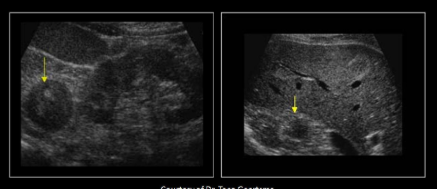
Adrenal adenoma
Adrenal cortical cancer
Neoplasm formation due to abnormal proliferation of cortical cells
Can get pretty large in size >6cm
Elevated androgen levels
Associated with hirsutism due to excessive androgen production
Most pts have Cushing syndrome b/c the tumor causes excess cortisol production
NO contrast washout on CT
USA Adrenal cortical cancer
Demonstrates complex appearance with hypoechoic solid components and cystic changes
Very aggressive and mets is common
Can invade renal vein and IVC
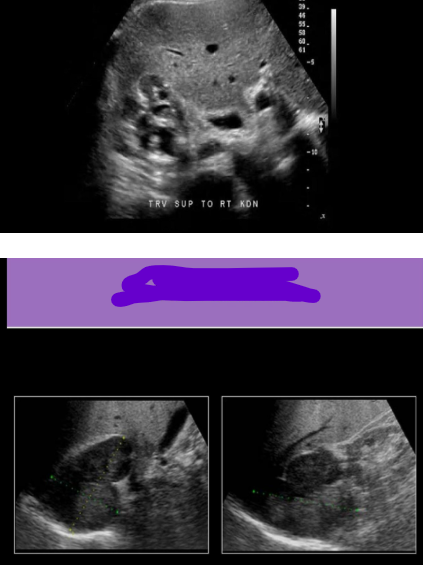
Adrenal cortical cancer
2nd most common abdominal tumor in pediatric pts
Neuroblastoma
Neuroblastoma
Malignant tumor of the medullar of the adrenal
Usually presents in younger children, <5yrs of age
Can also occur in the chest and neck area
Symptoms: tachycardia, night sweats, headaches
Requires surgical removal
Neuroblastoma Labs
Increased levels of norepinephrine, epinephrine and dopamine in the blood and urine
Neuroblastoma USA
Large echogenic, heterogeneous mass that does NOT distort renal contour, but can displace the kidney inferiorly
Eval kidney contour related to the mass to determine adrenal vs. renal origin
Use color to eval internal vascularity → will have color
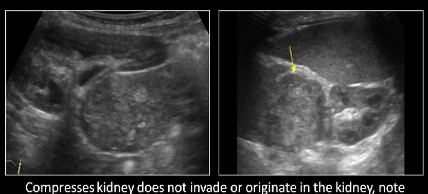
Neuroblastoma
Adrenal lymphoma
Adrenal glands are commonly affected by Non-Hodgkin lymphoma
Bilateral
Diffuse enlargement of the gland with varied echogenicity
Adrenal mets
Most common primaries are lung, breast, kidney and melanoma
Can be unilateral or bilateral
Demonstrate delayed contrast without on CT evaluate
Solid mass with heterogenous appearance
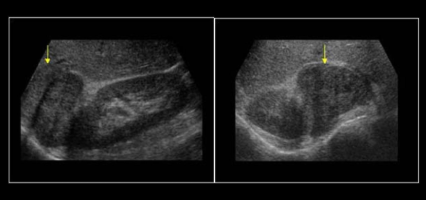
Adrenal mets
The right adrenal gland is ________ shaped
Triangle
Which of the following controls the function of the adrenal cortex?
Cortisol
Aldosterone
Adrenocorticotrophic hormone
Epinephrine
Adrenocorticotrophic hormone
__________ is responsible for fluid and electrolyte regulation, while ________ is responsible for metabolism regulation
Aldosterone; cortisol
Norepinephrine and epinephrine have what effect on the body?
Control heart rate and blood pressure
Aldosterone levels increase with:
Adrenal adenoma, adenocarcinoma and bilateral adrenal hyperplasia
Which of the following levels decreases with Addison disease or adrenal insufficiency
Cortisol
Norepinephrine
Testosterone
Epinephrine
Cortisol
What is monitored in pts with infertility or delayed/early puberty
Testosterone
What levels will be reduced in lab testing of a newborn with an isolated adrenal hemorrhage
Hematocrit
Which of the following is an adrenal mass composed of bony and fatty elements that result in propagation speed artifact
Myelolipoma
Pheochromocytoma
Lymphoma
Adenoma
Myelolipoma
What is caused by hypersecretion of ACTH that results in no change to cortisol production
Addison disease
What is caused by hypersecretion of ACTH by the pituitary gland which leads to the overproduction of cortisol
Cushing disease
Which of the following presents as hypernatremia and hypokalemia
Conn syndrome
Adrenal adenoma is part of what syndrome
MENS
A pheochromocytoma is part of what syndrome
VHL syndrome
Most pts with adrenal cortical cancer also have:
Cushing syndrome
What characteristic differentiates a renal mass from a neuroblastoma in an infarct
Renal contour