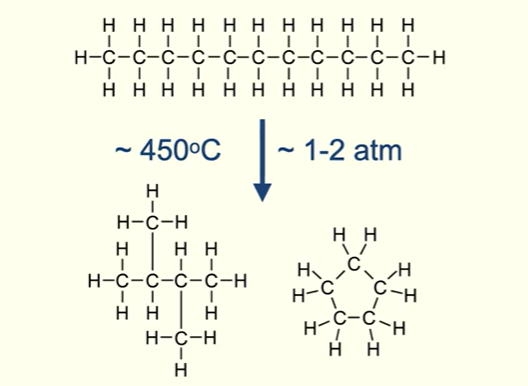
Thermal cracking and catalytic cracking of alkanes.
 Call Kai
 Learn
Learn Practice Test
 Spaced Repetition
 Match
Match Flashcards
 Knowt Play
1/5

Earn XP
Description and Tags
https://www.youtube.com/watch?v=Q3e-iB3QHFc
Name | Mastery | Learn | Test | Matching | Spaced | Call with Kai | Chat |
|---|
No analytics yet
Send a link to your students to track their progress
6 Terms
Whats a benefit of converting long chain hydrocarbons into shorter chain using cracking
Economical benefit , e.g for petrol / naphtha
Cracking also produces alkenes, they are reacting molecules , and are a major feedstock (raw material) for the chemical industry
What does thermal cracking require
Both a high temp (450 - 900 degrees) and pressure (70 atmospheres)
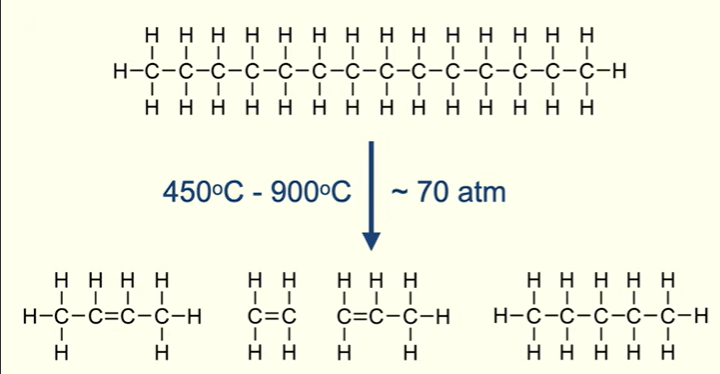
Whats a benefit of thermal cracking
We make a high percentage of alkenes in the products, alkenes are very useful molecules due to high reactivity
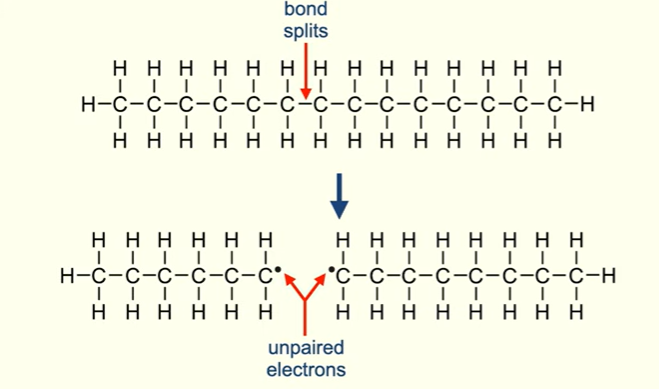
What happens during thermal cracking
A covalent bond between two carbon atoms splits to form intermediate molecules
When covalent bond splits, the intermediate molecules have one unpaired electron, these are called free radicals.
What does catalytic cracking require
A high temp (around 450 degrees), however does not require high pressure
Uses a zeolite catalyst, which contains a mixture of aluminium oxide and silicon dioxide.
Zeolite has a large surface area which helps to make it an effective catalyst.
What are products of catalytic cracking
Branched chain alkanes, they are especially useful for petrol, as they combust very easily
Catalytic cracking Can also produce cyclic alkanes and aromatic hydrocarbons such as benzene