✅️✅️1 - Introduction & Common Integument
 Call Kai
 Learn
Learn Practice Test
 Spaced Repetition
 Match
Match Flashcards
 Knowt Play
1/57

There's no tags or description
Looks like no tags are added yet.
Name | Mastery | Learn | Test | Matching | Spaced | Call with Kai | Chat |
|---|
No analytics yet
Send a link to your students to track their progress
58 Terms
anatomy
Study of the structure and shape of the body
systemic anatomy
Study of the structures that make up a body system.
body system
A group of structures that work together to perform a unique body function
topographic anatomy
The body is studied based on regions and the relations of the structures contained in that region
anatomical position
The position of the body with the four limbs touching the ground, the neck extended and the head oriented forward
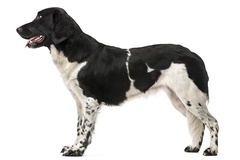
dorsal
_____ recumbency
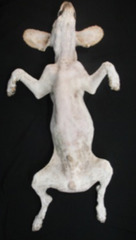
sternal/ventral
_____ recumbency

lateral
_____ recumbency

dorsal
-Refers to the "top" of the head, neck, trunk & tail
-Describes the "front" or "top" surface of the limb from the carpus or the tarsus distally (to the toes)

ventral
The "underside" of the head, neck, trunk and tail (toward the belly)

cranial
-Toward the head
-Describes "front" surface of limbs, proximal to the carpus and tarsus
caudal
-Toward the tail
-Describes "back" surface of limbs, proximal to the carpus and tarsus
dorsal
#1?

plantar
#2?

plantar
#3?

manus
[Manus/pes] is associated with the thoracic limb
pes
[Manus/pes] is associated with the pelvic limb
dorsal
#1?
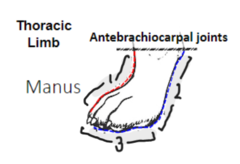
palmar
#2?

palmar
#3?

medial
Toward the middle line

right lateral
Toward the right side
left lateral
Toward the left side
proximal
Applied in limbs is the direction toward the body
distal
Applied in the limbs is the direction against the body
axial
Refers to the structures/surfaces that looks toward the axis
abaxial
The structures/surfaces that point to the opposite direction of the axis
axial
#2/#4?

abaxial
#1/#3?

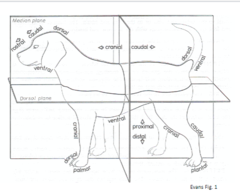
median plane
Divides the head, neck, trunk and the tail into equal right and left halves

sagittal plane
Passes through the head, neck, trunk, tail or limb parallel to the median plane
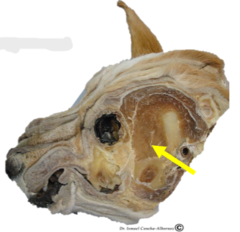
transverse plane
Transects the head, neck, body, or limb perpendicular to its own long axis
dorsal plane
-Runs at right angles to the median and transverse planes, dividing the body or head into dorsal and ventral portions, and the limbs into dorsal and palmar or plantar.
-Parallel to the dorsal surfaces of head, neck, trunk, manus or feet
sagittal plane
What type of section is indicated by the arrow?
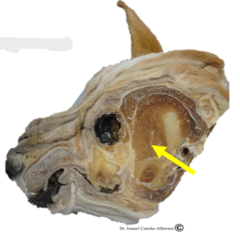
median plane
What type of section is indicated by the arrow?

rostral
Toward the nose, only used in the head region (red arrow)

caudal
Toward the tail (blue arrow)

internal
Within a body cavity (yellow arrow)

external
Outside a body cavity (blue arrow)

reviewed
Review
skin (cutis)
Includes cutaneous glands, hair, tactile hair, cornified portions of horns & antlers, cornified portions of claws & hoof
subcutaneous tissue (tela subcutanea)
Includes subcutaneous fascia and adipose tissue, subcutaneous muscles, nerves, superficial veins and arterioles
deep
-Toward the center of an organ, body cavity, or structure
-_____ to the deep fascia
superficial
-Away from the center of an organ or structure
-_____ to the deep fascia
deep fascia
What are the black arrows pointing to?

superficial fascia
- Loose CT connecting the dermis of the skin to deeper structures
- Contains cutaneous muscles, glands, fat, vessels, etc
deep fascia
-Stronger and denser layer of CT that more closely invests muscles or groups of muscles
-Very well developed in certain areas& important clinically
common integument
Skin (cutis) + subcutaneous tissue (tela subcutanea) = ?
sagittal
This is a _____ plane
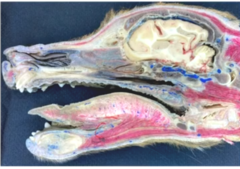
because the cut is right in the middle of the nasal septum, which divides the 2 nasal cavities)
How do we know this is a medial plane?

limbs
Most of the time, "proximal" is applied to what part of the body?
proximal
Closer to the trunk
distal
Further from the trunk
can not
We [can/can not] use "medial" and "lateral" when it comes to the digits.
90
The transverse plane is _____ degrees to the long axis of a structure
rostral
The nose is _____ to the eye
internal
The brain is _____ to the cranial cavity
external
The temporal muscle is _____ to the cranial cavity