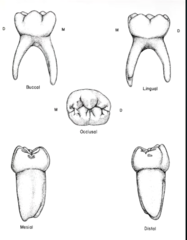
Dental Anatomy - Primary Dentition
 Call Kai
 Learn
Learn Practice Test
 Spaced Repetition
 Match
Match Flashcards
 Knowt Play
1/35

There's no tags or description
Looks like no tags are added yet.
Name | Mastery | Learn | Test | Matching | Spaced | Call with Kai | Chat |
|---|
No analytics yet
Send a link to your students to track their progress
36 Terms
primary dentition are also known as
deciduous dentition
Universal Notation
- alphabetic
- A-J (starting at maxillary right)
- K-T (starting at mandibular left)
- E and F, O and P are central incisors
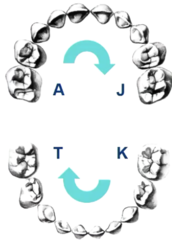
there are __ teeth in primary/deciduous dentition
20
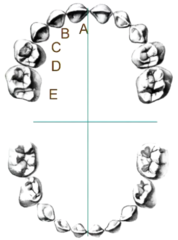
Palmer Notation
- A: central incisor
- B: lateral incisor
- C: canine
- D: first molar
- E: second molar
- bracket indicates quadrant
- maxillary right canine is upper right bracket and C
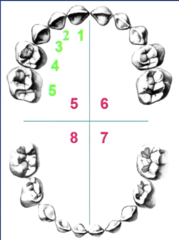
FDI Classification
First number (quadrant)
5- maxillary right
6- maxillary left
7- mandibular left
8- mandibular right
Second number (tooth)
1- central incisor
2- lateral incisor
3- canine
4- first molar
5- second molar
Dental Formula
- number and letter designation of the various types of teeth
- indicates dentition on only 1 side of the mouth but does include upper and lower quadrants so you multiply by 2 for the entire dentition
Dental Formula Example
- number pattern for primary and permanent human teeth
- I - incisor, C - canines P - premolars and M - molars
- Permanent Dentition (2 on top, 2 on bottom, etc)
I: 2/2 C: 1/1 P: 2/2 M: 3/3
- Primary Dentition
i: 2/2 c: 1/1 m: 2/2
Characteristics of Primary Teeth
- smaller in overall dimension than permanent teeth
- roots are longer and more slender than their crowns
- narrow cervical root necks on anterior teeth
- cervical ridge on anterior (La and Li) and posterior (Buccal)
- short and narrow root trunks on posteriors
- posterior roots flare considerably
- minimal or no root trunk
- more opaque and whiter than permanent teeth
the purpose of root flare on posteriors is to
creates additional space for the permanent premolar crown to develop
Characteristics cont
- pulp chamber proportionately larger than permanent tooth chambers
- pulp horns are higher and closer to the enamel than in permanent teeth
- root canals are narrower and finer than permanent teeth
- thin enamel and dentin (can cause cavities to occur quicker)
Eruption schedule
Central Incisors: 6 mo (Mand) 7.5 mo (Max)
Lateral Incisors: 7 mo (Mand), 9 mo (Max)
Canines: 16 mo (Mand), 19 mo (Max)
First Molars: 12 mo (Mand), 14 mo (Max)
Second Molars: 20 mo (Mand), 24 mo (Max)
Replacement of Deciduous Teeth
- permanent teeth positioned lingual or beneath predecessors
- resorption (osteoclastic activity) melts deciduous roots away for around a year or longer
- exfoliation (detachment) of deciduous crown
Active Eruption
- movement through mucous membrane of alveolar process
- completed when tooth contacts opposing dentition
Passive Eruption
continuous process of adaptation to changing conditions like tooth wear or loss
Primary Dentition Period
- when you only have deciduous teeth
- 6 mo to 6 years of age
Mixed Dentition Period
- deciduous and permanent teeth present
- 6 years to 12 years of age
Maxillary Central Incisors
- greater mesiodistal than cervicoincisal length
- no mamelons or grooves
- nearly straight incisal edge
- prominent labial and lingual cervical ridges
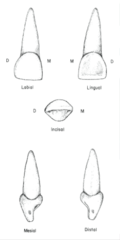
Maxillary Central Incisors roots
- twice the length of the crown
- tapers toward apex
- round cross section
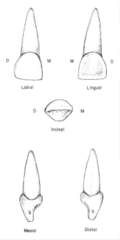
Maxillary Lateral Incisors
- similar crown to centrals but smaller in all dimensions
- greater cervicoincisal length compared with mesiodistal width
- deeper lingual fossa and more pronounced marginal ridges than central incisors
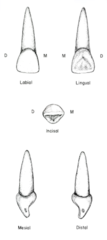
Maxillary Lateral Incisors roots
appear much longer in proportion to the crown compared to centrals
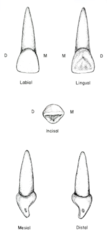
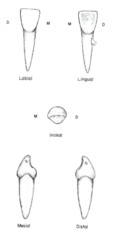
Mandibular Central Incisors
- straight incisal margin
- no mamelons
- M and D sides taper evenly
- marginal ridges less pronounced than primary max incisors
- wide labiolingual dimension
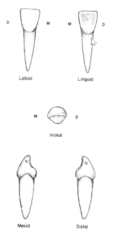
Mandibular Central Incisors roots
- 2-3x the crown height in length
- taper to pointed apex
- narrow and conical (cone shaped)
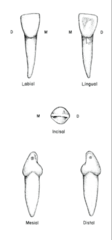
Mandibular Lateral Incisors
- wider, longer, more developed cingulum than centrals
- sloped incisal margin
- labiolingual dimension is equal to central incisors
- cingulum offset to the distal
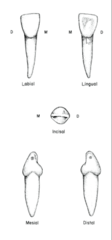
Mandibular Lateral Incisors roots
- distal longitudinal groove
- distal curvature
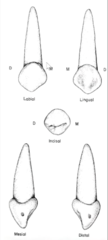
Maxillary Canines
- bulkier than primary incisor crowns in every aspect
- more cervically restricted in regard to mesiodistal width
- more convex on mesial and distal surfaces
- longer mesioincisal ridge
- well developed facial lobes with a sharp cusp
- ML and DL fossa
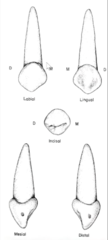
Maxillary Canines roots
- twice as long as the crowns
- more slender than perm max canines
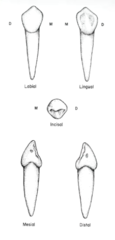
Mandibular Canines
- narrower labiolingually than maxillary canines
- similar incisocervical length
- longer distoincisal cusp ridge
- less prominent lingual features than maxillary canines
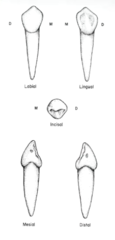
Mandibular Canines roots
- long, narrow, almost twice the crown length
- shorter and more tapered than maxillary canine roots
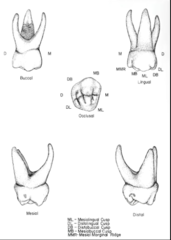
Maxillary First Molars
- different from other primary or permanent teeth
- wider buccolingually than mesiodistally
- two major cusps (MB and ML)
- distolingual cusp may be present (small and rounded)
- cervical line offset toward mesial
- transverse and oblique ridges
- central, mesial, distal triangular fossae
- prominent cervical ridge on buccal surface
- disto-occlusal groove
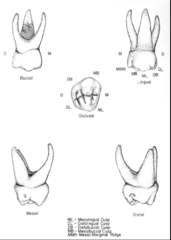
Maxillary First Molars roots
- 3 roots, lingual largest
- flare to accommodate developing permanent premolar
- very short root trunk
- roots are long, slender, widely divergent
Maxillary Second Molars
- shape similar to maxillary first permanent molar
- smaller than permanent maxillary first molars but larger than primary maxillary first molars
- 4 major cusps and 5th minor Cusp of Carabelli
- cervically narrow
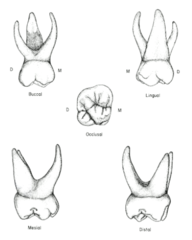
Maxillary Second Molars roots
- shorter root trunk than perm max molar
- longer roots than primary first molar
- 3 widely flared roots (lingual longest, distobuccal shortest)
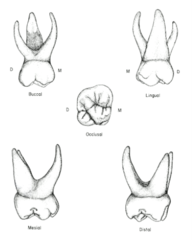
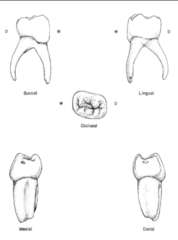
Mandibular First Molars
- crowns unlike any other primary or permanent tooth
- wider MD than BL
- 2 buccal cusps (M larger than D)
- 2 lingual cusps (M larger than D)
- bulbous curvature on buccal surface in cervical 3rd with narrow occlusal table
- central and mesial pits
- transverse ridge
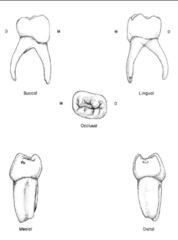
Mandibular First Molars roots
- 2 roots (M and D)
- mesial root is flat and broad with two root canals
- distal root has one root canal and is thinner and shorter
- apex is very blunt and almost flat
Mandibular Second Molars
- crown like permanent mandibular first molars but smaller
- less pentagonal shape
- MB, DB, D cusps more equal in size
- narrow BL dimension
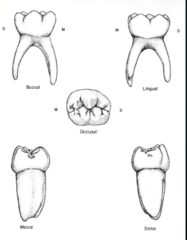
Mandibular Second Molars roots
- twice as long as the crowns
- slender, long, widely flaring
- M root longer than D