Molecular Biology Exam 1, Genes are DNA PT 1
 Call Kai
 Learn
Learn Practice Test
 Spaced Repetition
 Match
Match Flashcards
 Knowt Play
1/31

There's no tags or description
Looks like no tags are added yet.
Name | Mastery | Learn | Test | Matching | Spaced | Call with Kai | Chat |
|---|
No analytics yet
Send a link to your students to track their progress
32 Terms
Chromosomes
physical basis of inheritance
most of the genetic material found with in the nucleus (some in mitochondria)
genetic material divided into units of densely packed DNA
What are the levels of organization of chromosomes in smallest to largest
nucleosome<30 nm fiber<protein scaffold
nucleosome
negative DNA wrapped around a positive histone
DNA + protein (histone)
4 subunits of histone
200 bp of DNA can be spooled around a single histone
“molecular spools”
acetylation - reverses the + charge of the histone to release the DNA, so that the genetic code can be accessed

30 nm fiber
6 nucleosomes connected together
involves linker histones
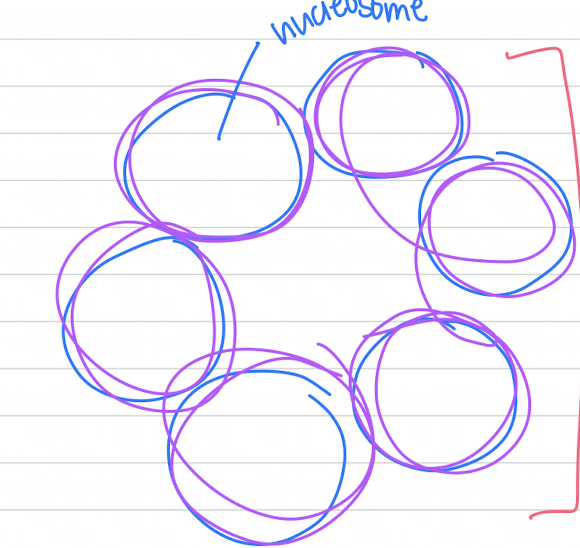
protein scaffold
30 nm fiber, centromere
solenoids that are further compacted

Why was it thought that protein was the most likely candidate for the transmission of traits (molecule of inheritance)
diversity of options due to 20 amino acid compounds (compared to the 4 nucleic acids)
Frederick Griffith
foundational study in discovering DNA as molecule of inheritance
studied Streptococcus pneumoniae, which infections are usually lethal in mice
observed that certain colonies were less virulent and that there were morphological differences as well (virulent = smooth, polysaccharide capsule) (nonvirulent = rough)
experimental design of Griffith’s experiment
step 1: inject virulent (S) into the mouse = death, inject nonvirulent strain = mouse survives
step 2: boiling of S strain + injecteion of heat killed S cells into mouse = mouse survive, boiling S strain + inject heat killed S cell + live R strain = death
In Griffiths experiments, why did the mouse injected with the heat killed S strain (virulent) + live R strain (nonvirulent) = death?
the cellular debris from the S strain was able to convert the R strain into the virulent form via transformation
the gene causing the protective polysaccharide capsule is transformed from the S strain to the R strain, causing the R stain to become indetectable by the mouses immune system, resulting in death
who did an experiment based on the info gathered in Griffiths experiment to determine the molecule of inheritance
Avery, Macleod, & McCarty
Avery, Macleod, & McCarty experimental design
RNase added to the heat killed sample → breakdown of RNA → injected into mouse → DEATH
protease added to heat killed sample → breakdown of proteins → inject into mouse → DEATH
DNA added to the head killed sample → breakdown of DNA → inject into mouse → SURVIVES
What two experiments strongly implicated that DNA was the molecule carrying genetic info
Griffith’s and Avery, Macleod, & McCarty’s
Hersey- Chase Experiment
bacteriophage and E. coli
the components of DNA were labeled with different biomarkers
phosphorous 32 P - found in DNA, and not proteins
sulfur 35 S - found in proteins but not DNA
two separate cultures of E coli were infected and then agitated to cause dissociation of phage and bacteria
In 32 P labeled phages → most of the radioactivity was associated with the bacterial cell fraction (DNA entered the host cell = DNA was the molecule of inheritance )
In 35 S labeled phages → most of the radioactivity associated with phage ghosts fraction (protein did not enter the host cell)
the “capstone” experiment that proved DNA as the molecular of inheritance
what three key properties were assumed for DNA
DNA must allow for successful replication of the genetic material at every cell division (“high fidelity”, structure allows for fateful replication)
DNA must encode all the information needed for the assembly of proteins by an organism (proteins)
DNA must be able to change (mutations must be possible)
*also, structure must be relatively stable as so that organisms can rely on its ended information
what information was already known prior to Watson and Crick’s discovery of the double helix
building blocks (4 nucleotides)
chargarff’s base composition rules
x-ray diffraction data (double helix)
what are the 3 chemical components of DNA
Phosphate, deoxyribose (sugar), nitrogenous base (adenine, guanine, cytosine, thymine)
phosphate → allows linkage
purine nucleotides
adenine, guanine; double ring structures
pyrimidine nucleotides
cytosine, thymine, uracil (RNA only); single ring structures
what are the purines matched to the pyrminidines
A - T (or U)
G - C
DNA has a — at the 2’ position
H
what are regions with many A-Ts called?
the TATA box, which is found at the start of the genome and origin of replicaiton. A-T forms 2 Hydrogen bonds, meaning it is more easily accessed than G-C, which has 3 hydrogen bonds.
chargaff’s rules of base composition
the total number of pyrimidine nucleotides (T+C) always equals that total number of purine nucleotides (A+G)
Amount of T= amount of A; amount of C= amount of G)
Rosalind Franklin, X-ray diffration
diffraction pattern showed regular, repeating features consistent w'/ a helix = helped to establish dimension of the DNA (diameter and spacing between bases
showed that there were 10 base pairs per turn
the distance between bases was 3.4 A
helical structure allows phosphate backbone to face outwards and protect the bases and H-bonding within
DNA structure
Watson & Crick → composed of two side by side chains of nucleotides; bases project to the center and pair
two strands twist into the shape of a double helix; sugar phosphate backbone forms the sides of the helix
DNA is typically right handed double helix
in the analogy of DNA resembling a spiral staircase, think of the hydrogen bonds as “steps”
sugar phosphate backbone: sides and rail
base pair: steps
H-bond - connections holding the steps together
periodicity
each base pair is twisted from the previous one by 36 degrees
takes 10 bp to go completely around the helix
info taken from rosalind frankling diffraction research
major groove and minor groover
the two distinctive sizes of grooves that are not equal in size
major groove contains most DNA-protein interactions (for replication, transcription) (does not require opening and closing of sections of DNA when scanning for correct activation sites)
minor = 12 A
major = 22 A
12 + 22 = 34 A (length of one turn in DNA)
major and minor grooves present a chemical code for protein binding
major and minor grooves expose different chemical groups of DNA bases
pattern provide a chemical code that proteins recognize by interacting with the chemical groups
major groove each bp present a characteristic pattern of:
A = hydrogen bond acceptor
D = hydrogen bond donor
M = nonpolar methyl group
H = nonpolar hydrogen

nucleotide
phosphate, sugar, and nitrogenous base; the building block of nucleic acids

where do phosphates and new growth attach to on a nucleotide
at 3’
which DNA groove gives enough info for proteins to read the DNA sequence, without having to open up the two separate strands. why?
major; the pattern of hydrogen bonds and methyl groups allow proteins to recognize specific regions of DNA
DNA backbone
alternating phosphate and deoxyribose sugar units;(sugar phosphate backbone)
phosphosiester linkage connects the 5’ carbon of one deoxyribose to the 3’ carbon of another deoxyribose
said to 5’ to 3’ polarity (key, since DNA strands are synthesized in a 5’ to 3’ direction
phosphate backbones run in an antiparallel direction → adds stability to DNA molecule
which type of pairing between bases is most stable
C-G ; requires higher temp. to separate two strand of DNA