TCP Week 7 (Environmental Emergencies)
 Call Kai
 Learn
Learn Practice Test
 Spaced Repetition
 Match
Match Flashcards
 Knowt Play
1/75

There's no tags or description
Looks like no tags are added yet.
Name | Mastery | Learn | Test | Matching | Spaced | Call with Kai | Chat |
|---|
No analytics yet
Send a link to your students to track their progress
76 Terms
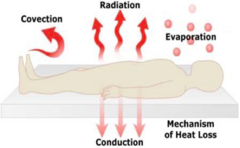
mechanisms of heat loss picture
convection is air blowing off heat
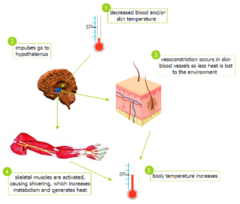
mechanism of heat production/conservation
1. decreased blood and/or skin temp
2. impulses go to hypothalamus
3. vasoconstriction in skin blood cessels so less heat is lost to the environment
4. skeletal muscles are activated, causing shivering, which increases metabolism and generates heat
5. body temp increases
locations - core body temperature
- rectal
- bladder
- esophageal
hypothermia definition
core body temperature is less than 35 degrees Celsius (95 degrees Fahrenheit)
mild hypothermia temp
32-35°C (89.6-95°F)
moderate hypothermia temp
28-32°C (82.4-89.6°F)
severe hypothermia temp
< 28°C (< 82.4°F)
predisposing/risk factors for hypothermia:
- BGL?
- nutrition?
- alcohol?
- pituitary patho?
- DM?
- burns?
- Drug O.D.?
- aging?
- other?
- Hypoglycemia: decreased heat production
- Malnutrition: decreased heat production
- Alcohol abuse causes increase peripheral vasodilation --> increased heat loss
- Hypopituitarism: decreased BMR, decreased heat production
- DM impairs vasoconstriction --> increased heat loss
- Burns: increased heat loss via evaporation and radiation
- Drug overdose: impairs vasoconstriction increased heat loss
- Extreme age: decreased shivering, unable to produce heat
- Parkinson's disease
s/sx of mild hypothermia
- Shivering
- Ataxia
- Lethargy
- Dysarthria
- Pale, cold, numb skin early
- Increased BP, RR and PR
- Clouded sensorium/poor judgement
s/sx of moderate-severe hypothermia
- NO shivering
- Weak and or irregular pulse
- Slow shallow breathing
- Absent DTR's
- progressive decline in LOC
- Mild incoordination, confusion, lethargy, coma
effects of moderate-severe hypothermia on cardiac system
- Sinus bradycardia
- Slow atrial fibrillation, ventricular fibrillation, asystole
the heart is extremely irritable by rough handling or endotracheal intubation, so use caution
effects of moderate-severe hypothermia on EKG
- prolonged P wave and QRS intervals
- increased risk of V. fib or asystole
- T wave inversion
- Muscle tremor artifacts: fine baseline artifacts
- Osborne wave (J wave)
evaluation of hypothermia
- Identify the precipitant or risk factor(s)
- Thorough medical history
- Thorough physical examination
- Laboratory studies to evaluate for underlying disease
- ECG
- ABG
- Gentle handling to prevent arrhythmias
treatment of hypothermia
- Support the patient: ABC's
- Rewarm (but slowly!!)
why is it that rapid rewarming may be hazardous?
because hypothermic patients are particularly vulnerable to lethal cardiac arrhythmias
passive/external treatment for hypothermia
- move to heated shelter
- remove wet clothing
- layer with dry clothing and blankets
active/external treatment for hypothermia
- heated blankets
- warm packs
approx. ~105.8 F
active/internal treatment for hypothermia
- Large bore IV
- Heated IV fluids
- Heated, humidified oxygen
- Warm lavage of the bladder or stomach
- Peritoneal dialysis
- Open cardiac massage
severe hypothermia may appear clinically ________ yet...
may appear dead and yet respond to vigorous rewarming and resuscitation
therefore, a hypothermic patient should not be considered dead until all reasonable resuscitative measures have failed.
rewarmed to 36 degrees Celsius (96.8 degrees Fahrenheit); "no one is dead until they're warm and dead".
first degree frostbite
- Partial skin freezing
- Numbness, erythema, edema
- No blisters
- No tissue loss
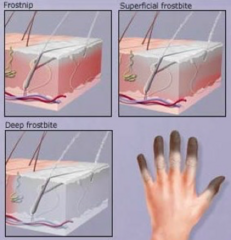
second degree frostbite
- Edema, erythema and blister formation within 6-12 hours, blister fluid is clear
- Numbness
- No tissue loss

third degree frostbite
- Freezing with death of skin, hemorrhagic blisters
- Skin necrosis
- Blue-gray discoloration
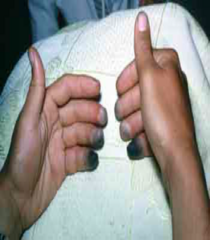
fourth degree frostbite
- Freezing with full-thickness damage, with muscle, tendon and bone freezing
- Ultimate loss of body parts
- Eventually dry, black mummified

what comes first when treating frostbite?
treat hypothermia first; THEN thaw
thawing of frostbite
- remove wet clothing and apply dry clothing
- apply constant warmth, by exerting gentle pressure with a warm hand without rubbing
- separate digits
- elevate/protect from trauma
- no smoking
- gentle ROM
- rapid rewarming significantly decreases tissue necrosis --> immersion of the affected body part in 40-42 degrees Celsius water for 20-30 minutes or until flush
- parenteral opioid analgesics (i.e. morphine)
rapid rewarming is NOT ok with _______ but ok with _______?
do not rapidly rewarm with hypothermia
CAN use rapid rewarming with frostbite
post thaw of frostbite treatment
- rubbing a frostbitten extremity is a contraindication
- avoid refreezing
- debride clear blisters
- leave hemorrhagic blisters intact
- dress injured area and blisters with aloe vera cream
- tetanus immunization prophylaxis
- Ibuprofen 12 mg/kg per PO, divided doses
- IV fluids
- Antibiotics
- Begin daily hydrotherapy
- Surgery only if infection
hyperthermia
heat illness resulting in an imbalance between heating and cooling
predisposing factors to hyperthermia (elderly)
- poor physical condition
- possible cardiac pathology
predisposing factors to hyperthermia (young)
- decreased sweating
- increased metabolic rate
predisposing factors to hyperthermia (drugs)
- diuretics lead to depletion of Na+, K+, H20
- cocaine, hyperactivity
predisposing factors to hyperthermia (hazards)
hazards = firefighters
predisposing factors to hyperthermia (chronic dz)
- hyperthyroidism
- malnutrition
pathophysiology of heat edema
cutaneous vasodilatation and orthostatic pooling of interstitial fluid in gravity dependent edema
s/sx of heat edema
- Mild
- Pedal edema: elderly, lengthy sitting, non-acclimated.
- Temperature: normal
- BP: normal
- CNS: normal
- Sweat: +
- Heart rate: Normal
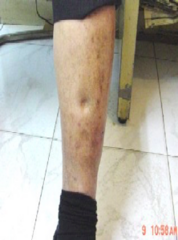
treatment of heat edema
- Elevate feet
- No diuretics (risk of electrolyte and water loss)
- Excellent outcome
pathophysiology of heat cramps
Sweat sodium losses may be replaced with hypotonic fluid resulting in whole body sodium deficit
excessive sweating → loss of sodium and water → replacing lost fluid with hypotonic fluids (pt drinks plain water) → sodium is not adequately replaced, becomes diluted → decreased extracellular sodium contributes to muscle cramps
s/sx of heat cramps
- Mild
- Painful muscle contractions
- Thirst
- Temperature: Normal or elevated
- Blood Pressure: Normal
- CNS: Normal
- Sweat: +
- Heart Rate: Tachycardia
treatment for heat cramps
- Move to a cool environment
- Rest
- Resolves after sodium balance is reestablished
heat exhaustion pathophysiology
- metabolic heat produced by muscles during activity outpaces body heat transfer to environment
- core temperature rises to levels that may disrupt organ function
s/sx of heat exhaustion
- syncope, N/V, confusion, decreased muscle coordination
- Temperature: Normal or up to 104F, 40C
- Blood Pressure: Orthostatic changes
- CNS: Usually normal
- Sweat: +, profuse
- Heart Rate: tachycardia
treatment for heat exhaustion
- Cool environment
- Rest
- IV saline
- Leg elevation
- Application of ice water soaked towels to the head, trunk, extremities
- Outcome: typically very good
pathophysiology of heat stroke
- Failure of thermoregulation.
- Internal organ tissue temperatures rise above critical levels .
- Children >> adults (higher metabolism)
s/sx of heat stroke
- Mental status changes; confusion, irritability, coma, seizures, ataxia
- Hyperventilation
- Temperature: > 104-105F (40-41C)
- Blood Pressure: normal
- CNS: Usually abnormal
- Sweat: (+) young and active; (-) elderly
- Heart Rate: Irregular
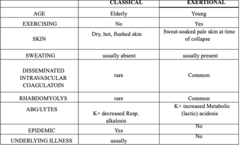
classical vs exertional heat stroke chart (know well)
treatment for heat stroke
- Immediate cooling to 38 C, (100.4 F)
- Fluid and electrolyte replacement
- Admit to ICU
- Poor Prognosis with delayed treatment (>2 hours) after onset
compare: heat stroke vs heat exhaustion

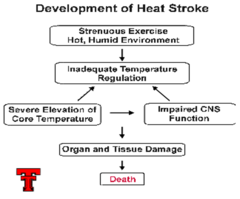
development of heat stroke
prickly heat
acute inflammation of the sweat ducts caused by blockage of the sweat pores by macerated stratum corneum
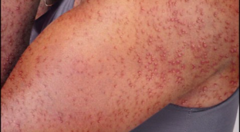
clinical features of prickly heat
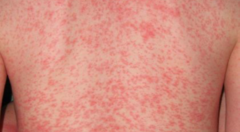
pruritic, maculopapular, erythematous rash over the normally clothed areas of the body

treatment of prickly heat
- Wearing clean, light and loose fitting clothing
- Avoid sweat-generation situations
- Use of talc or baby powder is of no benefit
lightning (power)
- A single lightning bolt can release between 200 megajoules and 7 gigajoules of energy.
- This energy is enough to power a small town for a day
lightning (voltage)
- The voltage of a typical lightning flash is around 300 million volts.
- Some lightning bolts can reach up to 1 billion volts.
lightning (temperature)
- Lightning can heat the air it passes through to 50,000 degrees Fahrenheit (about 27,760 degrees Celsius).
- This is five times hotter than the surface of the sun.
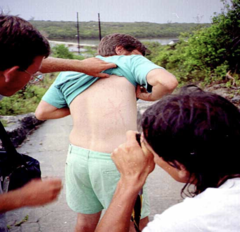
"flashover phenomenon"
lightning often travels over the surface of the body called flashover and is less likely to cause internal cardiac injury or muscle necrosis
wet skin may decrease the risk of internal injury, helping the current travel along the outside of the body; this may explain how victims may survive exposure to tremendous amounts of electrical current
as the current passes over the skin, it vaporizes the moisture on the skin and may destroy clothing in an explosive manner and produced unusual skin burns
lightning burn (linear)
1st and 2nd degree burns
areas with heavy sweat
hand & neck with branching to chest and legs
lightning burn (punctuate)
full thickness circular burn with starburst pattern
lightning burn (feather)
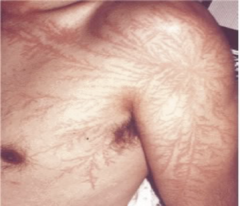
caused by electrical current spread along the skin where resistance is low
the "burn" is a result of cutaneous imprints
from electron showers that track the skin and develop a fern like pattern with branches.
lightning burn (thermal)
2nd and 3rd degree burns from clothing and heated metal objects.
lightning strike management
- ABC
- ECG, cardiac isoenzymes, urinalysis, BUN and Creatinine, serum electrolyte
- Baseline hearing and vision
- IV Fluid replacement
- CAT scan r/o intracranial trauma
- Suspect hypothermia with thunderstorms
- tetanus immunization prophylaxis
- hospitalization
Hymenoptera Stings
local
-Swelling, erythema
-more extensive may have edema
-Risk varies with location: bronchospasm, laryngeal edema
-hypotension may occur with anaphylaxis

Hymenoptera Stings
toxic
multiple stings (>50)
-erythema, fever, HA, drowsiness, edema, involuntary muscle spasm, edema
-Risk varies with location: bronchospasm, laryngeal edema

Hymenoptera Stings - Management
-ABC (esp. with oral-facial swelling)
-Remove stinger, scrape instead of pinch/pull
-Ice, analgesics, antihistamine (i.e. diphenhydramine)
-Systemic reactions: epinephrine, IV fluid
-Corticosteroid
-Tetanus immunization prophylaxis
-Hospitalize patients with cardiovascular or respiratory comprise
Which is the Most Aggressive Wasp?
Yellow Jacket >> Cicada Killer

bed bugs
feed on blood in each stage of life (ew)

bed bugs clinical features
-Bites are typically painless
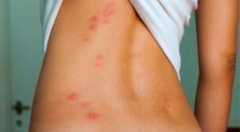
-Erythematous papules, bullae and wheals may develop
-Liner bite patter on skin is well described with bed bugs and brown or black patterns of excrement may be found on bed linen.
bed bugs treatement
Cold compresses, topical steroids, and antihistamine to relieve associated pruritus.
Symptoms following a bite: treat as previously outlined for Hymenoptera envenomation
Get rid of clutter, vacuum home, clean all fabrics, lightly spray insecticide onto all areas bed bugs are present, steam fabric and furniture, properly caulk all cracks and crevices will prevent bed bugs from finding their way back in the home.
Black Widow Spider - Pathophysiology of Envenomation
neurotoxic, causes depletion of acetylcholine from presynaptic terminal and end plate potentials at the neuromuscular junction, neurotoxin causes rigidity and spasms of most large muscle groups, especially the abdomen
Black Widow Spider - Clinical Presentation
initial? 15 min-1 hr? 2-12 hr?
Initially: "pinprick" sensation, fleabite appearance
15 minutes - 1 hour later: severe pain at the bite site, muscle spasm of the abdomen
2-12 hours later: CNS and PNS involvement, HA, diffuse paresthesia, muscle rigidity
• upper extremity bites: pain in chest
• lower extremity bites: pain in abdomen, may mimic pancreatitis, acute appendicitis
Black Widow Spider - Clinical Presentation
sx peak when?
Symptoms peak 2-3 hours after bite, last 24 hours-3 days, death is rare
Black Widow Spider - Management
-Generally symptomatic
-ABCs
-Symptoms usually reach max intensity in 1-3 hrs, can continue up to 48 hrs, low mortality rate
-IV calcium gluconate for alleviation of severe cramps associate with black widow spider bites
-Tetanus immunization prophylaxis
-Ice, wound care to bite site
Black Widow Spider - Management
high risk individuals
antivenom - one vial
test for horse serum sensitivity first, used if patient with black widow spider envenomation presents with abdominal pain, muscular cramping, irritability and hypertension
Brown Recluse Spider - Identification
Identified by a dark brown violin-shaped marking on its cephalothorax.
prefers warm, dry, untraveled areas (i.e. abandoned buildings, attics, closets, wood piles), fabrics (i.e. stored blankets, sheets and clothing) most bites occur in summer months, most bites occur at night (spider is nocturnal) or while dressing.
Identification:
-Brown to tan
-Both sexes equally dangerous
-Multiple bites suggest another cause
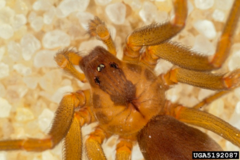
Brown Recluse Spider: Pathophysiology of envenomation
chiefly cytotoxic causing local tissue destruction and an intense inflammatory response
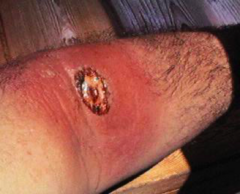
Brown Recluse Spider: Clinical Presentation
1-4 hours?
2-6 hours?
12-16 hours?
2-6 days?
Initially: +/- painful
1-4 hours later: Painful, red blisters at bite surrounded by pale ring, +/- red halo, Bull's eye lesion, Fever, chills, malaise, nausea
2-6 hours later: Serve burning pain, Pruritus
12-16 hours later: Wound site becomes vesiculated, Marked edema
2-6 days: Necrosis at bite site, Regional, lymphadenopathy , Shock
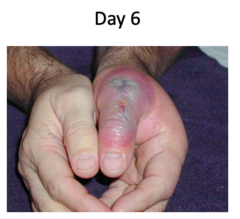
Brown Recluse Spider: Treatment
-Typical brown recluse spider bite self-limited and self-healing, without long-term consequences
-Pain resolves in about 1 week
-Lesions heal slowly
Treatment:
-Analgesia
-Close follow-up
-Antibiotics
-Ice, elevation
-Tetanus immunization prophylaxis
-Wound care