Water and carbon cycles
 Call Kai
 Learn
Learn Practice Test
 Spaced Repetition
 Match
Match Flashcards
 Knowt Play
1/101

There's no tags or description
Looks like no tags are added yet.
Name | Mastery | Learn | Test | Matching | Spaced | Call with Kai | Chat |
|---|
No analytics yet
Send a link to your students to track their progress
102 Terms
Importance of water
S:Drinking, leisure activities, cooking, cleaning
Ec: Industry, tourism, agriculture
Env: Rich source of wildlife, aquatic ecosystems, ensures health of rivers and wetlands
Importance of carbon
Absorbed by plants, consumed by animals, holds synthetic items together, found in everything, a building block for all living things
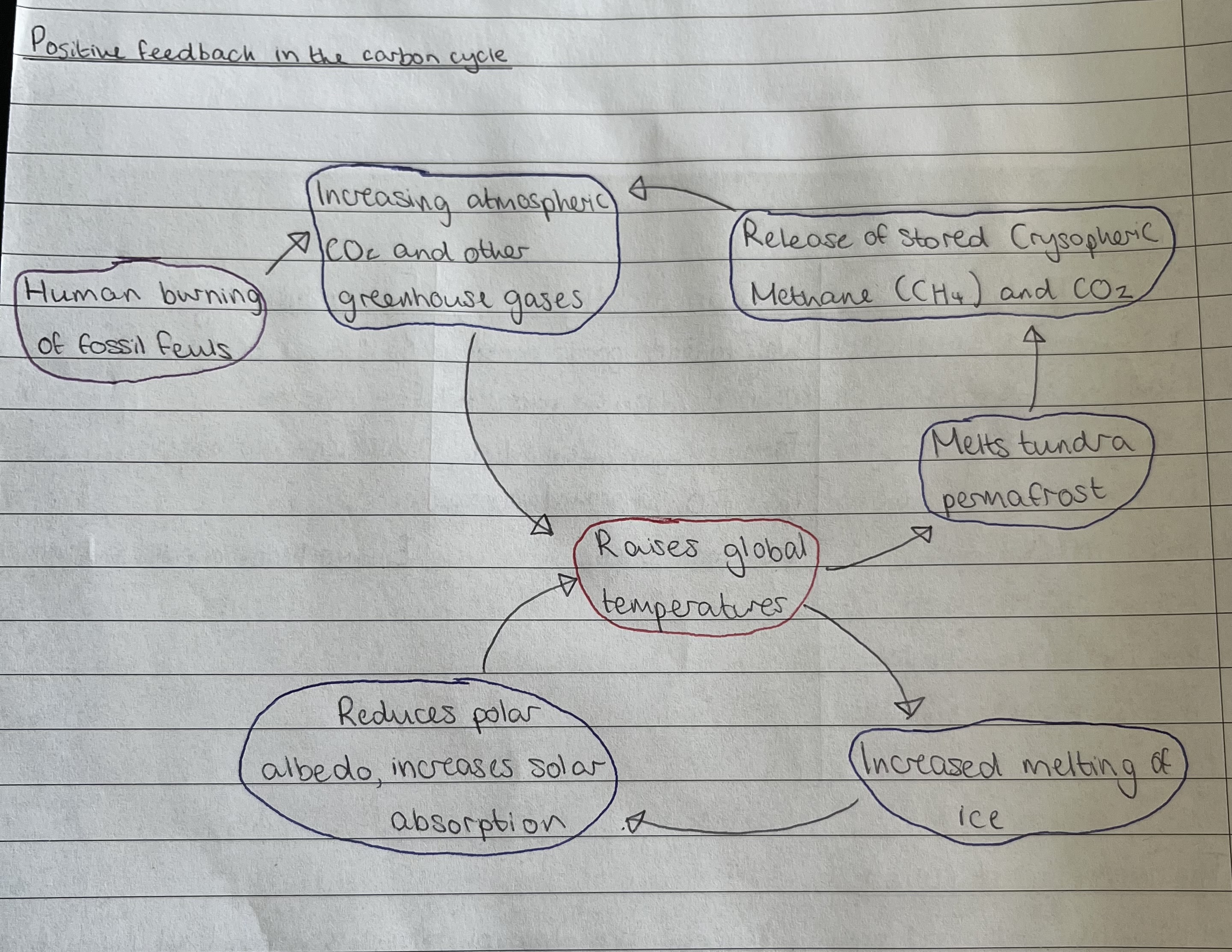
Positive feedback in the carbon cycle
.
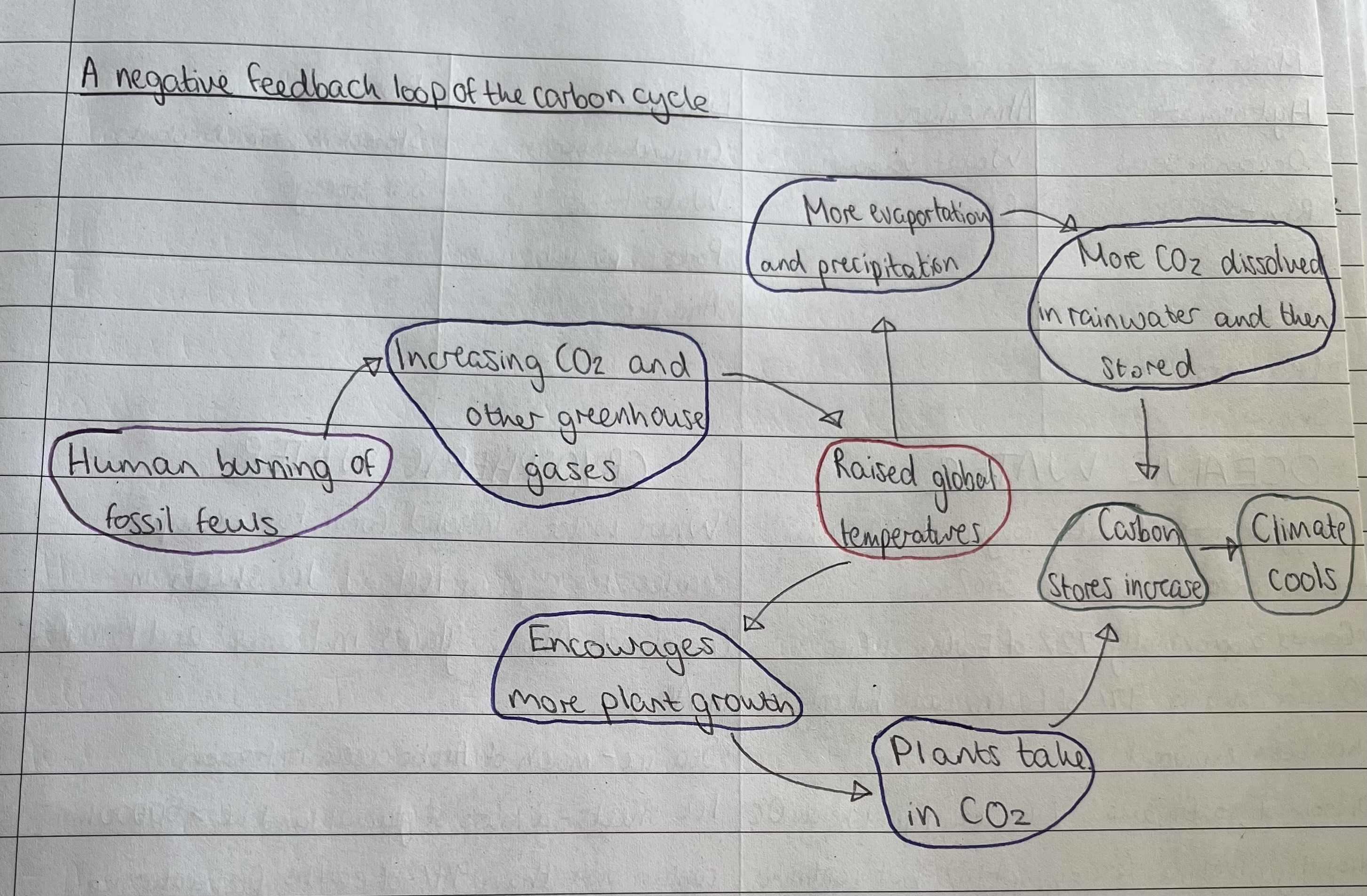
Negative feedback in the carbon cycle
.
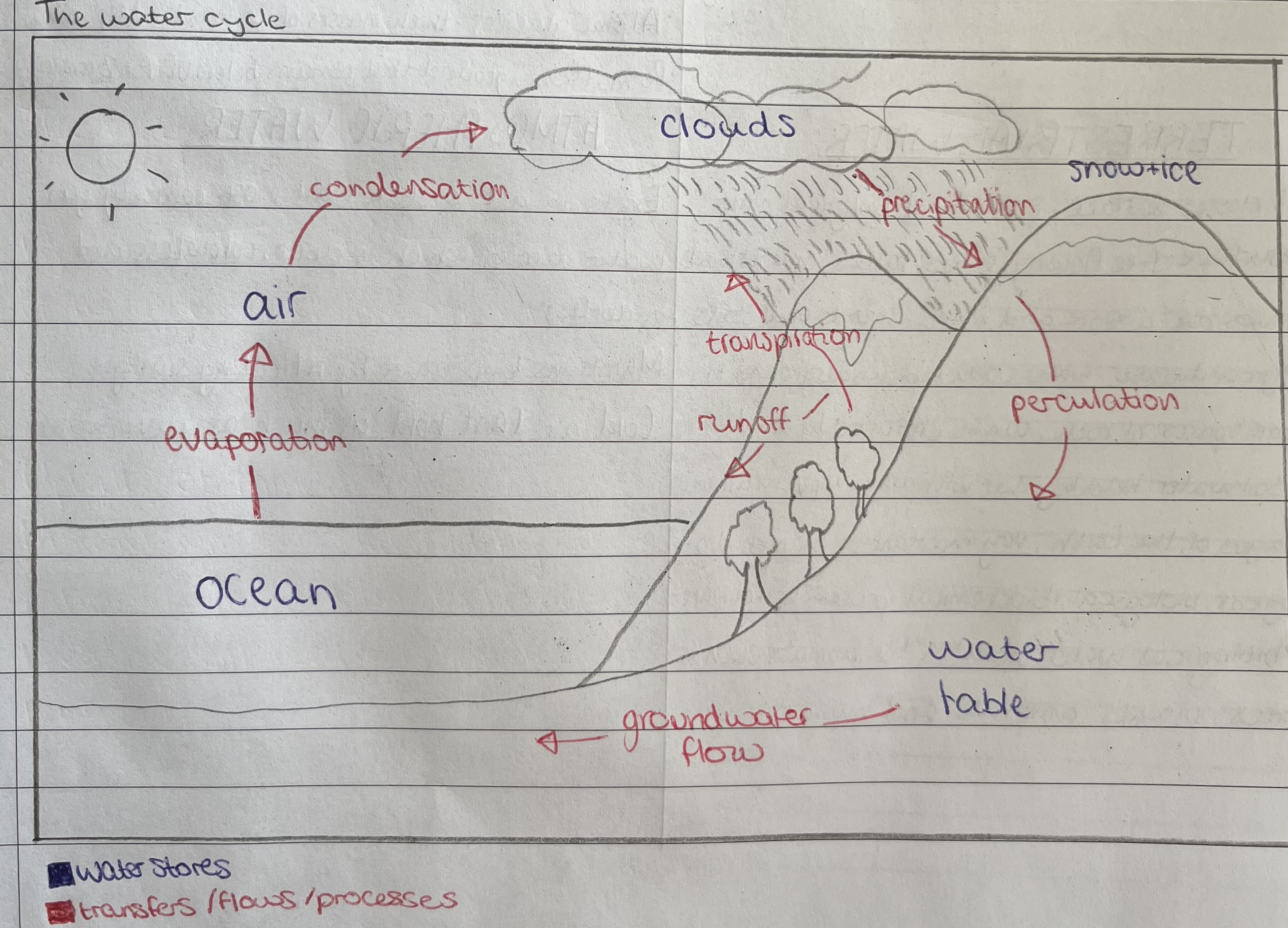
The water cycle
Major stores of earths water
Oceanic - 97% of earths water, only 5% explored
Cryosphere - water in solid form e.g. sea ice, ice sheets, ice caps, alpine glaciers, permafrost
Terrestrial - 4 classes: surface, groundwater, soil and biological
Atmospheric - exists in all 3 states but most commonly water vapour, relfelcts sunlight so maintains earths temperature, redistrubtes water around the globe and cleans air by precipitation
What % of water on earth is freshwater
3%, only 1% of this is easily accessible
Overland flow
Fast flow of water down slopes to the nearest channel
Infiltration
Water soaking into the ground, rate depends on soil porosity
Throughflow
Lateral movement of soil water downslope, eventually reaching the nearest channel
Perculation
Water moving vertically down the soil and saturated rock
Groundwater flow
Once water percolates, it is held in the pores of rocks as groundwater, passes slowly into rocks and can feed rivers in times of drought
Evaoporation
Energy from solar radiation hitting water causing it to change shape from a liquid to a gas - water vapour
Condensation
As air cools it holds less water vapour to access water converts to liquid, visible as clouds
Precipitation
Clouds become too heavy to hold the water so it releases it as rain, snow, hail or sleet
Transpiration
Loss of water from vegetation through stomata or surfaces
Interception
Temporary storage of precipitation on a natural or man made canopy
Stem flow
The portion of precipitation intercepted by the canopy that reaches the ground via stems or stalks
Drainage baisin
Area of land that is drained by the river
River source
Where the river starts, in upland areas
River mouth
Where the river ends and meets the sea
Watershed
Highest lying land that separates drainage baisins
Tributary
Small river leading to the main river
Distributary
Where the river splits into two separate channels
Confluence
Where two rivers meet
River channel
Area of land where river water flows
river discharge
volume of water which flows through the river at any given time
water balance
the balance between the inputs and outputs of a drainage basin
water balance equation
precipitation=discharge+evaporation+/-changes in storage
what does water balance vary depending on?
river regimes and soil moisture budget
river regimes
discharge levels in rivers rise and fall, often showing an annual pattern
soil moisture budget
how much water soil can absorb
soil moisture utilisation
water in soil being used up by plants and animals due to potential evapotranspiration exceeding precipitation, occurs in early summer
soil moisture recharge
water stores filling back up as precipitation increases, occurs in autumn
soil moisture surplus
water stores are full, soil is saturated due to precipitation exceeding potential evapotranspiration, leads to overland flow, occurs in winter
soil moisture deficit
lack of precipitation and high evapotranspiration means that water stores have dried out, plants wilt or have adaptations, occurs in late summer
Physical and human factors affecting discharge levels
Soil type, geology, climate, vegetation coverage, drainage density, basin area
Deforestation, urbanisation, farming, irrigation schemes, river management schemes, water abstraction schemes
Flood hydrograph
A graph that shows how a rivers discharge changes over a period of rainfall
Where and what is the Eden basin case study
Located in north west of England in Cumbria, very vulnerable to flooding due to steep topography and low lying confluences.
Physical and human factors that effect the Eden Basin
Higher rainfall than UK average, long and narrow shape, igneous rocks on west side all also contribute to flood risk.
Farming in the area reduces infiltration and vegetation, construction reduces infiltration and creates UHI effect, deforestation and climate change enhances risk
Flood event in the Eden Basin
December 2015, 203mm of rain in 48 hours, over 2000 properties were flooded
Why does carbon make the basis of all living matter?
It’s simple atomic structure enables it to to form bonds easily
What type of radiation enters the earths atmosphere?
Short wave radiation (UV)
Key stores of carbon in the lithosphere
Sedimentary rocks and fossil fuels
2 categories in the biosphere
Plants and soils
What is the slow carbon cycle
Millions of years of laying down of sedimentary rocks and ocean sediment, carbon gets slowly released from weathering, transportation and volcanic activity
What is the fast carbon cycle
Movement of carbon through food chains within a lifetime - photosynthesis can take minuets
difference between inorganic and organic carbon
inorganic is non-living, found it sedimentary rocks, gas and coal. organic is living and found in all forms of life
is the carbon cycle an open or closed system?
Closed
Lithosphere as a carbon store
99.9% of worlds carbon, found in sedimentary rocks and as fossil fuels, both organic and inorganic forms
Hydrosphere as a carbon store
Second largest store, 0.04% of worlds carbon, found in the surface layer of water and deep in the oceans
Cryosphere as a carbon store
Less than 0.001% of worlds carbon, mainly in permafrost (frozen soil)
Atmosphere as a carbon store
0.001% of worlds carbon, CO2 has vital role in regulating earths temperature, also found as methane and carbon monoxide
What is the natural and current amount of CO2 in the atmosphere?
Natural- 280ppm 2021- 400ppm
Biosphere as a carbon store
0.0004% of worlds carbon, stored in living organisms and vegetation, plant litter, soil humus and peat
Fluxes in the carbon cycle
Photosynthesis, respiration, decomposition, combustion, ocean uptake, ocean outgassing, ocean pumps, sequestrian, wildfires, volcanic activity
combustion of carbon
burning it in the presence of oxygen to release energy
decomposition
The break down of matter, often by a decomposer which releases carbon dioxide through their own respiration
outgassing
The release of dissolved carbon dioxide e.g. at plate boundaries or warming the oceans
photosynthesis
The process of converting carbon dioxide and water into glucose and oxygen
respiration
The process of converting glucose and oxygen into carbon dioxide and energy
sequestratian
The transfer of carbon from the atmosphere to other stores e.g. living biosphere, formation of inorganic rocks, etc.
Ocean outgassing
Water dissolves CO2, warm surface water is carried to polar regions making it dense enough to sink, when it returns to the surface and warms it looses CO2 to the atmosphere (vertical circulation)
3 natural changes in the carbon cycle
Wildfires release CO2 through combustion
Volcanic activity realises carbon during eruptions
Climate change melts the cryosphere and increases ocean out gassing and wildfires
Milankovitch cycles
Earths orbit around the sun
Earths tilt towards the sun
Earths wobble relitive to the sun
What is the eccentricity cycle?
96,000-100,000 year cycle of the distance between the earth and the sun changing
What is the precession cycle?
21,000 year cycle of Earth sometimes tilting towards/away from the sun
What is the obliquity cycle?
42,000 year cycle of changes in the spinning effect of the Earths daily rotation
what is anthropogenic forcing?
human influences to changes in the carbon cycle
what are the 4 anthropogenic forces?
burning fossil fuels, agriculture, deforestation, cement manufacturing
what impact does warmer temperatures have on the climate?
more photosynthesis → more CO2 absorbed → temp decrease
more decomposition/combustion/permafrost melting → more CO2 released → temp increase
what impact does colder temperatures have on the carbon cycle?
reduces transfer of carbon between stores because carbon is frozen in water stores as ice ad respiration/photosynthesis is reduced
explain how fossil fuel combustion has an impact of the carbon cycle
makes up 75% of human forcing, burning coal, oil and gas for energy required for domestic lives, workplaces, leisure and transport
Explain how cement manufacturing has an impact on the carbon cycle
5% of human emissions, released from warming calcium carbonate and burning fossil fuels to power process, for every 1000kg produced, 900kg of carbon is released
Explain how farming practises have an impact on the carbon cycle
When soil is ploughed, air mixes in increasing microbial activity (increasing decomposition), methane is produced from livestock during digestion (enteric fermentation)
Explain how deforestation has an impact on the carbon cycle
Logging to clear land for infrastructure or agriculture, some is natural, 13 million ha. of worlds forests cut down every year, reforestation reduces net loss of forests, biomass often burned and exposed land accelerates decomposition, soils get degraded leading to possible desertification and a negative impact on water cycle
Explain how urban growth has an impact on the carbon cycle
Over 50% live in urban areas, continuous growth, CO2 emitted from energy consumption and cement manufacture, vegetation cleared, reducing storage in biomass
What is carbon sequestration?
Capturing CO2 from the atmosphere and putting it into long-term storage, the two main types are geological and terrestrial/biological sequestration
What is geological sequestration?
Capturing CO2 at its source and injecting it in liquid form into underground stores such as salt formations and deep in the ocean where it can remain for thousands of years
What is terrestrial/biological Sequestration ?
Using plants to capture CO2 by using land management strategies to maximise carbon store in soil and plants e.g. by enriching ecosystems. However there is a risk of forest fires which instantly releases all carbon back into atmosphere
Impact of the changing carbon budget on the land
Warming tundra increases rate of decay, some farmland is replaced by trees which stores much more carbon, wildfires are extinguished, storing more CO2 in woody material
Impact of ocean acidification
pH of oceans surface has decreased by 30% since 1750, less carbonate ions for corals and plankton to make shells making them thinner and more fragile, acidification is linked to millions of oyster larvae dying, acidic water dissolves rocks releasing carbonate ions increasing oceans capacity to absorb CO2
What is the carbon budget?
Difference between the inputs and outputs of carbon in a sink
What is radiative forcing?
Forced temperature increase / enhanced greenhouse effect
Implications of permafrost melting
Permafrost in the northern hemisphere holds 1672 Gtc, if just 10% of this thaws it is predicted it will lead to a 0.7% temperature increase by 2100
examples of how climate change is affecting life on earth
global precipitation patterns are changing
more heatwaves and forest fires
more extreme weather events
agricultural productivity is compromised
sea levels are rising leading to flooding
more species are becoming extinct
what is the climate like in rainforests?
equatorial so warm and wet
rates of what are high in rainforests (6)
precipitation
evapotranspiration
nitrogen leeching and recycling
humidity
decomposition
biodiversity
importance of rainforests
provides 20% of worlds oxygen
used in cancer-fighting drugs
holds 50% of Earths plant and animal species
valuable food resources
major carbon sink that regulates the climate
how big is the amazon rainforest?
550sq/km
how does the amazon rainforest impact the water cycle?
high precipitation, evaporation, interception, transpiration
50% of rain is recycled
only 30% of rain reaches forest floor
how does the amazon rainforest impact the carbon cycle?
high photosynthesis, CO2 uptake, productivity, sequestration and decomposition
holds 80-110bn tonnes of carbon
local carbon mitigation strategies
reducing technology use, heating/air con, energy efficient lightbulbs, appliances, buildings, diet changes and reduced car usage
national carbon mitigation strategies
increased use of renewable energy, improved urban design, carbon capture and storage, improved aviation policies and biological sequestration
how has deforestation impacted the water cycle?
evapotranspiration and precipitation reduced
flood risk increased due to more surface runoff
river discharge reduced due to less precipitation
freshwater ecosystems are destroyed due to flash floods
soils loose bacteria and fungi to decay matter, become dry and baked as they are more exposed to the sun
pre-combustion capture
removing CO2 from fuels before it is burnt
post-combustion capture
removes CO2 from flue gas after the fuel has been burned
oxy-fuel combustion
burning fuel in pure oxygen instead of air, producing a flue gas that’s mainly COs and H2O which is easier to separate
what is the Paris agreement?
a legally binding global treaty on climate change, adopted in 2015, to limit global warming to well below 2°C, ideally 1.5°C, above pre-industrial levels
Approaches to mitigate deforestation in the Amazon rainforest
Environmental laws to ban excessive logging and control land use
Protection policies such as national parks
Selective logging
Re-planting the same species of tree lost