Extractions
 Call Kai
 Learn
Learn Practice Test
 Spaced Repetition
 Match
Match Flashcards
 Knowt Play
1/93

Earn XP
Description and Tags
Lectures 10 and 11
Name | Mastery | Learn | Test | Matching | Spaced | Call with Kai | Chat |
|---|
No analytics yet
Send a link to your students to track their progress
94 Terms
What is defined as an extraction not requiring a gingival incision (other than within the sulcus) or sectioning of the tooth?
simple extraction (closed, uncomplicated, or nonsurgical extraction)
What is defined as an extraction that requires a gingival incision, bone removal, and/or sectioning of the tooth?
surgical extraction (open or complicated extraction)
What is the process by which the periodontal ligamtn is fatigued or torn and alveolar bone is expanded to facilitate removal of the tooth from the alveolus?
elevation
What is the process by which the periodontal ligament is cut or severed to loosen teeth from the surrounding alveolar bone?
luxation
List indications for extractions.
severe periodontitis
pulp necrosis
tooth resorption
stomatitis
fractured teeth (adult, deciduous)
traumatic malocclusion
crowding
unerupted teeth
unhealthy teeth in jaw fracture line
failed endodontic treatment
List contraindications for extraction.
ethics (disarming procedures such as canine extraction on aggressive dogs)
severe systemic disease (CHF, uremia, uncontrolled endocrine disease, severe coagulopathies, untreated leukemia/lymphoma)
previous radiation therapy (leads to osteonecrosis, poor wound healing)
Endodontic therapy can be an alternative to extractions for which cases?
pulp necrosis
fractured adult teeth
traumatic malocclusion
What are the three fundamental steps for successful extraction?
adequate visualization of the tooth to be extracted
an unimpeded pathway for the removal of the tooth
use of controlled force to luxate or elevate and remove the tooth
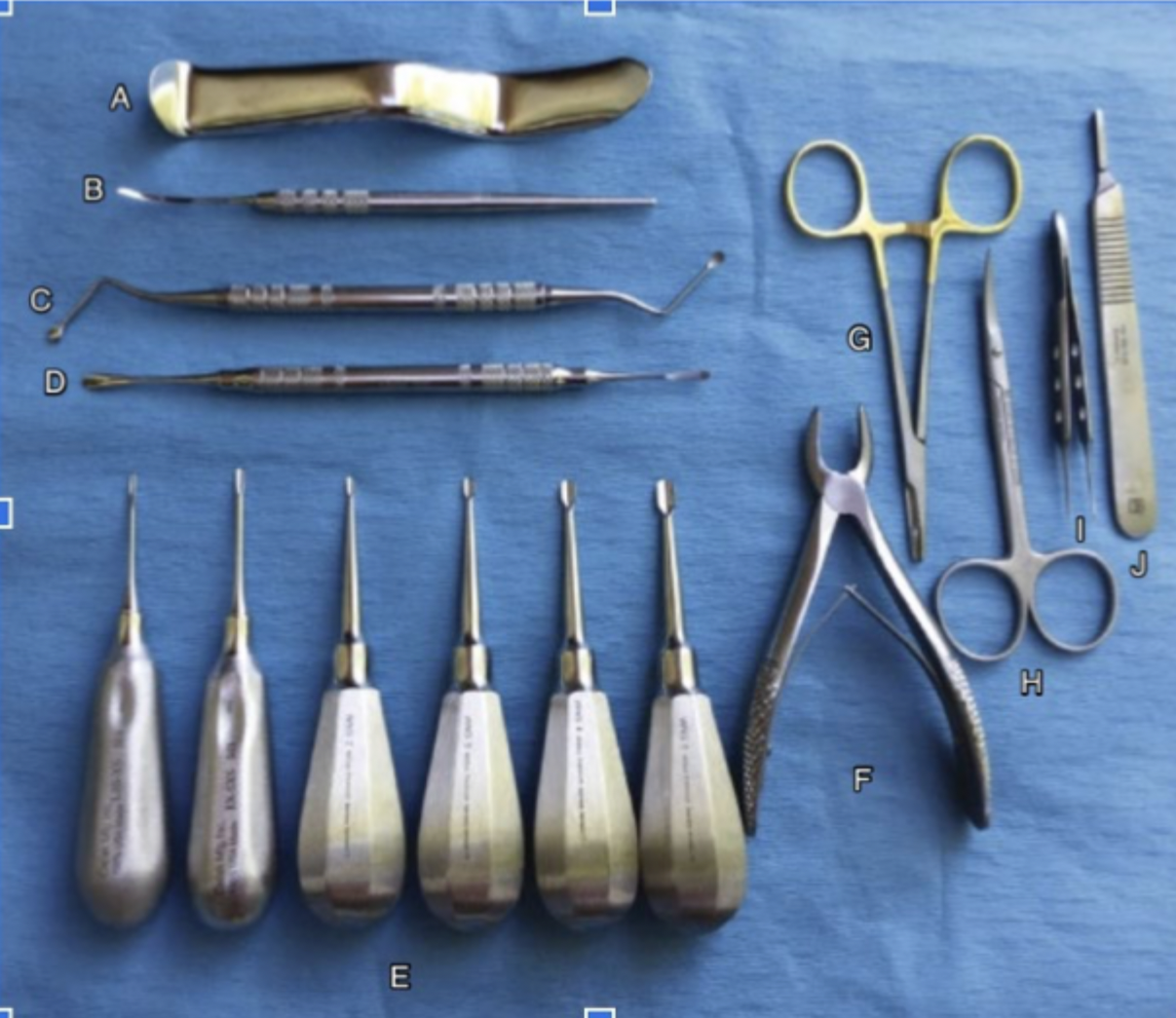
What is A?
Minnesota lip retractor

What is B?
Feline lip retractor

What is C?
Miller bone curette

What is D?
Periosteal elevator
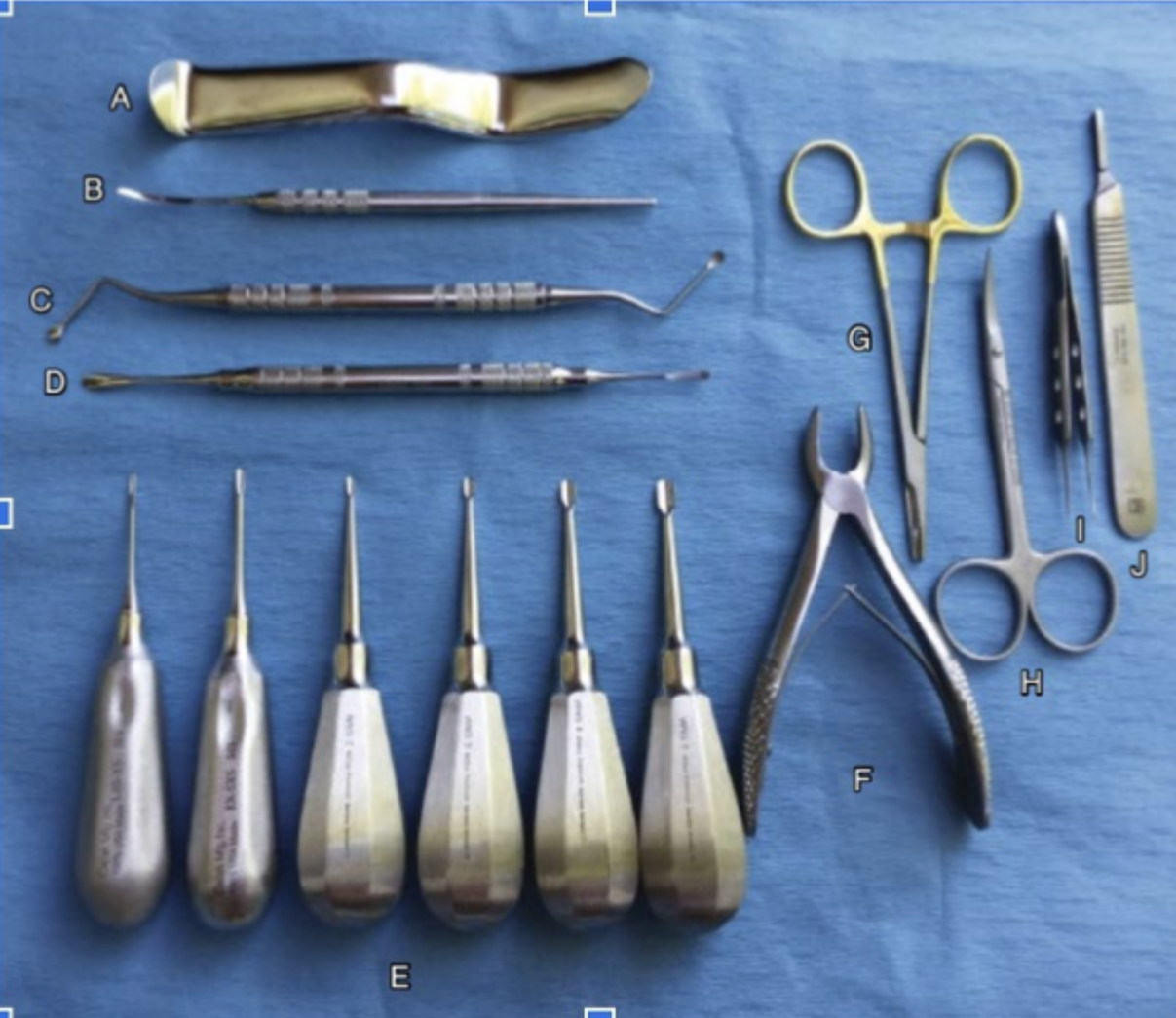
What is E?
straight and winged elevators
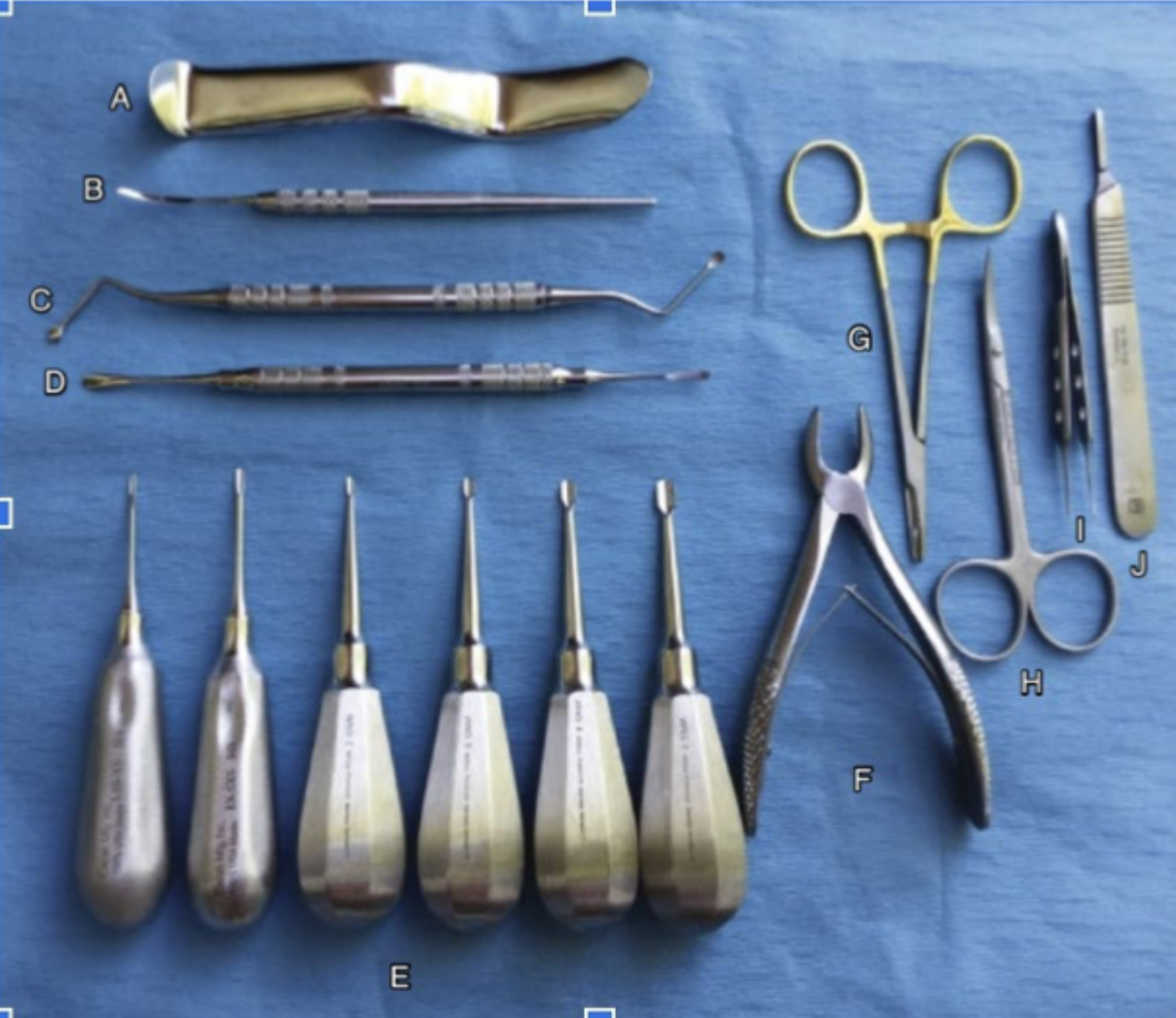
What is F?
Small breed extraction forceps

What is G?
Needle holders
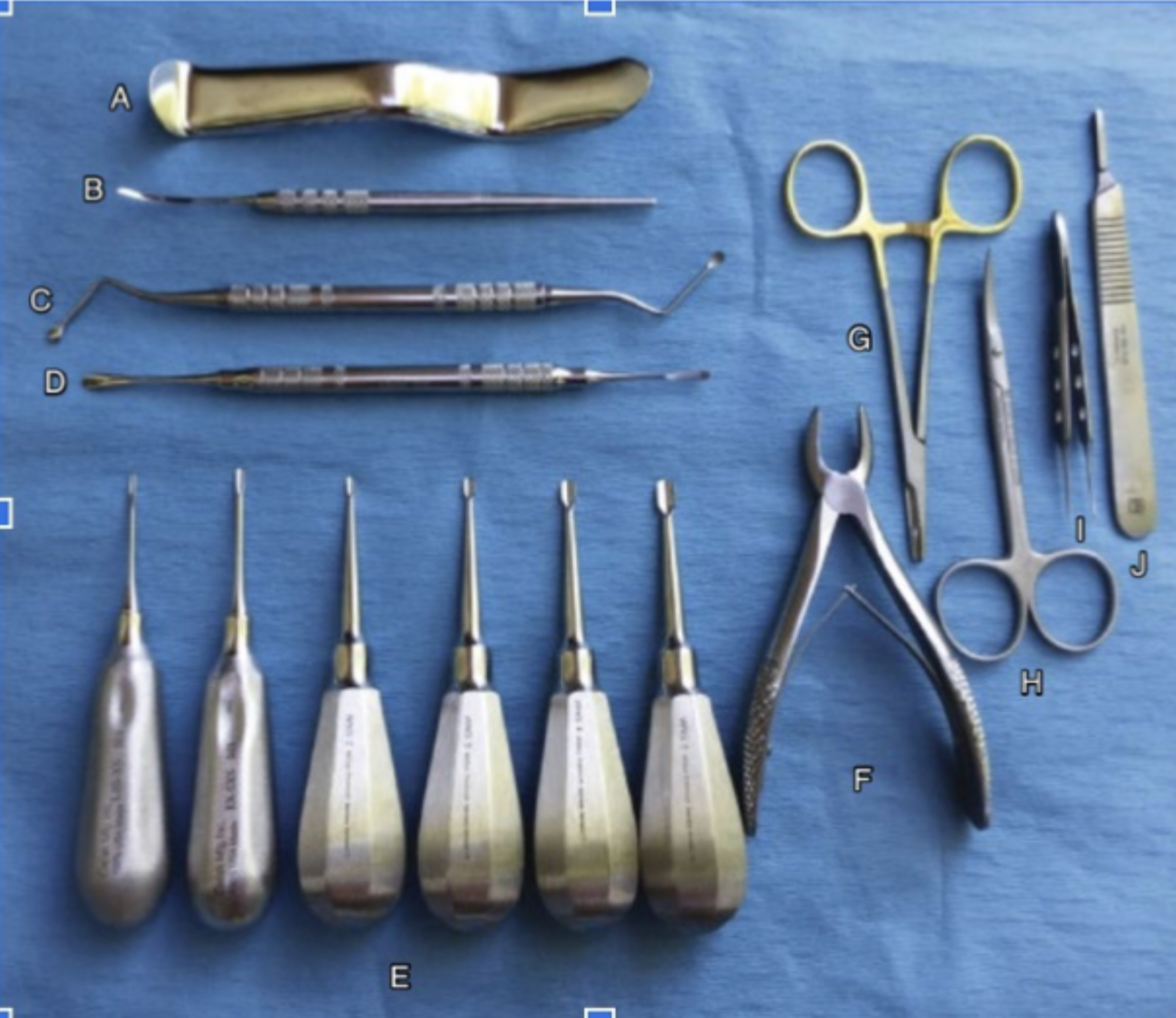
What is H?
Iris scissors
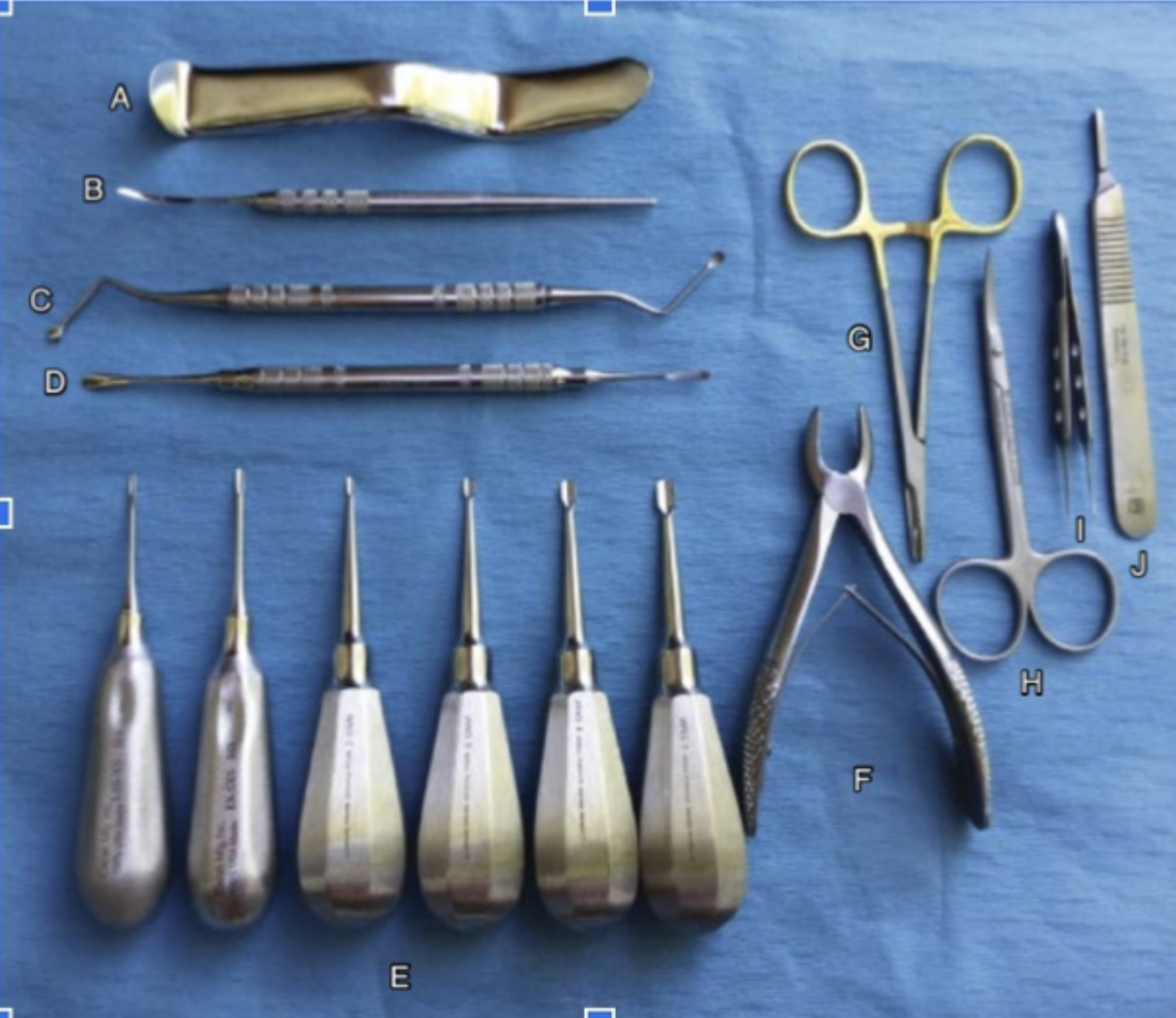
What is I?
thumb forceps
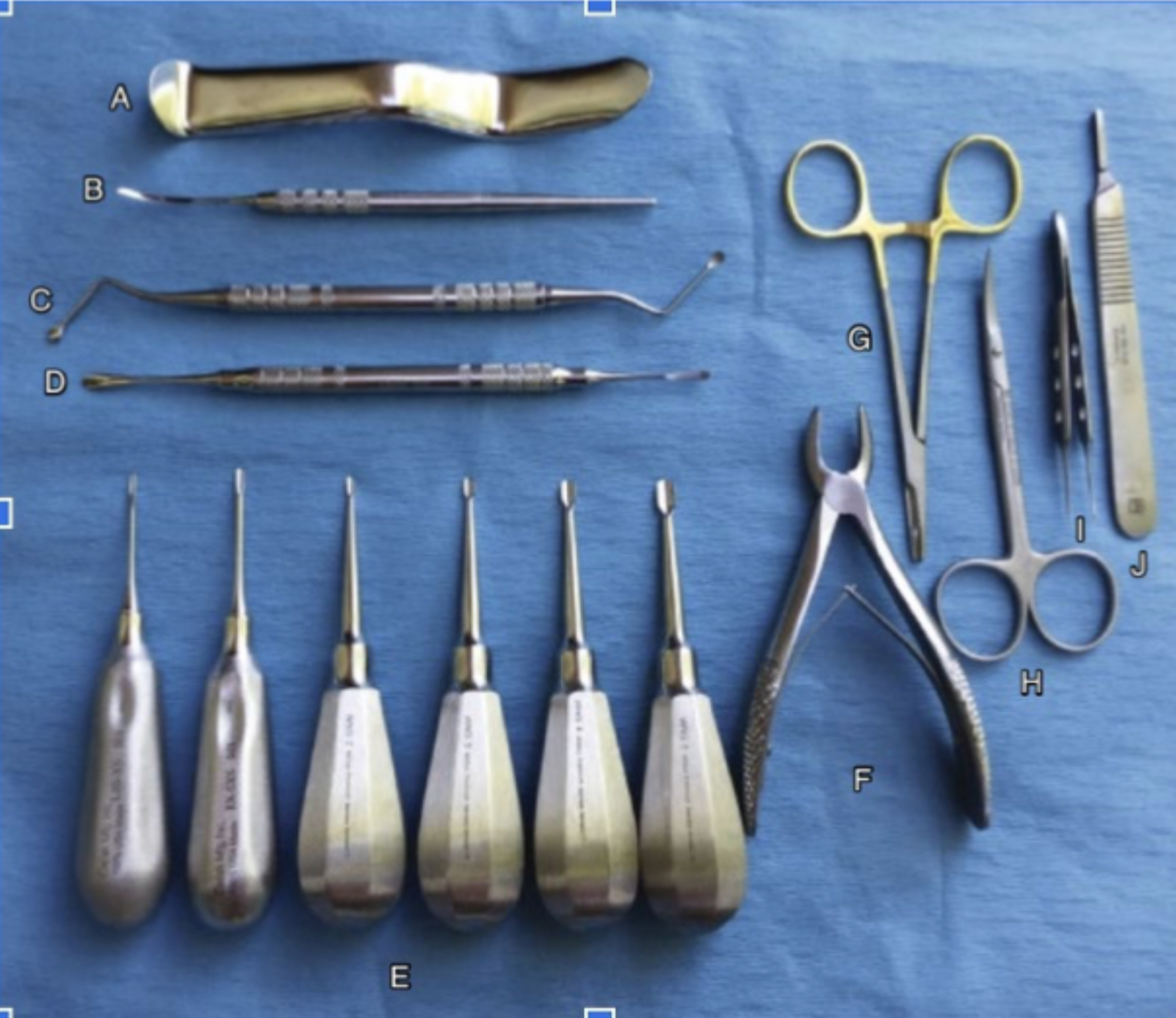
What is J?
scalpel blade handle
What size and type of suture should be used for extractions?
4-0 or 5-0 Monocryl
What is the difference between an elevator and a luxator?
an elevator has a semicircular shape for leveraging against the tooth to fatigue and tear the periodontal ligament fibers
a luxator has a flat blade designed to enter the periodontal space to cut the periodontal ligament fibers

What is A?
suction tip

What is B?
air-water syringe

What is C?
high speed handpiece

What is D?
low speed handpiece

What is E?
optional second high speed handpiece

What is F?
fiber-optic light
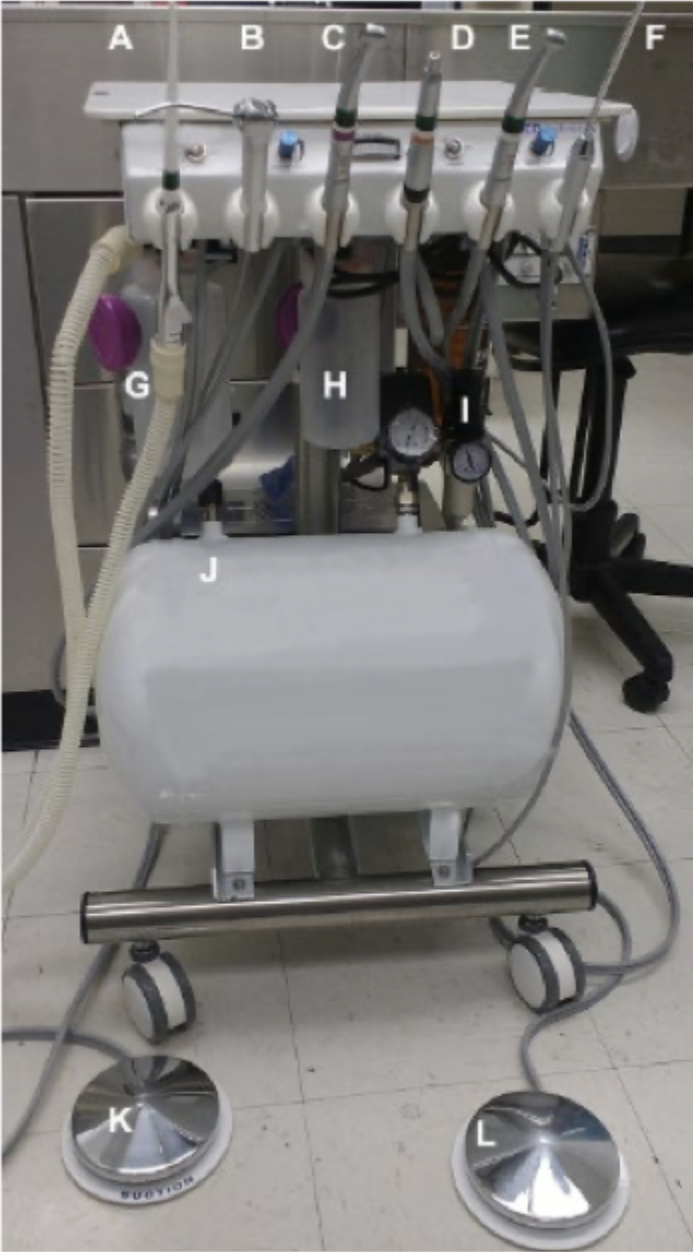
What is G?
suction bottle

What is H?
exhaust air bottle/filter

What is I?
pressure regulator

What is J?
compressor tank

What is K?
suction rheostat (foot pedal)

What is L?
rheostat (foot pedal)
What should you do is you get the bur stuck in gauze or other soft tissue?
remove the gauze/tissue and get a new bur other wise you will damage the turbine since it can onyl rotate in one direction

What type of high speed handpiece bur is this and what is it used for?
701 cross cut taper fissure
removes hard tissue quickly

What type of high speed handpiece bur is this and what is it used for?
#4 round bur
penetrate bone or tooth material

What type of high speed handpiece bur is this and what is it used for?
inverted cone
make an undercut

What type of high speed handpiece bur is this and what is it used for?
taper fissure
sectioning teeth

What type of high speed handpiece bur is this and what is it used for?
diamond bur
crown preparation procedures
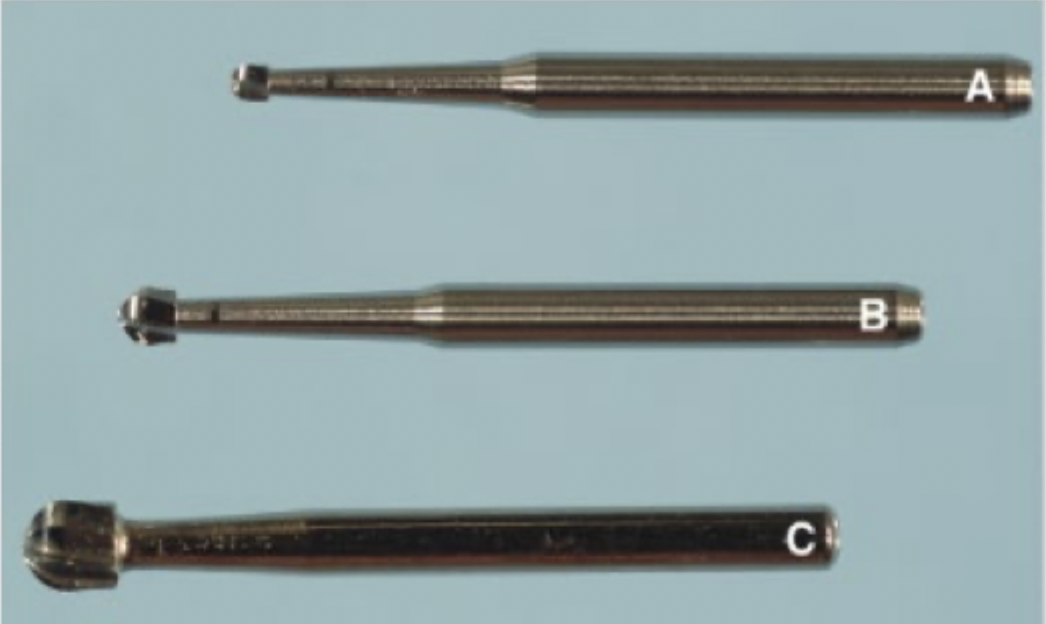
What type of high speed handpiece bur is this?
different size round burs (A = #2, B = #4, C = #8)
What are surgical principles for flap design?
good exposure = sufficient size
preserve blood supply
prevent dehiscience/delayed healing by making sure edges of the flap lie over intact bone
non-tension closure by making vertical releasing incisions at line angles of adjacent teeth

Is this the correct placement of releasing incisions for a flap design? If not, explain why.
Yes
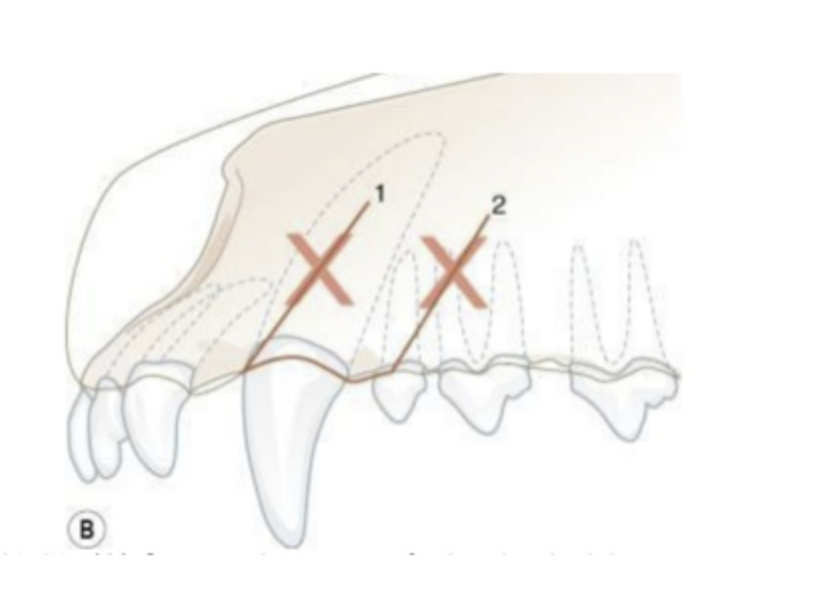
Is this the correct placement of releasing incisions for a flap design? If not, explain why.
No
lines cross area of boner removal, leaving incision over an empty space
crosses the attached gingiva directly over the buccal aspect of the adjacent tooth, which will likely result in gingival defect
What mechanical principle should be used with extraction forceps?
leverage —> twist once and pull down and out in a continuous movement
What angle should the suture needle pass through the gingiva or mucosa whe suturing the oral mucosa?
90 degree
What should be done during patient preparation for a dental with extractions?
preanesthetic evaluation including minimum database (CBC/Chem/UA ± ELISA testing)
intraoral dental radiographs PRIOR to extractions
plan for “water control” —> high speed handpiece cooled by water, control methods to prevent aspiration
ensure you have 0.05% cholhexidine rinse for oral cavity
PPE for team
What should be done DURING the dental but BEFORE the extractions?
remove calculus
What should be done DURING the dental and AFTER the extractions?
post extraction intraoral dental radiographs for accurate medical record documentation
Which patient position allows for easier drainge of fluids perioperatively but only allows for evaluation of one side at a time?
lateral recumbency
Which patient position allows for better visualization of all teeth and facilitates caudal maxillary extractions but poses more risk of fluid pooling?
dorsal recumbency
What should be included for post op care following a dental with extractions?
multimodal pain control (locoregional nerve blocks, NSAIDs, gabapentin, opioid)
homecare —> soft food for 5-7 days, avoid chew toys and treats for 7-10 days
ice packs
oral rinses
monitor for signs of halitosis, inappetence, lethargy
post op recheck 2 weeks later
A closed extraction technique applies to any single rooted tooth or tooth with fused roots, except?
canine teeth
How should we prepare for a closed/simple extraction?
remove calculus
rinse mouth with chlorhexidine gluconate
perform pre extraction radiographs
Do you need to close the gingiva when using a closed/simple extraction technique?
YES, you need to close the socket left behind using 4-0 or 5-0 monocryl in a simple interrupted pattern
Which teeth commonly require surgical/open extraction?
Maxillary PM4
Mandibular M1
Canine teeth
Maxillary ot mandibular PM not affected by advanced stage periodontal disease
Maxillary 3rd incisor not affected by advanced stage periodontal disease
List indications for open extraction of 2 rooted teeth.
fracture
periodontal disease
non vital tooth
List indications for open extraction of maxillary canine.
fracture
periodontal disease
oronasal fistula
non-vital tooth
List indications for open extraction of mandibular canine.
fracture
periodontal disease
non-vital tooth
What should you watch out for when performing open extraction of mandibular M1?
mandibular canal (jaw fracture risk)
What should you watch out for when performing open extraction of maxillary canine?
penetration into the nasal cavity
What bur should be used to remove alveolar bone across the root surface to expose the root and periodontal ligament when performing open extraction of maxillary canine?
diamond bur (coarse grit)
What tool should be used for a periosteal release during open extraction of the maxillary canine?
LaGrange scissors
What should you watch out for when performing open extraction of mandibular canine?
mandibular canal (jaw fracture risk)
Why should we NEVER remove bone on the lingual aspect of the mandibular canine?
will cause jaw fracture
List surgical principles of extraction.
create a mucogingival flap
remove alveolar bone to expose roots 2/3 apically
section multi-rooted teeth
gently elevate each section out of the alveolus
perform periosteal release
close mucogingival flap in simple interrupted suture using 4-0 or 5-0 monocryl
List indications for open extraction of maxillary PM4.
fracture
periodontal disease
non-vital tooth
When creating a flap for maxillary 4th PM extraction, how large should it be?
base of flap should be twice as large as the area you will be covering
What should you be mindful of when creating a flap for maxillary 4th PM tooth extraction?
location of parotid and zygomatic salivary ducts
List indications for a crown amputation in cats.
type 2 tooth resorption
where the root has been so resorbed that no PDL is present
List contraindications for crown amputation in cats.
type 1 tooth resorption
teeth with endodontic disease
Leaving root tooth fragments may be considered should patient be deemed high risk under what conditions?
if tooth <4mm
patient is unstable under anesthesia
high risk of damaging surrounding structures
List causes of fractured root tips.
too aggressive elevation (impatient)
insufficient buccal bone removal
ankylosed roots / hypercementosis / dilcerated roots
incomplete sectioning of multi rooted teeth
List ways to prevent fractured root tips.
judicious elevation (slow down and be patient)
remove enough bone especially if tooth is periodontially sound
radiograph prior to extractions to evaluate periodontal ligament space
List potential consequences of fractured root tips that are not removed.
pain
infection from pulp necrosis within the pulp of the retained root tip
higher risk in teeth affected by endodontic or periodontal disease
What should be done to confirm the location of fractured root tips, associated adjacent structures, and pathology with surrounding bone?
radiographs, multiple views!

What tool is this?
root tip pick
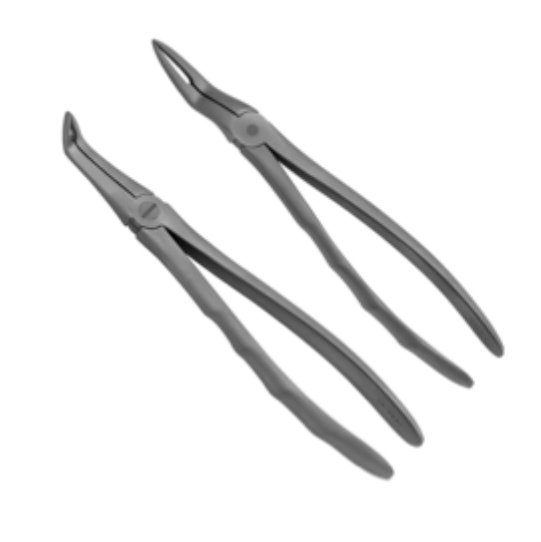
What tool is this?
root tip extraction forceps
Fractured roots can be accidentally displaced beyond the alveolus when attempting to remove them. List examples of these places they may displace to.
nasal cavity
maxillary recess (palatal to PM4 in dogs)
mandibular canal
retrobulbar space
List ways to prevent displaced fractured root tips.
remove enough alveolar bone and use cylindrical diamond bur to visualize the root tip
carefully elevate root tip without excessive apical force
don’t blindly elevate down in the apical alveolus
don’t attempt to pulverize the root tip with a high speed bur
What should you do if root tips displace into the nasal passages?
refer to dental specialist
What should you do if root tips displace into the mandibular canal?
carefully remove additional bone to be able to visualize root tip
be careful to avoid neurovascular bundle in the mandibular canal
can use suction with a red rubber catheter to attempt to retrieve the root tip
What should you do if the alveolar bone fractures?
remove loose bone fragments
smooth rough bony surfaces with a diamond bur
What teeth pose the highest risk for iatrogenic mandibular fracture?
mandibular canine tooth in dogs
1st mandibular molar tooth in small breed dogs
What may create higher risk for iatrogenic mandibular fracture?
mandibular canine tooth or 1st mandibular molar tooth
teeth diseases by periodontal or endodontic disease
What may occur with overzealous elevation and slippage of dental elevator into underlying vascular structures or trauma to vascular structures with high speed burs?
hemorrhage
What should you do if ligation of hemorrhage is not possible?
direct pressure with gauze spone
use clotting agents in alveolus
close alveolus with mucoperiosteal flap
What adjacent anatomic structures are at risk for iatrogenic trauma?
optic nerve
autonomic innervation to the eye
maxillary artery
maxillary branch of the trigeminal nerve
infraorbital nerve
penetration of the retrobulbar space and brain
adjacent teeth when using high speed burs and elevators
How can we treat flap dehiscence?
HIGHLY clinician dependent:
surgical repair ASAP
delayed surgical repair
allow to heal by second intention
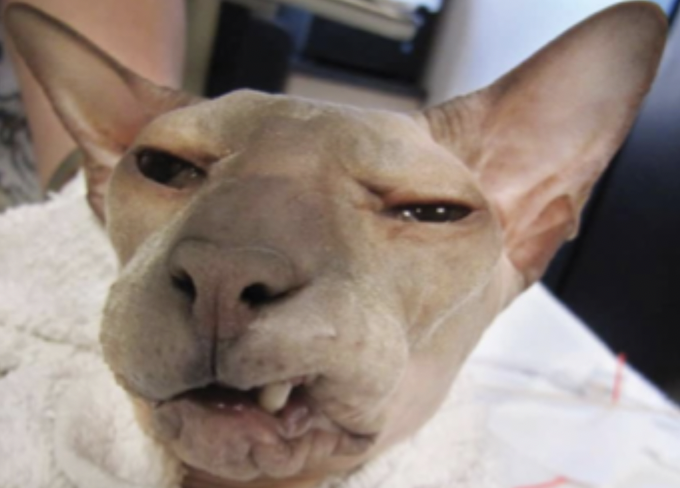
What is a potential complication of maxillary canine tooth extraction most commonly seen in cats when the mandibular canine tooth contacts the upper lip or rests on the outside of the upper lip and results in an ulcer?
lip entrapment
How can we prevent lip entrapment?
paying close attention to flap positioning and by not removing excess bone during extraction of the maxillary canine tooth
How can we treat lip entrapment that does not self correct?
coronal reduction and endodontic treatment or extraction of the mandibular canine tooth
How can we treat oronasal fistula associated with maxillary canine teeth?
repair with proper single layer mucoperiosteal flap sutured without tension
Should you use bone grafting material in oronasal fistula repair?
NO
What direction should your releasing incision be when creating a flap for oronasal fistula repair?
horizontal
List the proper steps to perform an open, surgical extraction of the maxillary 4th PM tooth.
create a triangle (3-corner) mucogingival flap
ensure preservation of structures exiting infraorbital canal mesially and the parotid salivary duct distally
remove buccal bone over distal root and mesiobuccal root with #2 round bur or diamond bur
outline mesial and distal borders of roots with a #1/2 or #1/4 round bur
section distal root from the two mesial roots using a crosscut fissure bur through furcation
make a V-notch to allow better access for elevator
carefully remove distal portion of the distal cusp with the crosscut fissure bit
be careful not to damage the adjacent maxillary 1st molar
allows elevation of the distal root without placing pressure on the adjacent maxillary 1st molar
elevate and extract distal root
section mesiobuccal root from mesiopalatal root using a crosscut fissure bur
elevate and retract the mesiobuccal root
remove intra-radicular bone over the mesiopalatal root with a #2 round bur
outline mesial and distal borders of root with a #1/2 or #1/4 round bur
elevate and extract the mesiopalatal root
prepare for flap closure and close