chem I chapter 2 atoms, molecules, and ions
 Call Kai
 Learn
Learn Practice Test
 Spaced Repetition
 Match
Match Flashcards
 Knowt Play
1/137

There's no tags or description
Looks like no tags are added yet.
Name | Mastery | Learn | Test | Matching | Spaced | Call with Kai | Chat |
|---|
No analytics yet
Send a link to your students to track their progress
138 Terms
Democritus
a greek philosopher that was the first person to think of an atoms existence, he believed that matter was composed of tiny indivisible particles called atoms
But he had no experimental evidence to support this.
Aristotle came up with the second theory of atoms:
•others believed that matter consisted of various combinations of the four “elements”—fire, earth, air, and water.
In 1807, English schoolteacher John Dalton proposed his
his atomic theory.
Dalton’s atomic theory can be summarized in five postulates: number 1
Matter is composed of exceedingly small particles called atoms. An atom is the smallest unit of an element that can participate in a chemical change
Dalton’s atomic theory can be summarized in five postulates.: 2
1)An element consists of only one type of atom, which has a mass that is characteristic of the element and is the same for all atoms of that element.
Dalton’s atomic theory can be summarized in five postulates.:3
3)Atoms of one element differ in properties from atoms of all other elements.
Dalton’s atomic theory can be summarized in five postulates.: 4
3)A compound consists of atoms of two or more elements combined in a small, whole-number ratio. In a given compound, the number of atoms of each of its elements are always present in the same ratio.
Dalton’s atomic theory can be summarized in five postulates.:
3)Atoms are neither created nor destroyed during a chemical change, but instead rearrange to yield a different type(s) of matter.
Dalton’s atomic theory provides a?
a microscopic explanation of the many macroscopic properties of matter that you’ve learned about.
If atoms are neither created nor destroyed during a chemical change, then the total mass of matter present when matter changes from one type to another will remain?
•constant aka (the law of conservation of matter).
Law of definite proportions or the law of constant composition:
•: All samples of a pure compound contain the same elements in the same proportion by mass.
•Illustrated by experiments performed by French chemist Joseph Proust.
•What are atoms composed of?
•Is there something smaller than an atom?
J.J. Thomson experimented with?
•cathode ray tubes.
•Cathode ray tube: what is that?
•A sealed glass tube from which almost all the air had been removed
•Contained two metal electrodes
with a high voltage was appllied to the electrodes in a cathode a visible beam called what appeared between them?
it was called a cathode ray
in the cathode ray no matter what metal was use the beams always deflected toward?
•toward the positive charge and away from the negative charge.
•Thompson was able to calculate the ___ of the cathode ray particles.
charge-to-mass ratio
The cathode ray particles were much lighter?
atoms
the particles in cathodes had what charge?
•negatively charged.
•These particles are indistinguishable, regardless of the source material.
This cathode ray particle is what we now call an?
•an electron—a negatively charged, subatomic particle with a mass more than one thousand times less than that of an atom.
thomas suggested that atoms resembled?
plum pudding (or a choco chip cookie), the raisins or chips are the particles in the atom
Robert A. Millikan’s did what experiment?
the oil drop experiment
Millikan created microscopic oil droplets, which were?
electrically charged.
the drops in the oil drop experiment were __ or _ by wan electric field
slowed or reversed
Millikan was able to determine the charge on
individual drops
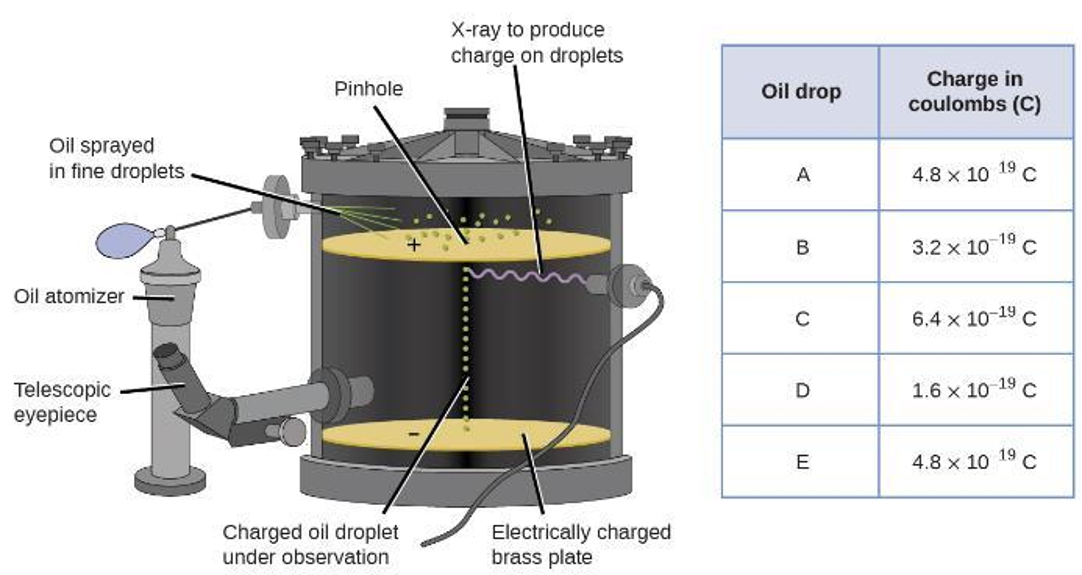
Millikan’s experiment measured the charge of individual oil drops. The tabulated data are examples of a few possible values look at the picture of it below:
oil drop experiment image
The charge of an oil drop was always a multiple of a specific charge:
•1.6 × 10⁻¹⁹ C, which is the charge of an electron.
Thompson already showed the charge to mass ratio of an electron to be
•1.759 × 10¹¹ C/kg, which allowed us to find the mass of an electron.
Ernest Rutherford’s did a experiment called?
Gold Foil Scattering experiment
what did ernest ruthfords gold foil scattering experiment essentialy do
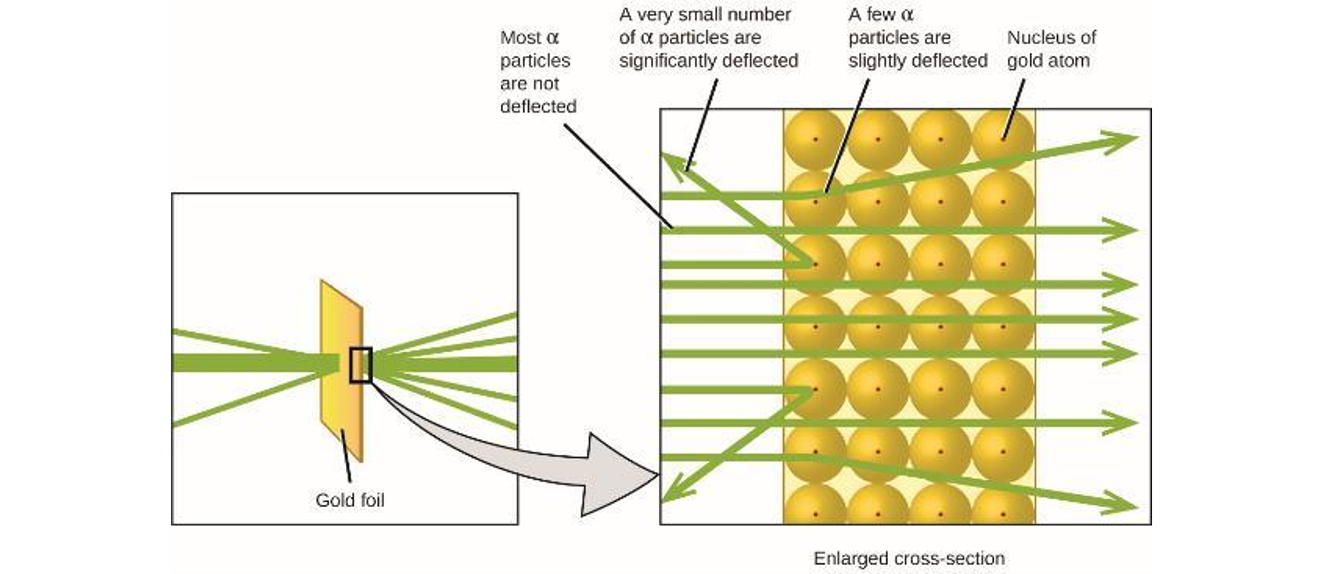
he Aimed a beam of positively charged alpha particles (α particles) at a very thin piece of gold foil. The scattering of these a particles was examined using a luminescent screen that would glow briefly when hit.
what did the gold foil experiment look like?

image of gold foil experiment
ernest ruthford concluded that because most of the alpha particles went through…
The atom is mostly empty space
ernest ruthford concluded that because a few particles were deflected at small angles..
The alpha particle came close to something small and positive (nucleus).
ernest ruthford concluded that because very rarely particles were deflected at large angles..
The alpha particles hit a small, very dense, and positively charged center (nucleus).
found that The nucleus contains most of the
ruthford found that it contains most of the mass
ruthford fund that - charged electrons surround the?
nucleus
ruthford found that the proton, a positively charged, subatomic particle is located in the
nucleus
gold experiment replacement for plum pudding model:
Neutrons:
•Uncharged, subatomic particles with a mass approximately the same as that of protons
•Discovered by James Chadwick in 1932.
•Neutrons are also found in the nucleus.
__and __ are much heavier than ___
protons and neutrons are heavier than electrons
what occupys almost all of an atoms volume?
electrons
•Small units are needed.
•Atomic mass unit (amu).
1 amu =
•1.6605 x 10⁻²⁴ g.
•Proton units
•Mass = 1.0073 amu
•Charge = +1
units for a Neutron
•Mass = 1.0087 amu (slightly heavier than a proton)
•Charge = 0
units for a Electron
•Mass = 0.00055 amu
•Charge = –1
what is the symbol for a proton?
p+
what is the charge of a proton?
+1
what is the relative mass of a proton?
1
what is the sumbol and charge for a neutron?
n and 0
what is the relative mass of a neutron
1
what is the symbol and charge of a electron
e- and -1
what is the relative charge of a electron
1/1840
p and n are located in the?
nucleus
electrons are found in the?
the electron cloud outside the nucleus in energy levels.
The number of protons in the nucleus of an atom is its
atomic number
An atom is considered neutral when it has the same number of?
electrons and protons.
(p+ = e-)
Therefore, the atomic number also indicates the number of electrons in a neutral atom.
Atomic Number
•The number of protons in an element.
It is always a
•whole number.
For neutral elements (no charge) the # of p+ =
•= # of e-
The number of protons will
never change for an element.
Atomic Mass
•Read right off the Periodic Table.
•The number will have a decimal.
It is the weighted average of all the elements isotopes
mass number is the?
•Number of protons and neutrons combined.
•It is always a whole number.
•Mass number (A) = number of protons + number of neutrons
Mass number (A) =
number of protons + number of neutrons
Neutrons =
•= mass # - atomic #
isotipes are atoms with the name number of protons but a different number of?
neutrons, they are chemically alike. BUT have different mass numbers.
they are written like:
element - mass number like C-13
The symbol for a specific isotope of any element is written by
by placing the mass number as a superscript to the left of the element symbol
The atomic number is sometimes written as a
•a subscript to the left of the element symbol.
example of isotopes image:

Atomic #=
protons = electrons (for neutral atoms)
Mass # =
protons + neutrons
Neutrons =
= mass # - atomic #
An atom or group of atoms that has a •positive or negative charge because the number of protons and electrons?
are not equal.
Ions form when an atom?
gains or loses electrons.
Charge of an atom =
number of protons – number of electrons
How to Write Ions:
•An ionic charge is written as a sign (positive ‘+’ or negative ‘-’) followed by a number.
•The number represents the amount of electrons gained or lost.
Cations
•An atom or group of atoms with a positive charge.
•Metals lose electrons to become cations.
cations Have the same name as the element that forms them, but?
different chemical properties.
Anions
•Atoms or groups of atoms with a negative charge
•Nonmetals tend to form ions by gaining electrons
The name of the anion is the element name with
•with “-ide” on the end
An atom that gains one or more electrons will exhibit a negative charge and is called an
anion
An atom that loses one or more electrons will exhibit a positive charge and is called an
cation.
A chemical symbol is an abbreviation that we use to indicate an element or an?
•atom of an element.
Most symbols have one or two letters, but three-letter symbols have been used to describe some elements that have atomic numbers greater than?
112
Only the first letter of a chemical symbol is
capitalized.
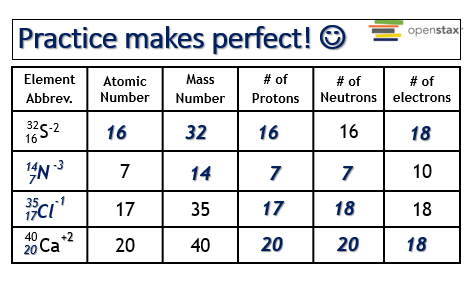
write down the mass number 2+ charge and atomic number in the correct spots for HE and MG


answer the questions in the image
answers for chart
Each proton and each neutron has a mass of ~
1 amu
what particle ways much less than 1 amu
a electron
Therefore the atomic mass of a single atom in amu is approximately equal to its?
mass numbers
However, most elements exist naturally as a mixture of
•two or more isotopes.
The periodic table lists the
•weighted, average mass of all the isotopes present in a naturally occurring sample of that element.
average mass=
E(fractional abundance x isotopic mass)
another average mass equation is?
((%1)/100)xAtomic mass 1+((%2)/100)xAtomic mass 2+…
Calculate the atomic mass of chlorine if the two common isotopes of chlorine have masses of 35.45 amu (75.00% abundance) and 37.29 amu (25.00% abundance).
Atomic mass of Chlorine= 35.91 amu
The occurrence and natural abundances of isotopes can be experimentally determined using an?
•instrument called a mass spectrometer.
in a mass spectrometer The sample is vaporized and exposed to a
high-energy electron beam that causes the sample’s atoms (or molecules) to become electrically charged, typically by losing one or more electrons. •These cations are then separated by their mass and charge.
Molecular formula:
•A representation of a molecule or compound which consists of the following:
1)Chemical symbols to indicate the types of atoms.
2)Subscripts after the symbol to indicate the number of each type of atom in the molecule.
•Subscripts are used only when more than one atom of a given type is present.
A structural formula:
•shows the same information as a molecular formula but also shows how the atoms are connected.
Many elements consist of
•discrete, individual atoms.
Some elements exist as
molecules.aka diatomic molecules, like hydrogen which cant be alone in nature