Enzymes + HL Enzymes
 Call Kai
 Learn
Learn Practice Test
 Spaced Repetition
 Match
Match Flashcards
 Knowt Play
1/45

There's no tags or description
Looks like no tags are added yet.
Name | Mastery | Learn | Test | Matching | Spaced | Call with Kai | Chat |
|---|
No analytics yet
Send a link to your students to track their progress
46 Terms
Enzyme
a biological catalyst made of protein
Catalyst
a substance that speeds up a chemical reaction without being used up in the reaction
Catabolic reaction
large molecules are broken down into smaller molecules, releasing energy
ag digestion, amylase converts starch into maltose
Anabolic reaction
small molecules are joined together to form large molecules, using energy
DNA polymerase forms and repairs DNA
Structure of enzymes
- each enzyme has its own unique shape, and will only react with one type of substrate
- the protein of the enzyme is folded into this 3d shape
- the area of the enzyme that reacts with the substrate is called the active site
What is the induced fit theory?
the shape of the active site is induced, meaning it changes shape slightly to make the substrate fit better
What is the enzyme substrate complex
enzyme bonded to substrate
What is the result of enzyme action?
- new product released
- enzyme released is unchanged and can be reused
How does pH affect enzyme action?
- changes the shape of the active site, hence affecting how well the enzyme works
- optimum pH varies depending on the enzyme
How does temperature affect enzyme action?
- as temperature increases, the rate of reaction increases
- optimum temp for human enzymes 37 degrees celcius
- optimum temp for plant enzymes 20-30 degrees celcius
- above optimum temperature, enzymes become denatured
Denatured enzyme
permanent change in the shape of the active site of an enzyme and can no longer function, irreversible damage
caused by both incorrect pH and high temperatures
Inhibitors
attach to enzymes and destroy their shape, effectively denaturing the enzymes
Example of beneficial inhibitors
- insecticides affect enzymes in insects causing their death
- drugs can affect enzymes involved in pain, causing the pain to stop
Harmful inhibitors
- nerve gases used by terrorists attach to the enzymes involved in our nervous system
- cyanide denautres an enzyme involved in our respiratory system
Bio-processing
the use of enzyme controlled reactions to produce a product
Bioreactor
a vessel or container in which living cells of their products are used to make a product
Immobilised enzymes
enzymes that are attached to each other, or an inert material and can easily be reused
Physical methods of immobolising enzymes
adsorption- enzymes are physically attached to inactive supports such as glass beads or ceramics
adsorption to ceramics
enclosed by a membrane
enclosed in a gel
Chemical methods of immobilising enzymes
bonded to inert support
bonded to each other
Advantages of immobilised enzymes
- efficiency of enzymes is not affected
- can be easily recovered from the product so you can get a pure sample easily
- enzymes can be reused, which also cuts costs
- often more stable when immobilised
Uses of immobilised enzymes
- penicillin acylase changes the structure of penicillin to make more antibiotics that will fight a wider range of bacteria
- lactase converts lactose into sweeter sugars glucose and galactose which are then used by food manufacturers
What is the enzyme immobilised in the experiment?
sucrase
What is the substrate of that sucrase?
sucrose
What are the products of that sucrase?
glucose + fructose
What compound was used to immobilise the enzyme?
sodium alginate
What compound was used to harden the gel beads?
calcium chloride
Describe the procedure used to immobilise the enzyme?
form a paste with the sodium alginate and water + leave for 5 mins to soak
add yeast to water and leave for 5 mins
mix the sodium alginate paste and yeast thoroughly
dissolve calcium chloride in water in a large beaker
syringe some of the mixture and slowly add drops into the calcium chloride solution
allow the beads to harden for 15 minutes
Why are the beads rinsed before use?
to remove unbound enzyme/yeast cells
Describe how you applied the immobilised enzyme to convert the substrate to the product?
pour beads into a separating funnel + yeast in water to another
dissolve sucrose in warm water + add solution to separating funnel
test the product by allowing it to drip onto a glucose testing strip
record time for glucose to first form
What are the results of the immobilisation experiment?
the immobilised enzymes are slower but have a clearer product
the yeast water solution is quicker but has a cloudier product
Name an enzyme on which you investigated the effects of heat denaturation:
catalase (celery)
What is the substrate of catalase?
hydrogen peroxide
What is the product of hydrogen peroxide?
water and oxygen
Describe how you investigated the heat denaturation of the enzyme named:
add 20cm3 pH buffer 9 solution
add a drop of washing up liquid
blend celery filter the solution into the graduated cylinder
add hydrogen peroxide to another graduated cylinder
place both in a 0o, 25, 40, 60 water bath
remove and add solutions together
record foam volume after 2 minutes
subtract original volume
ADP
Adenosine Diphosphate
- low energy carrier
ATP
Adenosine Triphosphate
- high energy carrier
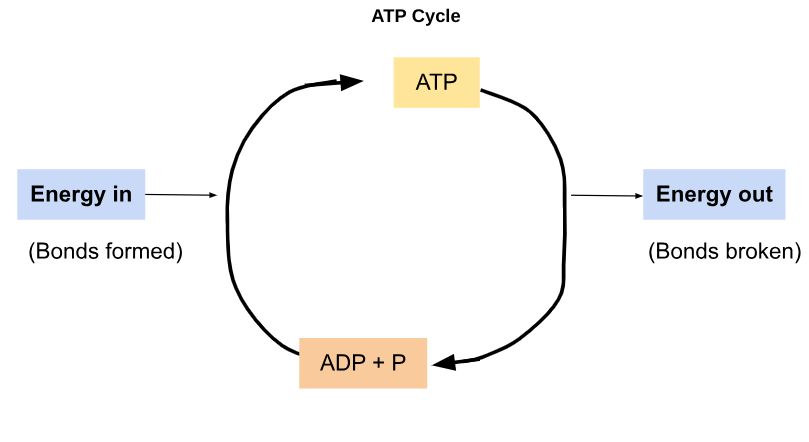
Formation of ATP
ADP + P → ATP
- Anabolic reaction
Release of energy from ATP
ATP → ADP + P
- Catabolic reaction
ATP Cycle
NAD+
Nicotinamide Adenine Dinucleotide
- low energy carrier
- used in respiration
NADH
Nicotinamide Adenine Dinucleotide + Huydrogen
high energy carrier
used in respiration
Formation of NADH
NAD⁺ + 2e⁻ + H⁺ → NADH
- bonds with high energy electrons
Release of energy from NADH
NADH → NAD⁺ + 2e⁻ + H⁺
- releases high energy electrons
NADP+
Nicotinamide Adenine Dinucleotide Phosphate
- low energy carrier
- used in photosynthesis
NADPH
Nicotinamide Adenine Dinucleotide Phosphate + Hydrogen
- high energy carrier
- used in photosynthesis
NADH cycle