Strat Quiz 1
 Studied by 0 people
 Call with Kai
 Learn
Learn Practice Test
 Spaced Repetition
 Match
Match Flashcards
 Knowt Play
1/48

Earn XP
Description and Tags
Ch 1-3
Name | Mastery | Learn | Test | Matching | Spaced | Call with Kai |
|---|
No study sessions yet.
49 Terms
What is Strategy?
The set of coordinated actions that a company’s managers take in order to outperform the company’s competitors and achieve superior profitability
well crafted strategies provide lasting success - not just short term
guidance on what they should do and what they should not do
How to compete (strategy is about making choices and choosing how…)
How to position the company in the marketplace
how to attract customers
how to compete against rivals
how to achieve the company’s performance targers
how to capitalize on opportunities to grow the business
how to respond to changing economic and market conditions
Strategy is about competing differently
every company’s strategy needs to have a distinctive element that draws in customers and provides a competitive advantage
do what rival firms don’t do or what they can’t do - pressures rivals
copying does not make a good strategy
involves making choices about how best to compete differently from rivals
guides the company in both what it must do and what is must not do
Successful strategies…
are predicted on actions, business approaches, and competitive moves aimed at:
appealing to buyers in ways that set a company apart from its rivals
by either providing products with higher perceived values or efficiently producing at lower costs
staking our a market position that is not crowded with strong competitors
3 Central Questions all Business face
What is our present situation?
industry conditions, competitive pressures, market standing, competitive strengths and weaknesses, future prospects in light of changes taking place in the business environment
What should the company’s future direction be and what performance targets should we set?
what buyer needs to try to satisfy
which growth opportunities to emphasize
where to head and what outcomes to strive to achieve
What’s our plan for running the firm and achieving good results?
challenges managers to craft a series of competitive moves and business approaches-henceforth called a strategy-for heading the firm in the intended direction, staking out a market position, attracting customers, and achieving the targeted outcomes
Identifying a firm’s strategy - what to look for (the pattern or actions that define a company’s strategy)
actions to strengthen the firm’s bargaining position with suppliers, distributors, and others
actions to gain market share via more performance features, better designs, quality or customer service, wider product selection, or other such actions
actions to gain increased market share or profitability via lower costs
actions to enter new product or geographic markets or to exit existing ones
actions to capture emerging market opportunities and defend against external threats to the company’s business prospects
actions to strengthen standing and reputation through corporate responsibility and environmental sustainability programs
actions to strengthen corporate culture, motivate employees, and create a productive working environment
actions to strengthen competitiveness via strategic alliances, and collaborative partnerships, mergers, or acquisitions
Achieving competitive advantage
required meeting customer needs either more effectively (with products or services that customers value more highly than those offered by rivals) or more efficiently (by providing products or services at a lower cost to customers)
Achieving SUSTAINABLE competitive advantage requires:
giving buyers lasting reasons to prefer a firm’s products or services over those of its competitors
developing expertise and long-term competitively valuable capabilities that cannot be readily overcome by rivals
putting the constant quest for sustainable competitive advantage at center stage in crafting the company’s strategy
5 basic strategic approaches
low-cost provider
focused differentiation
focused low-cost
broad differentiation
best-cost provider
low-cost provider strategy
achieving a cost-based advantage over rivals by driving costs out of the business
broad differentiation strategy
differentiating the firm’s product or service from rivals in ways that appeal to a broad spectrum of buyers
focused low-cost strategy
concentrating on a narrow buyer segment (or market niche) by having lower costs to serve niche members at a lower price
focused differentiation strategy
concentrating on a narrow buyer segment (or market niche) by offering buyers customized attributed that meet their specialized needs and tastes better than rivals’ products
best-cost provider strategy
giving customers more perceived value for their money by satisfying their expectations on key quality features, performance, and/or service attributes that match or exceed their price expectations
Why a company’s strategy evolves over time
managers typically make adjustments in their company’s strategy in response to:
changing market conditions
advancing technology
fresh moves of competitors
shifting buyer needs
emerging market opportunities
new ideas for improving the strategy
Company’s strategy is a blend of proactive initiatives and reactive adjustments
deliberate strategy - proactive planned strategy elements
emergent strategy - reactive strategy elements
strategies are both proactive and reactive - the current (realized) strategy is determined by new planned initiatives and strategy elements from prior periods and new elements that emerge as managers adaptively react to changing circumstances
other strategy elements that don’t work are abandoned from the proactive initiatives
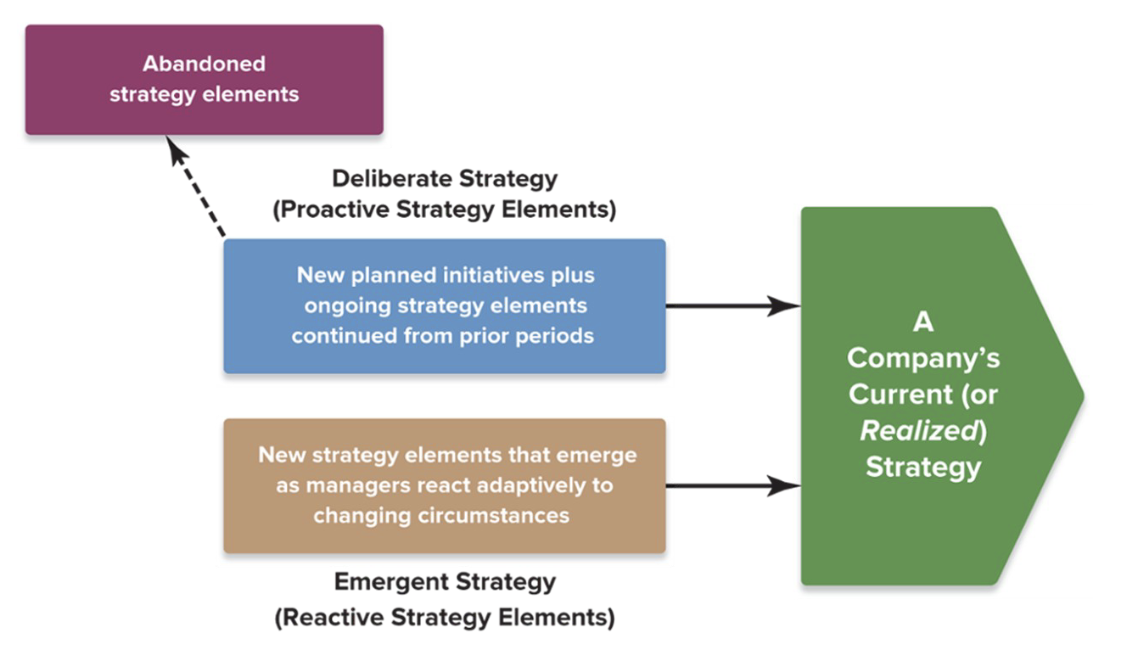
a company’s strategy is partly proactive and partly reactive
realized (current) strategy is a blend of
proactive (deliberate) strategy elements that include planned initiatives to improve the company’s financial performance and secure a competitive edge
reactive (emergent) strategy elements developed on the fly in response to unanticipated developments and fresh market conditions
abandoned and superseded strategy elements that no longer fit with the company’s ongoing strategy
a company’s strategy and its business model (money)
How the firm will make money:
by providing customers with value
the firm’s customer value proposition
by generating revenues sufficient to cover costs and produce attractive profits
the firm’s profit formula
it takes a proven business model - one that yields appealing profitability - to demonstrate viability of a firm’s strategy
the relationship between a company’s strategy and its business model
Realized strategy:
competitive initiatives
business approaches
Business Model:
value proposition
profit formula
Business Model Elements: The Customer Value Proposition
The customer value proposition is:
satisfying buyer wants and needs at a price customers will consider a good value
the greater the value provided (V) and the lower the price (P), the more attractive the value proposition is to customers
Business Model Elements: The Profit Formula
The profit formula:
Created a cost structure that allows for acceptable profits, given that pricing is tied to the customer value proposition
V - the value provided to customers
P - the price charged to customers
C - the firm’s costs
The lower the costs (C) for a given customer value proposition (V-P), the greater the ability of the business model to be a moneymaker
The Business Model and the Value-Price-Cost Framework
Customer Value (V)
Customer’s share (Customer Value Proposition)
Product Price (P)
Firm’s share (Profit Formula)
Per-Unit Cost (C)
Three tests of a winning strategy:
The Fit Test
exhibits good fit with situation (external and internal aspects of a firm’s dynamic situation)
The Competitive Advantage Test
results in competitive advantage
The Performance Test
promotes superior performance (as indicated by the firm’s profitability, financial and competitive strengths, and market standing)
Why crafting and executing strategy are important tasks
Strategy provides:
a prescription for doing business
a road map to competitive advantage
a game plan for pleasing customers
a formula for attaining long-term standout marketplace
Good Strategy + Good Strategy Execution = Good Management
What does the Strategy-Making, Strategy-Executing Process Entail?
Developing a strategic vision, a mission statement, and a set of core values
setting objectives for measuring the firm’s performance and tracking its progress
crafting a strategy to move the firm along its strategic course and achieve its objectives
executing the chosen strategy efficiently and effectively
monitoring developments, evaluation performance, and initiating corrective adjustments
Strategy-Making Strategy-Executing Process

Factors shaping decisions in the strategy-making strategy-execution process
external considerations
does sticking with the company’s present strategic course present attractive opportunities for growth and profitability
what kind of competitive forces are industry members facing, and are they acting to enhance or weaken the company’s prospects for growth and profitability
what factors are driving industry change, and what impact on the company’s prospects will the have
how are industry rivals positioned, and what strategic moves are they likely to make next
what are the key factors of future competitive success, and does the industry offer good prospects for attractive profits for companies possessing those capabilities
internal considerations
does the company have an appealing customer value proposition
what are the company’s competitively important resources and capabilities, and are they potent enough to produce a sustainable competitive advantage
does the company have sufficient business and competitive strength to seize market opportunities and nullify external threats
are the company’s costs competitive with those of key rivals
is the company competitively stronger or weaker then key rivals
Stage 1: Developing a Strategic Vision, Mission Statement, and Set of Core Values
Developing a strategic vision:
delineates management’s aspirations for the firm to its stakeholders
provides direction: “where we are going”
sets forth a compelling rationale (strategic soundness) for the firm’s direction
uses distinctive and specific language to set the firm apart from its rivals
Wording a Vision Statement Dos
Be Graphic
be forward-looking and directional
keep it focused
have some wiggle room
be sure the journey is feasible
indicate why the directional path makes good business sense
make it memorable
Wording a Vision Statement Don’ts
don’t be vague or incomplete
don’t dwell on the present
don’t use overly broad language
don’t state the vision in bland or uninspiring terms
don’t be generic
don’t rely on superlatives
don’t run on and on
Why communicate the vision?
fosters employee commitment to the firm’s chosen strategic direction
ensures understanding of its importance
motivates, informs, and inspires internal and external stakeholders
demonstrates top management support for the firm’s future strategic direction and competitive efforts
Putting the Strategic Vision in Place - What needs to be done:
put the vision in writing and distribute it
hold meetings to personally explain the vision and its rationale
creates a memorable slogan or phrase that effectively expresses the essence of the vision
emphasize the positive payoffs for making the vision happen
Why a Sound, Well-Communicated Strategic Vision Matters
it crystallizes senior executives’ own views about the firm’s long-term direction
it reduces the risk of rudderless decision making
it is a tool for winning the support of organization members to help make the vision a reality
it provides a beacon for lower-level managers in setting departmental objectives and crafting departmental strategies that are in sync with the firm’s overall strategy
it helps an organization prepare for the future
Developing a Company Mission Statement
A well-conceived company mission statement:
uses specific language to give the firm its own unique identity
describes the firm’s present purpose- “who we are, what we do, and why we are here”
focuses on describing the firm’s business, not on “making a profit”- earning a profit is an objective, not a mission
An “Ideal” Mission Statement
identifies the company’s product or services
specifies the. buyer needs it seeks to satisfy
identifies the customer groups or markets it is endeavoring to serve
gives the company its own identity that sets the company firm apart from its rivals
clarifies the firm’s purpose and business makeup to stakeholders
Linking the Vision and Mission with Core Values
Core Values:
are the beliefs, traits, and behavioural norms that employees are expected to display in conducting the firm’s business and in pursuing its strategic vision and mission
become an integral part of the firm’s culture and what makes it tick when strongly espoused and supported by top management
match the firm’s vision, mission, and strategy, contributing to the firm’s business success
Stage 2: Setting Objectives - The purpose of setting objectives:
to convert the vision and mission into specific, measurable, challenging yet achievable performance targets and deadlines for achieving these targets
to focus efforts and align actions throughout the organization
to serve as yardsticks for tracking a firm’s performance and progress
to provide motivation and inspire employees to greater levels of effort
Converting the Vision and Mission into Specific Performance Targets
Characteristics of Well-Stated Objectives:
specific
quantifiable (measurable)
challenging (motivating)
deadline for achievement (time-limited)
Setting stretch objectives (how they promote better overall performance)
setting stretch objectives promotes better overall performance because stretch targets:
push a firm to be more inventive
increase the urgency for improving financial performance and competitive position
cause the firm to be more intentional and focused in its actions
create an exciting work environment and attract the best people
help prevent internal inertia and contentment with modest gains in performance
cautions about stretch goals
realistic stretch goals:
definitely reachable, with a strong and coordinated effort on the part of company personnel
overly ambitious stretch goals:
are usually beyond the organization’s capabilities to reach, regardless of the level of effort
involve radical expectations that often go unachieved, and run the risk of killing motivation, eroding employee confidence, and damaging both worker and company performance
can work as envisioned if:
the company has ample resources and capabilities
its recent performance is strong
What kinds of objectives to set
Financial objectives:
communicate top management’s goals for financial performance
are focused internally on the firm’s operations and activities
strategic objectives:
are the firm’s goals related to market standing and competitive position
are focused externally on competing successfully against the firm’s rivals
The need for short-term and long-term objectives
short-term objectives:
focus attention on quarterly and annual performance improvements to satisfy near-term shareholder expectations
long-term objectives”
force consideration of what to do now to achieve optimal long-term performance
help pose a barrier to overemphasizing achieving just short-term results and postponing/delaying actions needed to achieve long-term performance targets
Examples of common financial objectives
an x percent increase in annual revenues
annual increases in after-tax profits of x percent
annual increases in earnings per share of x percent
annual dividend increases of x percent
profit margins of x percent
an x percent return on capital employed (ROCE) or return on shareholders’ equity investment (ROE)
increase shareholder value- in the form of an upward-trending stock price
bond and credit ratings of x
internal cash flows of x dollars to fund capital investment
Examples of common strategic objectives
winning an x percent market share
achieving lower overall costs than rivals
overtaking key competitors on product performance or quality or customer service
deriving x percent of revenues form the sale of new products introduced within the part five years
having broader or deeper technological capabilities than rivals
having a wider product line than rials
having a better-known or more powerful brand name than rivals
having stronger national or global sales and distribution capabilities than rivals
getting new or improved products to market ahead of rivals
the need for a balanced approach to objective setting
a balanced scorecard approach:
strives to place a balanced emphasis on achieving both financial and strategic objectives by tracking measures of both financial performance and the competitiveness of its market position
The four dimensions of a balanced scorecard:
financial objectives
customer: objectives relating to customers and the market
internal process objectives relating to improving productivity and quality
organizational objectives concerning human capital, culture, infrastructure, and innovation
good strategic performance is the key to better financial performance
good financial performance is not enough:
current financial results are lagging indicators and do not assure the development of competitive capabilities for delivering better financial results in the future
setting and achieving stretch strategic objectives signal improvements in a firm’s competitiveness and strength in the marketplace
ongoing good strategic performance is a leading indicator of a firm’s increasing capability to deliver improved future financila performance
Setting objectives for every organizational level
breaks down overall performance targets into targets for each of the organization’s separate units
forsters setting lower-level performance targets or outcomes that support achievement of firm-wide strategic and financial objectives
extends the top-down objective-setting process to all organizational levels
Stage 3: crafting a strategy - strategy making:
addresses a series of strategic HOWs
requires choosing among strategic alternatives
should always entail actions to do things differently from competitors rather than running with the herd
is a collaborative team effort that involves managers in various positions at all organizational levels
Strategy-making involves managers at all organizational levels
chief executive officer (CEO):
has ultimate responsibility for leading the strategy-making process as the strategic visionary and chief architect of strategy
senior executives:
fashion the major strategy components involving their areas of responsibility
managers of subsidiaries, divisions, geographic regions, plants, and other operating units (and key employees with specialized expertise):
utilize on-the-scene familiarity with their business units to orchestrate their specific pieces of the strategy