SB 2: Chromosomes & Inheritance
 Call Kai
 Learn
Learn Practice Test
 Spaced Repetition
 Match
Match Flashcards
 Knowt Play
1/26

There's no tags or description
Looks like no tags are added yet.
Name | Mastery | Learn | Test | Matching | Spaced | Call with Kai | Chat |
|---|
No analytics yet
Send a link to your students to track their progress
27 Terms
Normal human chromosomes
Each human cell carries 23 pairs of chromosomes in the nuclei (46 total)
Within each pair, chromosomes match
Exception of male sex chromosomes (XY)
Scientists studying fertilization
Found that maternal and paternal gamete (cells) equally contribute egg and sperm nuclei
Implies something in the nucleus contains hereditary material
More studies revealed smaller, discrete, colored bodies called chromosomes
Mitosis vs. Meiosis
Mitosis results in two daughter cells that are identical to the parent, somatic
Meiosis allows for the chromosomes composing each pair to segregate, so the resulting gamete receives only one chromosome from each pair
Generates egg/sperm cells containing half the number of chromosomes (haploid)
Fertilization
Chromosomes in a fertilized egg consist of two matching sets, one by maternal gamete, one by paternal
Maternal and paternal chromosomes form pairs, alike in size and shape
These cells are diploid (two matching sets)
Chromatin
A mass of extremely fine tangled string that resembles the chromosome
Surrounded by the nuclear envelope
Each chromatin thread is composed of DNA (genetic info) and protein (package and manage info)
Interphase
Gap 1 (G1) - cell achieves most of its growth, period from birth of a new cell to onset of chromosome replication
Synthesis (S) - DNA synthesis and chromosome duplication
Gap 2 (G2) - Cell grows, synthesizes proteins needed for mitosis
Prophase
Mass of chromatin condenses into discrete, individual chromosomes
Each condensed chromosome has been duplicated during interphase, so it consists of sister chromatids attached at the centromere (X shape)
Dark-stained nucleoli breaks down, ceasing the manufacture of ribosomes to focus energy on cell division
Prophase outside the nucleus, in the cytoplasm
Microtubule network from interphase gets replaced with new set of microtubules that are more dynamic (grow outward and shrink back from centrosomes)
Duplicated (2) centrosomes from earlier travel outside the nucleus to opposite ends of the cell
Separation driven by the microtubules within each centrosome interacting and generating force to push apart
Prometaphase
Breakdown of nuclear envelope, allowing microtubules extending from centrosomes to invade nucleus
Chromosomes attach to microtubules using kinetochore (structure in centromere region of chromatid)
Metaphase & Anaphase
Metaphase plate
Anaphase, separation
Telophase, prophase in reverse
Cytokinesis
Cell’s decision to divide
Conditions within the cell that register being a sufficient size for division
Signals from environment, hormonal cues/contacts with neighboring cells
Initiation during G1 period of Interphase
Regulatory checkpoints to ensure correct chromosome separation
Enzymes monitoring DNA replication to ensure that cells do not begin mitosis until all chromosomes have been copied
Somatic cells
Cells that grow and divide via mitosis, or stop growing and become arrested in G0
Make up organism’s tissue
Germ cells
Set aside during embryonic development for the specialized role in gamete production
Half the number of chromosomes

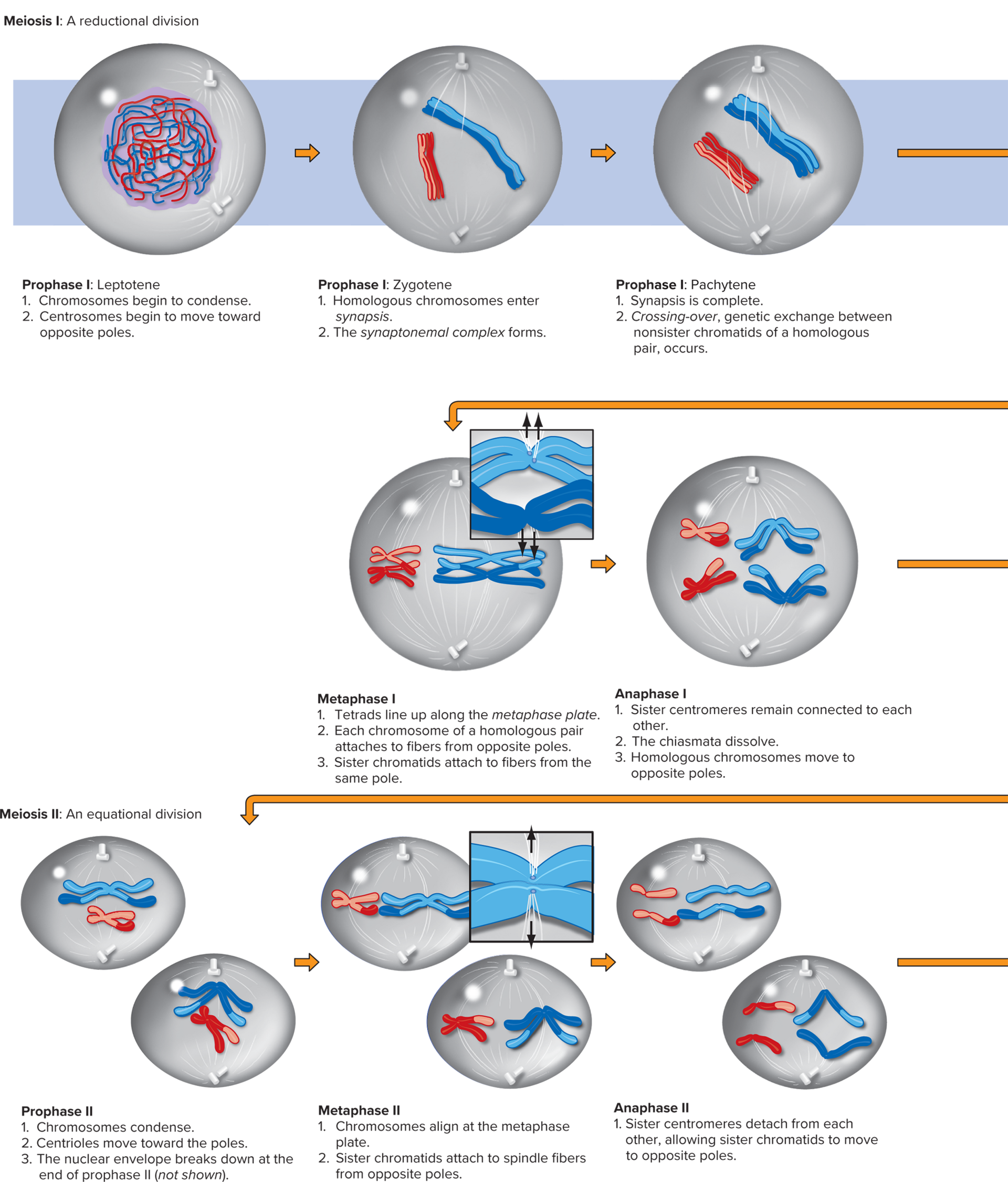
Meiosis divisions
Two successive nuclear divisions (Meiosis 1 and 2) but only one chromosome duplication (1)
PMAT in each round
Round 1: Parent nucleus divides into two daughter nuclei, Round 2: Each daughter divides, resulting in four nuclei
Four nuclei are partitioned in four cells from cytokinesis
Recombination
Homologous chromosomes pair with each other in Meiosis 1 (same gene, different allele)
Non-sister chromatids exchange parts to produce new combinations of the alleles of different genes
Sister chromatids on a chromosome are no longer identical
Prophase 1
Condensation of chromatin
Pairing of homologous chromosomes
Reciprocal exchange of genetic info between paired homologs
Prophase 1 - Zygotene
Chromosome seeks out its homologous partner
Homologs are zipped together in a process called synapsis
Synaptonemal complex: protein structure that aligns the homologs with precision
Prophase 1 - Pachytene (Form Tetrad)
A synapsed chromosome pair is known as a Bivalent (encompasses two chromosomes) or a Tetrad (four chromatids)
One side of bivalent is a maternally derived chromosome, one side is paternally derived
Prophase 1 - Pachytene (Recombination)
Recombination nodule structures appear along the synaptonemal complex
Exchange between non-sister (M and P) chromatids occur at these nodules
Crossing over resulting in recombination of genetic material
Retain size
Prophase 1 - Diplotene
Dissolution of synaptonemal complex
Homologs remain merged at intervals along their length called chiasmata (sites where crossing over occurred)
Metaphase 1
Kinetochores of sister chromatids fuse, each chromosome has one kinetochore
Kinetochores of homologs attach to microtubules from opposite spindle poles
Homologs align at the metaphase plate, maternal and paternal versions on either side; however, each bivalents’ orientation is independent of others
Anaphase 1
Chiasmata dissolves
In each homolog pair, one chromosome consisting of two sister chromatids segregates to each spindle pole
Cohesion keeps sister chromatids together
Prophase 2
If the chromosomes decondensed during the preceding interphase, they recondense during Prophase 2
Nuclear envelope breaks down and spindle apparatus reforms
Mistakes in Meiosis produce defective gametes
If homologs of do not segregate during Meiosis 1, they may travel to the same pole together and become part of the same gamete
Nondisjunction
Meiosis contributes genetic diversity
Independent alignment of non-homologous chromosomes
Crossing over
2^n
Mitosis vs. Meiosis
Mitosis = all eukaryotic cells, conservative mechanism (preserves genetic status quo), produces growth/increasing number of cells, promotes continual replacement of organ tissue, plant parts, etc
Meiosis = sexually reproducing organisms, genetic variation