Ch 5 - Accounting for Merchandising Operations
 Call Kai
 Learn
Learn Practice Test
 Spaced Repetition
 Match
Match Flashcards
 Knowt Play
1/31

Earn XP
Description and Tags
ACC 101
Name | Mastery | Learn | Test | Matching | Spaced | Call with Kai | Chat |
|---|
No analytics yet
Send a link to your students to track their progress
32 Terms
retailers
merchandising companies that purchase and sell directly to consumers
e.g., Walmart, Office Depot
wholesalers
merchandising companies that sell to retailers
e.g., McKesson, United Stationers
sales revenue
the primary source of revenue in a merchandising company
cost of goods sold
the total cost of merchandise sold during the period
operating expenses
expenses incurred in the process of earning sales revenue
e.g., advertising expense and rent expense
gross profit
the excess of net sales over the cost of goods sold
= Sales Revenue - Cost of Goods Sold
inventory
the merchandise that companies buy and sell to customers
reported as a current asset on the balance sheet
perpetual inventory system
an inventory system under which the company keeps detailed records of the cost of each inventory purchase and sale in the Inventory account, and the records continuously show the inventory that should be on hand
Companies determine the cost of goods sold each time a sale occurs
periodic inventory system
an inventory system under which the company does not keep detailed inventory records in the Inventory account throughout the accounting period but determines the cost of goods sold only at the end of an accounting period
Companies determine the cost of goods sold only at the end of the accounting period
purchase invoice
a document that supports each credit purchase
FOB shipping point
freight terms indicating that the seller places goods free on board the carrier, and the buyer pays the freight costs
Ownership of goods passes to the buyer when the public carrier accepts the goods from the seller
Buyer pays freight
FOB destination
freight terms indicating that the seller places the goods free on board to the buyer’s place of business, and the seller pays the freight
Ownership of goods remains with the seller until the goods reach the buyer
Seller pays freight
purchase return
a return of goods from the buyer to the seller for a cash or credit refund
purchase allowance
a deduction made to the selling price of merchandise, granted by the seller so that the buyer will keep the merchandise
purchase discount
a cash discount claimed by a buyer for prompt payment of a balance due
e.g., 2/10, n/30; meaning 2% discount if payment is made within 10 days, otherwise, the net amount is due within 30 days
sales invoice
a document that supports each credit sale
sales returns and allowances
transactions where the seller either accepts goods back from the buyer (a return) or grants a reduction in the purchase price (an allowance) so the buyer will keep the goods
contra revenue account
an account that is offset against a revenue account on the income statement
e.g., Sales Returns and Allowances is deducted from Sales Revenue on the income statement; Sales Discounts to Sales Revenue
Normal balance = debit
sales discount
a reduction given by a seller for prompt payment of a credit sale
Normal balance = debit
multiple-step income statement
an income statement that shows several steps in determining net income
distinguishes between operating and nonoperating activities
highlights intermediate components of net income
shows subgroupings of expenses
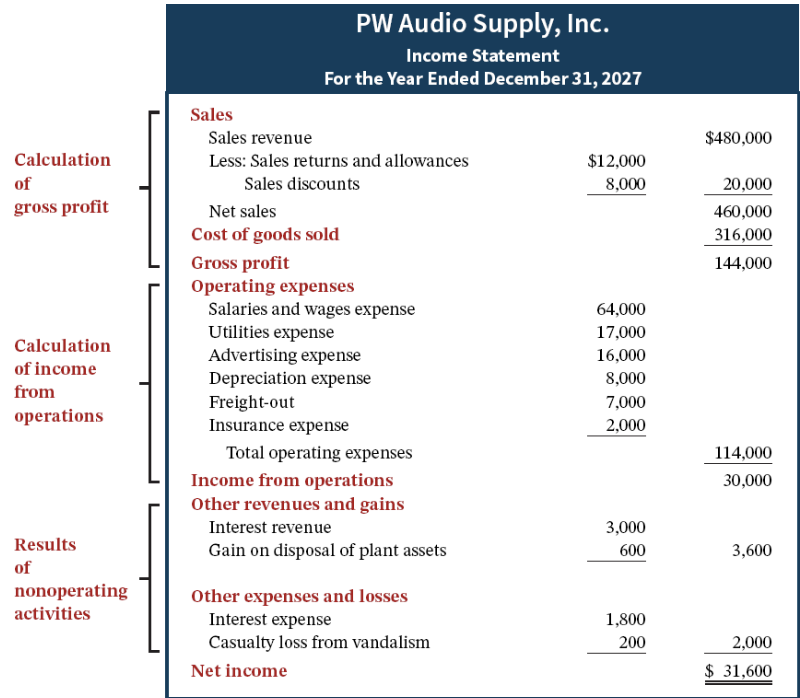
gross profit
the excess of net sales over the cost of goods sold
= Sales revenue (or Net sales) - Cost of Goods Sold
represents the merchandising profit of a company; not the overall profit
gross profit rate
gross profit expressed as a percentage, calculated by dividing the amount of gross profit by net sales
= Gross profit / Net sales
expresses a more meaningful (qualitative) relationship between net sales and gross profit
selling expenses
Advertising expense
Sales salaries
Freight-out
administrative expenses
Insurance expense
Utility expense
Depreciation expense
nonoperating activities
various revenues, expenses, gains, and losses that are unrelated to a company’s main line of operations
income from operations
income from a company’s principal operating activity, determined by subtracting operating expenses from gross profit
identifies the results of the company’s normal operations
= Net Sales - Cost of Goods Sold (aka Gross Profit) - Operating Expenses
other revenues and gains
a nonoperating-activities section of the income statement that shows revenues and gains unrelated to the company’s main line of operations
e.g., interest revenue, dividend revenue, rent revenue, gain from the sale of property, plant, and equipment
other expenses and losses
a nonoperating-activities section of the income statement that shows expenses and losses unrelated to the company’s main line of operations
e.g., interest expense, casualty losses, loss from the sale of abandonment of property, plant, and equipment, loss from strikes
single-step income statement
an income statement that shows only one step—subtracting total expenses from total revenues—in determining net income
revenues - include both operating revenues and other revenues and gains
expenses - include both operating revenues and other revenues and gains
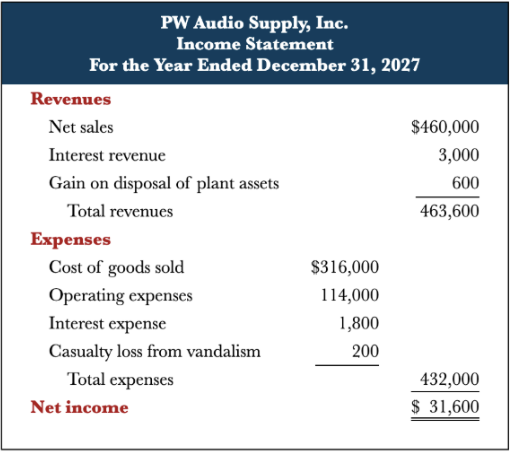
net income
the total of the debit column exceeds the total of the credit column in the balance sheet columns
net loss
the total of the credits exceeds the total of the debit balances