Alchemy Unit 10: Heat
 Call Kai
 Learn
Learn Practice Test
 Spaced Repetition
 Match
Match Flashcards
 Knowt Play
1/24

There's no tags or description
Looks like no tags are added yet.
Name | Mastery | Learn | Test | Matching | Spaced | Call with Kai | Chat |
|---|
No analytics yet
Send a link to your students to track their progress
25 Terms
Temperature
The degree of hotness or coldness transferred between bodies
Joseph Black
- Recognizes a lag in time (heat) when ice is melted (same for boiling).
- Believed that heat mixed with the substance then combined with it. Explains why the temperature doesn't change.
- Called latent heat because it was hidden.
- Determined that different bodies have different requirements for this heat. Called it a specific heat (c).
- Calculated as amount of heat needed to raise the temperature of 1 gram of a substance by 1 °C (now known as a calorie).
Lavoisier
Disproved phlogiston. Burned books on it. Created a table of
elements that included caloric.
Caloric
A heat fluid that flows from a heated or bruised substance
Simon LaPlace
- With Lavoisier
- Conducted studies with respiration and combustion.
- Both processes used oxygen while providing an air and caloric.
- In the absence of oxygen, a candle dies and so does a guinea pig.
- Wanted to measure the quantity of caloric: developed an ice calorimeter.
Benjamin Thomson a.k.a. Count Rumford
- American - NH (Tory)
- Became a gunnery expert. Experiments with gunpowder.
- Moved to London after the war, bought a commission, and was knighted in 1784.
- Moved to Bavaria where he served one of the Dukes. Invested as Count Rumford.
- 1799: splits his time between England and France. Founds Royal Institution of Great Britain.
- Marries well again but separates from his wife after a few years.
Count Rumford
- Dissatisfied with the idea of caloric that flowed from hot to cold bodies.
- What happened when you rubbed your hands together?
- Cited latent heat as responsible by grinding off part of the material.
- Watched cannon being bored; observed that the drilling gave off tremendous heat. Saw brass chips flying off, thus liberating caloric.
- Noted that horses had to work harder when the drill bit got dull. Fewer chips were being released but more heat generated.
Count Rumford's calorimetry experiment
- Built a container around the cannon so that it could be immersed in water.
- If temperature is increasing as the drilling efficiency is decreasing (liberating less chips) then an entity is not being released.
- No such thing as caloric!
- Proposes that heat is related to the movement of tiny particles (Newtonian).
- Heat is related to motion (heat is energy that is related to motion).
- More friction = more energy
Humphry Davy
- Rumford's student and associate
- On a 29 °F day, he rubbed ice cubes together until they melted. Temperature of the water was 35° F.
- There was no source of caloric. Heat was derived from friction only.
Thermodynamics
Study of heat and energy as they relate to work
Energy
The ability to do work. Appears in many forms.
Kinetic energy
Work in motion
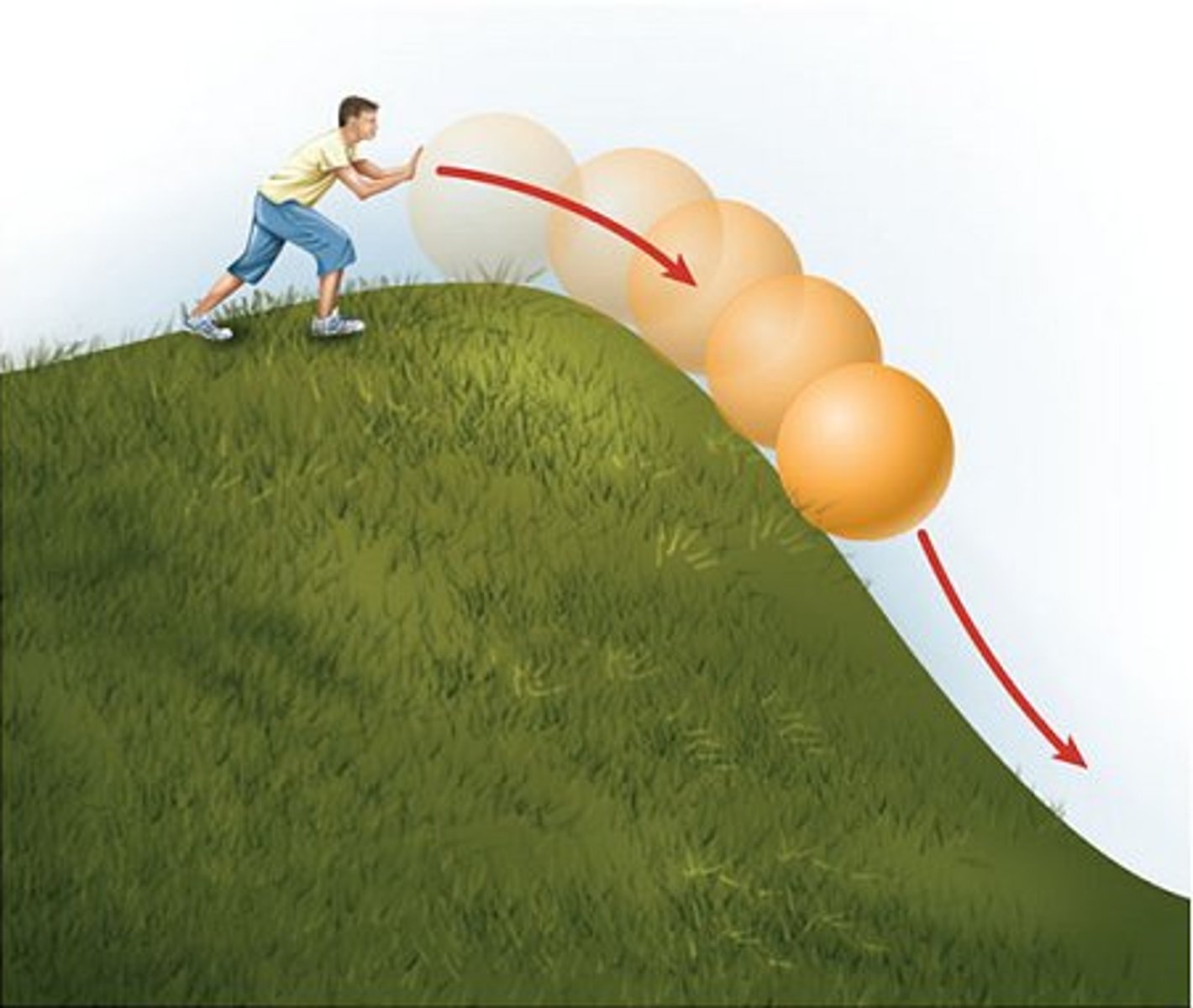
Potential energy
Stored energy with ability to be released and do work

Energy equation
Energy = q + w
Energy must be conserved.
1st Law of Thermodynamics
- The total energy of the universe is constant.
- Can be transferred from one type of energy to another (kinetic to potential or chemical to electrical).
EUniverse = ESystem + ESurroundings = 0
Heat
- SI Unit for Energy is the Joule (Force/unit distance)
- J = kg • m2 / s2
- Calorie: 1 Cal = 1 Kcal = 1000 cal
- Energy required to raise 1 g of water by 1 °C.
- 4.184 J = 1 cal.
Specific heat (c)
c (heat capacity) = amount of heat required to change the temperature of 1 g of a substance by 1 °C
c = q / m • ΔT or
q = c • m • ΔT
Enthalpy (ΔH)
- The heat content of a system.
- ΔH is best thought of as the potential energy stored in the chemical bonds of a substance.
ΔHrxn = ΔHfinal- ΔHinitial
Exothermic reaction
- A process (reaction) that liberates heat TO the environment
- Favored
ΔHrxn = ΔHfinal- ΔHinitial = (-)
Ex. Combustion of butane
Endothermic reaction
- A process (reaction) that requires heat FROM the environment
- Disfavored
ΔHrxn = ΔHfinal- ΔHinitial = (+)
Ex. Melting of ice
Hess's Law
The enthalpy change of an overall process is the sum of all the enthalpy changes of its individual steps.
Entropy (S)
The measure of disorder or randomness in a system.
2nd Law of Thermodynamics
In any spontaneous process, the entropy of the universe is increasing.
SUniverse = Ssystem + SSurroundings > 0
Favorable vs. disfavored process
Favorable if ΔS = (+)
Disfavored if ΔS = (-)
Gibbs Free Energy (G)
- A consolidation of Enthalpy, Entropy, and Temperature
- Explains how some processes are reversible
ΔG = ΔH - TΔS
ΔG = (-), exorgonic (spontaneous)
ΔG = (+), endorgonic (not spontaneous)
ΔGrxn = ΔGfinal - ΔGinitial