aseptic technique microbiology
 Call Kai
 Learn
Learn Practice Test
 Spaced Repetition
 Match
Match Flashcards
 Knowt Play
1/71

There's no tags or description
Looks like no tags are added yet.
Name | Mastery | Learn | Test | Matching | Spaced | Call with Kai | Chat |
|---|
No analytics yet
Send a link to your students to track their progress
72 Terms
When working in a microbiology lab, it is important to ensure that _________ of media, pipets, microbes cultures, and glassware are minimized.
contamination
The more a sterile object or a microbial culture is exposed to the atmosphere, your hands, the air, and on inanimate objects, the more likely it will be?
contaminated
Learning how to preserve the purity of objects used in a microbiology lab, is a process known as?
aseptic technique
Aseptic technique is commonly maintained through the use of a what?
busen burner flame or micro-incinerator
When properly working, a short blue-to-colorless flame should appear at the top of the Bunsen burner.
When an object such as the top of a test tube or an inoculating loop or inoculating needle is passed slowly through the flame, heat will do what?
incinerate any organisms that may be present and will sterilize the object.
When flaming the neck of a glass tube, the uncapped end of the tube is briefly passed through the flame, why?
to kill any organisms present on the mouth of the tube
When using a micro-incenerator, the uncapped end of the tube is positioned how?
held in front of the opening and rotated to heat the tube
Holding the glass in the flame or heat of the incinerator for a long period will cause, what?
the glass to shatter
To correctly flame an inoculating loop, the base of the loop (closest to the handle) is held in the flame until it glows what color?
The remainder of the loop is slowly pulled through the flame until it glows _______ as well
orange
How long is the loop or needle inserted into the incinerator for sterilization
10 seconds
Does the loop or needle need to cool after taking it out the incinerator?
yes, the needle needs to be cooled for several seconds, but care must be taken not to contaminate the loop or needle while it is cooling.
A student properly flames her loop but then forgets to let it cool. Instead, she immediately inserts the hot loop into her broth culture. What is the most important issue associated with this mistake?
the hot loop may create aerosols when it touches the culture
Should you rest the loop or needle on the bench, blow on the loop or needle or wave it around to cool it, or touch it with your fingers to see if is still hot?
no
Any time a cap is removed from a tube or flask of medium, care must be taken to minimize, what?
contamination of the medium
Caps of flasks and tubes should remain where when the flasks and tubes are not in use?
they should remain on flasks and tubes any time the flask or tube is not in use
How should you hold the flask or tube when a cap is removed and the neck of the glassware flamed?
at an angle to reduce the possibility that organisms in the air might fall into the tube
Should caps be taken off a tube and laid to the side?
no
In order to study a single ype of microorganism, a _____ _____ of the organism must be obtained
pure culture
What is a culture of one type of organism?
pure culture
Microbiologists often want to transfer a pure culture of an organism from one medium to another in a process known as?
inoculation
Describe the process of inoculation:
a tiny amount of the microorganism is removed from one medium using an inoculating loop or an inoculating needle and transferred or inoculated into or onto fresh medium. also reffered to as subculturing
What is a substance that has been designed to support microbial growth
culture medium (aka growth medium)
All bacteria need the following basic nutrients: a carbon source such as glucose (for energy), a nitrogen source, a phosphate source, cofactors from mineral nutrients, and water. The basic composition of a minimal medium is:
a single carbon source and various organic and inorganic molecules dissolved in water.
a culture medium that contains the minimal nutrients possible for growth
minimal medium
example of minimal medium: glucose minimal salt
Glucose minimal salt is also an example of what kind of medium?
chemically defined medium
What is a basic culture medium with a known chemical composition.
By this we mean that we know exactly which substances have been added to the medium, the exact chemical formulas of these organics and/or inorganic ingredients, and in what quantities they were added.
chemically defined medium
What kind of medium is this?
One in which not all of the chemical ingredients added are known. You may be wondering how you could make a medium and not know what is in it.
chemically undefined medium,
The unknown factor comes in when we add additional nutrients in the form of extracts and other supplements.
What are fasidious species?
have complex nutritional requirements, meaning that they will only grow when their culture medium has been supplemented with specific nutrients that they require for growth.
Blood agar is an example of an
enriched medium that is supplemented (enriched) with nutritious mammalian blood
growth media can also be prepared in different physical states. what are some of the phsyical states
liquid, solid, and semi-solid forms, depending upon how much agar is added
What is being described?
A complex carbohydrate and cell wall component of certain seaweed species that is not metabolized by most bacteria (meaning it has no nutritional value to them). Agar, which melts at about 100°C and solidifies below 45°C, is used as a solidifying agent (similar to gelatin) in media recipes
agar
referred to as a broth, is one that contains no agar (solidifying agent
liquid medium
What kind of medium typically contains between 1 percent and 5 percent agar (1 gram agar per 100 milliliters water equals 1 percent), which allows for the formation of discreet bacterial colonies on its surface. It is solid but not “rock solid,” and the surface can still be damaged if not handled carefully.
solid medium
What kind of medium is this: one that contains a low percentage of agar (typically less than 1 percent) and is softer and more gelatinous than a solid agar. This quality allows microbes to move through the medium and so can be used to examine motility (bacterial movement).
semi-solid medium
Bacteria can move through a liquid medium freely, but testing motility in a semi-solid medium allows us to visually follow the distinct path that the bacteria make through the agar.
Bacteria can move through a liquid medium freely, but testing motility in a semi-solid medium allows us to visually follow the distinct path that the bacteria make through the agar.
Removing organisms from a liquid culture:
What is the first step
The caps on all of the tubes used in this laboratory fit loosely. Always be sure to grasp all tubes by the glass portion rather than by the cap.
Removing organisms from a liquid culture:
What is the second step?
Some settling of the bacteria in broth tubes may have occurred during incubation. Gently shake or vortex broth tubes to resuspend the organisms. Do not invert the tubes to mix the organisms.
Removing organisms from a liquid culture:
What is the third step?
Flame the inoculating loop over the Bunsen burner or place it inside an incinerator until it glows red-orange. Allow the loop to cool briefly without letting it contact anything and without blowing on it to hasten cooling. One suggestion is to count to 10 after removing the loop from the flame or incinerator.
Removing organisms from a liquid culture:
What is the fourth step?
Remove the cap of the culture tube containing the organisms using your ring and pinkie fingers and hold the cap next to your palm. Your graduate teaching assistant will demonstrate this procedure. Briefly flame the neck of the tube through the Bunsen burner two or three times or rotated in front of the opening of an incinerator. Do not hold the glass in the flame or heat for a long period of time or it will shatter. To minimize contamination, hold the tube at an angle to the benchtop while the cap is removed.
Removing organisms from a liquid culture:
What is the fifth step?
Insert the cooled inoculating loop into the liquid bacterial culture. If the loop is too hot, you will hear a hissing sound and may see steam rising from the culture. This is not desirable, as you are killing bacteria when this occurs and potentially creating aerosols. If it does, allow the loop to cool in the broth and then continue with the procedure. You should see liquid in the looped portion of the instrument when you remove the loop from the bacterial culture.
Removing organisms from a liquid culture:
What is the 6th step?
Reflame or heat the neck of the tube containing the liquid culture. Replace the cap and return the tube to the rack. Perform this procedure as quickly as possible because you do not want to allow the loop to become contaminated by organisms in the air.
Removing Organisms from a Slant Culture:
Identify step one
Flame or incinerate the inoculating loop and heat the mouth of the test tube as previously described.
Removing Organisms from a Slant Culture:
Identify step two
Insert the inoculating loop into the tube and carefully scrape some of the bacteria growing on the surface of the medium using the loop.
Again, ensure that the loop has sufficiently cooled before attempting to remove organisms. Try not to break the surface of the agar during this procedure. You do not need to fill the looped area with culture. A small but visible amount of organisms in the loop will suffice.
Removing Organisms from a Slant Culture:
Identify step three
Reflame or heat the neck of the tube and transfer the inoculum to fresh medium.
Removing Organisms from an Agar Plate Culture
identify step 1:
Examine the agar plate carefully before you begin. The agar is contained in the bottom portion of the plate.
Removing Organisms from an Agar Plate Culture
identify step 2:
Flame or incinerate the inoculating loop as described previously.
Removing Organisms from an Agar Plate Culture
identify step 3:
Lift the lid of the Petri dish so that it makes a 45º angle with the bottom of the plate. Do not remove the lid entirely, because this makes contamination of the agar much more likely.
Removing Organisms from an Agar Plate Culture
identify step 4:
insert the loop between the lid and the bottom of the plate and gently scrape a small amount of growth from the agar without gouging the agar in the process. You do not need to fill the loop with the culture; remember that a tiny amount will have millions of organisms.
Removing Organisms from an Agar Plate Culture
identify step 5:
Replace the lid on the plate and transfer the inoculum to fresh medium.
Inoculation of fresh media
identify step 1:
1. Remove the cap from the tube of medium you wish to inoculate and flame or heat the neck of the tube as described.
a. If you are inoculating a broth culture, dip the loop into the broth and gently move the loop back and forth to transfer organisms from the loop to the new medium.
b. If you are inoculating an agar slant, gently “squiggle” (streak) the loop along the surface of the slant to transfer organisms. You want to accomplish this without breaking the surface of the slant. Reflame or heat the neck of the tube and replace the cap.
c. If you are inoculating an agar deep, stab the inoculating needle approximately ¾ of the way into the bottom of the deep and then carefully withdraw it. You do not need to move the needle around in the agar deep because the mechanical action of stabbing the medium causes organisms to be transferred to the agar deep from the needle. Reflame or heat the neck of the tube and replace the cap.
inoculation of fresh media
identify step 2:
If you are inoculating an agar plate, lift the lid of the plate 45º and gently streak the loop along the surface of the agar to transfer organisms. You want to accomplish this without breaking the surface of the medium.
a. When performing a spot inoculation, a concentrated area of organisms—about the size of a quarter—is placed on the plate.
b. When performing the streak plate technique, the bacteria are diluted across the surface of the medium in an attempt to isolate individual colonies of bacteria. See Exercise 3 for more details on this technique.
c. Replace the lid on the plate.
inoculation of fresh media
identify step 3
Completely flame the loop in the Bunsen burner or place inside the incinerator. This incinerates any bacteria that may remain on the loop.
In today’s exercise, each student will practice aseptic technique and subculturing with a pure culture of a pigmented bacterium. The fact that the organism produces a pigment allows you to see what you are transferring from tube to tube. Remember what you learned in earlier exercises regarding the size of bacteria, and bear in mind that a little bacterial growth contains millions, if not billions, of organisms.
what is inoculum?
the bacteria transferred to a new media
Which of the following best describes aseptic technique?
to manipuluate bacteria without introducing contaminants
This video shows a student improperly sterilizing an inoculating loop. What is the student’s mistake?
the wire portion of the instrument was not adequately heated,
A student properly flames her loop but then forgets to let it cool. Instead, she immediately inserts the hot loop into her broth culture. What is the most important issue associated with this mistake?
the hot loop may create aerosols when it touches the culture
If a student forgets to flame the mouth of a broth culture tube before transferring culture to it, what might result?
the medium in the tube might become contaminated
indicate which action is most likely to introduce contaminates into the sample?
sterilizing the loop before putting it down
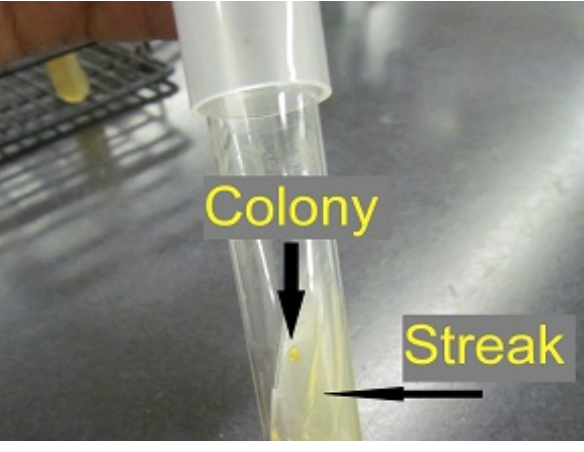
What error in aseptic technique most likely caused this contaminant colony to grow on this agar slant
failure to flame the mouth of the tube
A student inoculated an agar slant with inoculum from a colony on a Petri plate. The slant was incubated at an appropriate growth temperature for this species for 2 days. The results are shown in this photograph. Which hypothesis best explains why there is so little growth on the agar?
the loop dug into the agar during inoculation
You have finished sterilizing your inoculation loop using the Bunsen Burner, but realized you need to leave your bench to get the media you intend to inoculate. What should you do with your sterilized loop to prevent needing to sterilize it again?
Place the loop in a test tube rack, loop side up, to prevent the loop from touching a surface.
When you inoculate a plate, what do you with the lid of the plate?
Holding the lid in your hand, partially cover the plate with the lid during the inoculation.
The process of transferring microorganisms from one medium to another is known as:
subculturing
Microorganisms are typically present in which of the following locations?
in the air, on lab surfaces, and on your
When should inoculating instruments be flame sterilized?
before and after you transfer the culture
Which of the following statements is true regarding proper aseptic culturing techniques?
It is necessary to hold the inoculating instrument in the Bunsen burner flame until it becomes red hot.
Once you have sterilized your inoculating loop, it is important that you wait 10-20 seconds before using the loop to pick up a sample from your culture. What is the purpose of letting the inoculating instrument cool off?
Avoid killing the bacterial cells with excess heat
an inoculating _____ is generally used to obtain an inoculum from a broth culture, while an inoculating _____ is typically used to transfer microorganisms to an agar deep tube.
loop; needle
Why must you allow an inoculation loop or needle to cool after sterilization before inserting it into a culture of bacteria?
(Both correct answers must be selected to earn credit)
Select All That Apply
A.To prevent contaminating the bacteria
B.To prevent forming aerosols
C. To prevent killing the bacteria
D.To prevent breaking the glass tube
b & c
Which bacterium is used for the aseptic technique lab exercise?
Serratia marcescens
What is a chemcally defined medium?
A basic culture medium with a known chemical composition
What ingredient is added to broth medium to make a semi-solid or solid medium?
agar