Biology - B4.1 Adaptation to environment
 Call Kai
 Learn
Learn Practice Test
 Spaced Repetition
 Match
Match Flashcards
 Knowt Play
1/33

There's no tags or description
Looks like no tags are added yet.
Name | Mastery | Learn | Test | Matching | Spaced | Call with Kai | Chat |
|---|
No analytics yet
Send a link to your students to track their progress
34 Terms
Definition habitat
The place in which a community, species, population or organism lives
What is included in the descriptions of a habitat?
Geographical location, physical conditions, type of ecosystem
What are adaptations? Type and definition
Abiotic or biotic adaptations
Genetic traits specific to a species, due to evolution
Definition abiotic
non-living
Examples of abiotic variables
Temperature, light intensity, water availability, wind, humidity, pH of soil or water, availability of mineral ions, salinity of soil or water
What is he habitat of Marram grass?
Dunes at the sea with a lot of wind, sand and parallel to the beach

What are the challenges for Marram grass?
Must be tolerant to wind
Sand holds little water
Dry with high salinity
Dunes move and vegetation moves
What are adaptations that Marram grass experience?
The blades are folded so less wind can come to the stomata which are positioned inside the fold
Waxy cuticle on leaves
Woody structure when deprived of water
What is the habitat of tall-stilt mangrove?
A mangrove swamp with tropical temperatures, and aquatic environment
Positioned where the saltwater meets freshwater

What are the challenges that tall-stilt mangroves experience?
Increase in salinity for environment, so must be salt tolerant
Poor oxygen soil conditions
Adaptations of tall-stilt mangrove trees
Excrete the excess salt they absorb at the leaves
Roots come up out of the water and soil to get the extra oxygen
Large buoyant seeds that can populate and move everywhere
Definition range of tolerance and adaptations relation
The highest abundance of a particular species in the optimum tolerance range and the zone of intolerance
Adaptations give species a range of tolerance, as abiotic variables limit a species’ distribution
How do coral reefs form?
Colonies of coral polyps which are invertebrate animals
The polyps secrete a hard calcium carbonate exoskeleton
This exoskeleton builds up over many years to form the basis of the reef
Food is obtained through stinging cells but they also photosynthesise using symbiotic algae called zooxanthellae (live within coral)

What are symbiotic algae?
E.g. zooxanthellae in corals
The algae have a mutualistic relationship with the coral
Why do corals have these abiotic conditions in the marine ecosystem?
Shallow water, so that it’s closer to the light and can get enough light for photosynthesis
Slightly basic/alkaline pH of around 8 to 8.4, to allow deposition of calcium carbonate
Quite salty water is the correct osmotic condition for coral and zooxanthellae to survive
Clear water for light to penetrate for photosynthesis
Optimum temperatures are between 23-29°C for enzyme function and a fast rate of photosynthesis
What are the abiotic conditions of coral reef habitat?
Shallow water
Higher pH, 8.0 to 8.4
Quite salty
Clear water
Optimum temperature between 23-29°C
Definition terrestrial biomes
Areas characterised by specific climate conditions, plant communities and animal species
Temperature and rainfall impacting biomes
For any given temperature and rainfall pattern a particular natural ecosystem type is likely to develop
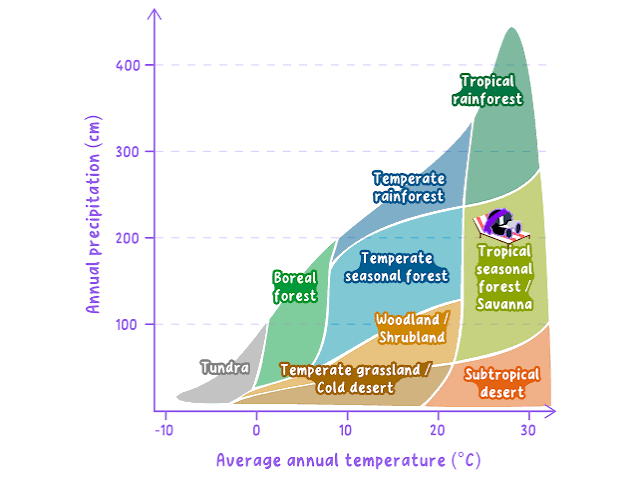
List of biomes
Tropical forest, temperate forest, taiga, grassland, tundra, hot desert

Climate conditions of tropical forest
High temperature, high amount of rainfall all year round, high light intensity, minimal seasonal variation
Climate conditions of temperate forest
Seasonal temperatures/moderate, moderate to high rainfall, moderate light intensity, warm summers/cold winters for seasonal variation
Climate conditions for taiga
Low to moderate temperatures (-10 to 20 °C), moderate rainfall, low to moderate light intensity, long winters and short cool summers for seasonal variation
Climate conditions for grassland
Warm temperatures, seasonal rainfall, high light intensity, normal seasons
Climate conditions for tundra
Cold temperatures (-30 to 10°C), low precipitation, low light intensity, long winters short cool summers for seasonal variation
Climate conditions for hot desert
Very high temperatures, very low rainfall, high light intensity, minimal seasonal variation
Climate conditions relating to biodiversity
High temperature and high rainfall levels lead to high biodiversity and a lot of plant growth
Examples of adaptations in hot desert
Fennec fox and Saguaro cactus

Adaptations of fennec fox
Nocturnal, avoids the highest temperatures of the day
Builds a den underground, for cooler temperatures
Has long thick hair for insulation
Has hair on the pads of feat for insulation on hot sand
Pale coat colour, reflects sunlight
Large ears to radiate more heat

Adaptations of saguaro cactus
Wide spreading root system to collect water
Deep roots to collect water
Fat stems with storage tissue to conserve water
Stems vertical to reduce interception of sunlight at midday
Thich waxy cuticle to reduce transpiration
Less leaves to decrease surface area and prevent heating

Examples of adaptations of the spider monkey
Long arms and legs for climbing
Flexible shoulders for swinging
Large hook-like hands to grasp branches and pick fruit
Feet for extra hands, hands for eating fruits
Long tail to grip branches
Larynx developed for wide range of sounds, can communicate
Active in day because then has best vision

Examples of adaptations of yellow meranti
Grow more than 100 metres, avoid competition for light
Trunk dense wood for support
Trunk with support in shallow soil
Smooth trunk, shed rainwater rapidly
Evergreen broad oval leaves for year-round photosynthesis
Enzymes for photosynthesis adopted for higher temperatures
Not many flowers produced to prevent eating
Transects as a method of gathering information
Can be used to gather data on the distribution of plant or animal species and correlate this data with chosen abiotic factors
Types of transects
Line transect, organisms that are touching the line at predetermined positions are recorded
Belt transects, quadrats placed at regular intervals and the abundance of the organisms are recorded
Methods of working with quadrats
Estimating percentage cover
Allocating descriptions of each organism according to a scale like the ACFOR scale (A=abundant, C=common, F=frequent, O=occasional, R=rare)