macro chapter 9
 Studied by 0 people
 Call Kai
 Learn
Learn Practice Test
 Spaced Repetition
 Match
Match Flashcards
 Knowt Play
1/21

Earn XP
Description and Tags
economic growth 2: technology, empiricism, politics
Name | Mastery | Learn | Test | Matching | Spaced |
|---|
No study sessions yet.
22 Terms
technical progress in the solow model
consideration of variable E: work efficiency
assume that technical progress increases labour input
increases E at exogenous rate g = ∆E/E
result: new production function Y = F(K,LE)
LE = labour input in efficiency units = (1+% growth) x L
if E increases, it acts like an increase in L
what is the solow model
economic framework
explains long-term economic growth through capital accumulation, labour growth, + technological progress
highlights that while saving/investment boost capital, only exogenous technological advancement drives sustained long-growth
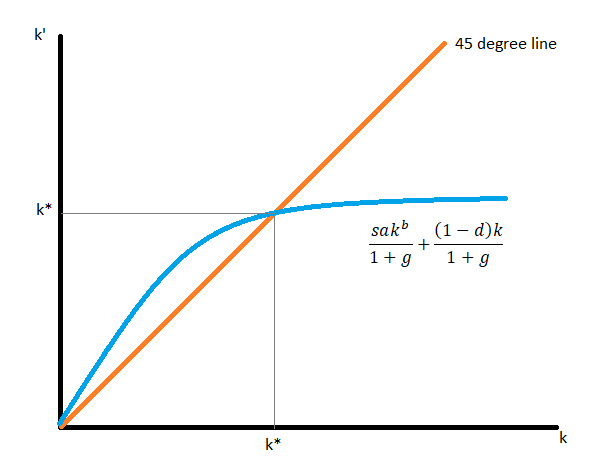
solow model formulae
y = Y/(LE)
k = K/(LE)
production function (output per efficiency unit) → y = f(k)
savings/investments (per efficiency unit) → sy = sf(k) = i
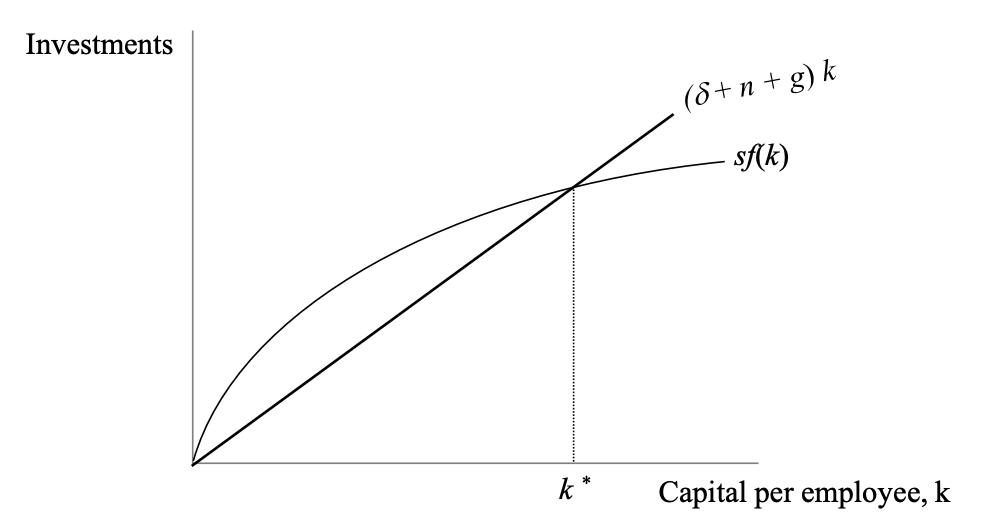
investment volume required to ensure that capital stock per efficiency unit remains constant (steady rate) → sf(k) = (δ + n + g)k
technical progress in the steady state
labour-increasing tech progress with rate g has similar effect in solow model, to population growth with rate n
capital intensity (k): capital stock per unit of labour efficiency
increase in efficiency units caused by tech progress → reduction in k
in steady state, investment sf(k) offsets reduction in k due to depreciation, population growth, + tech progress
the golden rule
describes consumption-maximising steady state
consumption
c* = y* - i*
= f(k*) - (δ + n + g)k*
c* is maximised if MPK = δ + n + g
respectively MPK - δ = n + g → GOLDEN RULE
at what rate does the capital per efficiency unit grow?
∆k* = 0 in the steady rate
no growth in k
no change/growth in capital stock
at what rate does the output per efficiency unit grow?
y* = f(k*) does not grow/change
at what rate is output per employee growing?
growth per capital (per employee)
growth rate by which employees become more efficient
it grows by g
people are more efficient → growth rate of capital stock grows by g
at what rate is the total output growing?
aggregated output grows by n + g
implications of the solow model
sustained growth in per capita income is only possible through technological progress
policy recommendation: stimulate technical progress
solow model sources of growth
quantity of production factors
labor and capital
determined by population growth and savings behaviour
efficiency of the use of production factors: Is determined by technical progress
how the technical progress arises is not explained in the model
empirical observations on the solow model (list)
convergence of economics
factor accumulation vs production efficiency
good corporate governance
convergence of economics
economics coverage with the same savings rate but different capital stocks
eg. japan and germany after WWII
if savings rates or efficiency differ, countries do not converge
conditional on steady-state variables
annual convergence is 2%
factor accumulation vs production efficiency
both variables are important for a high income
both variables are also correlated and difficult to separate
production efficiency attracts capital (eg investment)
factor accumulation favours conditions for higher efficiency
good corporate governance
explains differences in efficiency and thus differences in income across countries
major differences in quality of corporate governance → USA vs brazil
one explanation is lack of competition
second explanation is primogeniture
growth policy measures
influencing savings rate → private savings & government savings
gov can stimulate private investment with budget surpluses
private savings can be stimulated through incentives
policy examples
low taxation of capital income
higher consumption tax
tax exemption for private pension plans
private investments
are efficiently controlled by the market
capital is deployed where it generates the highest return
the state should only set competitive framework conditions
government investment
infrastructure investments necessary but difficult to measure
can the state generate +ve externalities through its own investments?
social returns then exceed private returns
effectiveness of industrial policy depends on the ability to measure +vs externalities
eg. investments in renewable energy
but danger of lobbying & bad investments
conditions for investments
institutions should be designed so the conditions favour investments, and allocation of investments is efficient
what makes a good institution?
reliable legal system with legal protection for shareholders & lenders
protection of property rights
functioning capital markets
promoting competition
limiting corruption
how can the state stimulate technological progress?
promotion of R&D → research at unis
research funding: DFG, Max Planck society, etc
create framework conditions for companies to engage in R&D: eg through patent right which allows entrepreneurial return from R&D
international trade
ricardo’s theory of competitive advantage
shows that countries can/should concentrate on more production-efficient goods