Berry College: BIO 207- Lab 1 (Eye and Ear)
 Call Kai
 Learn
Learn Practice Test
 Spaced Repetition
 Match
Match Flashcards
 Knowt Play
1/43

There's no tags or description
Looks like no tags are added yet.
Name | Mastery | Learn | Test | Matching | Spaced | Call with Kai | Chat |
|---|
No analytics yet
Send a link to your students to track their progress
44 Terms
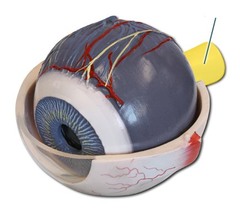
Optic Nerve
axons leave the eye and relay visual information to the brain
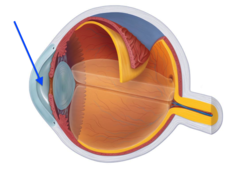
Aqueous Humor
provides nutrients to cornea, lens
Lens
focuses light on the retina

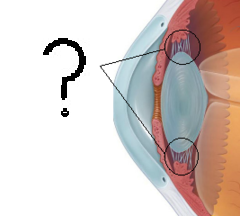
Suspensory Ligament
holds lens, adjust lens shape with ciliary body
Vitreous Humor
maintains pressure on retina

Pupil
adjusts amount of light that reaches the retina

Sclera
site of muscle attachment, protects, anchors eye

Cornea
refracts light

Choroid
provides nutrients to retina

Ciliary Body
smooth muscle that adjusts shape of lens to bend light to fovea

Iris
contains muscle that change the size of pupil

Ora Serrata
site where ciliary body meets retina

Retina
responsive to light, phototransduction

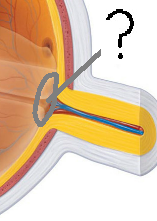
Optic Disc
site of axons leaving eye, vessels entering
Macula Lutea
site with high density of photoreceptors, contains, contains fovea centralis
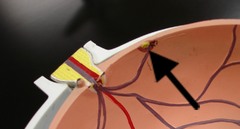
Fovea Centralis
indented center of the macula lutea, allows for detailed vision

Photoreceptors
responsive to light energy, relay signal to bipolar cells

Superior and inferior Rectus Muscles
extrinsic eye muscles that respectively move the eye superiorly and inferiorly

Medial and Lateral Rectus Muscles
extrinsic eye muscles that respectively move the eye medially and laterally

Superior Oblique Muscle
extrinsic eye muscles that moves the eye inferiorly and laterally
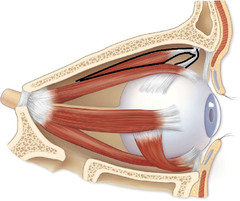
Inferior Oblique Muscle
extrinsic eye muscles that elevates eye superiorly and laterally

Blind Spot Test
- Illustrates the fact that the optic disk has no receptors
- focus on x while paper moves closer until the dot disappears
Visual Acuity Test
- tests ability to distinguish outlines and details
- uses Shelleen's Chart
- 20/20 is normal
Astigmatism Test
- tests for distortion of the lens and/or cornea
- if any line in a ray of black lines looks fuzzy or less dark, it could indicate some distortion
Afterimages Test
- exhibits bleaching of pigments in photoreceptors and resynthesis of pigments
- after staring at a light, a positive image appears with eyes closed, and then a negative image appears after a time with eyes open
Color Blindness Test
- tests cones' ability to detect different colors of light
- most genes for color vision appear on the x chromosome
- if one x chromosomes has a defect a normal x chromosome can counter it
- test using images made with various colored dots
Depth Perception Test
- tests retinas ability to accurately triangulate distance
- attempt to quickly place a pencil into a test tube at an arm's length away
Outer Ear
the outermost part of the ear, consisting of the pinna, the external auditory canal, and tympanic membrane
(air filled)

Middle Ear
the chamber between the eardrum and cochlea containing ear ossicles and pharyngotympanic tube
(air filled)

Inner Ear
the innermost part of the ear, containing the cochlea, semicircular canals, vestibule, and vestibulocochlear nerve
(fluid filled)
Auricle (pinna)
external portion of the ear that funnels sound into the ear
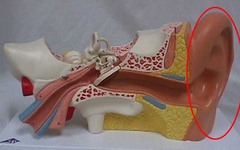
External auditory canal
portion of the outer ear that transmits sound waves from the pinna to the tympanic membrane

Tympanic membrane
a structure that separates the outer ear from the middle ear and vibrates in response to sound waves

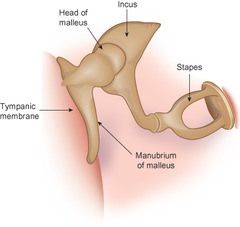
Ear ossicles
three small bones (malleus, incus, and stapes) located in the middle ear cavity that serve to transmit sound vibrations to the inner ear
Pharyngotympanic tube
connects the middle ear to the nasopharynx

Cochlea
a coiled, bony, fluid-filled tube containing cochlear duct and spiral organ in the inner ear that transmits sound

Semicircular canals
three canals within the inner ear that contain specialized receptor cells that are involved in balance and equilibrium

Vestibule
contains structures that help you sense gravity and linear acceleration
Vestibulocochlear nerve
cranial nerve involved in hearing and balance
Balance/equilibrium test
- demonstrates the brains attempt to regulate input from eyes and vestibular apparatus
- partner spins you on a stool and you attempt to remain focused ahead
- the fluid inside the inner ear continues to move as your head stops
Lab 2 pre-lab: Which of the following hormones is NOT secreted by the hypothalamus?
- growth hormone
Lab 2 pre-lab: (T/F) The pancreas is both an exocrine and an endocrine gland
true
Lab 2 pre-lab: In an individual with Type I diabetes:
Cells of the pancreas are attacked by the immune system
Lab 2 pre-lab: A hormone that causes release of another hormone is referred to as a(n) _________________ hormone
tropic