818 Exam 1 Concepts
 Call Kai
 Learn
Learn Practice Test
 Spaced Repetition
 Match
Match Flashcards
 Knowt Play
1/132

There's no tags or description
Looks like no tags are added yet.
Name | Mastery | Learn | Test | Matching | Spaced | Call with Kai | Chat |
|---|
No analytics yet
Send a link to your students to track their progress
133 Terms
kinetic homogeneity
the changes in plasma drug concentrations are reflected proportionately at the site of action
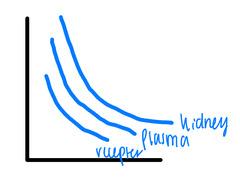
concentration homogeneity
the concentrations throughout the body are equal.
_________ at the site of action, drives response
drug concentration
concentration =
amount/volume
population parameters
describe a typical PK behavior in a population - used to inform dosing strategies for the general population
patient parameters
describes the PK behavior in a SPECIFIC individual based on patient specific factors (age, sex, body size, DDIs, diet)
using a population CL parameter, is the expected Css was 8.2 ng/mL but the actual measured Css of the patient was 3.8 ng/mL, what would this indicate?
that the patients actual CL is higher than the population parameter
exponential
model of rapid increase in drug concentrations due to absorption and distribution in the body (growth rate of the concentration - % increase)
logarithmic
model of decay of drug concentration in the body (% decrease)
e^0 = ?
1
e^infinity = ?
0
lnX = ?
LogX x 2.303
for e^-kt (exponential decay function), the ______ the value of K, the more rapidly the expression decays towards _____
larger; zero
for 1- e^-kt (growth function), the ________ the value of K, the more rapidly the expression grows towards ______
larger, one
zero order
non-linear
saturable
Michaelis-menton
zero order involves ....
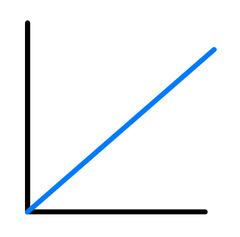
the elimination of a constant AMOUNT of drug lost per unit time
T/F: for zero order kinetics, the elimination rate is INDEPENDENT of drug concentration
TRUE
Draw a zero order concentration time graph (linear Y scale)
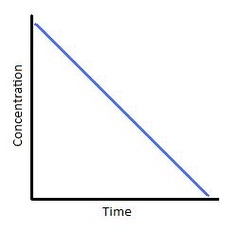
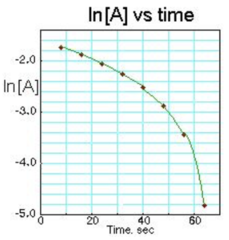
Draw a zero order concentration time graph (logarithmic Y scale)
T/F: Most pharmacokinetic processes are zero-order processes
FALSE
first order
linear kinetics, predictable
first order involves .....
the elimination of a constant PROPORTION (%) of drug per unit time
T/F: for first oder kinetics, elimination rate is DEPENDENT of drug concentration
TRUE
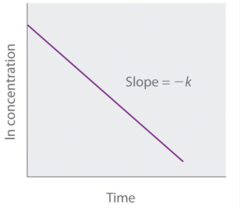
Draw a first order concentration time graph (linear Y scale)
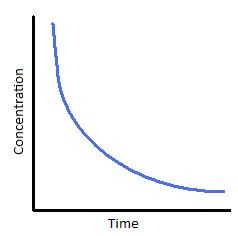
Draw a first order concentration time graph (logarithmic Y scale)
in pharmacokineitcs, _____ compartment model is often used to describe the drug elimination following a _____ order process after a IV ______ dose
one; first; bolus
what is "K"
the first order elimination rate constant (units = h^-1); represents fractional rate of loss of drug from the body
what does a value of K = 0.1 h^-1 indicate?
that 10% of the drug is lost every single hour (10% of the starting quantity/hr and then 1 hr later 10% of a smaller quantity is lost)
what is "Ko"
zero order constant
Half life (T 1/2)
the time needed for plasma concentration of the amount of drug in the body to decline by 50%
T 1/2 for zero order is ______ upon the initial concentration (Co) or dose (Xo)
DEPENDENT as T/12 = 0.5 will occur after half of the dose is gone
T 1/2 for first order is ______ upon the initial concentration (Co) or dose (Xo)
INDEPENDENT as T 1/2 is dependent on the elimination rate constant "k"
Allegra's K = 0.048 and Zyrtec's K = 0.082. which has the shorter half life?
zyrtec as the K value is larger and K and T 1/2 are inversely proportional
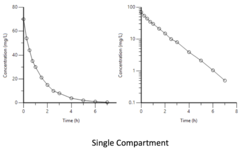
one compartment model
a mathematical description of the body which assumes the body behaves as a single homogenous unit (blood = tissues)
what are the 4 assumptions with the one compartment model?
1) instantaneous drug distribution
2) one PK system
3) linear kinetics
4) stationary system
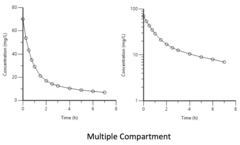
two compartment model
represents a transfer to and from central and peripheral compartments
draw the one compartment model graphs (linear and logarithmic Y scale)
draw the multi compartment model graphs (linear and logarithmic Y scale)
principle of superstition
applies to linear kinetics only and allows us to make predictions about concentration -> if you have a concentration at a certain dose, doubling the dose will double the concentration or tripling the dose will triple the concentration
According to the principle of superposition, which statement is TRUE?
a) The principle of superposition applies to drugs that exhibit linear and nonlinear pharmacokinetics.
b) Based on the principle of superposition, if you triple the dose of a drug, the resulting drug plasma concentration will double.
c) The resulting log-linear plasma concentrations with 3 different doses of the same drug will show them equally proportional to the drug dose.
d) A log-linear plot of 3 different doses of the drug will show equal concentrations but different slopes of elimination.
C
Area under the curve (AUC)
an indication of how much drug is in the body
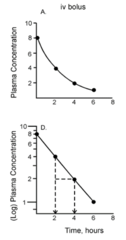
IV bolus
drug injected into the plasma/serum/blood at an instantaneous rate (< 5 min)
- the amount of drug at T0 = dose given
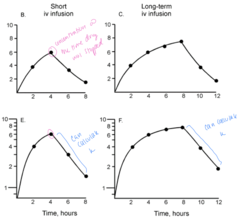
short IV & long IV infusion
drug dose administered as a constant rate infusion over a specific period of time
- may or may not reach Css
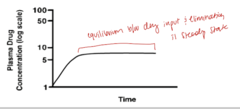
constant (continuous) IV infusion
drug dose administered as a constant rate infusion and that infusion does not stop
- likely will reach Css
intravenous vs extravascular administration
elimination
loss of substance from the body (irreversible process)
T/F: elimination is associated with the loss of potent compound
TRUE
Clearance
volume/time -> the amount of volume that the drug us completely removed from per unit of time
T/F: Clearance is additive
TRUE as its made up of Cl renal + Cl nonrenal
clearance for an organ is defined by what two things?
blood flow (Q) and extraction ratio (ER)
what is ER mean?
an indication of the organs ability to remove a drug from systemic circulation
fraction excreted unchanged (fe)
the quantitative measure of contribution of renal excretion to overall drug elimination; a % that will be multiplied by Cl total to determine Cl renal
T/F: want to collect a urine sample after 3-5 T 1/2 lives of the drug to be a sufficient collection to accurately determine amount of drug renally cleared
TRUE
restrictive drug clearance (low Cl))
low intrinsic clearance and ER (ER < 0.33)
non restrictive drug clearance (high Cl)
high intrinsic clearance and ER (ER > 0.67)
in restrictive drug clearance, CL = ?
Cl = Clint; only factors that affect enzyme activity or protein binding will affect the clearance of a low Cl drug
in nonrestrictive drug clearance, CL = ?
Cl = Q; only factors that affect blood flow will affect the clearance of a high Cl drug
Hepatic clearance & restrictions
bound and unbound drug but only unbound can enter the hepatocytes -> blood flow AND protein binding are restrictions
intrinsic clearance
how efficient the organ (liver) is at removing the drug from the body -> represents the maximal ability of the organ to remove the drug
restrictions of intrinsic clearance
protein binding and enzyme activity are restrictions; blood flow is NOT a restriction
unbound intrinsic clearance & restrictions
provides the best indicator of inherent enzyme activity since protein binding and blood flow are not restrictions -> only the activity of the enzyme is the restriction & Fu = 1
T/F: the unbound intrinsic clearance of a drug is always higher than the intrinsic clearance
TRUE
renal filtration
passive elimination
T/F: renal filtration is always the first step in Cl renal
TRUE
If Cl renal = CL filtration, then ....?
drug must only undergo filtration
If Cl renal < CL filtration, then ....?
drug must also undergo reabsorption
If Cl renal > CL filtration, then ....?
drug must also undergo secretion
tubular secretion
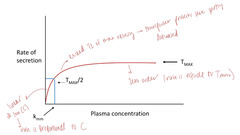
an active, saturable process based on the intrinsic ability of the transporter
T/F: at a low concentration of drug, the rate of tubular secretion increases in direct proportion to the drug concentration & this resembles first order kinetics
TRUE as rate = Tmax + C /kmm
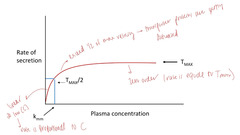
Kmm
a constant -> plasma concentration required to reach 1/2 T max
T/F: at a high concentration of drug, the rate of tubular secretion becomes constant and equals Tmax & this resembles zero order kinetics
TRUE as rate = Tmax
T/F: actively secreted drugs are susceptible to potential drug interactions
TRUE
non-ionic reabsorption
a passive process that depends on the ionization of the drug as only UNIONIZED drug will be reabsorbed
when the pH is 2 units ______ the pka of the base, then the molecule is 99% _______ and renal clearance of the drug will _______
below; ionized; increase
when the pH is 2 units _____ the pka of the acid, then the molecule is 99% _____ and the renal clearance of the drug will ______
above; ionized; increase
drug distribution
the movement or translation of drug molecules from the blood stream and into tissue
volume (Vd)
amount/concentration
what is volume of distribution?
the fluid (L) that would be required to contain all of the drug in the body at the same concentration that is measured in the body fluid
T/F: Vd is never measured directly and can only be extrapolated from C0 if has a one compartment model or first order kinetics.
TRUE as Vd = dose/C0
T/F: the larger the Vd, the smaller the Co
TRUE because the drug is being readily distributed into blood and tissues (inversely proportional)
large Vd (~ > 50-100L)
the drug is distributing out of the blood/plasma and into the tissues
small Vd (
the drug is staying in the blood/plasma
what is the smallest volume a drug can have if it stays in the plasma and remains completely bound?
7L -> 7 + 8 x Fu = Vd where Fu = 0 (no fraction unbound since drug all bound)
what is the largest volume a drug can have if it stays in the plasma and is completely unbound?
15L -> 7 + 8 x Fu = Vd where Fu = 1 (100% unbound)
T/F: CL and Vd are INDEPENDENT parameters
TRUE
unbound drug
the drug that influences drug distribution, elimination, and pharmacodynamic response as free drug can diffuse freely across membranes
Fu
fraction unbound drug (typically expressed from 0-1 or a percent)
fu = 0
the drug is completely bound to plasma proteins
fu = 1
the drug is completely unbound
Kassn
binding constant -> characterizes the binding affinity of a drug to a protein
predict what would happen to % unbound drug with the following occurrences:
- increase plasma protein concentration
- increase Kassn
- increase # of binding sites
% unbound would decrease for all of them
how do changes in protein binding affect drugs with a low Vd?
an change in fraction unbound drug (fu) will less than proportional change volume
how do changes in protein binding affect drugs with a high Vd?
an change in fraction unbound drug (fu) will result in a proportional change in volume
how do changes in protein binding affect drugs with a low (restrictive) clearance?
a change in fraction unbound drug (fu) will result in a proportional change in clearance of the drug
how do changes in protein binding affect drugs with a high (nonrestrictive) clearance?
an change in fraction unbound drug (fu) will result in NO CHANGE in clearance of the drug
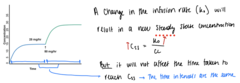
Concentration at steady state (Css)
observed when the amount of drug entering the body = the amount of drug being eliminated from the body
what is Css determined by?
ONLY by maintenance dose (Ko) and Cl
approx how many T 1/2 does it take to reach Css?
~5 half lives
T/F: a change in the infusion rate (K0) will change the time to Css
FALSE the only thing it will change is the concentration at Css
a change in CL will affect what in terms of Css
1) the steady state concentration (Css will be lower if Cl is increased)
2) the time to steady state concentration since T 1/2 is inversely proportional to CL