Chapter 1.3: Units of Measurement
 Call Kai
 Learn
Learn Practice Test
 Spaced Repetition
 Match
Match Flashcards
 Knowt Play
1/33

Name | Mastery | Learn | Test | Matching | Spaced | Call with Kai | Chat |
|---|
No analytics yet
Send a link to your students to track their progress
34 Terms
SI units
A unit composed of one or more of the base units of the Systeme International d’Unites, a revised form of the metric system
Base units
A unit that defines the standard for one of the seven physical quantities in SI; includes:
Mass: kilogram (kg)
Length: meter (m)
Time: second (s)
Temperature: kelvin (K)
Amount of substance: mole (mol)
Electric current: ampere (A)
Luminous intensity: candela (cd)
Derived units
Combinations of the seven base units, such as speed (meters per second)
Kilogram (kg)
The SI unit for mass
Is the only base unit whose name has a prefix
Is constant opposed to weight, varying due to gravity
Weight
A variable measurement that depends on the local gravitational field of an object
Meter (m)
The SI unit for length
The distance light travels in a vacuum in 1/299 792 458 sec
1.094 yards
Used also for volume, when cubed
Cubic meter (m3)
The SI unit for volume, derived from the meter (m)
Liter (L)
The more common chemistry measurement for volume, non-SI
Equivalent to 1 dm3
Uses uppercase L
milliliter (mL)
The more common chemistry measurement for smaller volumes, non-SI
Equivalent to 1 cm3
Also uses uppercase L
Second (s)
The SI unit for time
Based on an atomic standard: 9 192 631 770 oscillations of gaseous cesium atoms cooled to around 10-6 K, measured by lasers
Kelvin (K)
The SI unit for temperature
Differs from heat as just a measure of how hot or cold an object is and not the energy introduced
No degree sign is used for this unit
Uses the same size degree as Celsius, but is 273.15 degrees higher due to its zero point meaning absolute zero
Absolute zero
The temperature of 0 K or -273.15 degrees C, where all atoms cease movement
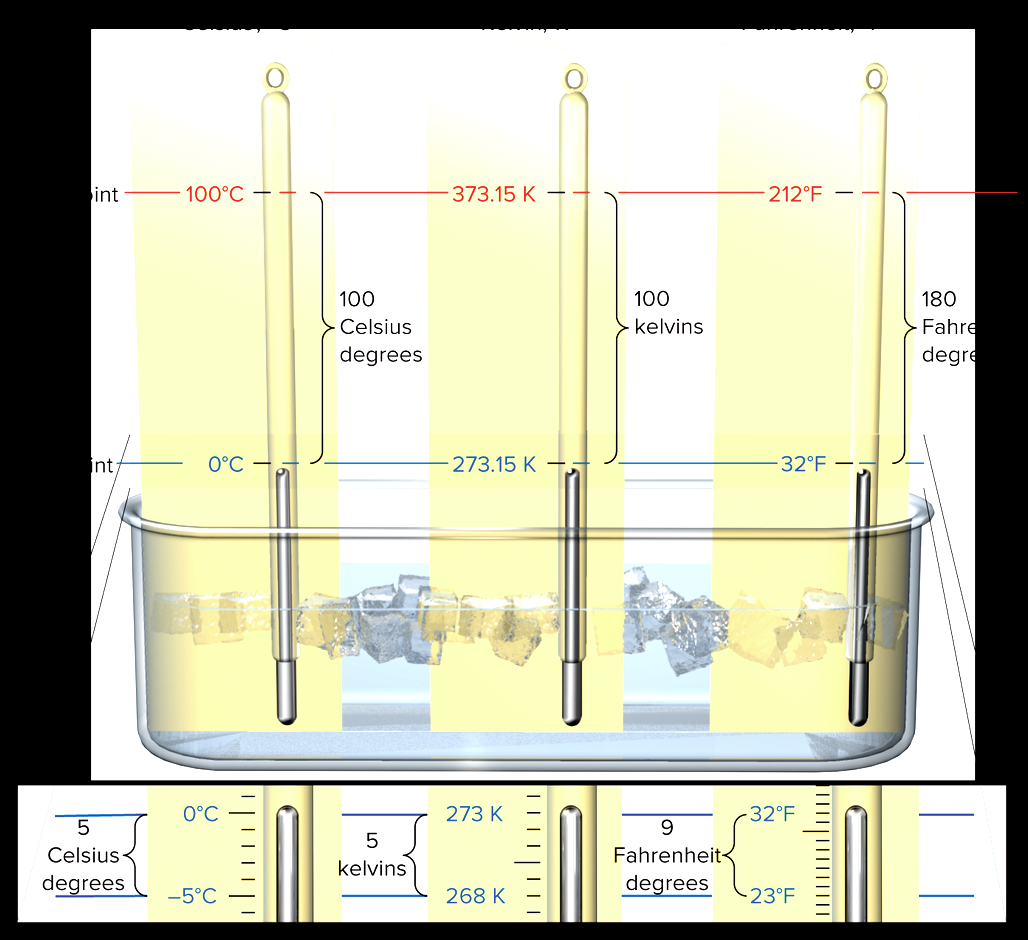
Celsius (C)
The metric unit for temperature; it sets water’s freezing point at 0 degrees and its boiling point at 100 degrees
Fahrenheit (F)
The English unit for temperature; it differs in zero point and degree size, with water freezing and boiling at 32 and 212 degrees respectively
Thus, 180 of these represent 100 Celsius degrees, leading to a 9/5 ratio — one can add 32 to fully convert
Converting back requires subtracting 32 first, then multiplying by 5/9
Temperature (T)
A measure of how hot or cold one object is relative to another
Heat
The energy that flows from an object with a higher temperature to an object with lower temperature
This flows from your hand into ice, instead of “cold” flowing into your hand
Thermometer
A graduated tube containing a fluid that expands when heated
Mole (mol)
The SI unit for an amount of substance
Ampere (A)
The SI unit for electric current strength
Candela (cd)
The SI unit for luminous intensity
Decimal prefixes
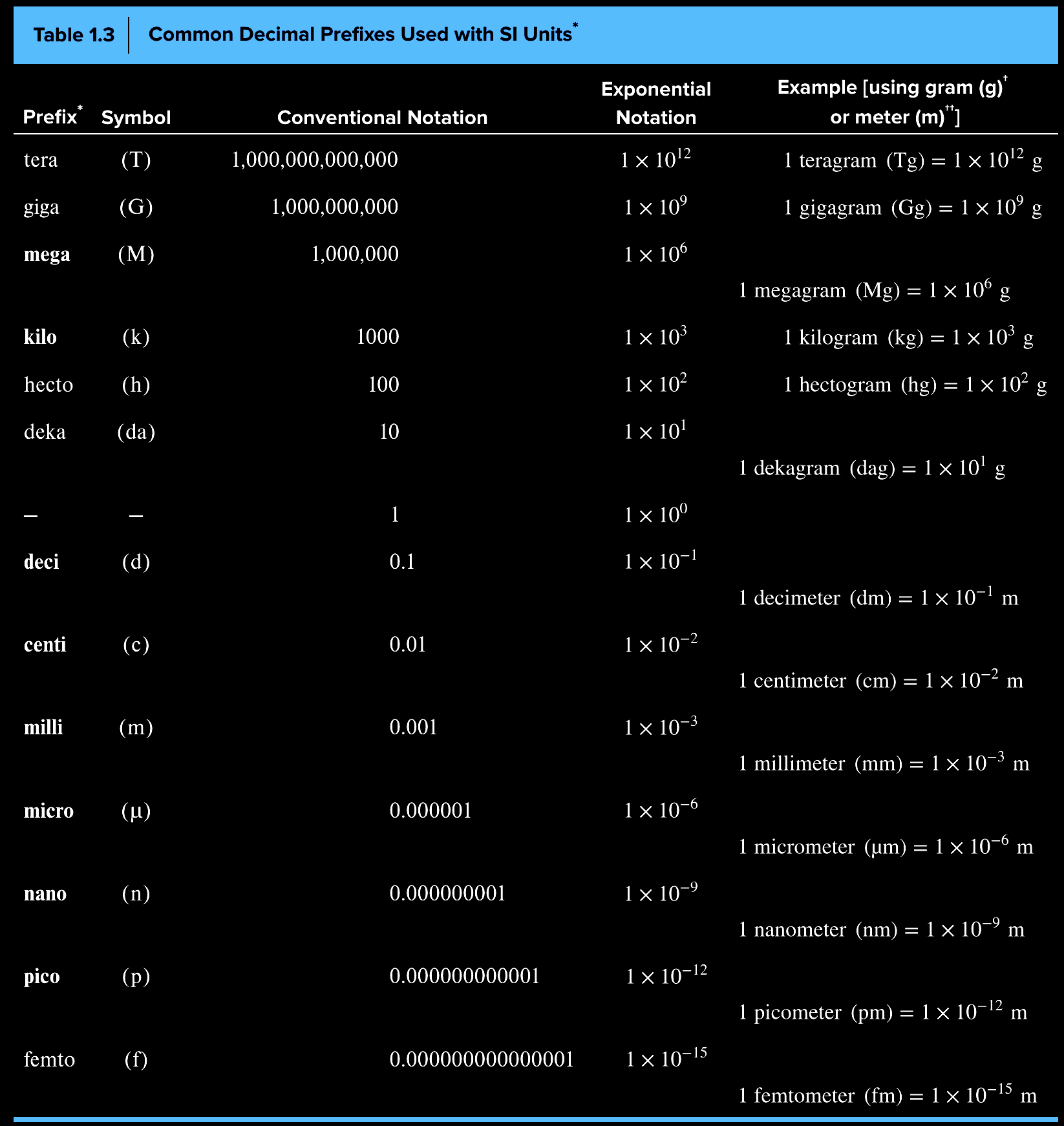
Prefixes to multiply the base unit for very large or small quantities; includes:
tera (T): 1 × 10¹²
giga (G): 1 × 10⁹
mega (M): 1 × 10⁶
kilo (k): 1 × 10³
hecto (h): 1 × 10²
deka (da): 1 × 101
base (one)
deci (d): 1 × 10⁻¹
centi (c): 1 × 10⁻²
milli (m): 1 × 10⁻³
micro (u): 1 × 10⁻⁶
nano (n): 1 × 10⁻⁹
pico (p): 1 × 10-12
femto (f): 1 × 10-15
tera (T)
The SI prefix for 1 × 10¹²
giga (G)
The SI prefix for 1 × 10⁹
mega (M)
The SI prefix for 1 × 10⁶
kilo (k)
The SI prefix for 1 × 10³
hecto (h)
The SI prefix for 1 × 10²
deka (da)
The SI prefix for 1 × 101
deci (d)
The SI prefix for 1 × 10⁻¹
centi (c)
The SI prefix for 1 × 10⁻²
milli (m)
The SI prefix for 1 × 10⁻³
micro (u)
The SI prefix for 1 × 10⁻⁶
nano (n)
The SI prefix for 1 × 10⁻⁹
pico (p)
The SI prefix for 1 × 10-12
femto (f)
The SI prefix for 1 × 10-15