Chapter 4: Energy, Water, and the Diversification of Life
 Call Kai
 Learn
Learn Practice Test
 Spaced Repetition
 Match
Match Flashcards
 Knowt Play
1/131

There's no tags or description
Looks like no tags are added yet.
Name | Mastery | Learn | Test | Matching | Spaced | Call with Kai | Chat |
|---|
No analytics yet
Send a link to your students to track their progress
132 Terms
Can you answer these learning objectives?
Define energy;
explain the role of energy in chemistry and life;
describe the relationship between carbon compounds and energy
discuss the function of ATP
outline the major energy harvesting schemes of cells
connect energy harvesting metabolism to biogeochemical cycling
provide examples of how energy drives evolution;
summarize the key life supporting properties of water and their chemical foundations
Biodiversity
the abundance of variety that exists across living things
Explain what you know about energy
Energy is the capacity to drive change
Life uses energy to operate the biochemical machinery of life
Energy in its various forms is the reason things do not simply stay the same forever through time
Life is a coordinated system of biochemical reactions, all of wich occur because of transfers of energy
Explain what you know:
Some energy is always wasted during energy transfers, causing systems to become less prone to change over time
Transfers of energy are never 100% efficient: Some of it is lost to an unusable form, usually as heat
This means that once energy is spent in a system, the potential from the system to undergo further change is reduced, and systems move inexorably over time toward a state of lesser available energy and potential for change.
left alone systems become less energetic and more stable over time but systems or parts of systems can be pused to more energetic, less stable arrangements by inputs of energy from elsewhere.
Explain what you know:
Heat, kinetic energy, and temperature
Kinetic energy is energy associated with motion
Heat is a form of kinetic energy, characterized by disorderly, chaotic vibrations of particles.
Temperature is a measure of the disordered kinetic energy
Explain what you know:
What are molecules made up of?
Molecules are made up of atoms joined together by chemical bonds.
Atoms: composed of a nucleus, which has protons and neutrons, and is surrounded by a cloud of negatively charged electrons that orbit the nucleus in surrounding shells, each of which hold a certain number of electrons.
The electric charges of protons and electrons project electric fields that attract particles of opposite charge and repel particles of like charges
Explain what you know:
Atoms achieve greater energetic stability by joining into bonds
Atoms achieve lower energy and more stability (energetically favorable) when their orbiting electrons are:
in balance with the number of protons in their nucleus
as close as possible to their nucleus
present in a number that completely fills any of the shells that are in use
Atoms achieve this by sharing or exchanging electrons with other atoms through chemical reactions
Atoms sharing electrons: covalent bond
Atoms exchanging electrons: ionic bond (ions carry electrical charge due to an imbalance between protons and electrons that results)
Cations: positively charged ions
Anions: negatively charged ions
Explain what you know:
Covalent bonds
Covalent bonds are strong since both atoms have mutual need of electrons
It requires large input of energy to break apart
Even more stable when one partner is more electronegative than the other, meaning it draws electrons more tightly towards its nucleus
Results in a polar bond characterized by a partial negaitve charge on the electron hogging side and a partial positive charge on the other side
Non-polar bonds are where electrons are shared more equally such that they do not distribute particularly close to either nucleus
Polar bonds are more energetically favorable than non-polar bonds because they are able to distribute themselves closer to the more electronegative nucleues
Glucose is a 6-carbon carbohydrate (sugar) with the chemical formula C6H12O6. The bonds in this molecule represent chemical energy. Which of the following is correct about these bonds? Explain why.
It will take an input of energy from the environment to cause the bonds to break
Bonds form between atoms because it is energetically favorable for them to do so, resulting in greater stability. It therefore takes an in[ut of energy to break the bonds and drive the atoms back to their less energetically stable state
Carbon (C) and hydrogen (H) exhibit very similar electronegativities. When carbon and hydrogen share electrons, what kind of C-H bond results? Explain
Non-polar covalent, with the electrons remaining equally distant from carbon and hydrogen on average
Because their electronegativities are similar, the shared electron will have no tendency to remain closer to one over the other, resulting in equal sharing between them.
Oxygen is the second most electronegative element, behind only fluorine in its tendency to pull electrons close to its nucleus. When oxygen (O) shares electrons with hydrogen (H), will the resulting O-H covalent bond be polar or nonpolar? Explain
Polar, with the electrons generally remaining closer to the oxygen on average
Because oxygen is much more electronegative than hydrogen, the shared electrons will generally be pulled more tightly toward the nucleus of the oxygen, resulting in a polar bond
Which of the following is correct about the charge distribution of C-H or O-H pairings?Explain
The O carries the partial negative charge in the O-H pair
Carbon and hydrogen have similar electronegativities, so they share the electrons equally. Oxygen is far more electronegative than either C or H, so it will tend to “hog” any electrons it shares with them, giving it a partial negative charge
Which covalent bond is more energetically favorable (stable): C-H or O-H?Explain
O-H
Because it is polar: the shared electrons are able to get closer to the nucleus of the more electronegative O than they can to either the C or H in the nonpolar C-H bond
The biomolecules of living things are organic molecules, meaning they have carbon backbones that are rich in C-C and C-H bonds. Oxygen in the air occurs as O2, which is formed by a double covalent bond between two oxygen atoms (O=O). Which of the following is correct about these bonds? Explain
C-C, C-H, and O=O are all nonpolar bonds
In each case the pairings between atoms with either identical or very similar electronegativities, and therefore the pulling of electrons toward their nuclei is the same
Suppose that some organic molecules are mixed with atmospheric oxygen, O2. Which of the following would result in the most energetically favorable (lowest energy, most stable) chemical outcome? Explain
The atoms of the organic molecules and oxygen rearrange to form CO2 and H20
It is more energetically favorable for the atoms to rearrange from the nonpolar C-C, C-H, and O=O bonds of the reactants into the highly polar bonds of CO2 and H2O with the enrgy difference being released as heat and/or light
The 6-carbon sugar glucose, C6H12O6, is a fundamental source of energy for living things. When hit with a sufficient spark of energy to break its bonds, glucose can react with oxygen in the air and burn, recombining with the oxygen to form carbon dioxide CO2 and water H2O while releasing energy as heat and light in the exchange:
C6H12O6 + 6 O2 → 6 CO2 + 6 H2O + energy
Why is energy released as a byproduct of this reaction? Explain
Because the polar bonds of CO2 and H2O are more energetically facorable than the nonpolar bonds of glucose and oxygen
Energy is always absorbed by molecules to break bonds and released from molecules when they form bonds. In this case, the amount of energy released from the newly formed bonds is greater than the amount it took to break the old bonds
Salt
The kind of molecule that results from the electrostatic attraction between cations and anions (ionic bond)
Explain what you know:
Nonpolar covalent bonds
Based on equal sharing of electrons between atoms
Occurs between atoms of similar electronegativities: both sides of the bond carry a neutral charge on avg, due to the shared electrons being pulled evenly between the participants
Energetically favorable because electrons and protons are in balance for all participants, but not as energetically favotable as it could be because the electrons are kept
Strong under all conditions
Examples: C-C and C-H
Explain what you know:
Polar covalent bonds
based on unequal sharing of electrons between atoms
occurs between atoms of very different electronegativities: one side of the bond (the more electronegative side) carries a partial negative charge on average while the other carries a partial positive charge, due to the shared electrons being pulled more strongly toward the more electronegative partner
More energetically favorable and stable than a nonpolar covalent bond because of the additional benefit of the electrons being distributed closer to a nucleus on average
strong under all conditions
Examples: C-O and O-H
Explain what you know:
Ionic bonds
based on attraction of opposite charges between ions
occurs between atoms of extremely different electronegativities: one atom is so much more electronegative that it strips the electrons and does not share them with its partner at all
energetically favorable because each atom fills it occupied shells and then compensates for the ionization problem by balancing its charge via close proximity to a partner of opposite charge
strong in dry conditions or nonpolar solutions byt comes apart easily in polar solutions
Examples: Na+ + Cl- = NaCl (Sodium chloride) and other salts
Explain what you know:
Redox reactions
Redox reactions release energy when they transfer electrons from one atom or molecule to another
Chemical reactions that involve the transfer of electrons are called oxidation-reduction or redox reactions
Oxidized: when atoms or molecules lose electrons in reaction
Reduced: Atoms or molecules gain electrons in reaction

Redox reactions involve electrons moving from one atom or molecule to another. Consider the example below, in which the transferred electrons are represented as an e- . Which of the reactants is oxidized in this reaction, and which is reduced? explain
Molecule A is oxidized in this reaction, while molecule B is reduced
In this reaction, the electrons transfer from molecule A to B. Molecule A thus loses the electrons = is oxidized, while molecule B gains them = is reduced
The 6-carbon sugar glucose, C6H12O6, is a fundamental source of energy for living things Consider the burning of glucose to release energy:
C6H12O6 + 6 O2 -> 6 CO2 + 6 H2O + energy
This is a redox reaction that cells do to get energy out of sugar, but capturing and using it rather than letting it escape as fire (light and heat). Which of the reactants is oxidized in this reaction, and which is reduced? Explain
The glucose is oxidized in this reaction, while the oxygen is reduced
The glucose is the electron donor and the oxygen is the electron acceptor: the C6H12O6 is oxidized to CO2, while the O2 is reduced to H20
Explain what you know:
Energy is tied to carbon in living things
Life is carbon based, meaning the biomolecules that make up the machinery of life have carbon skeletons.
These organic molecules are made up mainly of nonpolar covalent bonds among carbons and hydrogens, making them stable and rich in chem energy
if the electrons are moved out of the nonpolar bonds into more energetically favorable arrangements of polar bonds, energy will be released
Proteins, lipids, and carbohydrates all represent stores of energy that living things can use to drive metabolism
During times of plenty: living things are able to bring in more carbon and energy than needed, leading to increases in biomass
During times of shortfall: biomass decreases as living things expend their stored reserves to meet their needs
Explain what you know:
Living things pair energetically unfavorable reactions with favorable ones to drive their metabolism, mediated by enzymes and ATP
Enzymes: proteins that speed up the rates of biochemical reactions
Bind and orient the reacting molecules in ways that help them interact more efficiently
Each biochemical step in a metabolic pathway has a unique enzyme
The energy of chemical transactions comes from light or chemicals, and is usually delivered to the reaction by the molecule ATP
Energy currency of the cell (living things transfer energy from the fuel into molecules of ATP, which are spent on diff biochemical transactions as needed
ATP contains 3 phosphate groups
the bond between the 2nd and 3rd is highly unstable
This instability causes the 3rd phosphate group to break free as a negatively charged inorganic phosphate molecule HPO2- when ATP reacts with water, releasing a great deal of energy in the process
When an investment of energy causes nonpolar bonds in an organic molecule, such as sugar, to break, the atoms are freed to form more favorable polar bonds with other atoms, such as oxygen.
The result is a redox reaction: electrons move from the bonds of the organic molecule into something else
Explain what you know:
Hydrolysis
ATP (adenosine triphosphate) + H2O —> ADP (adenosine diphosphate) + Pi (inorganic phosphate) + energy
Cells use hydrolysis of ATP to transfer energy from ATP to other molecules
Explain what you know:
Cells generate ATP by 2 main kinds of redox pathways
Living things use energy from chemicals (chemotrophy) or light (phototrophy) to add an inorganic phosphate group to ADP
Substrate-level phosphorylation
involves a series of chemical rearrangements that culminate in the transfer of a phosphate group from a chemical compount to ADP.
Acheives relatively small amount of electron transfer from one kind of bond to another and yields little ATP per fuel molecule spent
Chemiosmosis
relies on an electric current (orderly flow of charged particles) flowing across a membrane to produce ATP.
the electrochemical gradient is set up by an ETS (electron transport system) that passes electrons from a fuel molecule down a chain of even more electronegative carriers
ETS achieve large amount of electron transfers and thus redox energy transfer for ATP production
Explain what you know:
Substrate level phosphorylation uses chemical rearrangements to generate small amount of ATP
Substrate level phosphorylation generates ATP by breaking down fuel molecule and recombining its atoms with other atoms to form more energetically favorable bonds and using the energy released to transfer a phosphate group from another molecule (substate) to ADP, generating ATP.
redox reaction because electrons are effectively transferred from the bonds of the fuel molecule into those of some other compoint
pathways are fundamental in metabolism of nearly all organisms but achieve relatively little electron movement, generating little ATP for each molecule of fuel consumed
Explain what you know:
Glycolysis
found in nearly all living things
transfers electrons from the 6-carbon sugar glucose into the electron carrier NAD+ which upon receiving the electrons forms a nond with a free proton (hydrogen cation, H+) to form NADH.
uses the energy of this transfer to phosphorylate the glucose fragments, which thenn transfer their phosphate groups to ADP
yields a profit of 2 ATP per glucose molecule consumed
Draw out the glycolysis process

Glycolysis uses a series of chemical rearrangements to ultimately move some of the chemical energy stored within the nonpolar bonds of glucose into a highly unstable bond within ATP instead. Glycolysis is able to produce a net profit of only 2 ATP molecules for every glucose molecule that is split.
Glycolysis is always an example of which of the following?
Chemotrophy
Glycolysis produces energy (ATP) from a chemical (glucose)=chemotrophy
Explain what you know:
What has to happen to keep glycolysis going?
NAD+ has to be recycled
to do this through fermentation or cellular respiration
fermentation:
the electrons that were transferred from glucose into the electron carrier can be deposited into a sacrificial waste molecule
produces compounds like lactic acid or ethanol
cellular respiration:
the electrons that were transferred can be passed into an ETS to generate even more ATP via chemiosmosis
Substrate level phosphorylation basic deffinition
a kinds of ATP generating scheme that uses a series of chemical rearrangements to phosphorylate a small amount of ADP for each fuel molecule consumed
glycolysis basic deffenition
a substrate level phosphoryation pathway found in nearly all organisms that consumes a molecule of glucose (C6H12O6) to produce 2 ATP along with 2 reduced electron carriers
the TCA cycle simple deffinition
a metabolic pathway that extracts additional electrons from the glucose fragments left over from glycolysis, oxidizing them all the way down to CO2 while generating the equivalent of 2 additional ATP by another round of substrate level phosphorylation in the process
Fermentation simple definition
the dumping of electrons from reduced carriers into a waste molecule (generating a reduced byproduct in the process), to recycle the carriers for ongoing substrate level phosphorylation; when a reference says that an organism produces energy by fermentation, it means the organism is using substrate level phosphorylation with fermentation instead of the electron transport scheme of cellular respiration
Explain what you know:
ATP production by chemiosmosis usually relies on an electron transport system to generate large amounts of ATP
ETS pass electrons stripped from a molecule through a series of ever-more electronegative carriers embedded in a membrane, and use the energy released along the way to transport free protons (H+) with their positive charges from one side of the membrane to the other. This establishes a seperation of charge across the membrane (membrane potential) which represents stored energy like a battery. Opening a protein channel in the membrane discharges the battery by allowing the protons to flow through it, pulled across the membrane by their positive charge fields to the more negative side. It is this proton motive force that powers the manufacture of ATP by chemiosmosis: as the protons flow through a protein cannel called ATP synthase, the energy of their motion causes it to jam a phosphate group onto ADP, thus generating ATP
Explain what you know:
Voltage
the term used to describe the force that pushes charged particles in a particular direction, thereby generating electrical current. Any time ions of opposite charge are separated by a membrane, the result is a membrane potential of a certain voltage, due to the attractive force between them. The greater the degree of difference between the separated charges, the greater the membrane potential and, thus, the greater the voltage
Explain what you know:
Many organisms—including all multicellular forms of life—rely on the higher ATP output of electron transport schemes to meet their energy needs.
The amount of ATP that can be generated through such schemes depends in large part on the source and final destination of the electrons that pass through the electron transport system The less electronegative the molecules that the electrons come from, and the more electronegative the terminal electron acceptor that the electrons ultimately flow to, the longer the chain of electron handoffs can be, and the greater the total amount of energy that can be released for proton pumping along the way
think of energy status as a hill—the higher on the hill the electrons start, or the deeper the valley the roll down into, the greater the distance they travel from top to bottom
Explain what you know:
Both cellular respiration and photophosphorylation generate ATP by chemiosmosis
Cellular respiration: chemical energy is used to extract the electrons from molecules for use in ETS
oxidative phosphorylation: the part of cellular respiration in which ATP is generated via the electron transport scheme
photophosphorylation: light energy is used to extract electrons from molecules to use in ETS
Explain what you know:
The most efficient form of cellular respiration
the most efficient form of cellular respiration that has evolved is aerobic respiration, which uses the electrons extracted from glucose during substrate-level phosphorylation with oxygen as the terminal electron acceptor
upon receiving electrons:
oxygen combines with 2 free protons to produce H2O as a byproduct
Yields as much as 28-30 ATP molecules by oxidative phosphorylation for each molecule of glucose consumed in glycolysis
Explain what you know:
Anaerboic respiration pathways in prokaryotes vs eukaryotes
Anaerobic respiration is much more diverse in prokaryotes than in eukaryotes
prokaryotes can oxidize and reduce many different compounds, so they play a major role in biogeochemical cycles
they help transform compounds containing carbon, sulfur, nitrogen, iron, and other elements
eukaryotes have fewer anaerobic respiration pathways, although some—including certain animals—can perform them
scientists are unsure of how eukaryotes gained these pathways:
they may have evolved from aerobic mitochondria, or
the original mitochondrial endosymbiont may have already been capable of both aerobic and anaerobic respiration
An organism produces all of its energy by glycolysis with fermentation. Is this energy production aerobic or anaerobic?
anaerobic
glycolysis and fermentation do not require oxygen (O2), so they are considered anaerobic processes
Is energy production by glycolysis with fermentation an example of anaerobic respiration?
No
glycolysis and fermentation are anaerobic processes, but they are not anaerobic respiration since they do not generate any ATP via an electorn transport system/chemiosmosis
Glycolysis + fermentation happens without oxygen, so it is anaerobic. But it is not anaerobic respiration.
The key difference is how ATP is made:
Glycolysis + fermentation: ATP is made directly during glycolysis. There is no electron transport chain (ETC) and no chemiosmosis.
Anaerobic respiration: Uses an electron transport chain + chemiosmosis to make ATP, but uses something other than O₂ as the final electron acceptor.
Electron transport with chemiosmosis:
simple deffinition
a kind of ATP-generating scheme that uses the redox energy released in an ETS to charge a cellular battery across a membrane by moving protons across it (thereby generating a proton motive force), which is then used to phosphorylate a large quantity of ADP for each source molecule consumed
Oxidative phosphorylation simple deffinition
the step of cellular respiration in which electrons that were originally taken by oxidizing a fuel molecule (often by some form of substrate level phosphorylation) are passed through an electron transport system for ATP production by chemiosmosis
Aerobic cellular respiration simple deffinition
uses glucose as the electron source and oxygen as the terminal electron acceptor for the electron transport system, producing up to 28-30 ATP by oxidative phosphorylation per glucose molecule consumed
anaerobic cellular respiration
uses glucose or another organic molecule or inorganic compound as the electron source with something other than oxygen as the terminal electron acceptor in the electron transport system, producing somewhat less than 28 ATP by oxidative phosphorylation per source molecule consumed
photophosphorylation simple deffinition
a light harvesting scheme in which electrons are usually excited by light from a photoactive pigment and passed through an electron transport system for ATP production by chemiosmosis; the pigment replaces its electrons by oxidation of some other source molecule
oxygenic photophosphorylation simple deffinition
electrons are stripped from water by chlorophyll, thereby producing oxygen (O2)
anoxygenic photophosphorylation
electrons are stripped from something other than water by a pigment molecule, or (less commonly) no ETS is used at all (as in the halobacteria, which use bacteriorhodopsin to directly shuttle protons across the membrane)
How Does Oxygenic Photophosphorylation Produce ATP?
photoactive pigments absorb light, causing their electrons to become excited (high energy)
these excited electrons enter an ETC (electron transport chain) where their energy is used to make ATP
the most efficient form is oxygenic phototrophy
chlorophyll absorbs light and sends its excited electrons to the ETC
chlorophyll replaces these electrons by taking electrons from water (H2O)
splitting water produces oxygen (O2) and protons (H+) as byproducts
using water is advanegeous because it is abundant, and this process produces enough ATP to support autotrophy (making organic molecules from CO2)
Cyanobacteria were the first and only organisms to evolve oxygenic photosynthesis
through endosymbiosis, an ancient cyanobacterium became the ancestor of modern chloroplasts
today, oxygenic photophosphorylation occurs in cyanobacteria and photosynthetic eukaryotes
How Does Anoxygenic Phototrophy Work?
Anoxygenic phototrophy is used by some bacteria and archaea.
They use light for energy but get electrons from substances other than water.
Because they don't use water, they do not produce oxygen (O₂).
It produces less energy per electron than oxygenic phototrophy.
The electron sources they need are less common, so these organisms can only live in certain environments.
They generally live where there is light, the specific molecules they need, and little competition from oxygenic phototrophs.
Some are autotrophs (make their own organic molecules/carbon compounds), while others are heterotrophs (must obtain carbon from other sources).
A certain organism generates ATP via an electron transport system. Which of the following must be correct about this organism?
it generates most of its ATP via chemiosmosis
electron transport systems occur across all kinds of feeders, and organisms that use them still produce some of their ATP via substrate level phosphorylation, but will supply much more through chemiosmosis
Strips electrons out of water, generating O2
oxygenic photophosphorylation
Puts electrons from sugar into NAD+ thus generating NADH
both glycolysis and the TCA cycle
transfers electrons from NADH into some other molecule for the sole purpose of recycling NAD+
fermentation
drops electrons from an electron transport system into oxygen, generating H20
aerobic cellular respiration
drops electrons from an electron transport system into some chemical compound in the environment other than oxygen
anaerobic cellular respiration
strips electrons out of some chemical compound in the environment other than water
anoxygenic photophosphorylationg
generates net profit of 2 ATP and 2 NADH from one molecule of glucose
glycolysis
utilizes chemiosmosis via an electron transport system
both photophosphorylation (almost always) and cellular respiration (always)
Do all forms of cellular respiration involve an electron transport system? Explain
yes
cellular respiration generates ATP from a reduced source (usually sugar) by the electron transport scheme of oxidative phosphorylation, by definition. therefore, all forms of cellular respiration-whether aerobic or anaerobic-have this in common
The purple bacteria, green bacteria, heliobacteria, and halobacteria are all phototrophic. The purple and green bacteria are photosynthetic, whereas the heliobacteria and halobacteria are not. Which of the following is correct about these organisms?explain
none of these organisms produce oxygen during their phototrophy
only the cyanobacteria ever evolved oxygenic phototrophy, and the eukaryotes then took it from them. so these are the only 2 groups that have it, any other kind of phototrophic organism must be anoxygenic
Do all forms of phototrophy utilize an electron transport system? Explain
No
Phototrophy is a general term for the use of energy from light to generate ATP, regardless of how. While all oxygenic and most anoxygenic phototrophs use an electron transport system for this, the halobacteria are remarkable exception
How do Halobacteria make ATP from light
Halobacteria are archaea that live in extremely salt environments
unlike most phototrophs, they do NOT use an ETC
they use a protein called bacteriorhodopsin
light causes bacteriorhodopsin to change shape and pump H+ (protons) across the membrane
this creates a proton gradient, which allows chemiosmosis to produce ATP
this process makes less ATP than using an ETC
it may show how simpler energy producing systems evolved into more complex ones
Why Do Prokaryotes Dominate Biogeochemical Cycles?
Prokaryotes use a much wider variety of chemicals than eukaryotes.
Biogeochemical cycles = movement and transformation of chemicals between living and nonliving things.
Cyanobacteria helped add oxygen (O₂) to Earth’s early atmosphere; land plants later increased oxygen levels further.
Both prokaryotes and eukaryotes are important in the carbon and oxygen cycles.
However, only prokaryotes can perform many chemical transformations involving:
Sulfur
Nitrogen
Metals
Other elements
Therefore, prokaryotes are especially important because they perform many chemical transformations that eukaryotes cannot.
Carbon fixation
Bacteria, archaea, eukarya
conversion of inorganic carbon from carbon dioxide into organic biomolecules such as sugar by primary producers
Carbon fixation builds sugars from CO₂, providing carbon and stored chemical energy that organisms depend on.
Autotrophs can get the energy needed for carbon fixation in two ways:
Photoautotrophy (photosynthesis): energy comes from light ☀
Chemoautotrophy (chemosynthesis): energy comes from inorganic chemicals ⚗
Bacteria and archaea can perform both types of autotrophy.
In eukaryotes, the only form of autotrophy is oxygenic photosynthesis, which originally came from cyanobacteria through endosymbiosis.
The earliest life was probably chemoheterotrophic, meaning organisms depended on environmental sources of complex carbon molecules.
The evolution of autotrophy allowed organisms to make their own carbon-containing molecules, letting life spread into many more environments.
Nitrogen fixation
bacteria, archaea
the conversion of inorganic nitrogen from dinitrogen gas into biologically usable forms such as ammonia NH3 and nitrate NO3-
Nitrogen-fixing prokaryotes (diazotrophs) convert atmospheric N₂ gas into usable forms of nitrogen.
This process requires ATP (energy).
Plants and other primary producers can then use the fixed nitrogen to build important molecules.
All organisms need nitrogen to make amino acids and nucleic acids (DNA/RNA).
Both bacteria and archaea can perform nitrogen fixation.
Oxygen interferes with nitrogen fixation, suggesting the pathway likely evolved before cyanobacteria added large amounts of oxygen to the atmosphere.
Before the development of industrial fertilizer production in 1909, nitrogen-fixing prokaryotes were the main source of usable nitrogen for life on Earth.
Fermentation
Bacteria, archaea, eukarya
the conversion of fuel molecules such as sugar to waste products such as various alcohols or acids, as part of a substrate level phosphorylation scheme in the absence of cellular respiration
Fermentation is probably one of the oldest ways organisms obtained energy from sugar.
It allows substrate-level phosphorylation to continue by recycling electron carriers.
Fermentation produces much less ATP than cellular respiration.
However, it allows organisms to survive when aerobic respiration is unavailable or insufficient.
Eukaryotic examples include:
Yeast → ethanol
Animal cells → lactic acid
Fermentation is especially important in prokaryotes, which have evolved many more fermentation pathways than eukaryotes.
Because of this diversity, prokaryotes can produce a wide variety of fermentation byproducts.
Cellular respiration
Bacteria, archaea, eukarya
the extraction and passing of electrons from fuel molecules such as sugar through an electron transport system in order to generate ATP by oxidative phosphorylation
Cellular respiration passes electrons through an electron transport system (ETC), producing much more ATP than fermentation.
Aerobic respiration:
Uses oxygen (O₂) as the terminal electron acceptor.
Produces more ATP per fuel molecule than anaerobic respiration.
Anaerobic respiration:
Uses a substance other than oxygen as the terminal electron acceptor.
Produces less ATP than aerobic respiration but more than fermentation.
Eukaryotes mainly perform aerobic respiration and get electrons from organic molecules.
Prokaryotes are much more diverse:
Can perform aerobic and anaerobic respiration.
Can obtain electrons from many organic and inorganic sources.
Can use many different terminal electron acceptors.
Methanogenesis
Archaea
anaerobic respiration scheme that results in the production of methane gas (CH4)
Methanogenesis is an ancient energy-producing pathway mainly found in archaea called methanogens.
Methanogens transfer electrons from H₂ or small organic molecules → CO₂.
This reduces CO₂ into methane (CH₄).
Methanogens use this process to produce ATP and apparently do not use substrate-level phosphorylation.
Methanogenesis may have been one of the earliest energy-harvesting pathways to evolve.
Before oxygenic photosynthesis evolved, methanogenesis may have contributed to higher methane levels in Earth’s atmosphere.
Methanogenesis has only been directly observed in archaea, although some bacteria contain genes associated with it.
Methanogenic archaea living in animal digestive systems can produce methane as a byproduct of digestion.
Methanotrophy
bacteria, archaea
the use of methane gas (CH4) as both a source of carbon and energy
Methanotrophs are prokaryotes that use methane (CH₄) as a source of electrons for anaerobic respiration.
They also use the carbon from methane to build organic molecules and biomass.
Different methanotrophs use different terminal electron acceptors, including:
Sulfate (SO₄²⁻)
Nitrate (NO₃⁻)
Methane can come from:
Abiotic sources = nonliving sources, such as hydrothermal vents.
Biotic sources = living organisms, such as methanogens.
Because of these different methane sources, methanotrophs can potentially be classified as autotrophs or heterotrophs.
Denitrification
bacteria, archaea
the destruction of biologically available nitrogen, ultimately back to the intert N2 form
Some prokaryotes use nitrogen compounds instead of oxygen as terminal electron acceptors during anaerobic respiration.
This process, called denitrification, converts nitrogen into progressively more reduced and less biologically available forms:
NO₃⁻ → NO₂⁻ → NO → N₂O → N₂
Nitrate → Nitrite → Nitric oxide → Nitrous oxide → Nitrogen gas
Eventually, nitrogen becomes N₂ gas, which most organisms cannot directly use.
Some prokaryotes instead convert nitrate (NO₃⁻) → ammonium (NH₄⁺).
This is NOT denitrification because ammonium is still readily available for organisms to use.
Oxygenic phototrophy
bacteria, eukarya
the use of water as an electron source for photophosphorylation, thereby producing oxygen as a byproduct
Light (photons) excites electrons in chlorophyll.
The excited electrons enter an electron transport system (ETC), which helps produce ATP.
Chlorophyll replaces its lost electrons by taking electrons from water (H₂O).
Splitting water releases oxygen (O₂) and protons (H⁺).
Enough ATP is produced to support carbon fixation.
Therefore, oxygenic phototrophs are always photoautotrophs—they use light energy to make their own organic molecules.
It is very successful because it only requires light and water, which are widely available on Earth.
Oxygenic phototrophy first evolved in cyanobacteria.
It later entered eukaryotes through endosymbiosis, eventually giving rise to chloroplasts.
anoxygenic phototrophy
bacteria, archaea
the use of light for energy via schemes that do not produce oxygen as a byproduct
In most forms of anoxygenic phototrophy, such as in the purple, green, and heliobacteria, electrons are stripped from a molecule other than water (such hydrogen gas H₂, various organic compounds, or even iron Fe²⁺) before being excited by light and passed through an electron transport system to generate ATP. Some forms of anoxygenic phototrophy produce enough ATP to support photosynthesis, but others do not, such that anoxygenic phototrophy is found among both autotrophs and heterotrophs. Because the electron donors used in anoxygenic phototrophy pathways are found only in select microenvironments, anoxygenic phototrophs are restricted to scarcer habitats than are oxygenic phototrophs.
Not all forms of phototrophy utilize an electron transport system to generate ATP. The halobacteria are a group of archaea that achieve photophosphorylation by using a transport protein called bacteriorhodopsin instead of an electron transport system to set up a proton motive force from which it generates ATP via chemiosmosis. Bacteriorhodopsin changes conformation when impacted by a photon of light, causing it to transfer a proton across its membrane in the process.
Why Is Oxygen Both Helpful and Harmful?
Oxygen is beneficial because it allows oxygenic photosynthesis and highly efficient aerobic respiration.
However, using oxygen can produce harmful reactive oxygen species (ROS).
ROS = oxygen-containing molecules that easily react with and damage cells.
Free radicals are a type of ROS that contain unpaired electrons, making them highly reactive.
ROS can interfere with normal biochemical processes, causing oxidative stress.
Organisms living around oxygen need protection from this damage.
Antioxidants protect cells by:
Preventing ROS from forming
Scavenging/neutralizing ROS
Repairing damage caused by ROS
How Did the Great Oxygenation Event Affect Life?
About 2.5 billion years ago, cyanobacteria evolved oxygenic photosynthesis and began releasing large amounts of oxygen (O₂).
This caused the Great Oxygenation Event, when oxygen greatly increased in Earth’s water and atmosphere.
Most early organisms were strict anaerobes and could not tolerate oxygen.
Because oxygen was toxic to them, many species died wherever oxygen spread.
Later, land plants evolved and increased oxygen levels even further.
Today, strict anaerobes mainly survive in:
Hypoxic environments = low oxygen
Anoxic environments = no oxygen
These environments protect anaerobes from oxygen and reduce competition with aerobic organisms.
What Is the Trade-Off of Aerobic Respiration?
Aerobic respiration produces much more ATP, but using oxygen also creates damaging reactive oxygen species (ROS).
Organisms must spend energy protecting and repairing their cells from ROS damage.
Because of these costs, some estimates suggest the extra energy gained from aerobic respiration may be largely offset by the energy needed to deal with oxygen damage.
However, aerobic respiration still provides an important advantage: oxygen is available almost everywhere on Earth.
Aerobic organisms can therefore live in many different environments.
Anaerobes rely on other terminal electron acceptors, which are less widely available, limiting where they can live.
Quick idea:
🫁 Aerobic respiration = more ATP BUT more ROS damage/cost
Main advantage: Aerobes can live almost anywhere O₂ is available, while anaerobes are restricted to fewer environments.
The eukaryotic domain of life is mainly dependent on which TWO kinds of energy pathways, as brought in by their original bacterial endosymbionts? explain
Aerobic respiration and oxygenic photophosphorylation
the eukaryotic domain was built on the two most productive energy harvesting pathways, both of which deal in oxygen (either consuming or producing it). Eukaryotes have leveraged these into larger and more complex cells and even multicellularity
How Did Better Energy Production Drive Evolution?
Electron transport systems (ETS) are extremely ancient and may have existed in LUCA (the last universal common ancestor).
Even before ETS, early life may have already used:
Proton gradients
ATP synthase
Chemiosmosis to make ATP.
The evolution of electron transport systems allowed organisms to pump their own protons, rather than depending on proton gradients already present in the environment.
This provided organisms with a major energy advantage.
Around 3 billion years ago, electron transport systems became much more diverse and widespread among bacteria.
At about the same time, bacteria rapidly diversified and spread into new environments, using new resources.
How Does Increased Energy Drive Evolution?
Evolution is strongly connected to how efficiently organisms obtain and use energy.
More available energy allows organisms to change, diversify, and thrive rather than simply survive.
Major evolutionary changes can occur when organisms gain:
New energy sources
New ways to obtain energy
More efficient ways to use energy
Examples:
Electron transport systems → greater metabolic diversity in prokaryotes.
Energy-producing organelles → greater diversity of eukaryotic forms.
More food + oxygen → animal diversification during the Cambrian Explosion.
Hinged jaws → new feeding strategies and diverse vertebrate body forms.
Cooking → greater energy intake, supporting hominid brain growth.
Galápagos finches → new food resources led to adaptive radiation.
The archaeal expansion
a rapid proliferation of new kinds of genes that appear to have occured about 3 billion years ago, coincident with the evolution of electron transport systems
About 27% of today’s gene families may have emerged within a relatively short 500-million-year period.
The development of more efficient energy systems provided organisms with more ATP.
This extra energy likely helped support the rapid evolution of new metabolic pathways and genes.
One major development was oxygenic photosynthesis in cyanobacteria.
The great oxidation event:
a steep ride in free oxygen that occured about 2.5 billion years ago following the cyanobacterial evolution of oxygenic photosynthesis
Cyanobacteria began producing large amounts of oxygen (O₂) from water.
Oxygen accumulated in Earth’s oceans and atmosphere.
Because oxygen is highly reactive, it:
Oxidized minerals in rocks and sediments.
Was toxic to many anaerobic organisms, disrupting their energy pathways.
Many organisms that couldn't tolerate oxygen likely died off.
However, increased oxygen eventually allowed aerobic respiration to become widespread.
Aerobic respiration provided a more efficient way to produce ATP.
This helped set the stage for the later diversification of eukaryotic life.
complex multicellularity
the phenomenon in which a single organusm is composed of a multitude of coordinated and highly specialized cells, made possible by the ability of each cell to carry and maintain far more genetic information
Eukaryotes likely emerged around the end of the Archaeal Expansion.
Increased oxygen allowed eukaryotes to take advantage of aerobic respiration.
Their aerobic endosymbionts (which eventually became mitochondria) provided large amounts of energy.
More available energy supported:
More complex membrane systems
Faster food uptake and internal transport
Larger cells
More complex cell shapes
Eukaryotes also evolved linear DNA, which could be packed more efficiently than circular DNA.
Together, these features helped eukaryotes evolve many different multicellular forms.
the cambrian explosion
a sudden diversification of animal forms that occured in the ocean about 550 million years ago, possibly sparked by increased oxygen levels combined with an abundance of untapped potential food sources
The Cambrian Explosion was a period of rapid animal diversification in the oceans lasting about 10 million years.
Before it, animals were mainly simple, sponge-like organisms.
During this period, most major animal phyla and basic body plans appeared.
The exact cause is uncertain, but increased oxygen levels may have played an important role.
More oxygen → more aerobic respiration → more available energy.
More energy could support:
Larger and more diverse body sizes
New feeding structures
New ways of obtaining food
Animals evolved into both herbivores and carnivores, with some animals beginning to eat other animals.
New feeding strategies allowed animals to obtain more energy from a wider variety of foods.
the vertebrate jaw
a mouth structure in vertebrates that is hinged enabling it to be opened and forcefully closed, allowing for more efficient intake of food from a wider variety of source
Jaws may have originally evolved to improve water flow across the gills.
Later, jaws became extremely useful for feeding.
Jaws allowed vertebrates to:
Capture and eat food more easily and quickly
Eat a wider variety of food sources
Obtain more energy
These new feeding opportunities helped vertebrates diversify into many different forms.
Very few jawless fish remain today, including lampreys and hagfish.
cooking
about 0.2 to 3 million years ago our ancestors discovered that heating food, often while soaking it in water, softens and alter it in ways that generally make the food easier to consume and digest
Easier eating and digestion meant less energy was needed to break down food.
This resulted in more net energy available to the body.
Less need for extremely powerful jaw muscles also meant the skull didn't need to be as thick for muscle attachment.
This provided more space inside the skull.
The combination of extra energy + more skull space may have supported the rapid growth of the hominid brain.
Why Is Water Essential for Life?
Most of the chemical and energy reactions of life require water.
Cells are essentially water-filled containers with many chemicals dissolved inside.
Organisms need more water by mass than any other substance.
The abundance of liquid water on Earth is a major reason Earth can support life.
Water has special chemical and physical properties that make it ideal for living organisms.
Most of these properties come from two important characteristics:
Water is polar.
Water can ionize.
Why Is Water a Polar Covalent Molecule?
Chemical bonds differ based on how much electrons are shared between atoms.
Nonpolar covalent bonds → electrons are shared equally.
Polar covalent bonds → electrons are shared unequally.
Ionic bonds → electrons are essentially transferred, rather than shared.
Water (H₂O) has polar covalent bonds, meaning its electrons are shared unequally between oxygen and hydrogen.
Water can also ionize, meaning it can separate into charged particles.
Water is formed from two hydrogen atoms covalently bonded to an oxygen atom. Which of the following is correct about this arrangement? Explain
Oxygen is much more electronegative than hydrogen (and is actually more electronegative than every other element but fluorine). Water molecules are polar because their electrons are held more tightly to the oxygen side.
Draw a molecule of water and a molecule of carbon dioxide. What is so diff about them
The polar bonds of a water molecule combined with its asymmetrical bent geometry result in one side of the molecule carrying a partial positive charge, and the other side a partial negative charge. This molecular polarity is not evident in carbon dioxide despite the similar electronegativity difference across its bonds, due to its symmetrical linear geometry.
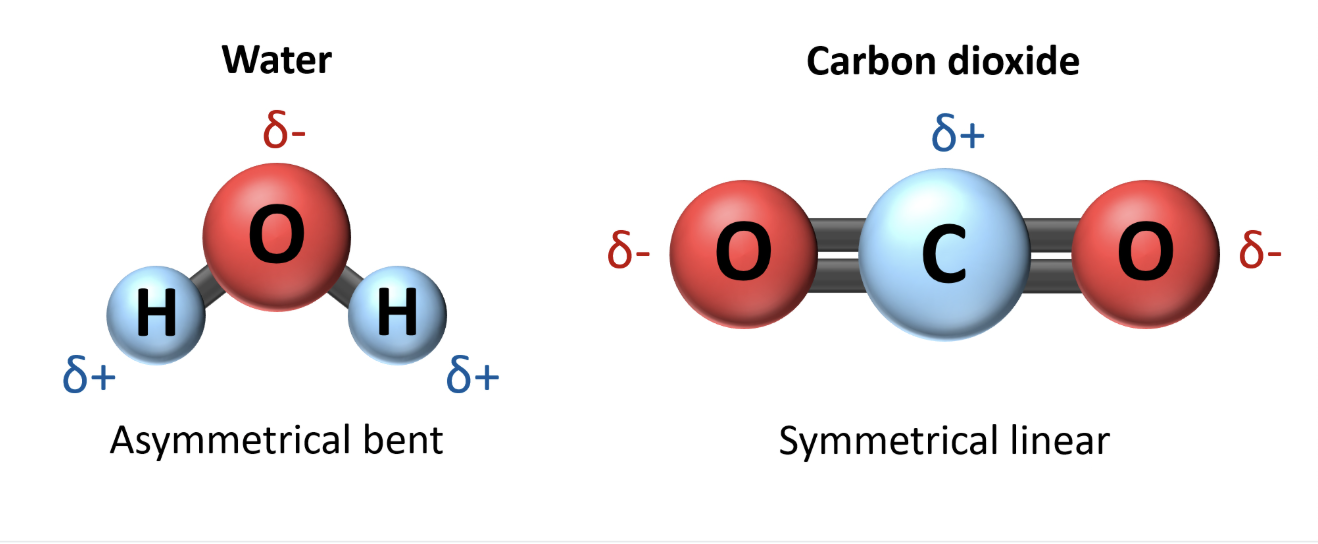
Why is water polar?
Why Is Water Polar?
Water (H₂O) has 1 oxygen covalently bonded to 2 hydrogens.
The molecule has a bent/boomerang shape.
Oxygen is more electronegative than hydrogen, meaning oxygen pulls the shared electrons closer to itself.
This unequal sharing creates partial charges:
Oxygen → partial negative (δ−)
Hydrogens → partial positive (δ+)
Because of these partial charges and water's bent shape, water is polar.
How Does Water’s Polarity Affect Its Behavior?
Because water is bent and asymmetrical, it has two different sides:
Hydrogen side → partially positive (δ+)
Oxygen side → partially negative (δ−)
These partial charges allow water to attract:
Anions (−)
Cations (+)
Other polar molecules
Water molecules also attract each other through weak attractions called hydrogen bonds.
The O–H bonds are strongly polar, so water can also ionize (split into ions) relatively easily.
In water-based (aqueous) solutions, you can find:
H⁺ = hydrogen ion/proton
OH⁻ = hydroxide ion
H₃O⁺ = hydronium ion
These ions can split apart and recombine with each other.
What Properties Make Water Essential for Life?
Water’s polarity, hydrogen bonding, and ability to ionize give it several life-supporting properties:
Excellent solvent: Water’s polarity allows it to dissolve salts, ions, and polar molecules, allowing many chemicals to interact in cells.
Cohesion: Hydrogen bonds cause water molecules to stick to each other, forming droplets and pools.
Adhesion: Water can stick to other polar substances, helping organisms transport water.
Temperature stability: Hydrogen bonds absorb and release heat, helping water resist rapid temperature changes.
Ice floats: When water freezes, hydrogen bonds hold molecules farther apart, making ice less dense than liquid water. Floating ice helps prevent bodies of water from freezing completely.
Acid-base reactions: Water can donate or accept H⁺ (protons), allowing it to act as either an acid or a base.
How Does Water Dissolve Substances?
Water’s polarity allows it to dissolve ionic salts.
Water’s partial charges attract the ions:
Oxygen (δ−) → attracts positive ions (cations)
Hydrogens (δ+) → attract negative ions (anions)
These attractions pull the ions apart, dissolving the salt.
Water molecules then completely surround each ion, creating a sphere of hydration, which keeps the ions dissolved.
Water can also dissolve large molecules like proteins and carbohydrates if they have charged or polar regions.
Hydrophilic = “water loving” → describes ions and polar molecules that are attracted to and dissolve easily in water.
How Do Hydrogen Bonds Affect Water?
Cohesion = water sticks to water
Hydrogen bonds cause water molecules to cling to each other.
This allows water to form pools and droplets and flow together.
Cohesion also creates surface tension, or a “skin” at the water’s surface.
Adhesion = water sticks to other substances
Hydrogen bonds allow water to stick to other polar molecules and surfaces.
Hydrogen bonds are also weak enough to break easily.
This allows water to separate into smaller droplets.
Objects can move through water.
Water molecules can escape and evaporate.
How Does Water Resist Temperature Changes?
Heat is the random movement (kinetic energy) of particles, and temperature measures this motion.
More particle movement → higher temperature
Less particle movement → lower temperature
In water, some added energy is used to break hydrogen bonds instead of making molecules move faster.
➡ Water can absorb lots of heat without its temperature rising much.
When water loses energy, hydrogen bonds form and release energy, helping maintain molecular movement.
➡ Water can lose lots of heat without its temperature dropping quickly.
Therefore, water is very good at stabilizing temperature.
Why Does Ice Float?
As water cools, its molecules move more slowly and form more hydrogen bonds.
When water freezes, hydrogen bonds lock the molecules into a rigid crystal structure.
This structure holds water molecules farther apart than they are in liquid water.
Therefore, ice is less dense than liquid water.
Because it is less dense, ice floats rather than sinks.
Ice forms on the surface of lakes and other bodies of water, while the water underneath stays liquid and habitable.
How Can Water Act as Both an Acid and a Base?
Many biochemical reactions involve the movement of protons (H⁺) and/or electrons.
Water can behave as either an acid or a base, depending on what it does with H⁺.
Water as an acid = DONATES H⁺
H₂O → OH⁻ + H⁺
Water gives away H⁺, leaving OH⁻ (hydroxide) behind.
Water as a base = ACCEPTS H⁺
H₂O + H⁺ → H₃O⁺
Water takes in H⁺, forming H₃O⁺ (hydronium).
Know These 4
H₂O (water) → can be an acid OR base
OH⁻ (hydroxide) → base
H⁺ (proton) → acid
H₃O⁺ (hydronium) → acid