bsc2011l : angiosperm practical review
 Call Kai
 Learn
Learn Practice Test
 Spaced Repetition
 Match
Match Flashcards
 Knowt Play
1/60

There's no tags or description
Looks like no tags are added yet.
Name | Mastery | Learn | Test | Matching | Spaced | Call with Kai | Chat |
|---|
No analytics yet
Send a link to your students to track their progress
61 Terms
Angiosperms (Anthophyta)
- flowering plants
- lack antheridia and archegonia bc reduction of m/f gametophytes
- 2 integuments around embryo
- protected/covered seeds; have fruits
- double fertilization
- 3n endosperm
parts of a flower
- stamen
- pistil
- sepal
- petals
calyx
made of whorls of sepals

corolla
all petals
stamen
Male part of the flower; made up of an anther and a filament.
- in a complete flower, it surrounds the pistil (the female pt of the flower)

filament
Supports the anther

anther
the part of a stamen that contains the pollen.
- microsporogenesis occurs inside anther

microsporogenesis
meiotic divisions producing pollen in anther
microgametophyte
pollen
- in angiosperms, typically consists of only 3 cells
pistil aka carpel
female part of the flower; ovary, style and stigma

carpel
The female reproductive organ of a flower, consisting of the stigma, style, and ovary.
- individual segments of an ovary that are fused 2gether; often not fused completely; styles most often are unfused & # of carpels making up pistil can easily be counted

flowers w/ both male and female reproductive structures...
self-pollination & fertilization is uncommon
- stamens & pistils on a single flower tend to mature @ diff times
- anthers are exposed & release pollen 1st
- l8r, stigma and style mature & are receptive to pollen de otra flowers
flower ovary
the female reproductive organ on flowers that hold ovules and become fruit in some plants/trees

megaspore mother cell
in angiosperms, this divides by meiosis to form 4 haploid *megaspores*
- 2n
- this large cell with 8 nuclei is the female gametophyte, called the *embryo sac*
megaspores
develop into female gametophytes
- 4 are produced
- 3 nuclei will fuse together, forming 1 3n nucleus
- it then undergoes 2 mitotic divisions in sequence, generating 4 triploid nuclei
- 3 of these form antipodal nuclei
- other migrates to center of the embryo sac and becomes polar nuclei
- remaining haploid nucelus from the initial meiotic division undergoes 2 rounds of mitotic cell divisions, making 2 synergids (n) & 1 haploid polar nucleus
- resulting megagametophyte has 7 cells, 8 nuclei; 4 n & 4 2n.
embryo sac
female megagametophyte; develops from the 2n megaspore mother cell within the ovule
primarily haploid

megagametophyte
ovule
- surrounded by 2 integuments
micropyle
opening between the integuments
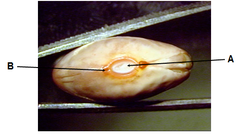
integument
tissue from the sporophyte that acts as the seed coat
double fertilization
sexual reproduct.
- pollination @ stigma - germination - pollen tube grows down thru style - tube has 3 nuclei, a pollen tube nucleus, & 2 sperm nuclei - pollen tube grows into ovary to an ovule - pollen tube grows to reach embryo sac thru the micropyle - mycropyle closes after fertilization
- 1 sperm fertilizes egg, 1 - 2n zygote - embryo
- other sperm fertilizes polar nuclei to forming a pentaploid(Lilium), but angiosperms usually have a 3n endosperm
stigma
site of pollination; where pollen is deposited
endosperm
3n nutritive tissue utilized by the growing embryo
seed
mature ovule w/ 2 integuments
fruit
mature ovary, contains the ovules
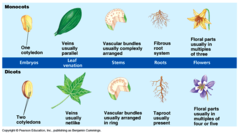
monocots
- advanced clade of angiosperms
- 1 cotyledon
- parallel veined
- fibrous/adventitious roots
- unorganized/scattered vascular bundle
- monosculate pollen; 1 aperature
- flowers in grps of 3

eudicots
- 2 cotyledons
- tricolpate; 3 germination apertures in pollen
- net-veined leaves
- flowers in grps of 4 or 5
- tap-root
- circular vascular bundle
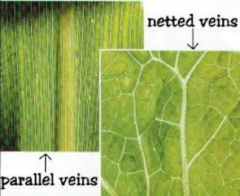
parallel venation
veins running parallel to one another along or across the leaf surface

reticular venation
netlike pattern of branching
magnoliids & eudicots
primary roots
taproots; 1 main root w/ many lateral filaments
- eudicots and magnoliids

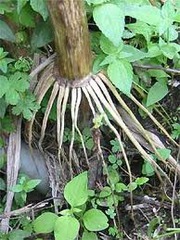
adventitious roots
bunches of fine, fibrous root filaments
- monocots
vascular tissue
xylem and phloem
xylem
transport h2o & dissolved minerals
-composed of vessels and or tracheids
- dead tissue - only cell walls remain
phloem
transport sugar/sucrose
- composed primarily of sieve tube cells
- living tissue
cortex angiosperm
ground tissue between vascular elements and the epidermis

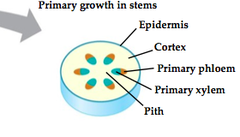
primary growth
growth in length
- produced by apical meristems
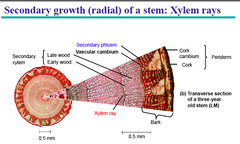
secondary growth
Growth produced by lateral meristems, grow in diameter
- result of vascular cambium & may also be bc of cork cambium
vascular cambium
produces secondary xylem and phloem
2ndary growth

cork cambium
located in cortex outside of phloem tissue; lateral growth by forming outerbark/cork

Scelerenchyma
thick-walled cells important in support

Collenchyma
a modified form of parenchyma specialized for support in young plant organs
apical meristem
tips of roots and shoots
primary growth

axillary buds
at base of leaves

node
site where leaves & buds emerge
plant body parts
shoot, leaves, root
buds
undeveloped shoots; may form flowers, leaves, or new lateral shoots
vascular bundle arrangement
inner to outer;
- pith
- xylem
- vascular cambium
- phloem
- sclerenchyma on outer edge of phloem
- collenchyma cells surround the top of ea of the vascular bundles
- epidermis = outermost cell layer
pith
lrg, thin-walled cells @ center of stem
spring xylem
vessels/rings produced during active growth in the early pt of the season
- lrgr diameters (outer rings)

summer xylem
vessels produced l8r in the season; narrower

phloem rays
light-colored, triangular
xylem rays
are associates w/ phloem rays; responsible for the lateral transport of food materials in the stem
lower epidermis
contains stomata; have air spaces w/in spongy mesophyll

guard cells
regulate the opening & closing of the aperature

spongy mesophyll
spongy layer found beneath the palisade mesophyll in a leaf
- gas exchange lrgly occurs across the spongy mesophyll

upper epidermis
the part of the leaf above the palisades layer; coated by cuticle
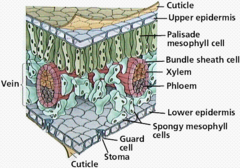
palisade mesophyll
elongated cells under the upper epidermis of a leaf; primary sites of photosynthesis w/in leaf

simple leaves
single blade

complex leaves
composed of a # of leaflets
axillary bud found on bottom of leaf

palmate
A leaf vein pattern in which there are several veins that all start at one point near the base. The veins look like the fingers of a hand

pinnate leaf
a leaf that is similar to a feather because the veins all stem from one major vein that goes straight up the middle

roots
store photosynthate in the cortex in the form of starch; anchors the plant in the substrate and abosrbs h2o & dissolved minerals de the surrounding environment