Module 2.1: Conducted and Wireless Media
 Call Kai
 Learn
Learn Practice Test
 Spaced Repetition
 Match
Match Flashcards
 Knowt Play
1/24

Earn XP
Description and Tags
prelim topic
Name | Mastery | Learn | Test | Matching | Spaced | Call with Kai | Chat |
|---|
No analytics yet
Send a link to your students to track their progress
25 Terms
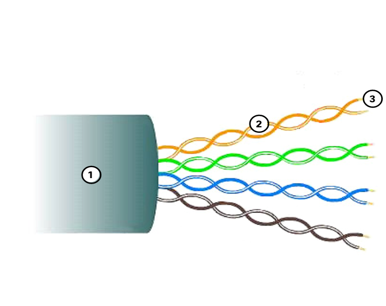
Twisted Pair Wire
One or more pairs of single conductor wires that have been twisted around each other.
Classified by category - Category 1 through Category 7
Twisting the wires helps eliminate electromagnetic interference between the two wires
Unshielded Twisted Pair (UTP)
It is the most common networking media
Terminated with RJ-45 connectors
Interconnects hosts with intermediary network devices
The outer jacket protects the copper wires from physical damage
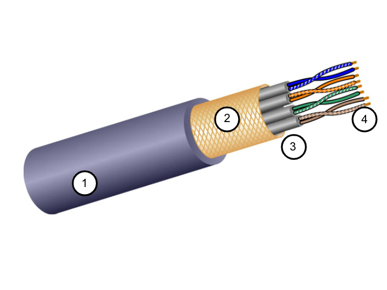
Shielded Twisted Pair (STP)
Better noise protection than UTP
More expensive than UTP
Harder to install than UTP
Terminated with RJ45 connectors
Interconnects hosts with intermediary network devices
Braided or foil shield provides EMI/RFI protection
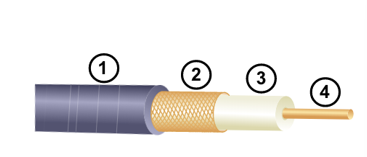
Coaxial Cable
These cables are commonly used in Wireless installations to attach antennas to wireless devices, Cable internet installations for customer premises wiring, or cable television.
This has a woven copper braid, or metallic foil to act as the second wire in the circuit and as a shield for the inner conductor
A copper conductor is used to transmit the electronic signals
Ethernet Straight-through
A type of ethernet cable where BOTH ends are T568A or T568B standard and is used for Hosts to connect to network devices
Ethernet Crossover
A type of ethernet cable where one end is T568A standard and the other end is T568B standard and is used to connect similar devices to each other: Host-to-Host, Switch-to-Switch, Router-to-Router, etc.
Fiber-Optic Cabling
A thin glass cable approximately a little thicker than a human hair surrounded by a plastic coating and packaged into an insulated cable
A photodiode or laser generates pulses of light which travel down the cable and are received by a photoreceptor
Can carry the highest data rate for the longest distances
More expensive than twisted pair and coaxial cables
Immune to EMI
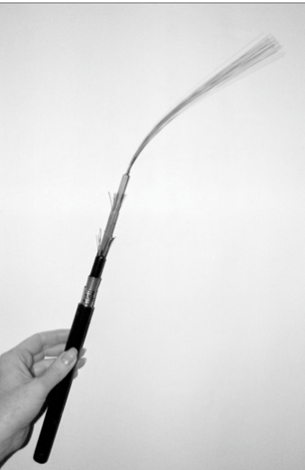
Single-Mode Fiber
A type of fiber-optic cable that has a very small core, uses expensive lasers, and is reliable for long distance applications
Very little reflection
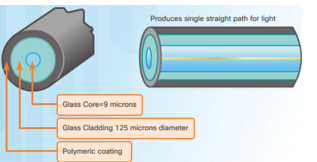
Multimode Fiber
A type of fiber-optic cable that has a large core, uses less expensive LEDs that transmit at different angles, and is good for 10Gbps over 550 meters
Causes more ray collisions, so you have to transmit slower
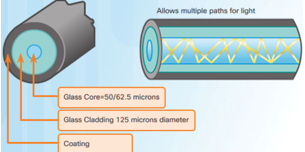
Encoding
(Physical Layer Characteristics)
refers to converting of the stream of bits into a format recognizable by the next device in the network path
Provides predictable patterns that can be recognized by the next device
Signaling
(Physical Layer Characteristics)
refers to how the bit values “1” and “0” are represented on the physical medium
the method will vary based on the type of medium being used
Bandwidth
(Physical Layer Characteristics)
Is the capacity at which a medium can carry data
Measures the amount of data that can flow from one place to another in a given amount of time; how many bits can be transmitted in a second
Physical media properties, current technologies, and the laws of physics play a role in determining this
Latency
(Bandwidth Terminology)
The amount of time, including delays, for data to travel from one given point to another
Throughput
(Bandwidth Terminology)
The measure of the transfer of bits across the media over a given period of time
Goodput
(Bandwidth Terminology)
The measure of usable data transferred over a given period of time
Dispersion
In fiber-optic cabling, refers to the spreading out of light pulse over time, it means increased loss of strength.
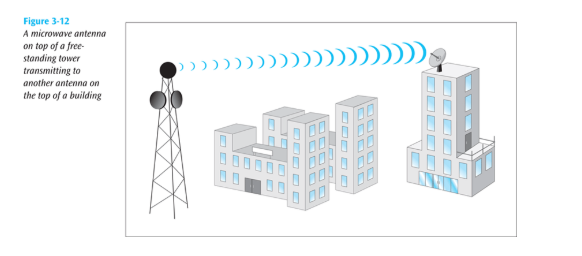
Terrestrial Microwave Transmission
Land-based, line-of-sight transmission
Approximately 20-30 miles between towers
Transmits data at hundreds of millions of bits per second
Signals will not pass though solid objects
Popular with telephone companies and business to business transmissions
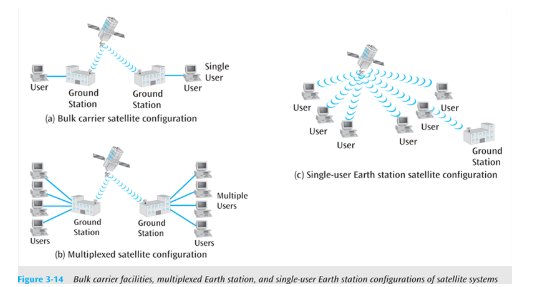
Satellite Microwave Transmission
Similar to terrestrial microwave except the signal travels from a ground station on earth to a satellite and back to another ground station
Can also transmit signals from one satellite to another
Satellites are classified by how far out into orbit each one is
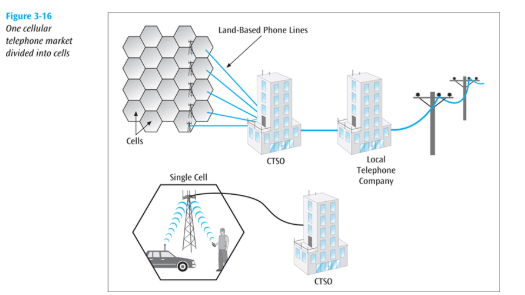
Cellular Telephones
Wireless telephone service, also called mobile telephone, cell phone, and PCS
Used to support multiple users in a metropolitan area (market). The market is broken into cells
Each cell has its own transmission tower and set of assignable channels
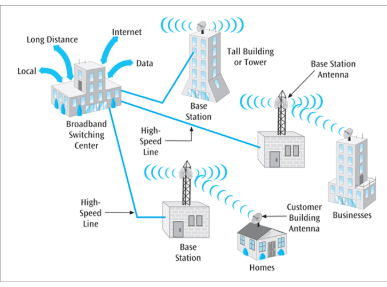
WiMax - Broadband Wireless Systems
Delivers Internet services into homes, businesses, and mobile devices
designed to bypass the local loop telephone line
Transmits voice, data, and video over high-frequency radio signals
The maximum range of 20-30 miles and transmission speeds in Mbps
IEEE 802.16 set of standards
Bluetooth
The specification for short-range communication, typical link range is from 10cm to 10m, but can be extended to 100m by increasing the power
Used for phones, headsets, notebooks, PDAs, etc.
Wireless Local Area Networks (IEEE 802.11)
This technology transmits data between workstations and local area networks using high-speed radio frequencies
Current technologies allow up to 100mbps (theoretical) data transfer at distances up to hundreds of feet
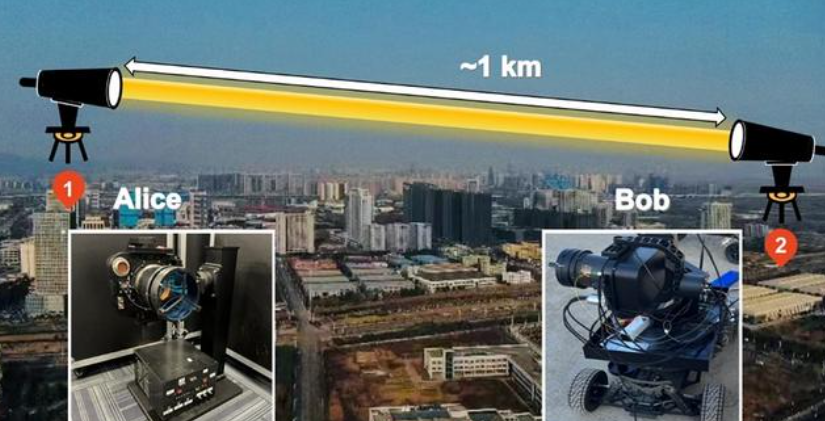
Free Space Optics Communications
Wireless communication that uses lasers, or more economically, infrared transmitting devices
Line of sight between buildings
Typically short distances, such as across the street
Newer auto-tracking systems keep lasers aligned when buildings shake from wind and traffic
Infrared Transmissions
These transmissions use a focused ray of light in the infrared frequency range
Very common with remote control devices, but can also be used for device-to-device transfers, such as PDA to computer
ZigBee
Based upon IEEE 802.15.4 standard
Used for low data transfer rates (20-250 Kbps)
Also uses low power consumption
primarily used for IoT devices.