Study Guide A ( Test 1)
 Call Kai
 Learn
Learn Practice Test
 Spaced Repetition
 Match
Match Flashcards
 Knowt Play
1/141

There's no tags or description
Looks like no tags are added yet.
Name | Mastery | Learn | Test | Matching | Spaced | Call with Kai | Chat |
|---|
No analytics yet
Send a link to your students to track their progress
142 Terms
What do Endocrine glands produce?
hormones
What type of physician treats hormone imbalances?
endocrinologist
What are Target Cells?
cells that have specific receptors for a hormone
How are hormones moved between endocrine glands and target organs?
“ by blood”
1. endocrine system → hormones secreted by endocrine cells into interstitial fluid and enter the blood within capillaries
2. travel through cardiovascular system
3. hormones leave the blood and enter interstitial fluid to have the hormones molecules available to entire body
4. hormone bind to target cell receptor either in cell or plasma
What are two central features of the nervous system and endocrine system?
1. response to stimuli → release of ligands (hormone/neurotransmitter)
2. binding of ligand receptor cell in target cell to create cellular change
What are noticeable differences between the Nervous system and the Endocrine system?
Endocrine system:
secretes hormones
target = any cell
slow reaction time
long-lasting duration of response
Nervous system:
neurotransmitter release
target= neuron, muscle cells, gland cells
rapid reaction time
localized range of effect
short-term duration to response
What are the four broad categories of hormone function?
regulation
homeostasis
digestive processes
reproductive activities
What are the Endocrine Glands?
Pituitary, pineal, thyroid, parathyroid, adrenal
What is Hormonal Stimulation?
What 2 hormones are examples of this?
1. release of another hormone triggers release of the hormone
ex:
Anterior pituitary releases TSH → TSH stimulates thyroid gland to release TH
What is Humoral Stimulation?
What is an example of this?
1. changes in level of nutrient or ion in the blood triggers release of the hormone
ex:
blood glucose lev. increase → increased blood glucose stim. pancreas to release insulin
What is Nervous system Stimulation?
What is an example of this?
1. stimulation by the nervous system triggers release of hormone
ex:
sympathetic division is activated → sympathetic preganglionic axons stim. adrenal medulla to release Epinephrine/norepinephrine
What are the 3 categories of circulating hormones?
Steroids, biogenic amines, proteins
What is the precursor for Steroids?
cholesterol
What is the precursor for biogenic amines?
amino acids
What is the precursor of proteins?
amino acid chains
Which two circulating hormones are water-soluble?
biogenic amines and proteins
Which circulating hormone is lipid-soluble?
steroids
What hormones fall into the category of Steroids?
estrogen, progesterone, testosterone, cortisol, aldosterone
What hormones fall into the category of Biogenic amines?
Epinephrine/Norepinephrine
What hormones fall into the category of proteins?
insulin, glucagon, GH
What is a local hormones?
short-lived signaling molecules that do not circulate within the blood
note: they influence changes in the tissues
ex: influencing diameter of blood vessels and pain perception
What is Autocrine Stimulation?
binding of signaling molecules with either the same cell that produced it
What is Paracrine Stimulation?
binding of signaling molecule to a neighboring cell
How would u classify Eicosanoids?
primary type of local hormones
How would you classify Prostaglandins?
most diverse eicosanoids
What type of hormones require a transport protein and why?
Lipid-soluble hormones do not dissolve readily within the blood plasma so they need a carrier protein.
What is another benefit of transport proteins?
they can prolong the life of the hormone and prevent early destruction of hormones
What is a bound hormone?
any hormone attached to a carrier protein
What is an unbound hormone?
unattached hormone = free hormone
What types of hormones do not require a transport protein and why?
water-soluble hormones readily dissolve within aqueous environment so, these hormones are generally releases directly into the blood and transported to target cells
Why is it important to maintain hormone levels within homeostatic limits?
to maintain balance of rate released by its elimination
What are the key ways to achieve hormone levels within homeostatic limits?
through negative feedback and sometimes positive feedback
What is the half-life of a hormone?
amount of time necessary to reduce hormone concentration within the blood to ½ of what had been originally secreted
What class of hormones have a longer half-life?
steroids
If a cell lacks a receptor for a hormone, will it have any impact on the cell?
no, b/c the hormone will not interact with the receptor
How does the type/distribution of target cells impact the influence of a particular hormone?
the greater the number of different target cells, the wider the potential influence that may be exhibited by a given hormone
Where are the receptors for lipid-soluble hormones located and why?
cytosol or nucleus b/c lipid-soluble hormones can diffuse across the plasma membrane
The hormone-receptor complex stimulates ______________ of DNA leading to protein synthesis.
mRNA
Where are the receptors for water-soluble hormones located and why?
outside the plasma membrane by receptor to allow passage b/c water-soluble hormones are unable to pass through plasma
What is the first messenger for water-soluble hormones?
signaling molecule
What is the second-messenger for water-soluble hormones?
receptor
Second messenger systems involve activation of ____________ proteins. This often results in the activation or inhibition of _________.
1. g-protein
2. enzymes
What are some things that influence the extent of a cell’s response to a hormone?
a single target cell can
display differing numbers of receptors for the same hormone = binding varying amounts of hormone
possess receptors for many hormones = respond to many at the same time
What is up-regulation?
target cells increase number of receptor = increase cell sensitivity to a hormone
What is down-regulation?
target cell decreases number of receptors = reduce target cell’s sensitivity to hormone
How does the number of receptors on a target cell influence the response of a cell to a hormone?
the greater number of receptors to more likely the hormone will respond and vice versa
sensitivity vs. decrease of sensitivity
Under what conditions does up-regulation typically occur?
when there is lower than normal hormone concentration
Under what conditions does down-regulation typically occur?
when there is elevated hormone concentration
How does up/down regulation help maintain homeostasis?
by helping to prevent either under or overstimulation of the target cell to promote normal level cellular response
What is synergistic hormone interaction?
hormones work together to produce greater effect
ex: estrogen + progesterone
What is permissive hormone interaction?
first hormone allows action of second hormone
ex: prolactin → oxytocin
What is antagonistic hormone interaction?
one hormone causes opposite effect of another hormone
ex: insulin vs. glucagon
Name two important hormones produced by the pancreas?
insulin + glucagon
Describe the shape and location of the pancreas.
shape: elongated organ
location: btwn duodenum of small intestine and the spleen and posterior to the stomach
99% of the pancreas has what function?
exocrine gland function → producing digestive enzymes
What cells help carry out the function of the pancreas?
pancreatic acinus
(modified simple cuboidal epithelial cells)
1% of the pancreas has what function?
to secrete glucagon or insulin
What is the name for the cluster of cells that help carry out the 1% function of the pancreas?
pancreatic islets or islets of langerhans
What cells produce insulin?
beta cells
What cells produce glucagon?
alpha cells
What is the Endocrine Function of the pancreas?
maintain concentration of glucose in the blood withtin normal range by secretion of insulin and glucagon into blood
What happens if hyperglycemia occurs?
excess glucose must be transported into other body cells that can use or store this resource
What happens if hypoglycemia occurs?
lethargy can occur
When is insulin released?
When blood glucose is high
How are carbohydrates stored and what organ stores them?
stored as: glycogen
in the: skeletal muscle or liver
How are lipids stored and what cells store them?
stored: fatty acids
in the: adipose tissue
Amino acids are taken up and may be converted into what form?
protein
Glucose is transported into cells via __________ transport proteins.
glucose
Do all cells require insulin for glucose transport?
no
What happens to insulin release as blood glucose levels drop?
less insulin is released from the pancreas
What stimulates the release of glucagon?
When there is low levels of blood glucose
How do hepatocytes (liver cells) respond to glucagon?
glycogenolysis (break down of glycogen)
gluconeogenesis ( forming of glucose )
How do adipocytes respond to glucagon?
lipolysis ( breakdown of fats to release fatty acids)
What is diabetes mellitus?
reduced insulin release or response to insulin
elevated blood/urine glucose levels
What are the 3 classic signs of diabetes?
increased hunger (polyphagia)
increased urination (polyuria)
increased thirst (polydipsia)
What is the reason for polyphagia?
cells are unable to normally absorb glucose from the blood into their cells
What is the reason for polyuria?
glucose lost in urine and pulls fluid into urine by osmosis
What is the reason for polydipsia?
abnormal loss of fluid in urine = dehydration
What type of diabetes is known as insulin-dependent diabetes?
type 1
What cells are destroyed in type 1 diabetes?
beta cells
What destroys the cells in type 1 diabetes?
viral infection
How is type 1 diabetes treated?
regular injections of insulin
What type of diabetes is known as insulin-independent?
type 2
What causes type 2 diabetes?
decreased insulin release or decreased insulin effectiveness on target cells
obesity
How is type 2 diabetes treated?
diet, exercise, medications
What is gestational diabetes?
diabetes in pregnant women
What System
communicates by hormones
adapts realtively slowly
reacts slowly to stimuli
may contin. responding long after stimuli stops
Endocrine System
What system
communicates by electrical impulses
adapts quickly to continual stimulation
Nervous System
The Endocrine System…
releases hormones into the bloodstream for general distribution
sometimes has very general effects
The Nervous System…
releases neurotransmitters at synapses
relatively local (specific effects)
reacts quickly to stim.
stops quickly when stim. stops
A hormone is a ________________________ and the target cell is ___________________________
1. molecule that has a metabolic effect on another cell
2. a cell that has receptors for specific hormones
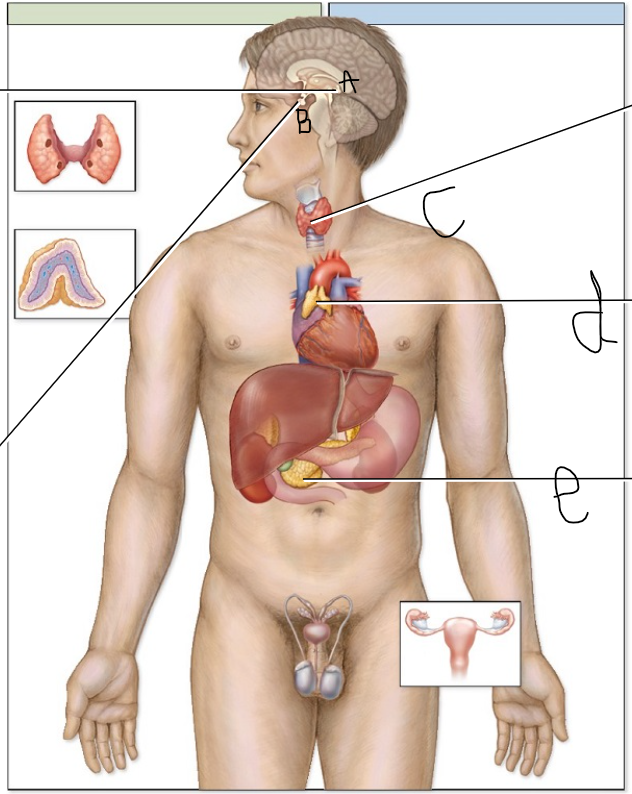
a) Pineal gland
b) Pituitary gland
c) Thyroid gland
d) Thymus
e) Pancreas
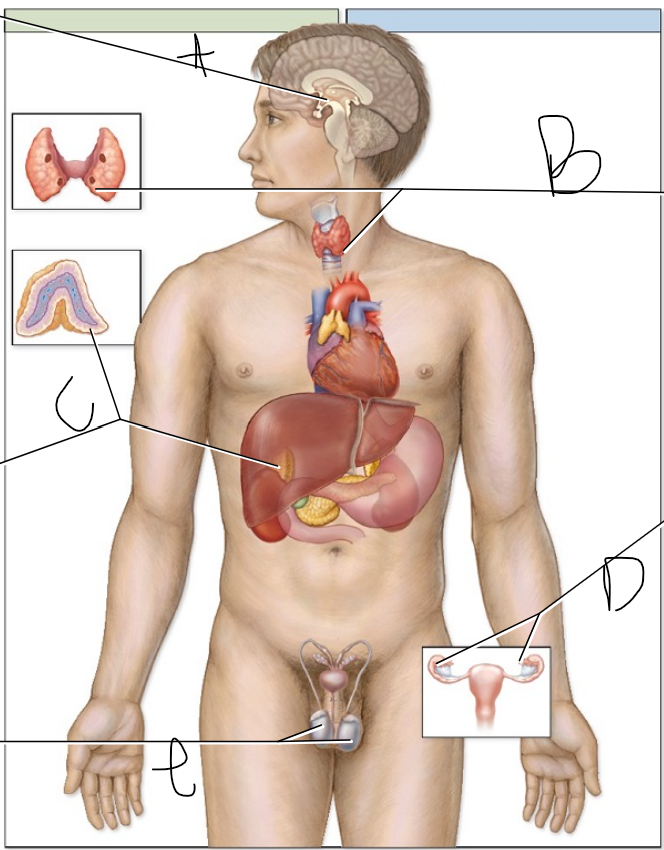
a) hypothalamus
b) parathyroid gland
c) adrenal gland
d) ovaries
e) testes
What are examples of Up-Regulation?
increased # of testosterone receptors in skeletal muscle following resistance training
In response to a chronic lack of a hormones, the target cell increases that concentration of receptors
greater response to the same magnitude of hormone release
What are examples of Down-Regulation?
decreased hormone receptors resulting from chronically high insulin levels
decreased response to an increase in hormone
in response to a chronic abundance of hormone, the target cell reduces the concentration of receptors
decreased sensitivity
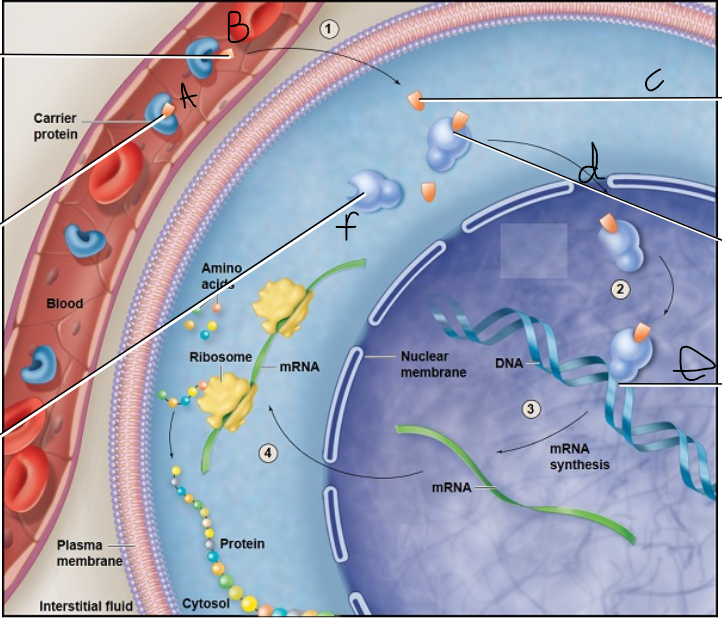
a)bound hormone
b)unbound hormone
c)hormone
d)hormone-receptor complex
e)hormone-response element
f)hormone receptor
Two or more hormones work together to produce a result is?
Synergistic effect
A hormone enhances an organ’s response to a second hormone, or increases the activity of the second hormone is?
permissive effect
One hormone inhibits the secretion and action of another hormone, or has an opposite effect is?
antagonistic effect
Testosterone is an example of which type of hormone?
steroid hormone