Ecology Exam 1
 Call Kai
 Learn
Learn Practice Test
 Spaced Repetition
 Match
Match Flashcards
 Knowt Play
1/132

There's no tags or description
Looks like no tags are added yet.
Name | Mastery | Learn | Test | Matching | Spaced | Call with Kai | Chat |
|---|
No analytics yet
Send a link to your students to track their progress
133 Terms
functional traits
morphological, physiological, or phenological characteristics affecting survival, growth, and reproduction
Endemism
a species that only exists in one specific geographic area in the world
where are the highest levels of endemism
in marine ecosystems - life evolved there first
the hydrologic cycle
dynamic movement of water among reservoirs at the global scale and the processes that cause water to move among reservoirs
reservoirs
locations that hold water within the hydrologic cycle
Reservoir turnover time
the time required for the entire volume of a reservoir to be renewed.
Reservoir turnover time for atmosphere
9 days
Reservoir turnover time for rivers
12-20 days
Reservoir turnover time for lakes
days to centuries
Reservoir turnover time for oceans
over 3000 years
Types of aquatic environments
Marine environments, transitional environments, freshwater environments
estuaries
freshwater to saltwater
salt marshes
saltwater to land
mangrove forests
saltwater to land
freshwater wetlands
freshwater to land
intertidal zones (marine environment)
occur globally where the ocean meets the land between high and low tides
what do intertidal zones create
creates microhabitats subject to highly variable conditions, causes species to live in the different zones based on their tolerance to conditions
Kelp forest structure (marine environment)
there is a canopy at the water’s surface, stipes extend from the canopy to the ocean floor Epi
stipes
kelp stems
Epipelagic zone
0-200m ; sunlit zone, photosynthesis possible, most surface life
Mesopelagic zone
200-1000 m ; twilight zone, light fades, no photosynthesis
what animals may live in the Mesopelagic zone
sperm whale, octopus
Bathypelagic zone
1000-4000m - midnight zone, completely dark, high pressure
Abyssal zone
4000-6000m, near ocean floor, cold, high pressure, sparse life
hadal zone
6000-11,000m ; deepest trenches, extreme pressure
gyres
wind created, are large circulation systems that move water across latitudes in a circular motion
thermohaline circulation
driven by differences in water density
what drives gyres
wind patterns and the Coriolis effect
5 major gyres
Indian, North Pacific, South Pacific, North Atlantic, South Atlantic
Upwelling
occurs when surface water is moved by some force (like wind) which allows deeper water to rise to the surface
what does upwelling do
brings cold, deep water with lots of nutrients to the surface
What drives thermohaline circulation
variation in temperature and salinity, resulting in density changes
cold/salter water is dense and sinks
warm/fresher water is less dense and rises
Variability of salinity
is less variable than temp and oxygen, varies with latitude and is relatively constant in one area
related to regional rainfal
where is oxygen concentration the greatest
at the surface due to photosynthesis of marine plants and agitation by the wind
which transitional environments are land to sea
salt marsh and mangroves
which transitional environment is river to sea
estuaries
what transitional environment is land to freshwater
freshwater marsh
land to sea transition factors
low oxygen soil, high salinity. dominated by salt-tolerant plants
land to sea ecosystem services
protect coastlines from erosion/storms
trap nutrients in sediments
support biodiversity
Estuary factors
freshwater from rivers mix with seawater, creates strong physical and biological gradients
very productive
freshwater marsh factors
wetland dominated by grasses
occur close to lakes, rivers
very productive and essential for birds, etc
Lakes salinity factor
more variable than ocean
rivers and streams salinity factor
salinity varies with soil type
Human threats to ocean
coastal pollution
warming and acidifying of oceans
freshwater pollution
Coral bleaching
corals lose their symbiotic algae due to elevated temperature. vulnerable to disease and death
ocean acidification
excess CO2 from atmosphere increase acidity in ocean. Harms marine life
Eutrophication
when high amounts of nutrients (usually from runoff) cause a dense algal bloom. Algae bloom uses up oxygen, leading to deoxygenation and animal deaths
Ecology
the study of relationships between organisms and the environment
Evolution
the change in gene frequencies (underlying phenotypic variation) within populations across time (generations)
Ecological situations can be viewed as:
forces driving evolutionary solutions to ecological problems
Evolution by natural selection
occurs when the interactions organisms have with their environment lead to changes in the traits of populations of organisms over generations
Tenets of Evolution by Natural Selection (5)
variation exists
variation has a genetic basis
more individuals are born than survive to reproduce
survival is non-random
survivors reproduce
speciation
variation exists
individuals in a population differ in traits
variation has a genetic basis
some traits are passed from parents to offspring through genes
more individuals are born than survive to reproduce
therefore not all genetic material is passed on
survival is non-random
some traits increase organism fitness and survival rates
survivors reproduce
therefore adventageous traits are more likely to be passed on to offpsring
speciation
given enough time and changes, populations can diverge into new species
Phenotype
the observable characteristics of an organism that result from the interactions between the genetic makeup of the individual and its environment
gene
a sequence of DNA or RNA which codes for a molecule that has a function
allele
a variant form of a gene
genotype
the genetic make up of an individual
phenotype
the characteristics an individual displays as a result of their genotype
Heritability
The measure of how much of the variation in a trait among individuals comes from genetic differences rather than environmental factors.
Natural selection can only produce evolutionary change within a population when traits are heritable.
passed down genetically from parents to offspring
natural selection
refers to differential survival and/or reproduction among phenotypes
fitness
an organism’s ability to survive, mate, and pass its genes on to the next generation
speciation
the process by which one population splits and evolves into two or more distinct groups due to accumulated genetic differences over time
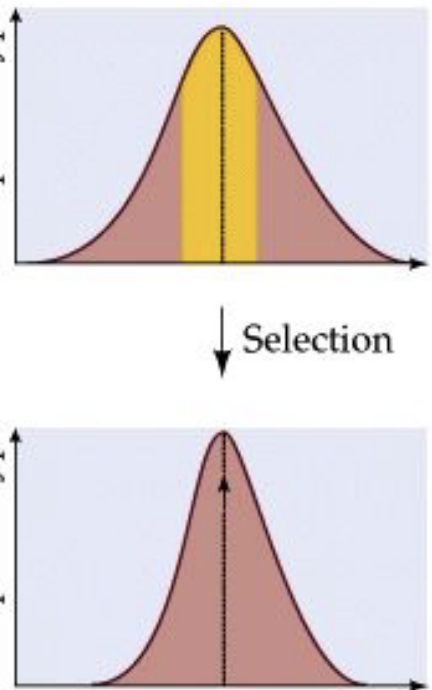
Which form of natural selection is this
Stabilizing selection
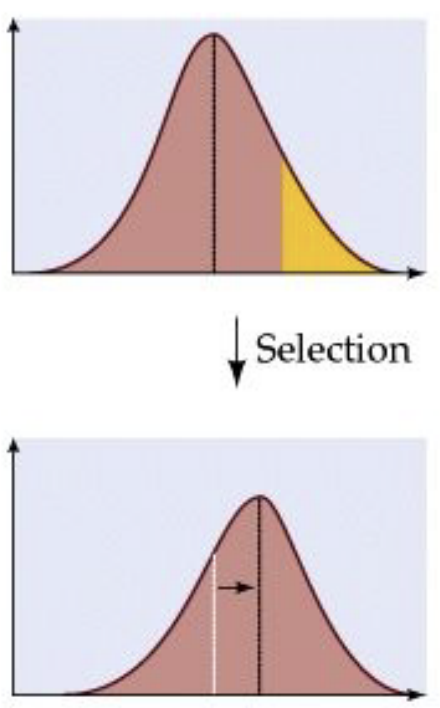
Which form of natural selection is this
Directional stability
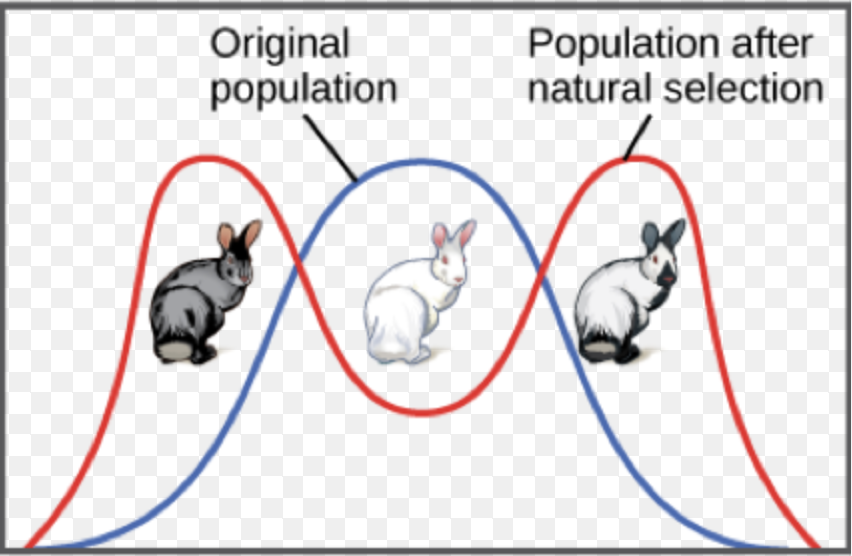
Which form of natural selection is this
Disruptive selection
Stabilizing selection
favors average phenotypes and selects against extreme variations
Directional selection
leads to changes in the population mean by favoring an extreme phenotype in the population.
Disruptive selection
occurs when two or more extreme phenotypes are favored over the average within a population
Macroclimate
prevailing climatic conditions over large areas and long time periods. Interacts with local landscape to produce microclimatic variation
Microclimate
small, specific area where the climate differs from the surrounding regional weather
Are macro or microclimates more relevant to most organisms
microclimates
Describe the factors that affect microclimate
altitude
aspect
vegetation
ground color
boulders/stones/rocks
burrows
Altitude affect on microclimate
higher altitude = lower temperature due to low air pressure
aspect def
the direction a slope or surface faces
some aspects are shaded, some exposed to direct sunlight - impacts temperature
aspect affect on microclimate
Hills, valleys, and cliffs influence local microclimates. Alters temperature, moisture, radiation
vegetation affect on microclimate
creates cooler, less variable temperatures
how do ground color, boulders, and burrows influence microclimates
ground color = dark absorbs and retains heat better than light colored ground
burrows - moderate temperature and minimized temp variation
undersides of boulders/stones create microclimates
Principle of allocation
Organisms have limited energy and resources. Therefore, if an organism allocates more energy to one function, such as growth or reproduction, it reduces the amount of energy available to other functions
Why do most species perform best in a narrow range of temperatures
enzymes - have optimal temps at which they work best
can shift optimal temp over time
species from diff locations have diff optimal temperatures
Heat balance equation

Hs in heat balance equation
total heat stores in an organism
Hm in heat balance equation
gained via metabolism
Hcd heat balance equation
Gained/lost via conduction (contact)
Hcv heat balance equation
Gained/lost via convection (wind/water)
Hr heat balance equation
Gained/lost via radiation (sun)
He heat balance equation
Lost via evaporation
Conduction
heat is directly transmitted from the environment to an organism
convection
heat travels to/from the organisms via movement of air or water
evaporation (heat balance equation)
water from the environment or sweat turns into vapor and carries away heat
Poikilotherm or Heterotherm
species whose body temperature varies with the
environment
Homeotherm
species that maintain a relatively stable body temperature
Ectotherms
species who rely on external sources of energy for regulating body temperature (ex=reptiles)
Endotherms
species that rely on internally derived metabolic heat energy (ex=mammals)
how did the experiment with bacteria demonstrate the principle of allocation
In an experiment with E. coli bacteria, bacteria that allocated more energy toward reproduction had less energy available for survival and maintenance. This demonstrated that organisms have limited resources, so investing more in one function means less for another.
What happens to enzymes when temp is too cold
they work slowly