Kirchnoff's Laws Current/Voltage
 Call Kai
 Learn
Learn Practice Test
 Spaced Repetition
 Match
Match Flashcards
 Knowt Play
1/5

There's no tags or description
Looks like no tags are added yet.
Name | Mastery | Learn | Test | Matching | Spaced | Call with Kai | Chat |
|---|
No analytics yet
Send a link to your students to track their progress
6 Terms
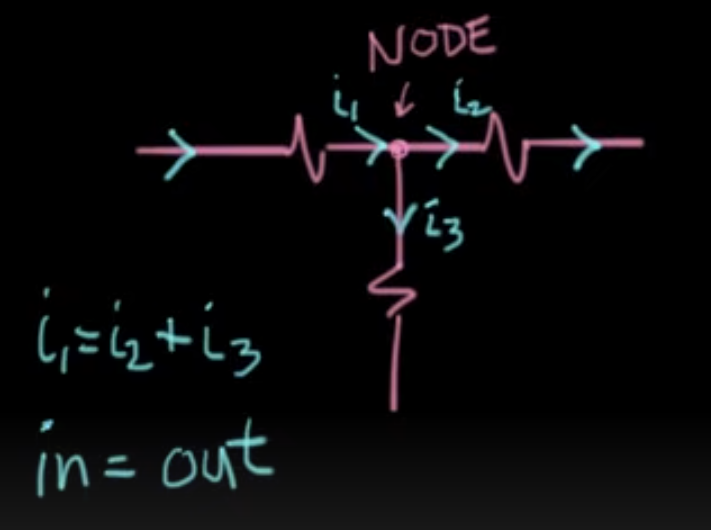
K-Law: 1 in, 2 out
A fundamental principle in electrical circuit theory that relates the current and voltage in a circuit. It includes two laws: Kirchhoff's Current Law (KCL), which states that the total current entering a junction equals the total current leaving, and Kirchhoff's Voltage Law (KVL), which states that the sum of the electrical potential differences around any closed circuit is zero.
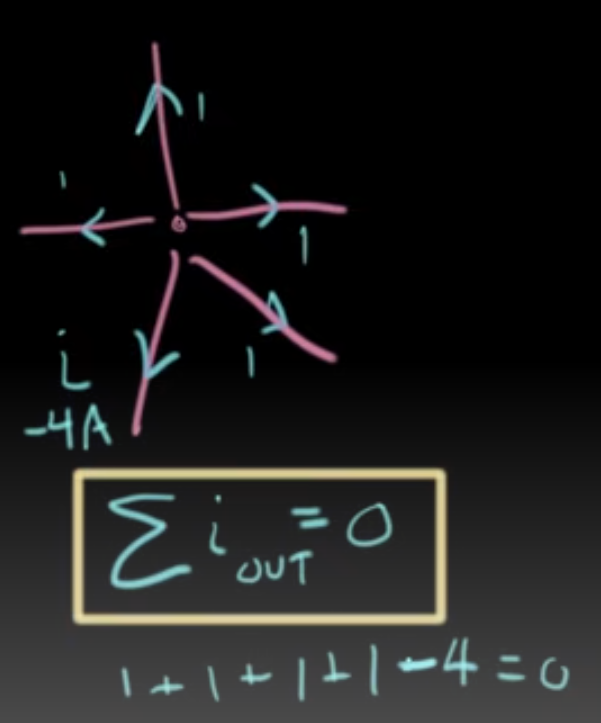
K-Law: 4 in
A configuration in electrical circuits where two currents flow in from a junction, adhering to Kirchhoff's Current Law by ensuring that the total current entering equals the sum of the currents leaving.
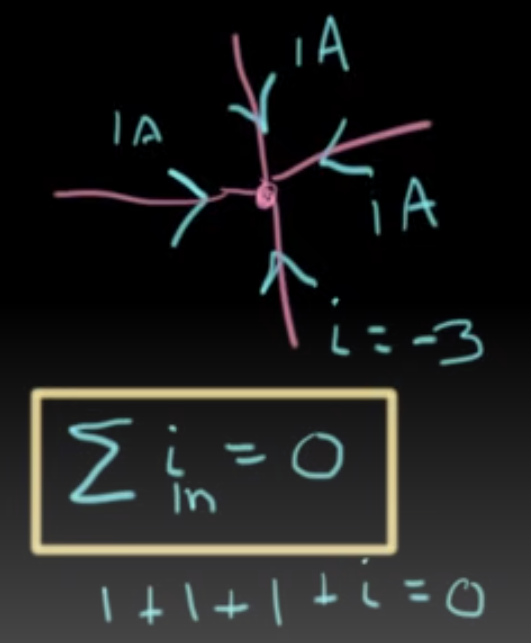
K-Law: 3 out
A configuration in electrical circuits where three currents flow out of a junction, adhering to Kirchhoff's Current Law by ensuring that the total current entering equals the sum of the currents leaving.
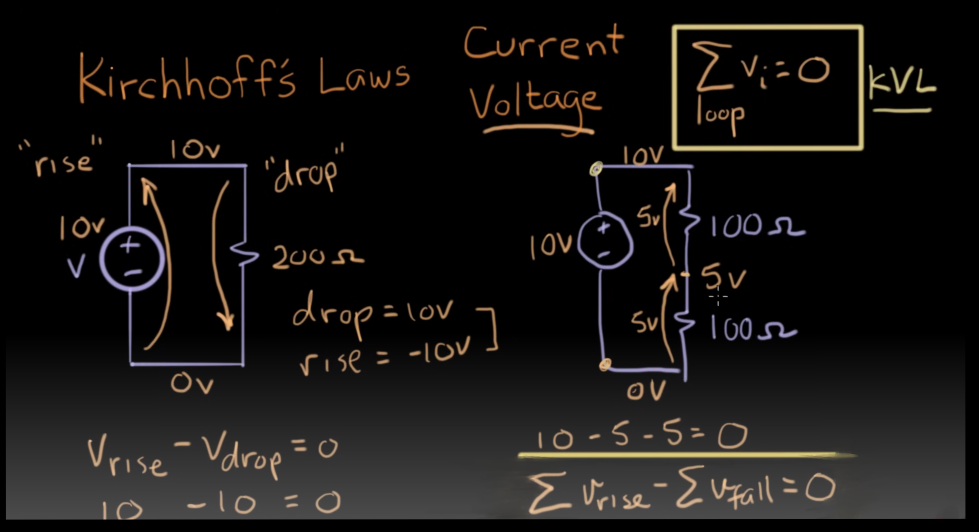
Kirchhoff’s Laws Voltage Law
Kirchhoff’s Voltage Law (KVL)—Flashcard Summary
Definition: The sum of all voltage changes (rises and drops) around any closed loop in a circuit is zero.
Key Concepts:
Voltage Rise: Increase in voltage (e.g., across a battery from 0V to 10V)
Voltage Drop: Decrease in voltage (e.g., across a resistor from 10V to 0V)
Loop Rule: Sum (voltage rise) - Sum(voltage drop) = 0
Example 1 (Single Resistor):
10V rise across battery
10V drop across 200Ω resistor
Net change: 10−10=0
Example 2 (Two Resistors):
10V rise across battery
5V drop across each 100Ω resistor
Net change: 10−5−5=0
Direction Doesn’t Matter: You can start at any node and go clockwise or counterclockwise—the total voltage change will always sum to zero.
Why It Matters: KVL is one of the two foundational tools (along with Kirchhoff’s Current Law) for analyzing electrical circuits.
Conventional.
Conventional current flowing through the cell has a positive voltage (gains energy). Current going through a resistor has a negative voltage (loses energy).
Loop from negative to positive, Current 2 goes out junction but is in similar path as the other current and voltage in loop
-V= - Current i * R - Current i i * R
^^^or^^^ 0= V - Current i * R - Current i i ^^^^ given KVL
AVOID SYSTEM OF EQUATIONS (LOOP 1 - LOOP 2) IF LOOPS SHARE A CURRENT