communication midterm
 Call Kai
 Learn
Learn Practice Test
 Spaced Repetition
 Match
Match Flashcards
 Knowt Play
1/46

There's no tags or description
Looks like no tags are added yet.
Name | Mastery | Learn | Test | Matching | Spaced | Call with Kai | Chat |
|---|
No analytics yet
Send a link to your students to track their progress
47 Terms
what is dyadic communication
communication between 2 people
what is Small-Group Communication
Communication among a small number of people
what is Public Communication
One person communicates with a group or audience
What is mass communication
Messages are communicated to a large, dispersed
audience through media.
why do we communicate
express needs;
• establish relationships;
• seek safety;
• express emotions;
• develop our identity;
• learn;
• teach;
• influence others;
• obtain support;
• entertain ourselves.
why is physical communication important
socially isolated people are sicker, more prone to early death, develop depression easier
what is intrinsic motivation in the context of communicating
We communicate because communication itself is satisfying.
what is extrinsic motivation in the context of communicating
We communicate to obtain another outcome.
what is Maslow’s hierarchy of needs
its a 5 tiered pyramid that proves that individuals generally must satisfy lower-level deficiency needs before higher-level growth needs fully motivate their behavior
what does the communication model look like
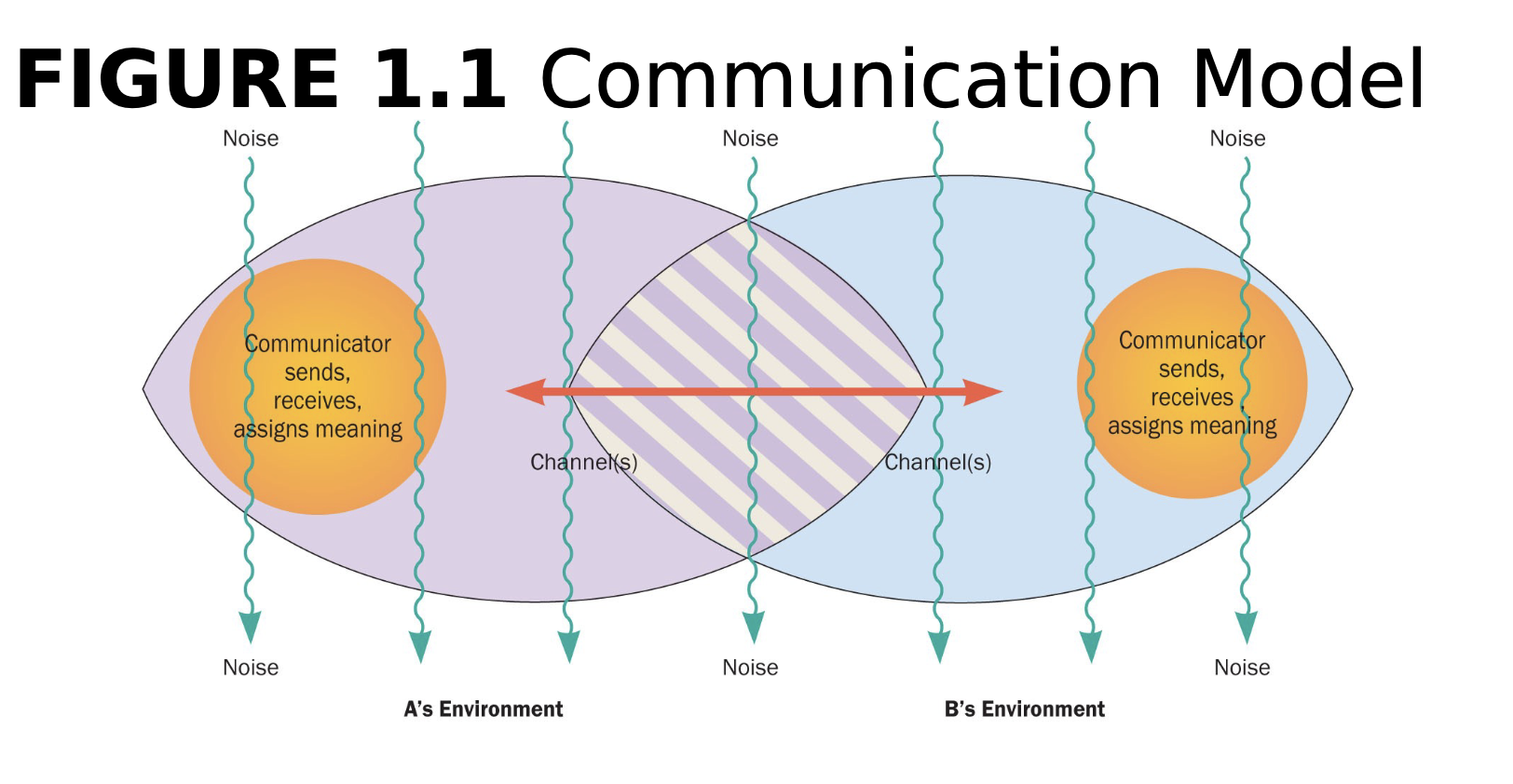
what are some insights from the communication model
Sending and receiving are
usually simultaneous, Meanings exist in and
among people, Environments affect
communication, Noise affects
communication, Channels make a difference.
what is a quantitative interaction
Any interaction between two people.
what is a qualitative interaction
When people treat one another as unique individuals, regardless of the context in which the interaction occurs or the number of people involved
what is happening in the transactional model
People are simultaneously sending, receiving and interpreting messages.
what are the eight key elements of communication
meaning, signs, encoding, decoding, feedback, channel, noise, context,
Media richness/leanness describes:
the amount of non-verbal cues conveyed through a communication channel that add clarity to a message
when does asynchronous communication occur
when there is a time gap between when the message was sent and
when it is received, while synchronous communication occurs in real time (i.e. email).
what is permanence
how long the message endures
what is culture
“The language, values, beliefs, traditions, and customs people share and learn.”
what are in-groups
groups with which we identify
what are out-groups
those we view as different
what is a co-culture
A subgroup part of an encompassing culture
why is adjustment necessary in communication
like in a hospital a doctor should not explain medical terminology in a really advanced way to a patient because you want them to completely understand and not be confused by legal jargon
what do interpersonal messages contain
information about both: the content of the message, and the relationship between the communicators
what are the four characteristics of communication
inevitable, irreversible, unique, and ephemeral
is communication always desirable
no not always, and the goal is not always more communication
what is communication competence
the balance between effective and
appropriate communication.
define ethnocentrism
Belief that one’s own culture is superior to others.
define prejudice
Unfairly biased and intolerant attitude toward others who belong to an out-group.
define stereotyping
exaggerated generalizations about a group
what is language
A system of vocal signs—and, potentially, graphic signs—shared by a community of individuals
explain how words are just arbitrary signs
A word does not inherently resemble the concrete object or idea it represents.
Example: the word “apple” has no natural physical connection to the fruit itself.
Meaning comes from shared linguistic conventions.
how does meaning vary across people
The same word can evoke different meanings or associations for different people.
Personal experience, knowledge, culture, and context can influence interpretation.
Effective communication therefore requires attention to the other person's meaning—not only our own.
how does meaning vary according to context
The same expression may communicate different meanings in different situations.
Example: “The carrots are cooked!” can be interpreted literally or idiomatically depending on context. Context helps receivers determine which meaning is intended.
define denotive meaning
The more literal or dictionary-associated meaning of a word.
•Focuses on what a word refers t
define connotive meaning
Associations, feelings, or ideas connected to a word. Can vary according to people,
experiences, and context. Example: “He is a real baby”
how does meaning vary in abstraction
Words can refer to highly specific entities or increasingly broad categories
how is language governed by rules
Grammar is the set of rules used to organize words in meaningful ways.
•These rules belong to a particular language.
•Rules vary from one language to another
how does language influence thought
•Language can impose or encourage particular ways of seeing the world.
•Words are not reality itself.
•Words can mask differences and nuances.
•Words can express both facts and deductions.
•Static evaluations can distort how we perceive changing realities.
how does language shape attention
The words we learn can focus our attention on some aspects of reality while
making other aspects less noticeable. Culture can teach us to emphasize certain concepts over others. We use vocabulary according to our needs. Example: a sommelier may use more than 100 words to describe characteristics of wine.
what’s a fact
A statement describing what is directly occurring
what is a deduction
An interpretation or inference that goes beyond the directly observed information.
what are static evaluations
A tendency to maintain preconceived opinions or earlier evaluations even when reality has
changed.
•Our evaluations of ourselves and others should adapt as situations and people evolve.
•Static evaluations can distort our perception of reality.
•“That’s just the way he operates”; etc...
what is Negation of another person
denying the other person within an interaction
what is recognition of another person
showing that we have noticed the person and accept how they define themselves and the relationship they wish to establish
what’s a euphemism
A way of presenting a harsh or hurtful reality
by softening its expression to avoid shocking
others
Exaggeration & lying
Exaggeration amplifies the meaning of a statement to create a greater
effect.
A lie is an assertion contrary to reality made with the intention of
deceiving