Exam 1 Groupme Cards
 Call Kai
 Learn
Learn Practice Test
 Spaced Repetition
 Match
Match Flashcards
 Knowt Play
1/110

There's no tags or description
Looks like no tags are added yet.
Name | Mastery | Learn | Test | Matching | Spaced | Call with Kai | Chat |
|---|
No analytics yet
Send a link to your students to track their progress
111 Terms
What are the 10 hallmarks of cancer
Uncontrolled proliferation
uncontrolled growth
abberant telomere length vs replication
resistance to cell death
angiogenesis
invasion adn metastatis
dysregulation of metabolism
tumor promoting inflammation
genome instability and mutation
avoiding immune detection
Which cancer hallmark is this describing?
continuous “go” signals through growth factors, receptors, or downstream pathways such as Ras and PI3K
sustaining proliferative signaling
Which cancer hallmark is this describing?
escape from antiproliferative controls, especially RB and p53 pathways
evading growth supressors
Which cancer hallmark is this describing?
avoidance of apoptosis and other death programs, often involves excess anti-apoptotic BCL-2 activity
resisting cell death
Which cancer hallmark is this describing?
maintenance of telomeres, usually by telomerase, so cells can keep dividing
enabling replicative immortality
Which cancer hallmark is this describing?
recruitment of blood vessels, often through VEGF, to supply oxygen and nutrients
inducing angiogenesis
Which cancer hallmark is this describing?
local tissue invasion and colonization of distant organs
activating invasion and metastasis
Which cancer hallmark is this describing?
metabolic reprogramming that supports rapid growth and biomass production
deregulating cellular energetics
Which cancer hallmark is this describing?
escape from immune recognition or elimination
avoiding immune destruction
Which cancer hallmark is this describing?
higher mutation and chromosome error rates generate variants that selection can act upon
genome instability and mutation
Which cancer hallmark is this describing?
inflammatory cells and signals provide growth and survival, angiogenic, and invasive support
tumor-promoting inflammation
What are three major pathways to tumorigenesis
RB: cell cycle entry
Ras: signaling cascade that drives cell growth
P53: tolerance to stress and DNA

What are telomeres? What is telomerase? How do they function within a normal cell? How do these contribute to tumorigenesis?
telomere: dna sequences at the ends of chromosomes
telomerase: enzyme that helps maintain them
Every time a normal cell divides, telomeres shorten until it reaches senescence.
Telomerase contributes to tumorigenesis by extending telomeres, which allows cancer cells to bypass senescence and achieve unlimited cell division
(if your confused watch a youtube video about how they contribute to tumorigenesis)
What are some examples of how genetic and epigenetic mechanisms promote evolution of cancer
an oncogene becomes activated, increasing cell proliferation
a tumor suppressor gene becomes inactivated, removing a cell cycle checkpoint
the cell develops resistance to apoptosis
DNA repair defects increase genomic instability
additional mutations can create new subpopulations of tumor cells
cells with the greatest survival and reproductive advantages exapnd through clonal selection
Def of epithelial cancers. Def of carcinoma. Some examples of epithelial cancers.
Epithelial: Cancer that covers body surfaces, organs, glands, and body cavities.
Carcinoma: a malignant tumor originating from epithelial cells
skin
breast
lung
colon
prostate
cervix
What is the difference between a carcinoma and adenocarcinoma
An adenocarcinoma is a carcinoma (epithelial cancer) that develops from glandular or secretory cells.
(basically a cancer with secretory functions)
What are some examples of adenocarcinomas
breast
lung
colon
prostate
pancreas
What are neuroectodermal cancers
includes certian nervous system derived cancers
gliomas
astrocytomas
neuroblastomas
what are mesodermal cancers?
A malignant tumor originating from these CT’s are called ______
cancer of tissues such as bone, muscle, CT, cartilage, fat, and blood vessels.
sarcomas
What are hematopoietic cancers
cancers arising from blood-forming cells
What type of hematopoietic cancer is this
cancer of blood forming cells, commonly involving bone marrow and blood
leukemia
What type of hematopoietic cancer is this
cancer of lymphocytes that commonly form masses in lymphatic tissue
lymphoma
What type of hematopoietic cancer is this
cancer of antibody producing plasma cells
myeloma
Some known or suspected carcinomas
vinyl chloride
liver angiosarcoma
What type of hematopoietic cancer is this
benzene
acute leukemias
Some known or suspected carcinomas
arsenic
skin carcinomas and bladder cancer
Some known or suspected carcinomas
asbestos
mesothelioma
Some known or suspected carcinomas
radium
osteosarcoma
Some known or suspected carcinomas
aflatoxin B1
liver cancer
The professor specifically points out aflatoxin B1.
What is the source of this carcinogen?
associated with what type of cancer
Produced by mold from improperly stored grains/peanuts
liver cancer
Why can a chemical that enters the body become carcinogenic after metabolism?
Because metabolic processing can convert a relatively inactive compound into a reactive compound that damages dna
Chromosome segregation and nuclear division occur during _____.
mitotis
What is this chromosome abnormality?
gain or loss of a whole chromosome
aneuploidy
(n+1) (n-1)
What is this chromosome abnormality?
catastrophic chromosome shattering & abnormal reassembly
chromothripsis
What is this chromosome abnormality?
formation of multiple copies of a gene or chromosome region
gene amplification
What is this chromosome abnormality?
a chromosome segment becomes joined to another chromosome
(think philadelphia chromosome (p9+p21)
translocation
What is this chromosome abnormality?
structural reorganization such as deletion, inversion, duplication or translocation
chromosome rearrangement
In terms of genetic and genomic instability, what happens if…
defective DNA repair
mutations remain in the genome and are passed on to daughter cells
In terms of genetic and genomic instability, what happens if…
loss of cell cycle checkpoints
Damaged cells progress through the cell cycle. Some important proteins are p53, p21, Rb, and p16.
In terms of genetic and genomic instability, what happens if…
chromosome segregation errors occur
during mitosis, errors can occur that involve a lagging or improperly attached chromosome, leading to aneuploidy or chromothropsis
In terms of genetic and genomic instability, what happens if…
telomere dysfunctions
critically short telomeres can cause chromosome ends to fude and this can lead to repeated cycles of fusion
In terms of genetic and genomic instability, what happens if…
regulation stress
rapid proliferation can cause DNA to stall or fail, further leading to DNA breaks and deletions
What are oncogenes and what do they do.
Activated versions of proto-oncogenes that drive excessive growth or survival.
involves GAIN OF FUNCTION mutations
The professor stated dominant and recessive cancer mutations. Between oncogenes and tumor suppressor genes, which one is dominant and which one is recessive and why.
ONCOGENES: involves and gain of function and only one is required, so it is considered to be dominant.
TUMOR SUPPRESSOR GENES: typically require both tumor suppressor alleles, so it is recessive.
Oncogenes involve ___ while tumor suppressor genes involve ___
Oncogenes involve a gain of function mutation
Tumor suppressor genes lead to a loss of function/protection
What is this?
tumor supressor gene
“guardian of genome”
regulates cell cycle arrest, dna repair, senescence and apoptosis
p53
What is this?
tumor supressor gene
regulates cell cycle and controls G1→S phase by inhibiting E2F transcription
maintains cells in G1 (resting) phase
guardian of the genome
RB
What is this?
proto-oncogene
involved with cell growth
part of MAPK/ERK pathway
transmits signals from GF receptors to nucleus
RAS
What is this?
proto-onogene
transcription factor
regulates genes involve din cell growth and proliferation
MYC
In simple terms what protooncogene is this
gives signal-growth
RAS
In simple terms what proto-oncogene is this
Makes more- multiplies
MYC
In simple terms what proto-oncogene is this
protects-prevents
p53
In simple terms what proto-oncogene is this
restraining-blocks cell cycle
Rb
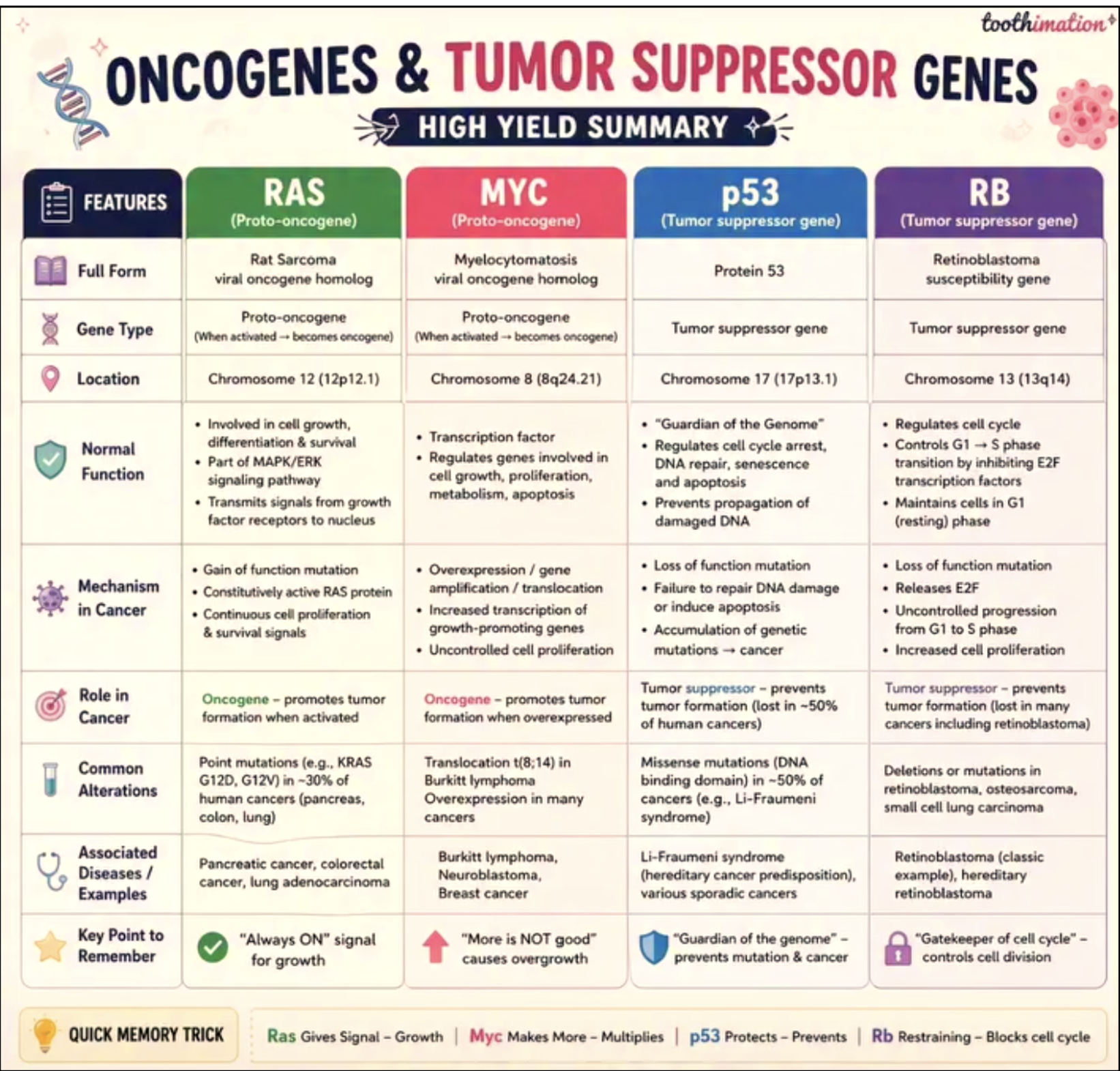
really study this
HPV is associated with what cancers
warts
cervical carcinoma
orophayngeal cancer
Mechanism for HPV and how it causes cancer
viral proteins E6 interferes with p53, reducing cell cycle arrest and apoptosis
E7 interferes with Rb, releasing E2F and encouraging entry into S phase
What cancer is HIV associated with
Kaposi’s sarcoma
HIV cancer mechanism
this autoimmune disease causes immune supression and reduces control of oncogenic viruses and abnormal cells
What cancers are associated with H pylori
gastric adenocarcinoma
H.pylori mechanism
some strains contain CagA capable of disrupting epithelial cell polarity
What cancer is HCV associated with and its mechanism (Hep C)
associated with liver cancer and hepatocellular carcinoma
chronic liver inflammation, liver injury and cirrhosis
What is quiescence
A TEMPORARY and REVERSIBLE state of arrest. Can re enter the cycle when it recieves appropriate mitogens/GF
when does differentiation occur
occurs when a cell becomes specialized to perform a specific function and then leaves the cell
what is endoreplication
when a cell replicates its DNA but does NOT DIVIDE, it therefore accumulates additional chromosomes to produce a polyploid cell
What is senescense
A STABLE and PERMANENT cell cycle arrest caused by cellular stress such as DNA damage, hypoxia, chemo, telomere shortening, etc.
Important to note: remains dormant and active. May release inflammatory substances (SASP) that promote inflammation and tumor progression
If senescent cells are linked to cancer pogression, why not use drugs to eliminate them?
Senescent cells are also involved in tissue healing. Killing all senescent cells may impair tissue repair.
DO senescent cells respond to mitogens
NO. unable to reactivate the E2F transcriptional program needed for cell cycle entry and DNA replication
In the hallmarks of senescence, explain the tumor suppressor pathway steps
stress activates p53
p53 stimulates p21 production
p21 inhibits cyclin-CDK complexes (primary molecular engines that drive cells forward through the different phases of the)
RB remains active and suppresses E2F (a family of proteins that control how cells grow, divide, and copy their DNA)
Cell remains arrested
how do p16 and RB work together to keep senescent cells out of cycle
p16INK4a blocks CDK4/6
with CDK4/6 blocksd, RB stays active.
RB prevents E2F from activating S-phase genes
Cell cannot re-enter the cycle
What are quiescent triggers
lack of GF or nutrients, or a need to divide
what are senescent triggers
DNA damage, telomere shortening, oncogene activation, stress
if senescent cells cannot re-enter the cell cycle, how can they cause cancer?
Secreting Inflammatory Factors (SASP): Senescent cells release a cocktail of cytokines, growth factors, and enzymes (such as matrix metalloproteinases) into nearby tissue.
Fueling Angiogenesis: The secreted SASP factors stimulate the creation of new blood vessels, supplying nearby precancerous or malignant cells with the oxygen and nutrients they need to grow.
Driving Cell Invasion and Metastasis: Chemical signals from senescent cells break down the extracellular matrix, making it easier for neighboring cancer cells to invade surrounding tissues and spread to other parts of the body.
Promoting Immune Evasion: The chronic inflammatory barrier created by senescent cells can block or exhaust immune cells, shielding nearby cancer cells from being detected and destroyed
what are three common cell death programs important for eliminating cancer cells
apoptosis
autophagy
ferroptosis
What is apoptosis
programmed cell death that removes damaged or infected cells without producing an inflammatory responce
Apoptosis has intrinsic and extrinsic pathways. What triggers them and role of mitochondria.
INTRINSIC
triggered by internal stress like dna damage, oncogene stress, chemo.
mediated by mitochondria
EXTRINSIC
triggered by extracellular signals binding to surface cell death receptors (FAS)
no mitochondria required
What triggers apoptosis intrinsic
dna damage, oncogene stress, chemo
What is autophagy
self eating
intracellular recycling system that uses autophagosomes to engulf damaged organelles and delivers components to lysosomes for degredation and reuse
how can autophagy suppress cancer
removing damaged mitochondria, limiting oxidative stress, and preventing accumulation od damaged proteins
how can autophagy be both beneficial and detrimental
BENEFICIAL: removes damaged mitochondria which prevents acumulation of damaged proteins
DETRIMENTAL: cancer cells use autophagy to survive nutrient deprivation and low oxygen. They can also recycle cellular materual for energy
what is ferroptosis
cell death caused by iron dependent accumulation of lethal lipid peroxides in cell membrane
how does ferroptosis help with the development of cancer
some cancer cells are vulnurable to ferroptosis due to high iron requirements.
some cancer therapies induce ferroptosis to kill cancer cells that resist apoptosis, basically functioning as a tumor supressor mechanism
if chromo 9 and 22 undergo translocation, this would produce the _____ fusion, and cause ___ ___ ___
BCR-ABL; chronic myelogenous leukemia (cml)
what drug blocks BCR_-ABL
imatinib (gleevec)
A chromosomal translocation creates BCR-ABL. What disease is associated with this alteration?
CML
what is the main idea behind ferroptosis
iron-dependent accumulation of lipid hydroperoxides to lethal levels
what is Bcl-2?
anti-apoptotic protein
An increased level of Bcl-2 means what?
decreased levels of apoptosis, contributing to cancer
what is bh3
a drug that inhibits Bcl-2 anti-apoptotic proteins