LEC 3 ENVI SCI
 Call Kai
 Learn
Learn Practice Test
 Spaced Repetition
 Match
Match Flashcards
 Knowt Play
1/77

There's no tags or description
Looks like no tags are added yet.
Name | Mastery | Learn | Test | Matching | Spaced | Call with Kai | Chat |
|---|
No analytics yet
Send a link to your students to track their progress
78 Terms
Air Pollution
Are substances that make air smelly,
discolored, or hazardous to breathe
Air Pollutants
Any chemical, physical (e.g., dust) or biological substance that changes the natural characteristics of the atmosphere
stationary sources,
mobile sources,
Area Sources
Emissions of air pollution come from four major source types:

Stationary Sources
factories, power plants, industrial facilities, and other fixed sources.
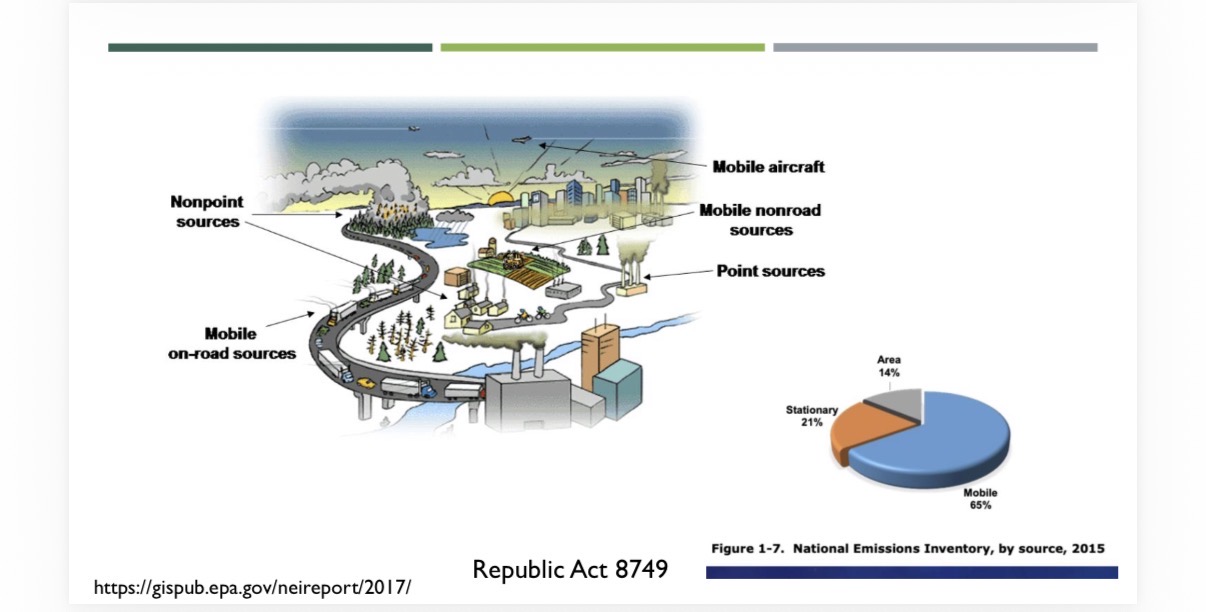
Mobile Sources
vehicles such as cars, buses, trucks, and motorcycles
Area Sources
activities that produce pollution over a broad area, such as construction, open burning, and similar activities.
Republic Act 8749
Philippine Clean Air Act of 1999
Agriculture Area Source
Animals confined to a barn or area (vs grazing animals), produce large amounts of manure.
Manure
emits various gases, particularly ammonia, into the air
Amonia
What gas does manure produce?
Biogenic (Natural Sources) Area Sources
Erupting volcano and Forest and prairie fires are examples of this area sources
Plants and trees
These emit hydrocarbons, and dust storms can create large amounts of particulate matter
Major Pollutants
▪ Particulate Matter
▪ Nitrogen Oxides
▪ Sulfur Dioxide
▪ Carbon Dioxide
▪ Carbon Oxide (Carbon Monoxides)
▪ Volatile Organic Compounds
▪ Ozone
Particulate Matter
Tiny solid or liquid particles that are small enough to remain suspended in the air.
Particulate Matter
Key component of smog
PM10
coarse particles that have diameters of less
than 10μm, which is roughly one-eighth the
diameter of a human hair;
Examples of PM 10
lead, iron, copper, nickel particulates
Carbon Monoxide
a very poisonous gas produced by incomplete fuel combustion
Hemoglobin
carbon monoxide has greater affinity with
Carbon Monoxide
Gas that causes drowsiness, headache, dizziness and nausea
Carbon Monoxide
can lead to asphyxiation or even death
Carbon dioxide
a primary product of combustion
Greenhouse gas
Carbon dioxide is considered as
Lead
Burning of lead gasolin that cause neurotoxins
Smog
was originally referred to as a mixture of smoke and fog.
Smog
It now becomes a generic term for a noxious (harmful) mixture of gases and particles in the air.
Smog
often be seen, especially over heavily populated areas, as a brownish-yellow or greyish-white haze in the ai
Volatile Organic Compounds
volatile hydrocarbon components of consumer products (paint thinners, roof tar, petroleum distillates)
Volatile Organic Solvents
Evaporating solvents and propellants (nail polish, deodorants, after-shave lotions, hair sprays,insecticides
Primary Pollutants
Pollutants that enters the air as the direct result of a specific activity
Secondary Pollutants
Pollutants formed by the further reaction of a primary air
Greenhouse Gas
The greenhouse effect is the rise in temperature that the Earth experiences because certain gases in the atmosphere (water vapor, CO2, Nitrous oxide, and methane) trap the energy from the Sun
10/31 zmikss
Thickness of stratosphere
0-10 miles
Thickness of Troposphere
UV-C
Absorbed in the Stratosphere by Ozone
UV-B
Absorbed mostly by ozone
UV-A
Partially absorbed by Ozone
63.7%
Percentage of CO2
6%
Percentage of N2O
11%
Percentage of CFC
18.9%
Percentage of Methane
Sources of Greenhouse Gases
Thermal power stations based on fossil fuels, mainly coal and mineral oil emit huge amounts of CO2.
Numerous factories and industrial chimney waste.
Automobiles
Deforestation and burning of fossil fuels
Impact of Greenhouse Effect
Global warming and climate change
Rise of sea level
Worsening of health effects
Changing forest and natural areas
Challenges to agriculture and food supply
Effect on the ozone layer
Effect on oceanic climate
Global Warming
is the long-term heating of Earth's surface observed since the pre-industrial period (between 1850 and 1900) due to human activities.
Between 1850-1900
Period of pre-industrialization
Climate Change
refers to long-term shifts in temperatures and weather patterns.
Acid Deposition
Any form of precipitation with acidic components, such as sulfuric or nitric acid that fall to the ground from the atmosphere in wet or dry forms.
Wet deposition (Acid Rain)
Rain or any other form of precipitation that is acidic.
Dry Deposition
acidified particles and gases which are deposited directly from the air.
Two Types of Acid Deposition
Wet and Dry Deposition
Clean Rain
naturally slightly acidic (pH of 5.6), containing acids formed when carbon dioxide reacts with atmospheric moisture
Less than 5.6 (<5.6) pH
Acid rain has what pH level
Impacts of Acid Deposition
• Surface water (rivers, lakes etc) and aquatic animals
• Soils
• Forests and vegatations
• Human Health
• Building and the Urban environment
Dissolving
Some gases, which are more soluble in a particular liquid than air, for example, ammonia in water, can be separated by
Gravity Settling Tanks
Particles larger than 50 mm are separated in
extracting sulphur from the fuel before use.
SO2 pollution can be controlled by
Pollution Control Laws
These laws should be enforced strictly
Population Growth
the leading cause of pollution
Trees
should be planted on the roadside, riverbanks, parks and open places as they keep the environment fresh.
Nuclear Explosion
This explosion should be restricted.
balanced and healthful ecology
The State shall protect and advance the right of the people to a ______ and __________ in accord with the rhythm and harmony in nature
Area-based
The State recognizes that the responsibility of cleaning the habitat and environment is primarily
Polluters must pay
The State also recognizes the principle that
concern of all
the State recognizes that a clean and healthy environment is for the good of all and should, therefore, be the _____
holistic national program of air pollution management
Formulate a _____________ that shall be implemented by the government through proper delegation and effective coordination of functions and activities;
cooperation and self-regulation
Encourage _____________ among citizens and industries through the application of market-based instruments;
Pollution prevention
Focus primarily on ________ rather than on control and provide for a comprehensive management program for air pollution
Promote Public information and education
and to encourage the participation of an informed and active public in air quality planning and monitoring; and
Formulate and enforce a system of accountability for short and long-term adverse environmental impact of a project, program or activity.
This shall include the setting up of a funding or guarantee mechanism for clean-up and environmental rehabilitation and compensation for personal damages.
Recognition of Rights in Philippine Clean Air Act of 1999
right to breathe clean air;
utilize and enjoy all natural resources
right to participate
right to be informed of the nature and extent of the potential hazard of any activity
right of access to public records
right to bring action in court or quasi-judicial bodies
right to bring action in court
The Department (EMB)
shall be the primary government agency responsible for the implementation and enforcement of this Act.
Environmental Management Bureau
EMB stands for
Role of Local Government Units
Local Government Units (LGUs) shall share the responsibility in the management and maintenance of air quality within their territorial jurisdiction.
Environment and natural resources officer
There may be established an Environment and Natural Resources Office in every province, city, or municipality which shall be headed by the
DENR Secretary
The Board shall be headed by the
RA 8749 - Philippine Clean Air Act of 1999
Philippine law designed to protect and improve the country’s air quality and prevent air pollution that can harm human health, ecosystems, and the environment.
Purpose of RA 8749
1. Prevent and control air pollution.
2. Protect the public from the harmful effects of polluted air.
3. Maintain clean and healthy air for present and future generations.
Main Goal of RA 8749
Clean air → healthier people + healthier environment