Plant Tax Lecture quiz 2
 Call Kai
 Learn
Learn Practice Test
 Spaced Repetition
 Match
Match Flashcards
 Knowt Play
1/37

There's no tags or description
Looks like no tags are added yet.
Name | Mastery | Learn | Test | Matching | Spaced | Call with Kai | Chat |
|---|
No analytics yet
Send a link to your students to track their progress
38 Terms
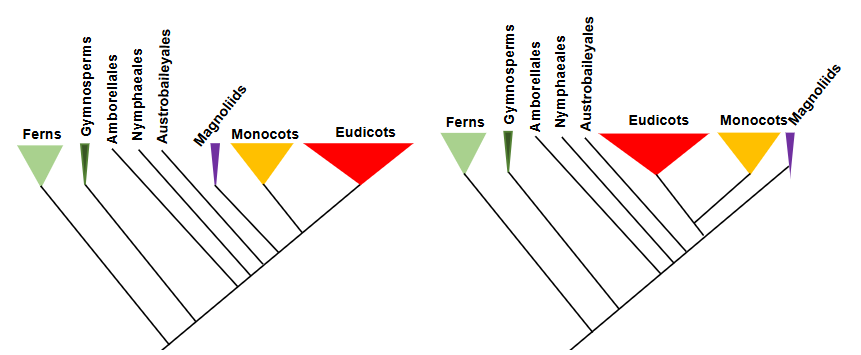
do the two trees in the figure show different evolutionary relationships?
no; these two trees show the same evolutionary relationship
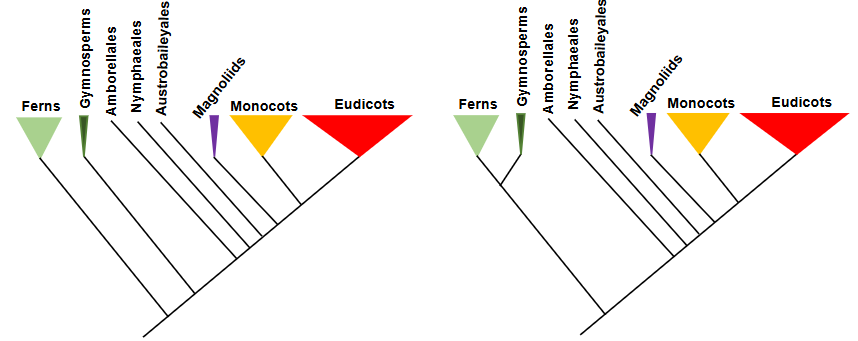
do the two trees in the figure show different evolutionary relationships?
yes; these trees show different evolutionary relationship

what type of group is shown indicated by the blue shading?
paraphyletic group

what type of group is shown indicated by the blue shading?
monophyletic group
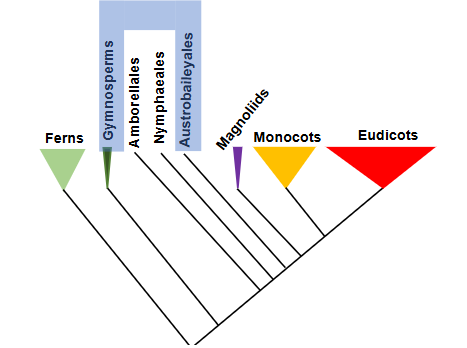
what type of group is shown indicated by the blue shading?
polyphyletic group
principle of Parsimony
Occam’s razor
William of Occam, 14th century
"entities should not be multiplied without necessity” = “the simplest explanation is usually the right one”

simple model of orbit around the sun; more or less parsimonious? name?
-more parsimonious
=Heliocentrism

simple model of orbit around the sun; more or less parsimonious? name?
-less parsimonious
=Geocentrism
The principle of Parsimony in character evolution
Fewer transitions are a simpler and more parsimonious explanation for
the evolution of new traits

Bats, humans, and woodpeckers example - if winged flight evolved only once…
7 changes (3 convergences)
If ‘winged flight’ evolved only once, then all the red (mammalian) traits must have evolved twice independently, which is a less parsimonious hypothesis

Bats, humans, and woodpeckers example - if winged flight evolved twice…
5 changes (1 convergence)
If ‘winged flight’ evolved twice, then all the red (mammalian) traits must have evolved once, which is more parsimonious hypothesis
Homology
The sharing of features due to common ancestry

Building trees: Outgroup
a taxon outside of our study group that will give polarity to our characters states.
ex: A redwood could be used as an outgroup to infer a tree of Angiosperms
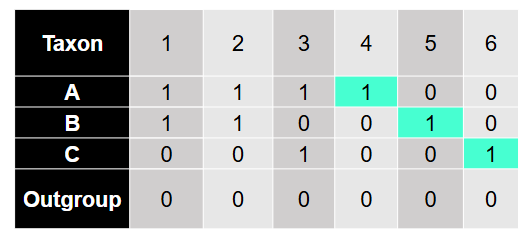
Autapomorphies
found in a single taxon
number of trees grows ______?
number of trees grows exponentially
3 taxa: 3 possible trees
4 taxa: 15 possible trees
10 taxa: > 34 million possible trees

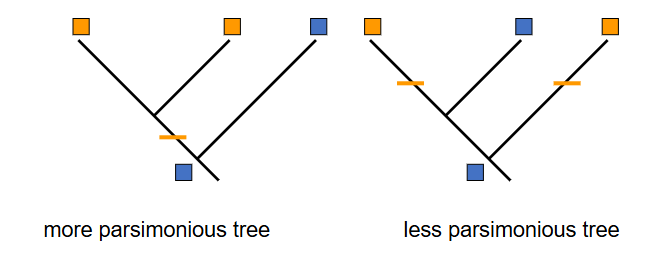
which tree is more parsimonious? what do green, blue, and yellow represent?
-first tree is more parsimonious
-green shows autapomorphies
-blue shows possible synapomorphies that support A and B as closely related
-yellow shows possible synapomorphies supporting A and C as closely related
The Molecular revolution : DNA sequence is comprised of what?
A DNA sequence is comprised of nucleotides or base pairs (bp)
A (adenine), C (cytosine), G (guanine), T (thymine)
Where is DNA in a plant cell? (3 places)
Nucleus (two version of each chromosome). Giant > 1Gb
Chloroplast: single and circular molecule of DNA. Small 150Kb
Mitochondrion: single and circular molecule of DNA Small 500Kb
DNA can belong to what two regions?
coding-regions (exons) or non-coding regions (intros)
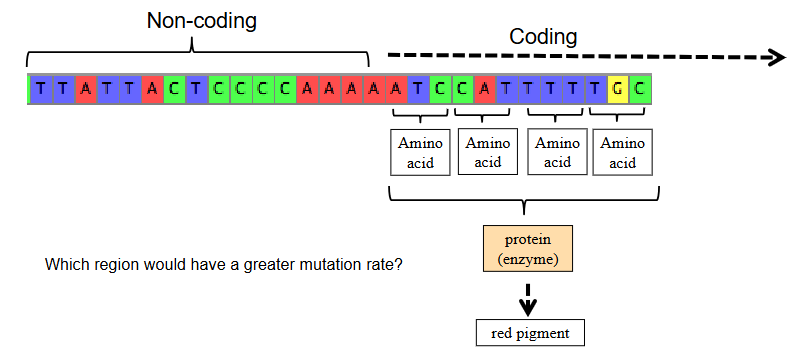
coding and non-coding regions: Which region would have a greater mutation rate?
higher mutation rate in non-coding
more mutations can occur and it matters less
active side more impacted by mutations (will be altered and handled quickly)
more changes occur in non-coding (not clean, not selected)
Plant DNA in phylogenetic analyses: Nuclear (amt of info, variability/amt of change, employability, problems)
Nuclear
Amt of info: vast (Excellent)
Variability/amt of change: High
Employability: Moderate because of its size
Problems: Lots of processing
Plant DNA in phylogenetic analyses: Chloroplast (amt of info, variability/amt of change, employability, problems)
Chloroplast
Amt of info: Medium
Variability/amt of change: Medium
Employability: Easy, medium size many genomes per cell
Problems: Not good when hybridization is present
Plant DNA in phylogenetic analyses: Mitochondrial (amt of info, variability/amt of change, employability, problems)
Mitochondrial
Amt of info: Low
Variability/amt of change: Poor
Employability: Easy, medium size many genomes per cell
Problems: Almost no variability, weird evolution
Sanger sequencing (analogous to recovering ___ from a book)
recovering single markers
• < 1000 base pairs
• Is the analogous of recovering one paragraph from a book (with thousands of pages)
marker
a contiguous sequence of DNA used for phylogenetic/genetic analysis
The first phylogenies of flowering plants were inferred from a single
chloroplast gene called?
rbcl
Nuclear DNA-based phylogeny of Layia was based on what nuclear region? why?
based on ITS (Internal transcribed spacer), a nuclear region that evolves fast
Nuclear region ITS evolves fast = good for species-level phylogenies
Single markers can be ____ to obtain larger matrices?
Single markers can be concatenated to obtain larger matrices (multiple gene/DNA regions)
Target Sequencing (analogous to recovering ___ from a book)
recovering multiple markers at a time
• Sequence a selection of regions
• Most common current method in phylogenetics
• Is the analogous of recovering hundreds of paragraphs from a book at the same time

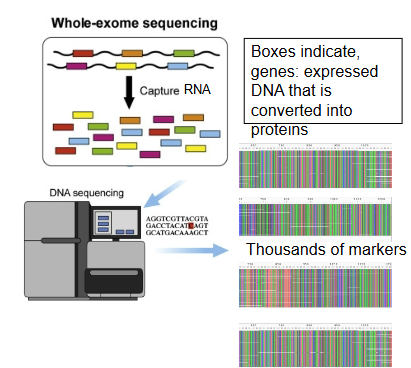
Exome Sequencing / transcriptomics (analogous to recovering ___ from a book)
recovering all coding DNA
• Recover all genes being expressed by sequencing RNA, ~30.000 genes
• Used for big picture phylogenies, Angiosperms, orders
• Is the analogous of recovering thousands of paragraphs from a book at the same time
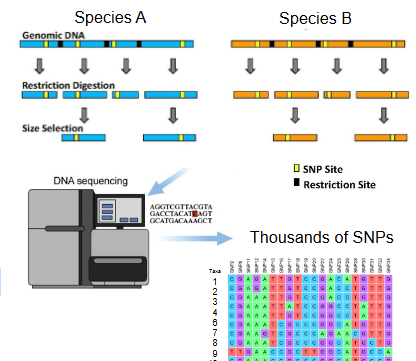
Restriction Associated DNA markers RAD, ddRAD (analogous to recovering ___ from a book)
recovering random fragments from the genome
• Sequence fragments of the genome after digestion with enzymes
• Researchers usually “distill” the data and only using variable positions: Single Nucleotide Polymorphisms (SNPs)
• Is the analogous of recovering thousands of random sentences from a book
Genome Sequencing (analogous to recovering ___ from a book)
recovering all the genome
• Sequence all DNA
• Because of genomic rearrangements, researchers usually look for Single Nucleotide Polymorphisms (SNPs)
• Is the analogous of recovering the entire book

Finding Homologous regions in whole genomes is difficult, reason why SNPs are preferred
• Chromosomes evolve and re-arrange, making it difficult to find corresponding parts between chromosomes ->
• Super-high computational demand
• Expensive
SNPs
single nucleotide polymorphisms
Sequencing techniques table

DNA is usually analyzed with methods different from parsimony
• Parsimony assumes that the rate of evolution is constant among all characters
This is not true for DNA, non-coding regions evolve faster than coding regions
Transitions are more common than transversions
• DNA data is analyzed with probabilistic methods that can model molecular evolution
Maximum likelihood and Bayesian methods
ML and Bayesian methods search for trees with the best probability of explaining the data taking into account a probabilistic model of DNA evolution

Advantages of DNA
• Repeatability
• Much more data
• Less subjective
• Discrete character states