APHUG U5 Vocab
 Call Kai
 Learn
Learn Practice Test
 Spaced Repetition
 Match
Match Flashcards
 Knowt Play
1/114

There's no tags or description
Looks like no tags are added yet.
Name | Mastery | Learn | Test | Matching | Spaced | Call with Kai | Chat |
|---|
No analytics yet
Send a link to your students to track their progress
115 Terms
Agriculture
The deliberate modification of the Earth’s surface through cultivating plants and raising animals for food or economic gain.
What do site and situation factors determine?
What gets farmed and where depends on site and situation factors
Site factors
Characteristics of the place itself (climate, soil, natural resources, and terrain)
Situation factors
Describes a place’s relationship to its surroundings (nearby rivers, roads, markets, and transportation networks)
What are the two categories of agricultural practices?
Intensive and extensive
Intensive agriculture
Uses less land but requires more labor and capital, and is typically closer to population centers.
Requires less land
Require more capital and labor
Located near larger population centers
Maximizes agricultural production
What are the types of intensive agriculture?
Plantation agriculture; market gardening; mixed crop and livestock farming
Plantation agriculture
Large-scale farms in tropical climates, often in periphery countries with low labor costs, producing cash crops for export.
Cash crops (plantation agriculture)
Grown for sale and not for use by the grower
Often grown by farmers in less economically developed areas to export to wealthier areas for income
Examples of cash crops
Coffee, sugar, tobacco, tea
Market gardening
Smaller farms focused on fresh fruits and vegetables, common in areas with long growing seasons (e.g. the southeastern part of the U.S.)
Mixed crop and livestock farming
Found in more economically developed countries, where crops like corn and soybeans are grown to feed livestock.
Extensive agriculture
Uses more land but requires less labor and capital, and is generally found farther from urban areas.
Requires more land
Requires less capital and labor
Located further from larger population centers, more in rural areas
Crops have a lower yield
What are the types of extensive agriculture?
Shifting cultivation; nomadic herding; ranching.
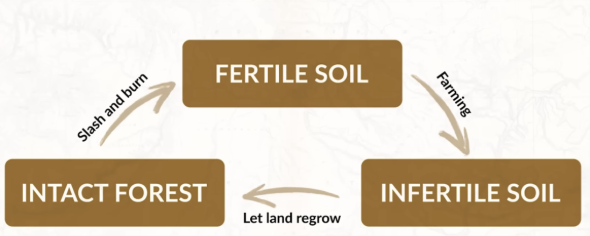
Shifting cultivation
Involves the land being cleared, then farmed until soil is depleted, after that the land is left to fallow (set aside for some time to allow nutrients to return to the soil) while farmers move to a new plot of land.
It is found in tropical climates such as Latin America, Sub-Saharan Africa, South East Asia.
Nomadic herding
Where herders migrate with their livestock through areas where sedentary farming isn’t feasible.
Ranching
Involves raising livestock on large areas of inexpensive land not ideal for crop farming.
What does intensive and extensive agriculture describe?
Intensive and extensive agriculture describes how farming is done.
Commercial agriculture
Focuses on producing food for sale and profit.
Where does commercial agriculture occur?
Core countries (more economically developed countries).
Subsistence agriculture
Focuses on producing food for the farmer’s family or local community.
Where does subsistence agriculture occur?
Periphery countries (less economically developed countries).
Can commercial/subsistence agriculture be paired with intensive/extensive agriculture?
Yes!
e.g. Extensive subsistence agriculture
e.g. Intensive commercial agriculture
Aquaculture
The farming of fish, shellfish, and other aquatic organisms.
What are the 3 types of rural settlement patterns?
Clustered; dispersed; linear
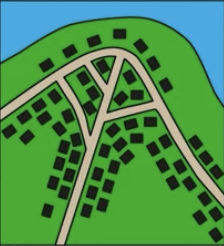
Clustered settlement patterns
The homes and buildings are close together.
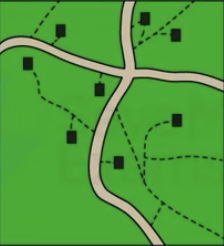
Dispersed settlement patterns
Homes and buildings are farther from each other.

Linear settlement patterns
Created to follow the line of transportation (river, railway, road) in the area.
What are the 3 rural survey methods?
Metes and bounds; long lots; township and range

Metes and bounds
Use natural landmarks in the area to define irregular parcels of land.
A specific measured boundary usually represented as a straight line.
Used in the east coast of the U.S. (rest of the country uses more township and range).
Often used for short distances.
Metes
Straight lines that connect to different parts of a geographic area
Measurements of direction and distance between points.
Bounds
Key natural or human-made landmarks that define the edges of the property.
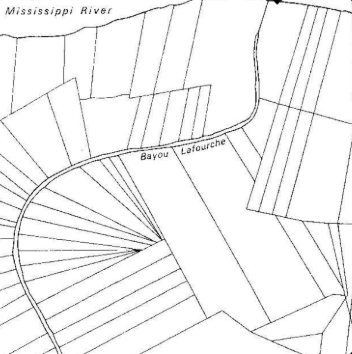
Long lots
Land divided into parcels of land with each lot connected to a transportation system (river or road).
Common in French-influenced areas like Louisiana and Quebec.
Helps facilitate the transportation of goods and services.

Township and range
Land divided by longitude and latitude to create a grid pattern (divides land into uniform square parcels).
Based on baseline and principal meridian.
Townships going North to South
Ranges going East to West
Chemical farming
The increased use of potassium, nitrogen, and phosphorus on plants to maximize production
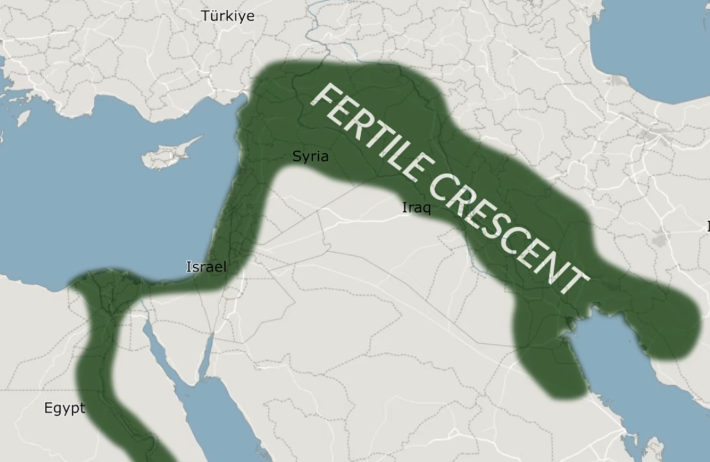
The Fertile Crescent
Hearth for crops like wheat, oats, and barley.
Located between the Euphrates River and the Tigris River.
Where did crops from the Fertile Crescent diffuse to?
Crops from the Fertile Crescent later diffused to Europe.
First Agricultural Revolution (Neolithic Revolution)
When humans shifted from hunting and gathering (nomadic - moving around once animals/hunting had been depleted) to sedentary farming (staying in one place).
What was the impact of the First Agricultural Revolution?
Stable population growth formed due to food surplus, which led to more complex societies to form.
Crops from Sub-Saharan Africa
Yams, sorghum, and coffee (Kenya, South Sudan)
Crops from Central America
Potatoes, maize or corn, squash, and peppers (Cuba, Mexico, Panama)
Crops from East Asia
Hearth for rice and soybeans (Japan, Korea)
Crops from Southeast Asia
Tropical fruits like mango and coconuts (Indonesia)
Crops and countries in tropical climate
Countries: Indonesia, African countries near the equator (Uganda), some countries in South America (Brazil)
Crops: coffee, sugar, pineapple
Crops and countries in subtropical climate
Countries: West Indies (e.g. Jamaica, Haiti), Panama, Vietnam
Crops: rice, cotton, tobacco
Crops and countries in dry climate
Countries: Australia, Northern Africa (Egypt, Morocco), West Asia (Mongolia), Western U.S. (Utah, Colorado)
Too dry for crops, so animals rule (cattle ranching - horses, sheep, goats).
Crops and countries in mediterranean climate
Countries: California (state), Spain, Italy, Greece
Crops: grapes, olives, dates (think Italian vineyards).
Crops and countries in warm-mid latitude climate
Countries: Southern U.S. (Alabama, Mississippi)
Crops: vegetables, fruits, rice.
Crops and countries in cold-mid latitude climate
Countries: Canada, Russia, Eastern Europe (Poland)
Crops: wheat, barley, livestock, dairy cows.

Colombian Exchange
Transfer of plants, animals, and diseases between the Old World and the New World.
Old World: Europe, Asia, and Africa
New World: The Americas (north and south)
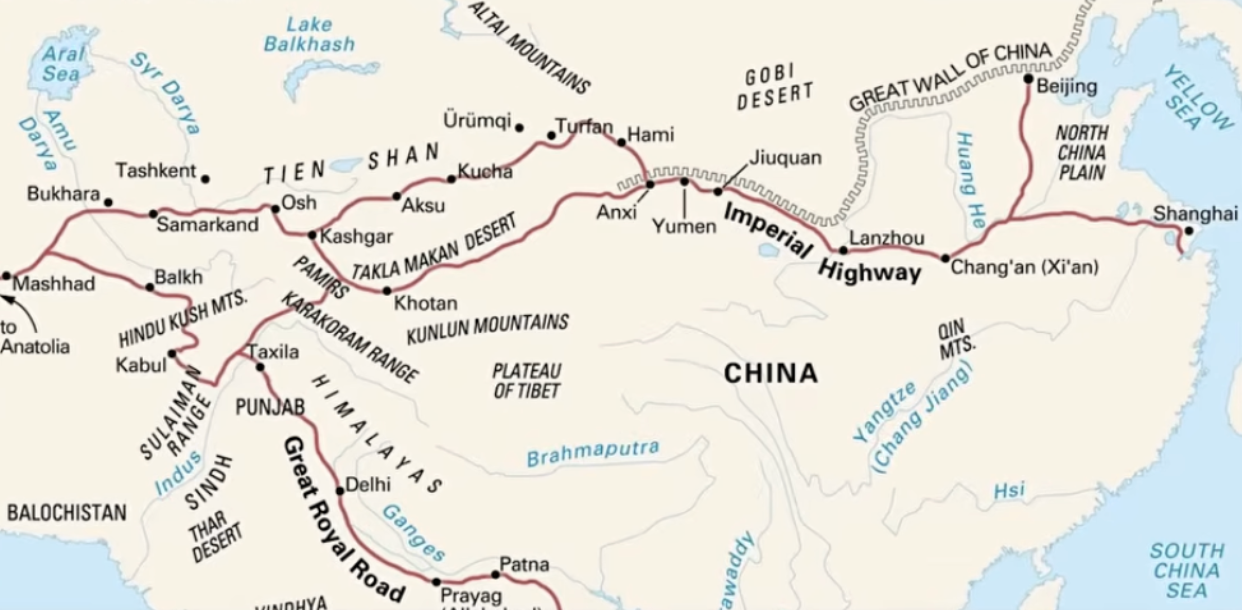
Silk Road
Network of trade routes that connected China and the Mediterranean from roughly 120 BCE to 1450 CE.
Second Agricultural Revolution
Took place in England during the industrial revolution around the 18th and 19th centuries and brought new technology that made farming more efficient.
Inventions from the Industrial Revolution (seed drill, steel plow, and mechanical reaper) dramatically improved agricultural output.
Transformed subsistence farming into commercial agriculture, driven by industrial technology and new techniques in Britain.
Seed drill
Mechanical planting device (drops seeds into soil) invented by Jethro Tull in 1701
Steel plow
Allowed farmers to break through tough soil efficiently, invented by John Deere
Mechanical reaper
Horse-drawn machine that cut and harvested grain crops much faster than manual labor, invented by Cyrus McCormick
The Norfolk system
Eliminated fallow fields by rotating four different crops in sequence to maintain soil fertility (wheat, turnips, barley, clover/ryegrass)
Enclosure Movement
Movement in England that privatized publicly owned agricultural land
Benefit of the Enclosure Movement
Having individuals own the land gave them an incentive to be more efficient since they had direct benefit from producing more crops and raising more animals
Impact of the Enclosure Movement
Countered tragedy of the commons (overexploitation, degradation & depletion of resources), increasing food production
Green Revolution
A mid-20th-century agricultural transformation (roughly 1950s–1970s) that massively increased global food production (particularly wheat and rice) by introducing:
High-yield seed varieties
Chemical fertilizers (nitrogen and phosphate)
Pesticides
Herbicides
Mechanized farming
Pesticides
Chemical inputs used to kill or control pests, insects, and weeds
Herbicides
Chemical agents used to kill unwanted plants and weeds that compete with crops
How did the Green Revolution start?
It started with Dr. Norman Bourlaug’s work with crossbreeding wheat varieties in Mexico.
Crossbreeding
Combines different plant varieties to produce hybrid seeds with stronger traits (e.g. shorter growing seasons and climate resistance).
What do hybrids come from?
Hybrids come from traditional crossbreeding
What do GMOs (genetically modified organism) come from?
GMOs came later (after the Green Revolution). GMOs come from altering the DNA of an organism to promote specific traits for increased production.
Positive impacts of Green Revolution
Lower production cost of crops
Food supply increased
Food prices decreased (more people could buy food)
Saved ~1 billion people from starvation
More economic opportunities — creation of industrial farms and large profits.
Negative impacts of Green Revolution
Loss of biodiversity
Soil degradation
Water pollution from chemicals
Increased fossil fuel use
Displacement of small family farms
Monoculture
Broader practice of growing one type of crop on a large scale over a wide area to maximize yields and efficiency.
Can be done continuously (monocropping) or rotated with other crops
Monocropping
Specific, often continuous, practice of planting the same crop in the same field year after year.
Bid-rent theory
Price of land increases the closer it is to the city due to scarcity
Why is intensive agriculture closer to city/market?
Require less land and have lots of money for capital/investments, so being near the city is fine for them
Why is extensive agriculture further from city/market?
Because this agriculture requires more land and they want to minimize costs, so they’ll be situated further from the expensive city
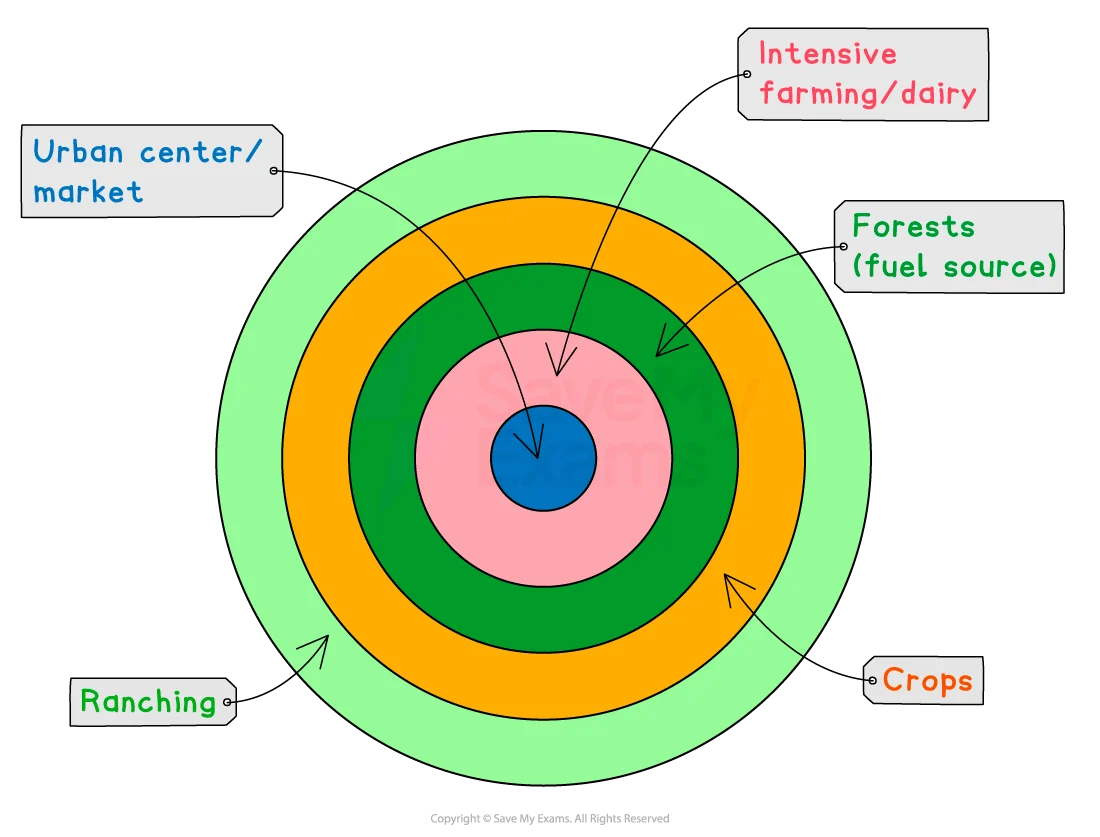
Von Thunen Model
Explains rural land use by showing how transportation costs and distance from the market shape what farmers grow and where.
Von Thunen Model 5 assumptions
All land is flat
All the land has similar site characteristics
One, single market
All land has equal access to the market
Farmers want to maximize profit
What is the center of the Von Thunen Model?
The center is the Market.
What is the first ring of the Von Thunen Model?
The first ring is dairy farming and horticulture (most perishable form of agriculture).
Because these goods are perishable (short shelf-life), they have to get to the market quickly.
Note: Von Thunen created this model before the invention of fridges.
What is the second ring of the Von Thunen Model?
The second ring is forestry.
Historically forests/lumber were needed for fuel and construction.
Lumber was heavy and hard to transport, so having it close to the market makes getting it convenient and bring transportation costs down.
Von Thunen is all about maximizing profit.
What is the third ring of the Von Thunen Model?
The third ring is grains and field crops.
Grains and field crops require a lot of land to grow, which means locating further from the center/market will be cheaper (assuming that farmers want to maximize profit).
These crops are also lightweight, which makes them cheap to transport.
These crops don’t need to be consumed immediately/refrigerated/perishable.
What is the fourth ring of the Von Thunen Model?
The fourth ring is ranching and livestock.
Located the furthest from the market where land is the cheapest.
It requires a lot of land to graze.
Farmers can offset some of the transportation costs with the savings they get from cheaper land.
Livestock can walk to the market or slaughterhouse.
What is outside the fourth ring of the Von Thunen Model?
Outside of the fourth ring is wilderness.
There is no commercial agriculture here because it’s too far away from the market that it would not be able to generate a profit.
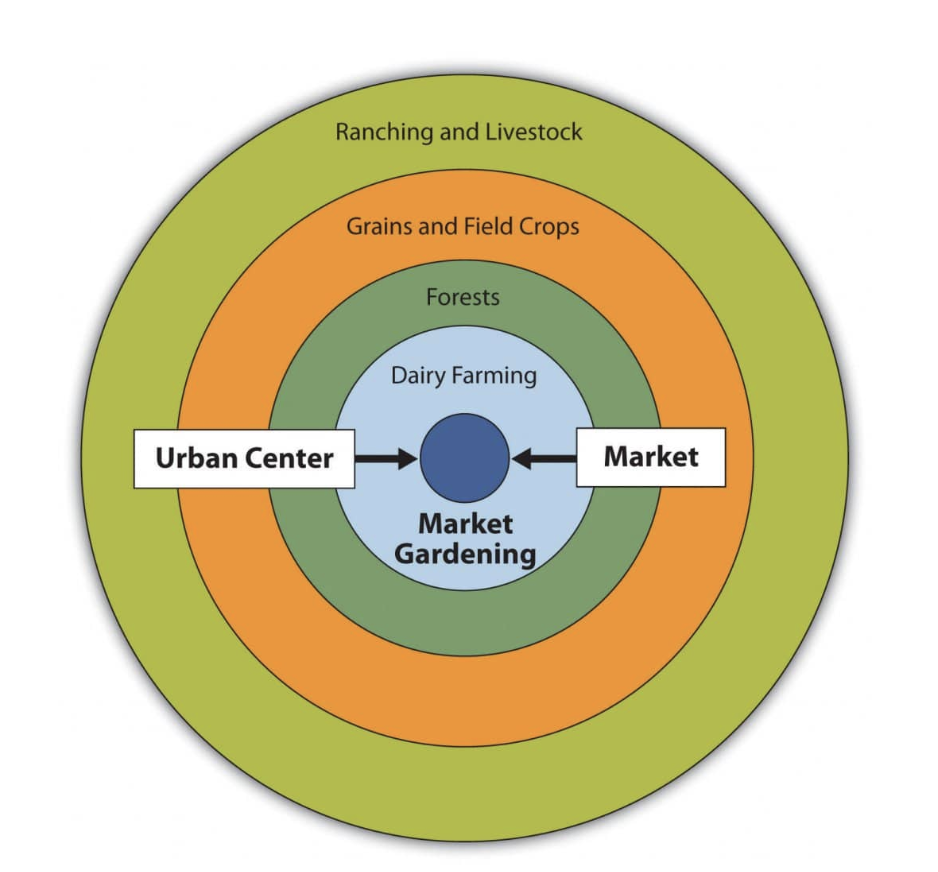
What are parts of the Von Thunen model that no longer make sense today/changed?
Forest is no longer on the second ring and is replaced with crop production, due to shifts in society’s needs (lower demand for lumber) and advancements in transportation (reduce cost of transporting certain goods).
Changes in production of livestock due to CAFO (concentrated animal feeding operation, aka “factory farms”), industrial farms, and agribusinesses.
Change in technology and transportation because cities can trade across the world and companies can create large commodity chains and global supply chains.
Economies of scale
As production increases, average cost per unit decreases.
As companies get larger, they can purchase better machines and more access to capital which lets them scale up
Large agribusinesses have achieved economies of scale
Many family farms have been purchased by larger farms to consolidate farms under one business
Agribusiness
Large-scale, industrialized, corporate-controlled food production system
Agribusinesses has led to the rise of monoculture (growing one type of crop across a wide area) and monocropping (when the farmer grows the same crop each year).
Commodity chain
The series of steps involved in gathering resources, producing a good, and distributing it to consumers.
Supply chain
Follows multiple inputs, commodities, and components from sourcing through manufacturing to distribution.
Commodity dependence
When more than 60% of a country’s exports are raw materials or agricultural products.
Countries with commodity dependence are vulnerable to price swings in global markets.
Carrying capacity
Maximum number of people, animals, or crops that an area can support
Biotechnology
The use of biological systems and living organisms in technology to create new products
Deforestation
When forests are cleared to make room for farming.
Desertification
When former arable land is no longer useful and becomes a desert
Soil salinization
Salt develops in the soil making it difficult to grow crops, often caused by monocropping
Chemical runoff
Chemical runoff can pollute rivers and lakes.
Soil erosion
Wearing away and removal of the upper layer of soil due to human activities (intensive agriculture)
Slash and burn
Burning forests to put nutrients back into the soil
Land Cover Change
When natural land is converted to farmland.
Ecosystems are destroyed.
Carbon stored in soil and trees are released into the atmosphere.
Pastoral nomadism
Farming livestock that grazes on land and moves around with the seasons
Food desert
An area where there are little to no sources of fresh or healthy food available
Irrigation
Movement of water from one place to another to help grow vegetation
Terrace farming
A method of agriculture that involves growing crops on the side of hills or mountains by creating terraces that are built into the slope.
Found in Vietnam