Drug Discovery PY366
 Call Kai
 Learn
Learn Practice Test
 Spaced Repetition
 Match
Match Flashcards
 Knowt Play
1/263

There's no tags or description
Looks like no tags are added yet.
Name | Mastery | Learn | Test | Matching | Spaced | Call with Kai | Chat |
|---|
No analytics yet
Send a link to your students to track their progress
264 Terms
What are medicines?
chemical preparation containing 1/+ drugs, administered with intention of having a therapeutic effect
What are medicines in antiquity?
Naturally sourced medicine not based on scientific knowledge but rather serendipity
Suboptimal outcomes because theres no structured development
What are two approaches to drug discovery?
Traditional (empiric)
Rational
What does the approach involve?
Isolate & purify the active substance from natural sources
Screen isolated compounds in bioassays to test their activity
Structural modification/optimisation of compound
What is the process?
Test molecule is synthesised on mg to g scale
Sent for bioassay testing
Data is returned and analysed
Structural changes are made and new molecules is synthesised and tested
Limitations of traditional approach
Identification of active agent in natural products is complex
The validity of the result of bioassay
Purification of active constituent often involves separation of biological activity of natural product
What is rational drug discovery?
Development of drugs that act against specific physiological or biochemical target
Identification of failures at an earlier stage of the discovery process
What is the germ theory of disease?
Diseases are caused by microorganisms that invade the body
Specific organism are causative agents for infectious disease
What did Ehrlich call Salvarsan and why?
Magic bullet
Its highly toxic to treponema (causative agent for syphilis) but not humans
What are the 4 steps of rational drug discovery process?
Target identification
Target validation
Lead discovery
Lead optimisation
Explain Step 1
Knowledge of physiology and pathology and biochemistry
Elucidation of biochemical pathways and regulatory systems
Pharmacology
Genomic libraries
Identify receptors, enzymes and ion channels
Gene profiling - over or under expressed in pathological conditions
Gene engineering tech - gene knock ins or knock outs
Explain Step 2
Structure of target complements lead molecule
Role of target in disease progression
Involvement of target in other processes (suitability of targeting it)
Interaction between target and other drugs
Dose response assay measuring activity of drug on target
Explain Step 3
Natural sources
Chemical libraries
Structure based design
Cell-based design
In-silico approach
Explain Step 4
Optimisation of pharmacological profile of lead molecules
Drug candidates with optimal properties:
Chemical
Pharmacodynamic
Pharmacokinetic
Toxicological
What are all 6 steps sin drug discovery?
Target identification
Hit identification
Lead optimisation
Pre-clinical development
Clinical candidate
Clinical trials
What is a target?
Any system that can potentially be modulated by a molecules to produce a beneficial effect
Biological macromolecule or complex that is critical for the disease e.g enzyme critical in life cycle of a virus
What is target validation?
A form of risk assessment
Better the validation, lower the risk in advancing the project is
Mitigates selection of wrong target and wrong patient population
How do we identify the correct target?
Is the target critically involved in the disease and normal biology
If yes to normal biology, its not a target we can use as normal physiology is affected if targeted
The location of the target
One not evenly distributed throughout body to minimise SE e.g. receptors in brain for stroke but they’re not present elsewhere
Can target manipulation lead to desired effect?
Can target be effectively studied?
Is the target able to be easily used in high throughput screening
Target Types
Cells - vaccines
DNA
Viral surface proteins
Transporters
Ion channel blockers
Receptor agonist/antagonist
Enzyme activators/inhibitors
Can you name 3 major components of target identification
Tissue expression
Target protein is expressed in desired organ
mRNA expression is altered in desired disease tissue
Protein expression is altered in disease tissue
Genetics
Genetic association of a variant with a disease
Genetic polymorphisms linked to disease state
Clinical experience
Known ligand affecting target pathway or protein has shown efficacy in disease
Name 3 technologies used to identify targets
DNA microarrays - screen for gene changes between physiological and diseased tissue
Proteomics - Post translation mods
RNA knockdowns - gene knockouts
What happens when a target is validated?
Literature survey and competitor info taken
Has a pathophysiologically relevant molecule target been identified
Analyse of molecular signalling pathways
Molecular pharmacology of variants
Determination of DNA and protein structure
Elucidation of function and mechanism of protein
What is target validation pharmacology?
Pharmacological tool moderates disease associated pathway in vitro
Ligand with intended mode of action modulates disease associated pathways ex vivo
Ligands with intended mode of action modulate disease associated pathway in vivo with target engagement activity relationship established
What is antisense tech?
identifies targets
siRNA blocks synthesis of targeted protein
Small interfering RNA
Creates dsRNA to stop protein expression
What is the purpose of transgenic animals?
Inhibits specific proteins in every cell in body which can determine role in biology and identify SE
Specific protein expression is inhibited in every cell
Identification of role of protein is not just in disease also normal biology
Tissue restricted and/or inducible KO are now more desirable with advancements of drug delivery
What is ligand pharmacology?
Determine whether a specific ligand against identified target have pharmacological effect in disease state
This is beneficial where there isn’t lockout gene available or mRNA is hard to knock down
Why are animal models of disease significant?
essential in bridging translational gap between preclinical and clinical research
Need to check how close it is to human condition in order for results to be extrapolated
Name T1D model and explain
Multiple low dose streptozotocin model
Toxin destroying B-cells so immune response is triggered
Chemically induced T1D
REAL T1DM NOT CHEMICALLY INDUCED
Name another 2 T1D model and explain
Non-obese diabetic mouse
Genetic
Closer to human model
Virally induced
Close to human model as virus role is established in development of diabetes
Name 3 T2D models
Genetically obese models
Treatments improve insulin resistance or improve beta cell function
Induced obesity
FAT RATS FAT RATS
Non-obese models
Insulin resistance model
How can animal models fail to identify effective treatment
Disease model does not fully reflect disease
Key cellular elements in animal model may not always be major players in human disease
Model is quantitatively wrong with species different in capacity and sensitivity
Incorrect translation of intervention to pt., target is relevant but not appropriately engaged pharmacologically
Incorrect dosing regimen because of species differences in pharmacokinetics
Physiology of primary target is different between species, or altered in human disease
Clinical endpoints differer in animal models
May be beneficial biochemically but have no effect on pt. symptoms
QoL is an important endpoint in clinical trials and is measured usually by questionnaire which cannot be done with animals
Animal models use an easy to measure objective endpoint for disease but these may not be the same endpoints for clinical trials
Why may drug fail even if animal model is correct?
Clinical trial design is not appropriate to test intervention under investigation
Negative clinical trials risk abandoning a hypothesis
Wrong dosing regimen
Study too short
Wrong patient population
Standard drug development approach:
Identify target
Develop assay for high-throughput molecular screen
Mass screening and/or directed synthesis programme
Select one or more lead structures
What molecular biology, in vitro studies and computer tech cannot do:
Integrated response
Reveal the unexpected
Determine therapeutic index
Assess importance of multiple mediators
Determine pharmacokinetics
Assess safety and toxicology
Set clinical dose range
What is pharmacodynamics?
Study of biochemical and physiological effects of drugs
Specifically those actions for which drug was designed
Information obtained includes
Lead optimisation
Efficacious dose range and therapeutic
Specificity
What is pharmacokinetics?
Determination of fate of substances administered externally to a living organism
ADME
Explain Absorption
Process where drug proceeds from site of admin to site of measurement in body
Varies due to route of admin
Oral is delayed and incomplete
IV drug is immediate and complete
Explain Distribution
Partitioning across membranes
Binding to tissue and blood components
Explain Metabolism
Determined by:
Location
Pro-drug
1st pass metabolism
Explain Excretion
Either unchanged or drug metabolites
Associated with chemical modification of drug with overall goal of getting rid of drug
Main process to remove unwanted substances
Types of Toxicology profiling
Single dose and repeated dose
Genotoxicity
Carcinogenicity
Reproductive and developmental toxicity
Local tolerance
Environmental issues
Molecular mechanisms of toxicity
Allergic response
Leads to anaphylactic shock
Deplete blood cell types
Receptor/ion channel/enzyme mediated
Animal toxins can block channels
Biochemical pathways
Inhibition of mitochondrial function (oxidative stress)
Organ directed toxicity
Hepatotoxicity
Nephrotoxicity
Mutagenesis and carcinogenesis
Teratogenicity
Testing methods
Preliminary toxicity testing
LD50 - test the dose of drug which kills 50% of treated animals within a specified short amount of time
Single dose studies
Effect of single dose
Designed to support repeated dose study
Identifying non toxic doses
Carried out on two different species and observed for 14 days
Repeated dose studies
Two mammalian species
Long duration studies
Dose is dependant on dose escalating studies
Drug administered by clinical route
Parameters monitored include:
Behavioural
Physiological
Biochemical
Histological
Local toxicity studies
Route of admin dependant e.g:
Dermal toxicity studies
Local signs (oedema, erythema)
Histological studies
Rectal tolerance studies
Signs of pain, blood or mucus
Histological studies
Parenteral drugs
For IV, IM, ID, SC
Sites of injection examined grossly and microscopically.
Types of allergenicity/hypersensitivity toxicological studies
Guinea pig maximisation
Evaluation of oedema and erythema
Determination of maximum non-irritant or minimum irritant dose
Local lymph node assay
Drug given on mouse ear skin
5 day treatment followed by auricular lymph node dissection
Carcinogenicity and oncogenicity studies
Lifetime bioassays
Drug used for >6 months or frequent intermittent use for chronic diseases
Chemical structure of drug indicates carcinogenic potential
What are clinical signs of toxicity
Respiratory
Abdominal breathing, gasping
Motor activity
Loss of righting reflex, tremors
Reflexes
Pineal, righting
Ocular signs
Lacrimation, iritis
Cardio-vascular signs
Bradycardia, tachycardia, vasodilation
Autonomic signs
Para/sympathomimetic actions or blockers
Other signs
Salivation, piloerection, GIT signs
Two types of preliminary toxicity testing
NOAEL (no observed adverse effects level)
Highest conc that does not produce a toxic response
LOAEL (lowest observed adverse effects level)
Lowest conc that produces a toxic response
What is the use of NOAEL?
Determining it and then converting to human equivalent dose
Target related safety
Tissue distribution
Target is highly expressed un organs other than those intended for therapeutic modulation
KO animals
Phenotypes observes in genetically manipulated animals are valuable in identifying potential issues
siRNA approach
Silencing the target in specific organs can help identify toxicities
Confirm role of target in a toxicological outcome
Inactive enantiomers
Inactive structure is a mirror image of the active isomer, however potential for chemistry related toxicity is equivalent
Determines that the target is cause of the toxicity
Chemistry related safety
Chemical series
Identify structural features associated with adverse effects
Metabolites
Is the drug metabolised into a chemical that causes adverse effects
Isomers
Does the drug have an isomer and does it show the same activity/toxicity
Impurities
During the synthetic pathway, what impurities are formed
What % remain in the final formulation
Do they cause any adverse effects?
Identifying physiological parameters for clinical monitoring of potential adverse effects
Adverse effects in animals for specific organs
Tissue expression of the target
Target itself
Hazard integration and risk assessment
Regarding patient safety
Co-morbs
Co-meds
Age
Risk benefit
Effect of drug on symptoms
Effect of drug on disabilities
Prognosis balanced against unwanted effects
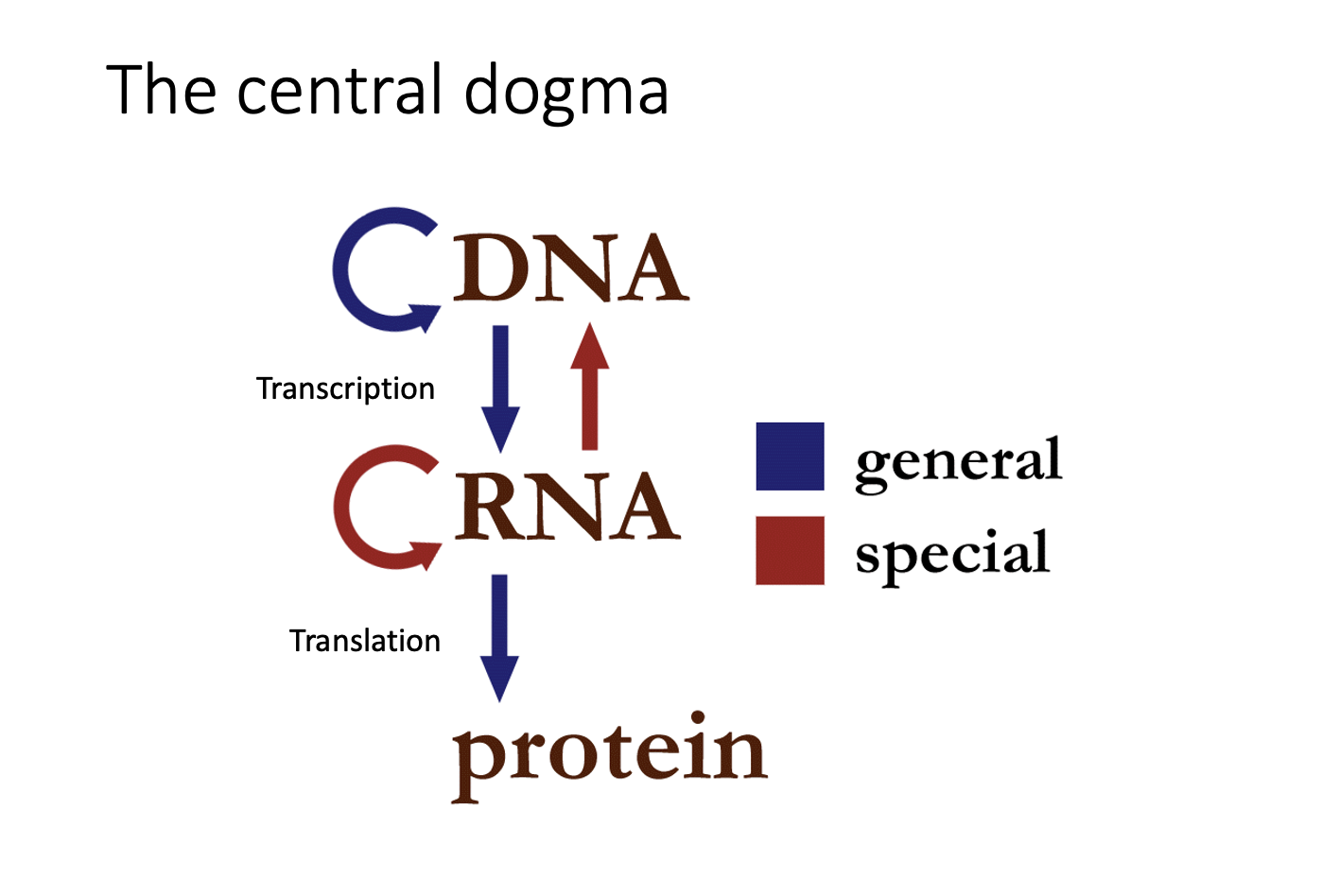
What is central dogma?
Flow of genetic info within a biological system
Once info is passed into protein, it cannot get back out
Curved red arrow around RNA
Red arrow going to DNA: DNA synthesised using mRNA template
What is molecular biology?
Study of biological molecules, their reactions and interactions
Generally understood to mean: study of molecular basis of genetics, including DNA, RNA and control of gene expression
Types of ‘omes
Genome - Total genetic content of cell/organism
Transcriptome - all mRNA molecules currently present in a cell/organism
Proteome - Total set of proteins currently present in a cell/organism
Define genome
Largely, the same between cell types within an individual
Includes
Protein coding genes
Introns and regulatory sequences
RNA coding sequences (siRNA, ribosomal components, tRNA etc.)
Junk DNA
Studied by transcriptomic and proteomic profiling
Epigenetics
Genotype vs Phenotype
Genotype
What is in the DNA
Inherited from parents
Deduced from gene sequence
E.g. genes encoding eye colour
Phenotype
What is observed in an individual
Protein expression
Environmental factors
Epigenetics
E.g. an individual with brown eyes
What is genetic polymorphism?
Difference in DNA sequence between individuals
Can involve:
Chance mutations
Induced mutations
Give examples of induced mutations
Viral infections
Chemical agents - can be mutagenic/carcinogenic
Can be linked to epigenetic changes
E.g. smoking increases methylation of DNA which can trigger tumour growth
Ionising radiation
How are gene disorders caused? with examples
They are caused by abnormalities in genome
Single gene mutations - point mutations and/or indels
E.g. CFTR gene mutations, sickle cell disease (beta-globin gene)
Chromosomal disorders - numerical and/or structural
E.g. down syndrome (trisomy 21)
Complex/ multifactorial disorders
E.g. Alzheimer's disease, some cancers
What are Genome wide association studies (GWAS)?
Collect very large data sets on individuals' genetic makeup
Look for associations between genetic variations and different disease states
What are clinical implications of GWAS?
Can establish correlation but not necessarily causation
Can be used for diagnosis and prognosis studies
Starting point for further biological study
What is the rile of the proteins involved?
What it the associated pathophysiology for those with the SNP variants
What are transcriptomes?
Complete set of mRNA molecules in a cell or organism
Will vary:
Between different types of cells - different cells have different functions
With environmental conditions
If mRNA goes up, does the amount of protein go up too?
Ribosomes recognise mRNA for translation, but efficiency varies based on mRNA sequences and structures.
Interactions with proteins and factors influence mRNA stability and translation.
mRNA degradation varies, affecting protein production; some mRNA have short half-lives, limiting translation rounds
How to calculate mRNA abundance and protein abundance?
RNA sequencing
DNA microarrays
Protein abundance:
Antibody based:
ELIZA assays
Mass spec
What is the experimental side of DB searching?
Protein mixture treated with trypsin which cleaves polypeptide chain at argenine and lysine. This generates tryptic fragment with ends dealinated by arg and lys residues
sample is fed into the mass spectrometer
mass spec lists peptide masses from sample
What is the computer side?
Has DB of potential proteins where you look for relevant microorganism that you used
Using theoretical trypsin digestion gives you list of possible masses that could’ve been produced
Compare detected masses to theoretical for protein ID
Why is molecular biology useful for drug discovery and development?
Targets are critical to drug discovery and can be identified in various ways
Likely to involve the comparison of healthy vs diseased tissue states
Literature searches
Classical biochemistry
Genomes
Transcriptomes
Proteomes
Genetic association studies
Look for the presence of DNA sequence variation in diseased vs healthy individuals/cells
Identify mutations and polymorphisms associated with disease
Gene expression studies (transcriptomics)
Looks for differences in gene expression in diseased vs healthy individuals (i.e. what genes are "on" and "off")
Protein expression studies (proteomics)
Look for differences in protein expression and modification in diseased vs healthy individuals (i.e. which proteins are made/not made/made more/made less/modified/not modified/modified differently)
4 characteristics of good targets
Unique to the pathogen/cell type (e.g. cancer) otherwise there will be higher chance of side effects
Essential (inhibition or antagonism needs to affect the cell or tissue)
Non-redundant (i.e. no other molecules with a similar function otherwise the other gene/protein may compensate when then target is inhibited)
Susceptible to modification - drug like molecules need to modify activity
Validation is done in two key steps: Explain them
Reproducibility once identified via a specific technique
Introduction of variation to ligand (drug) - target environment
Modulation of drug molecule activity results in changes in affinity for target
Variation in cell or tissue type should/ should not vary the effect
Mutation of binding domain of protein target should result in loss or modulation of drug effect
Altering amounts of gene/protein expression
Overexpression = making more of the protein than normal
Gene knockout = delete the gene and therefore stop protein production
Can also knock down the expression of mRNA using RNAi
Making the target
Unlikely that we can insolate or purify much of the protein from the source
Expression of the recombinant protein in a suitable host
E.g. E.coli - cheap, fast, <100kDa, no post translational modifications
Saccharomyces cerevisiae (an other yeasts) - slightly slower, more expensive, larger proteins possible, some posttranslational modifications (but not necessarily the right ones)
Cells in culture (e.g. insect cells, mammalian cells) - slower, expensive, no size limit, PTM's can be correct
Advantage of recombinant DNA techniques
You can essentially get unlimited amounts of protein which can enable structural and functional studies as well as screening
You can make altered forms (change the DNA to change the resulting protein) which means that isolated domains and regions can be studied
Alter single amino acid residues (site-directed mutagenesis) and test hypotheses about drug binding etc
Lead Discovery
Process of identifying active new chemical entities (leads) where subsequent modification can transform them into clinically useful drug
Lead generation
Strats developed to identify compounds which possess a desired but non-optimised biological activity
Why may lead activity molecules not automatically be good drug molecules?
May be peptidic
Poorly absorbed and rapidly cleared
May have poor “drug like” properties (PK)
Final drug may only slightly be similar to original substance
What are strategies for discovery of lead activity molecules?
Exploitation of biological information
Improvement of existing drugs
Systematic screening
Planned research and rational drug design
Exploitation of biological information
Study of natural products and indigenous medicine
Clinical obs of SE in medicines
Obs made in other scientific studies
Activities of industrial chemical products
Examples of natural products
Medicines e.g opium
Toxins and poisons e.g. snakes
Hallucinogens e.g. Alcohol
What is Bothrops jararaca?
Snake venom which peptides are used for ACEI
Lowers BP
Studies on peptide fragments showed that pro or aromatic amine acid in C-terminus were most effective
Examples of ethnopharmacology (indigenous medicines)
Neuromuscular blocking agents
Curare - arrow poison
Artemisinin
Active substance in TCM
Used for chloroquine
Artemether - methyl ether derivative
SE observation in medicine
Most drugs have SE
SE can be result of activity at other targets
Amplifying SE/minimising intended effects = New drug, target different receptor
E.g. procaine (local anaesthetic):
Rapidly metabolised
Has CNS effects
Procainamide (antiarrhythmic)
Resistant to esterases
Less lipid soluble
Fewer CNS effects
Observations made in other scientific studies
Anticancer alkaloids tested for anti-diabetic activity
Rats died of septicaemia due to leukopenia which told us vincristine, vinblastine were potent anti-leukaemia drugs
Activities of industrial chemical products
Nitroglycerin observed to give workers headaches
Potent vasodilator
Isosorbide mononitrate now used in angina treatment
How to improve existing drugs
Improving:
Potency
Selectivity
Safety
Duration of action
Formulation more easily handled by HCP
Formulation more acceptable to patient
Why may competing with market leader may be financially advantageous?
Target is already defined
Market is already established
Clinical trials have good reference
ß-lactams - side chain mods to penicillins allow for different selectivity of activity
What does systematic screening seek to test
As many different compounds as possible
Sources of test compounds can be
Natural products
Chemical libraries
Need for assays that are fast and reliable
What are 2 drugs derived from screening dyes?
Suramin - Trypanocide
Trypanosomiasis
Sleeping sickness in African
Chagas disease in south America
Protozoal parasite
Chloroquine - antimalarial
Name 5 other drugs derived from screening dyes?
Sulphonamides - antibacterial
Dapsone - antileprotic
Bendroflumethiazide and frus - diuretics
Chlorpropamide and Gibenclamide - antidiabetics
Mesalazine and olsalazine - UC
Drugs derived from screening organic chemical libraries
Promethazine - antihistamines
BDZ - anxiolytics and hypnotics
TCA’s
What is high throughput screening used for?
Screen large numbers of small molecule compounds for interaction with target system
Hope to find at least ONE hit on target system
Assay system immobilised
Many replicates in well-plates
Highly automated
Liquid handling
Detection of response
Presentation and analysis of data
Large robotic systems
How to create molecular libraries?
Combinatorial synthesis is a process to prepare large sets of organic compounds by combining sets of building blocks
Goal: Synthesise and test as many molecules as possible in as few steps as possible
What is combinatorial analysis?
3 points of diversity can generate:
Nr1X, Nr2X and Nr3 molecules
Each term is the number of different substituents at each position
Judicious selection of building blocks can mean that very large libraries can be constructed quickly
What are problems with combinatorial chemistry?
Working out what you have in the library
Working out which are active molecules
Low hit rates
High costs
Low quality hits
Chemically reactive
Problems with the chemistry
Individual chemical reactions should not yield alternative products
Should be high yielding at each step
Multistep reactions are problematic.
What are some current successes from high throughput screening/combinatorial chemistry?
Insulin mimetics
Thrombin inhibitors
Neuropeptide Y5 receptor antagonists
Selective COX-2 inhibitors
What is fragment based lead discovery
Libraries of fragments of drug molecules are screened
RMM <300
LogP<3
H bond acceptors & donors <3
Fragments that show binding to a target are selected for further development
Has better success rate than combinational chemistry
What is planned research and rational drug design?What is planned research and rational drug design?
Identify a target or biochemical system
Attempt to address the target
Use endogenous molecules as a starting point
Antimetabolites
Hitchings and Elion studied DNA synthesis
Thought to be possible to block growth of bacteria, protozoa or tumours by interfering with synthesis of nucleic acids
Looked of molecules that might be dihydrofolate reductase inhibitor