Bio chap 12
 Call Kai
 Learn
Learn Practice Test
 Spaced Repetition
 Match
Match Flashcards
 Knowt Play
1/113

There's no tags or description
Looks like no tags are added yet.
Name | Mastery | Learn | Test | Matching | Spaced | Call with Kai | Chat |
|---|
No analytics yet
Send a link to your students to track their progress
114 Terms
The continuity of life is based on the reproduction of cells or
cell division
In unicellular organisms, the division of one cell reproduces what?
The entire organism
Multicellular eukaryotes depend of cell division for?
Development from a fertilized cell
Growth
Repair
Cell cycle
The life of a cell from formation to its own division
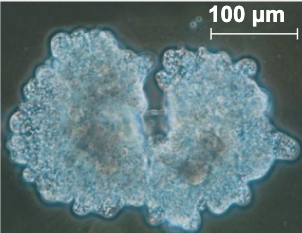
Reproduction
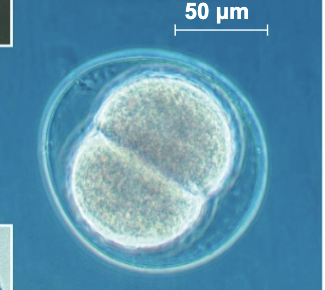
Growth and development
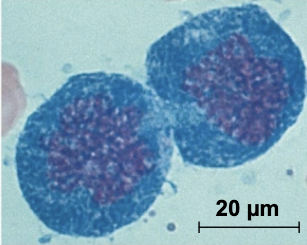
Tissue renewal
Genome
All of the DNA in a cell
DNA molecules in a cell are packaged into?
Chromosomes
A genome can consist of
A single DNA molecules (prokaryotic) or a number of DNA molecules (eukaryotic)
Centrosome
Organelle that produces microtubules
Centriolles
Factory site of microtubule production
Microtubules are
Spindle fibers
One portion of the chromosome is called
A sister chromatid
A sister chromatid after being replicated and copied becomes what?
A chromosome
Chromatin
A complex of DNA and protein that condenses during cell division
Somatic cells
(nonreproductive cells) have two sets of chromosomes
Gametes
(reproductive cells: sperm and eggs) Have half as many chromosomes as somatic cells
How is a nucelosome extended?
By being wrapped around histones, which then becomes a DNA complex
centromere
The attachment site of chromosomes
What happens to sister chromatids during cell division?
They separate and move into two nuclei
One separate, the sister chromatids are called?
Chromosomes
Eukaryotic cell division consists of
Mitosis and cytokinesis
Mitosis
The division of genetic material in the nucleus
Cytokinesis
The division of the cytoplasm
Cell cycle phases
Mitotic phase
Interphase- G1 phase, S phase, and G2 phase
Mitotic phase
Mitosis and cytokinesis
Interphase
Cell growth and copying of chromosomes in preparation for cell division
Which phase is about 90% of the cell cycle?
Inrerphase
G1 phase
First gap
S phase
Synthesis
G2 phase
Second gap where chromosomes are duplicated
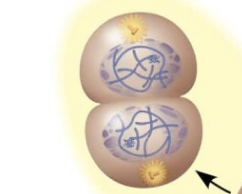
Telophase and cytokinesis
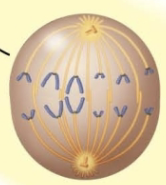
Anaphase
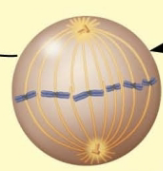
Metaphase
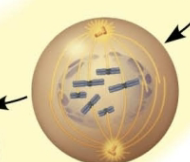
Prometaphase
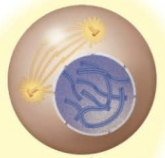
Prophase
First step of cellular division before prophase
G2 of interphase
First step of cellular division
Prophase
Second step of cellular division
Prometaphase
Third step of cellular division
Metaphase
Forth step of cellular division
Anaphase
Fifth step of cellular division
Telophase and cytokinesis
Mitotic spindle
A structure made of microtubules that controls chromosome movement during mitosis
In animal cells, assemble of spindle microtubules begins in?
The centrosome; The microtubule organizing center
What replicated during interphase?
The centrosome, forming two chromosomes
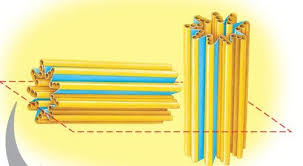
Centrioles
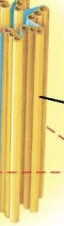
Mirrotubule
Aster
A radial array of short microtubules that extends from each centrosome

Aster
Early mitotic spindle
Centromere
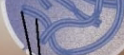
Chromosome
Prometaphase
Some spindle microtubules attach to the kinetochores of chromosomes and begin to move the chromosome
Kinetochores
Protein complexes associated with centromeres
Metaphase
Chromosomes are line up at the metaphase plate
Metaphase plate
A plane midway between the spindle’s two poles
Separase
Cleaves cphesions in anaphase
Anaphase
Sister chromatids separate and move along the kinetochore microtubules toward opposite ends of the cell
Depolymerizing
Shortens microtubules at their kinetochore ends during telophase

Kinetochore
Nonkinetochore microtubules from opposite poles during anaphase
Overlap and push against each other, elongating the cell
Kinetochore
A structure composed of several proteins that associate with the centromere region of a chromosome and bind to spindle microtubules
Telophase
Genetically identical daughter nuclei form at opposite ends of the cell
When does cytokinesis begin?
During anaphase or telophase and the spindle eventually disassembles
Similarity between plant and animal cell division?
The identical cells will be at the end
Difference between plant and animal cell division
Plant cells have a cell wall and cell plate while animal cells have the cleavage furrow
In animal cells, cytokinesis occurs by a process know as cleavage. What does this form?
Cleavage furrow
Binary fission
Chromosome replicates, and two daughter chromosomes actively move apart
The plasma membrane in binary fission of bacteria
It pinches inward, dividing the cell in two
Prokaryotes reproduce binary fission
True
Step one of mitosis
Chromosome replication begins
Step 2 of mitosis
One copy of the origin is now at the end of the cell
Step 3 of mitosis
Replication finishes
Step 4 of mitosis
Two daughter cells result
Mitosis evolved from binary fission
True
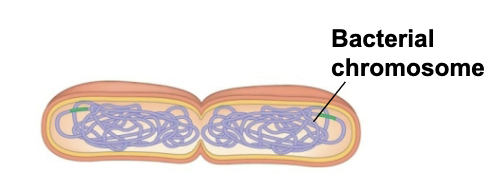
This type of cell division occurs where?
In bacteria
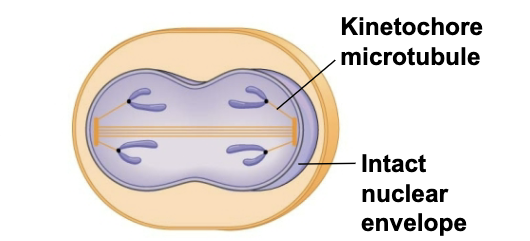
This type of cell division occurs where?
Dinoflagellates
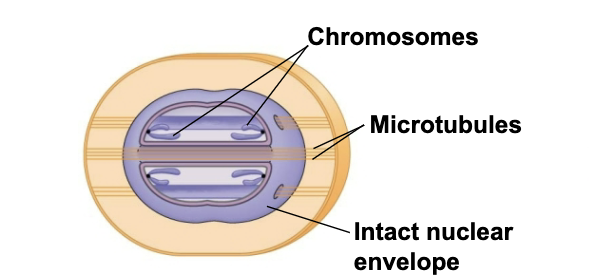
This type of cell division occurs where?
Diatoms and some yeasts
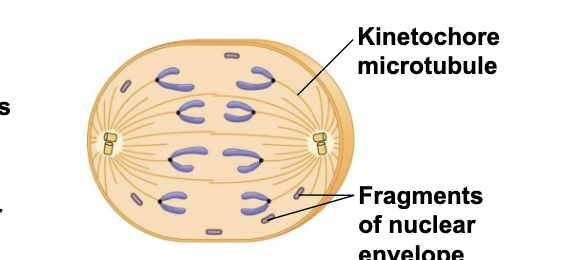
This type of cell division occurs where?
Most eukaryotes
Cell cycle control system
Directs the sequential events of the cell cycle
The cell cycle control system is regulated by?
Internal and external controls
Checkpoinds
Areas where the cell cycle stops until a go-ahead signal is received
M checkpoint
Ensures that the spindle fibers attach properly during metaphase
G1 checkpoint
Inhibits S-phase entry in G1 cells that have not yet committed DNA replication
G2 checkpoint
Ensures that the cell has completed DNA replication and that the replicated DNA is undamaged before entering mitosis
Cyclins and Cyclin-dependent kinases
Regulatory proteins involved in cell cycle control
With changes in concentration of its cyclin partner, what happens to Cdk?
The activity rises and falls
Maturation-promoting factor (MPF)
Cyclin-Cdk complex that triggers a cell’s passage past the G2 checkpoint into the M phase
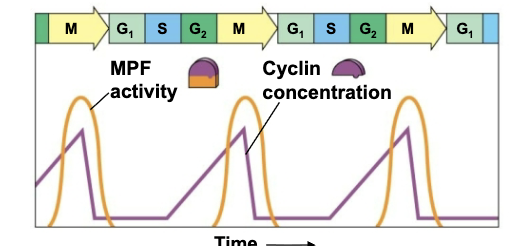
Fluctuation of MPF activity and cyclin concentration during cell cycle
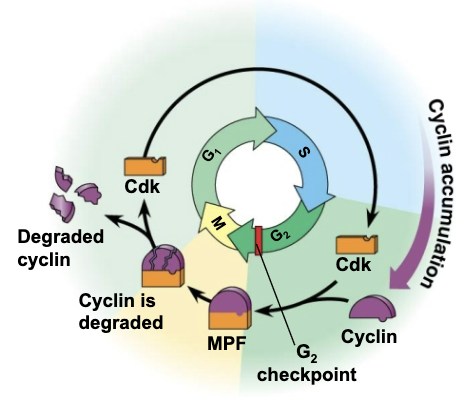
Molecular mechanisms that help regulate the cell cycle
Checkpoints register signals from outside the cell
True
Most important checkpoint
G1
G0 phase
If the cell does not receive the go-ahead signal, it will exit the cycle, switching into a nondividing state
Example of an internal signal
Cells will not being anaphase until all chromosomes are properly attached to the spindle at the metaphase plate
Integral signal ensures?
That daughter cells have the correct number of chromsomes
Growth factors
Released by certain cells and stimulate other cells to divide
Platelets form what?
Platelet-derived growth factor (PDGF)
Platelets
Blood cell fragments
Density-dependent inhibition
Crowded cells will stop dividing