Animal and plant cells
 View linked note
 Call Kai
 Learn
Learn Practice Test
 Spaced Repetition
 Match
Match Flashcards
 Knowt Play
1/13

There's no tags or description
Looks like no tags are added yet.
Name | Mastery | Learn | Test | Matching | Spaced | Call with Kai | Chat |
|---|
No analytics yet
Send a link to your students to track their progress
14 Terms
Cell
The smallest unit of life, forming the building blocks for all organisms.
Microscope
A tool used to see small cells that are not visible to the naked eye.
Unicellular organisms
Organisms made of only one cell eg. bacteria
Multicellular organisms
Organisms made from millions or billions of cells eg. trees and blue whales
Specialised cells
Cells that have different functions within multicellular organisms.
Nucleus
The component of a cell that contains genetic material (DNA) and controls the cell’s activities.
Cytoplasm
The liquid part of the cell in which chemical reactions occur, primarily made of water.
Cell membrane
A flexible outer layer that surrounds the cell, controlling the movement of substances in and out.
Mitochondria
Cell structures where energy is released from glucose during respiration.
Cell wall
A tough outer layer in plant cells that provides strength and support, made of cellulose.
Vacuole
A space inside a plant cell that contains cell sap, keeping the cell firm.
Chloroplasts
Structures in plant cells that contain chlorophyll and where photosynthesis occurs.
What makes up an animal cell?
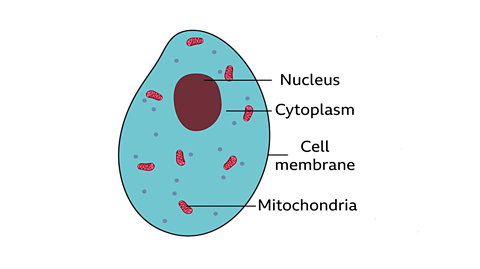
Each component in the animal cell has a particular function. Animal cells often have an irregular shape.
The four key components of most animal cells are:
Nucleus - this contains the genetic material (DNA) of the organism and controls the cell’s activities.
Cytoplasm - the liquid that makes up most of the cell in which chemical reactions happen. This is mainly water.
Cell membrane - a flexible outer layer that surrounds the cell and controls which substances can pass into and out from it.
Mitochondria - tiny parts of cells floating in the cytoplasm where energy is released from glucose from food. The mitochondria, found in the cell cytoplasm, are where most respiration happens.
What makes up a plant cell?
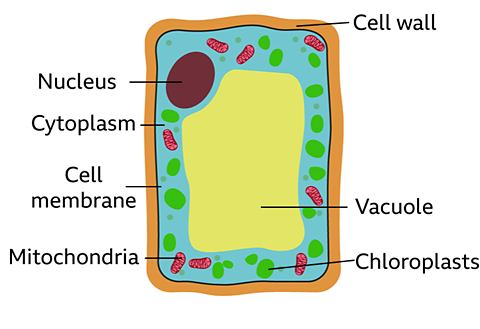
Plant cells often have a regular shape. They have the same cell components as animal cells: a nucleus, cell membrane, cytoplasm and mitochondria.
They also have these extra three as well:
Cell wall: a tough outer layer of the cell, which contains cellulose to provide strength and support to the plant.
Vacuole: a space inside the cytoplasm that contains a watery liquid called cell sap. It keeps the cell firm.
Chloroplasts: structures found in the cells of green parts of plants only (leaves and stems) which contain a green pigment called chlorophyll in which photosynthesis occurs.