ASVAB Mechanical Comprehension
 Call Kai
 Learn
Learn Practice Test
 Spaced Repetition
 Match
Match Flashcards
 Knowt Play
1/100

There's no tags or description
Looks like no tags are added yet.
Name | Mastery | Learn | Test | Matching | Spaced | Call with Kai | Chat |
|---|
No analytics yet
Send a link to your students to track their progress
101 Terms
What is displacement?
the change in an object's position from where it started to where it ended.
Where an object moved
How far it moved from the starting point
Displacement only cares about:
✅ Initial location
✅ Final location
It does not care about the path taken.
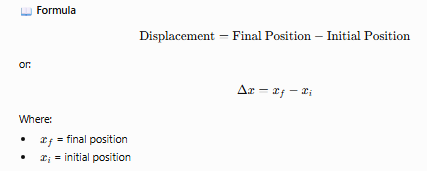
What is the formula for displacement?
What is distance?
Measures the entire path traveled.
Example:
A runner completes one lap and returns to the starting point.
Distance:
✅ Large (the whole lap)
Memory Trick
Distance follows the path
What is the difference between displacement and distance?
📖 Displacement
Measures the change from start to finish.
📖 Distance
Measures the entire path traveled.
Memory Trick
"Distance follows the path; displacement points to the finish."
What is velocity?
The rate at which an object changes position.
It tells:
"How quickly is an object moving in a specific direction?"
What is the formula for Velocity?
Memory Trick
"Velocity has speed with a direction."
Velocity cares about:
How fast
Direction
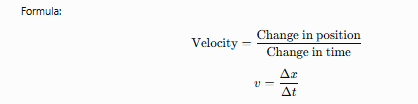
What is the formula for Speed?
Speed only cares about:
How fast
Total path traveled

What is projectile motion?
The movement of an object through the air while only being affected by gravity.
What are examples of Projectile Motion?
Examples:
A thrown ball
A fired projectile
A kicked soccer ball
What are the characteristics of projectile motion?
Horizontal motion:
Velocity stays constant
No horizontal acceleration
Vertical motion:
Gravity changes velocity
Acceleration is downward
Memory Trick
"Sideways stays, gravity sways."
How does gravity affect projectile motion?
Gravity only affects the vertical direction.
The vertical velocity changes because gravity pulls downward.
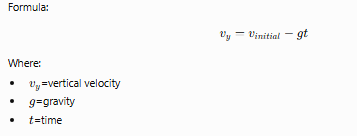
What is the formula for gravity affecting projectile motion?
What is force?
A push or pull acting on an object.
Memory Trick
"Force is a push or pull that makes things move or change."
Examples of Force
Examples:
Pushing a box
Pulling a rope
Gravity pulling objects down
What is Force measured in?
Newtons (N)
What is Newton’s First Law of Motion?
An object at rest stays at rest, and an object in motion stays in motion unless acted upon by an outside force.
What is the Law of Inertia?
Newton’s First Law of Motion aligns with the Law of Inertia by stating how an object that is at rest will remain at rest while an object in motion will remain in motion unless there is an outside force that is acted upon it.
What is Newton’s Second Law of Motion?
Acceleration depends on:
The force applied
The object's mass
Memory Trick
"Force makes acceleration; mass makes it harder."
What is the formula for Newton’s Second Law of Motion?
F = ma
Where:
F = force
m = mass
a = acceleration
🔑 Relationship
More force → more acceleration
More mass → less acceleration
What is Newton’s Third Law of Motion?
For every action force, there is an equal and opposite reaction force.
Example:
A rocket pushes gas downward.
The gas pushes the rocket upward.
Memory Trick
"Every action gets an equal reaction."
What is the formula for force?
F = ma
Force equals:
mass x acceleration
What are the units used for Force?
Newtons (N)
Regarding Force.
What is friction?
A force that resists motion between two surfaces touching each other.
Memory Trick
"Friction fights movement."
Examples of Friction?
Examples:
Tires gripping pavement
Shoes gripping the ground
What is static friction?
Friction that occurs between objects that are not moving.
Memory Trick
"Static = still."
What are examples of Static Friction?
Example:
A book sitting on a table.
The friction prevents it from sliding.
What is kinetic friction?
Friction that occurs when surfaces are already moving against each other.
Which friction is less, is it Kinetic friction or Static Friction?
Kinetic Friction
Due to how:
Starting movement requires more force than maintaining movement.
What is an example of Kinetic Friction?
Example:
Sliding a box across the floor.
What is work?
The transfer of energy when a force moves an object.
What does Work require?
Force
Movement
What is the formula for Work?
W = Fd
Where:
W = work
F = force
d = displacement
When is work positive?
Force and movement are in the same direction.
When is work negative?
Force and movement are opposite directions.
What is an example of Positive Work?
Example:
Pushing a box forward.
What is an example of Negative Work?
Example:
Friction slowing a sliding object.
What is momentum?
The measure of how difficult it is to stop a moving object.
Memory Trick
"Momentum means motion that wants to keep going."
What is the formula for Momentum?
Formula:
p = mv
Where:
p = momentum
m = mass
v = velocity
More mass or speed = more momentum.
What is acceleration?
The rate at which velocity changes.
Memory Trick
"Acceleration is velocity's alteration."
What is the formula for Acceleration?

When does Acceleration occur?
When an object:
Speeds up
Slows down
Changes direction
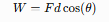
What is the Two-Dimensional Work Formula?
Where:
F = force
d = displacement
θ (theta) = angle between force and displacement
The cosine adjusts the amount of force actually contributing to movement.
What is energy?
the ability of an object or system to do work on another object.
Energy is what allows something to:
Move
Change
Apply force
Perform work
What does Energy allow?
Energy allows work to happen
Work and energy are directly connected.
What is the Unit of measurement for Energy?
Joules (J)
What is kinetic energy?
the energy an object has because of its motion.
If an object is moving, it has kinetic energy.
When there is more mass, is there more Kinetic Energy or less Kinetic Energy?
More kinetic energy
How much Kinetic Energy does an object have at rest?
Zero
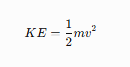
What is the formula for Kinetic Energy?
KE = kinetic energy
m = mass
v = velocity
What is gravitational potential energy?
Stored energy an object has because of its height above the ground.
The higher an object is, the more ____ of energy it has.
Gravitational Potential Energy
Gravitational potential energy increases when:
Height increases
Mass increases
What is the formula for Gravitational Potential Energy?
m = mass
gg = acceleration due to gravity
h = height
Memory Trick:
"Higher height = higher stored energy."

What is elastic potential energy?
Stored energy caused by an object being stretched or compressed.
Key Point:
The energy is stored until the object returns to its original shape.
What is an example of Elastic Potential Energy?
Examples:
A stretched rubber band
A compressed spring
A pulled bowstring
Memory Trick:
"Stretch or squeeze, energy it keeps."
How is mechanical energy conserved when friction is ignored?
When friction is absent, mechanical energy is conserved, meaning the total amount of energy stays the same.
What is the formula for Mechanical Energy?

Falling object example for explaining energy.
At the top:
High height
High potential energy
Low kinetic energy
Falling object example for explaining energy.
While falling:
Potential energy decreases
Kinetic energy increases
Falling object example for explaining energy.
At the bottom:
Low potential energy
High kinetic energy
The total energy remains constant.
How is electric force different from gravitational force?
The force that occurs between electrically charged objects.
what charges regarding electric force attract and repel each other?
Attract objects together
Repel objects apart
Unlike gravity, electric force can push objects away.
What is Gravitational Force?
The force of attraction between objects with mass.
Does Gravity pull or repel objects together?
Only:
Pulls objects together
Gravity cannot repel objects.
Example:
Earth pulls objects toward its surface.
Main Difference Between Electric Force and Gravitational Force
Force | Can Attract? | Can Repel? |
|---|---|---|
Gravity | ✅ Yes | ❌ No |
Electric Force | ✅ Yes | ✅ Yes |
Memory Trick:
"Gravity grabs, electricity can grab or push."
How do like electric charges interact?
Charges that are the same push away from each other.
Positive repels positive.
Negative repels negative..
How opposite electric charges interact?
Charges that are different pull toward each other.
Positive attracts negative.
What is power?
The rate at which work is performed.
🧠 Memory Trick:
"Power is work done with speed.
What does Power measure?
How quickly energy is transferred or work is completed.
Two machines can do the same amount of work, but the one that does it faster has more power.
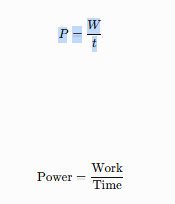
What is the formula for Power?
P = Power
W = Work performed
t = Time
How does time affect power?
Power increases when:
✅ More work is done
✅ The same work is completed in less time
Memory Trick:
"Same work, less time = more power."
Example of which engine has more Power:
Two engines lift the same weight.
Engine A:
Takes 20 seconds
Engine B:
Takes 10 seconds
Engine B has more power because it completes the work faster.
Is power a scalar or vector quantity?
Scalar quantity.
A scalar has:
✅ Magnitude (amount)
but does not have:
❌ Direction
How is power measured?
Watts (W)
1 watt = 1 joule of work per second
How is engine power measured?
Horsepower (hp)
Examples:
Car engines
Aircraft engines
Industrial machines
What is the purpose of a cam?
to convert one type of motion into another.
From Rotational motion —> Linear motion
What is a cam?
A mechanical device used to create timed, controlled, and repeating motion in a machine.
What does a rotating cam cause?
Causes another part to move back and forth in a straight line.
🧠 Memory Trick:
"Cam spins, follower moves."
What are the two main parts of a Cam?
Cam
Follower
What do the two main parts of a Cam do?
work together to create controlled, repeating motion.
Memory Trick:
"The cam creates; the follower traces."
What does a cam rotate around and what are its features?
Rotates around a fixed point
Has bumps and smooth areas
What does a cam control?
Controls when and how the follower moves
Think of the cam as the driver of the system.
Memory Trick:
"Cam = control wheel."
What does it mean that a cam rotates around a fixed point?
A cam spins around one stationary point called an: Axis
Example:
A wheel spins around its axle.
The axle stays in place while the wheel rotates around it.
Memory Trick:
"Axis stays; cam plays."
What is the axis?
The center of rotation.
Why does a cam have bumps and different shapes?
High points (bumps) push the follower outward.
Low points allow the follower to move inward.
What does the cam’s shape determine?
How far the follower moves
When the follower moves
How often the movement repeats
What is a follower in a cam system?
The part that rests against the outside edge of the cam.
What is the job of the follower?
Follow the cam’s shape
Move according to the cam’s rotation
The follower does not rotate with the cam.
It moves because the cam pushes against it.
Memory Trick:
"The follower follows the cam's form."
How does the follower move when the cam rotates?
The follower moves because it follows the changing shape of the cam.
Movement depends on whether the follower is touching:
A high point
A low point
What happens when the follower reaches a bump on the cam?
The cam pushes the follower outward/upward.
This happens because the bump takes up more space and forces the follower away from the center of rotation.
Memory Trick:
"High spot = push up."
What happens when the follower reaches a lower area on the cam?
The follower moves inward/downward.
This happens because there is less material pushing against the follower.
Memory Trick:
"Low spot = follower drops."
What determines the movement of the follower?
The shape of the cam determines the follower’s movement.
Changing the cam shape changes what?
The timing of movement
The distance traveled
The pattern of movement
What is normal force?
A support force that acts perpendicular (90°) to a contact surface.
The word "normal" in physics means perpendicular.
Why does normal force exist?
Exists because a surface prevents an object from passing through it.
What is an example of normal force?
A box sitting on a table:
Gravity pulls the box downward.
The table pushes the box upward.
The upward push from the table is the normal force.
What direction does normal force act on a horizontal surface?
Weight (gravity) pulls downward. Normal force pushes upward.
normal force acts:
Straight upward because it is perpendicular to the horizontal surface.
What is the relationship between normal force and weight?
When an object is resting on a flat surface and not accelerating:
Normal Force=Weight
The forces are equal in magnitude but opposite in direction.
How does normal force act on an angled surface (wedge)?
The normal force is not vertical.
Instead, the normal force acts: Perpendicular to the surface
Example of normal force acted on an angled surface (wedge).
A box resting on a ramp:
Gravity pulls straight downward.
The ramp pushes the box at a 90° angle away from the ramp.