Module 3 - Macromolecules
 Call Kai
 Learn
Learn Practice Test
 Spaced Repetition
 Match
Match Flashcards
 Knowt Play
1/42

There's no tags or description
Looks like no tags are added yet.
Name | Mastery | Learn | Test | Matching | Spaced | Call with Kai | Chat |
|---|
No analytics yet
Send a link to your students to track their progress
43 Terms
Know the four major macromolecules
Carbohydrates
Lipids
Proteins
Nucleic Acids
Macromolecules:
large organic molecule, usually comprising smaller molecules joined together to form a larger molecule.
Monomers:
a smaller molecule that can be combined with other similar or identical molecules to create a polymer.
Polymers:
a larger molecule made up of many similar or identical subunits.
Carbohydrates
Monomers are simple sugars like glucose and fructose (monosaccharides).
Polymers include starches, glycogen, and cellulose (polysaccharides).
Lipids
These do not form true polymers.
They are composed of distinct units like glycerol and fatty acids, which form larger structures such as triglycerides, phospholipids, and steroids.
Proteins
Monomers are amino acids.
They link together to form polymer chains called polypeptides, which then fold into functional proteins
Nucleic Acids
Monomers are nucleotides, consisting of a sugar, a phosphate group, and a nitrogenous base.
Polymers are polynucleotides, specifically DNA and RNA.
How does your body store unused energy (glucose) in the short term and in the long term?
Glucose provides molecular energy for the body.
Excess glucose stored as glycogen in the short term or fat in the long term
Complex Carbohydrates
Energy production & structure.
Simple carbohydrates (monomers).
Glycogen: carbohydrate storage in animals.
Starch: carbohydrate storage in plants.
Complex Carbohydrates (Polymers):
Energy production & structure.
1:2:1 ratio
Carbon:Hydrogen:Oxygen
Simple carbohydrates (monomers).
Monosaccharides and Disaccharides
Glucose
Fructose
Galactose
Glycogen: carbohydrate storage in animals.
Stored in liver and muscle
Starch
carbohydrate storage in plants.
Complex Carbohydrates (Polymers):
Polysaccharides
Starch
Glycogen
Cellulose
Chiti
What are the functions of lipids?
non-polar molecules insoluble in water
Fats, oils, waxes, cholesterols and hormones
Lipid function:
Energy storage.
Cushion's internal organs.
Insulation.
Membrane Structure.
Water storage.
Toxic storage.
Chemical Messengers.
Structure of a triglyceride
lipid molecule formed by three fatty acids bonded to a glycerol.
Most common lipid molecule found in foods
Differences between unsaturated and saturated fatty acids.
Saturated fatty acid: no double bonds.
Saturated with H atoms.
Unsaturated fatty acid: one or more
double bonds between carbon atoms.
What are hydrogenated fats?
Trans fats (lipids)
Know common types of lipids (sterols, phospholipids and waxes).
(sterols,
phospholipids
and waxes).
Sterols
lipid with four interlocking carbon rings.
Cholesterol: important in animal cell membranes.
Testosterone and Estrogen: hormones important to the development of different sexes in humans
Phospholipids
a charged lipid composed of a glycerol, a phosphate group, and two fatty acids
Waxes
a single long chain fatty acid linked to a glycerol head.
Water repellant coating used by plants and animals.
Low-density lipoproteins (LDLs):
cholesterol that travels from liver to body and can clog arteries of the heart.
“Bad cholesterol.”
Saturated fats and trans fats.
High-density Lipoproteins (HDLs):
cholesterol that travels from body to liver, clearing cholesterol from the system.
“Good cholesterol.”
Omega-3 fatty acids.
Essential
can't be produced by humans so you need to take them
Two fatty acids are essential to humans:
Alpha-linolenic acid (omega-3 fatty acid).
Linoleic acid (omega-6 fatty acid)
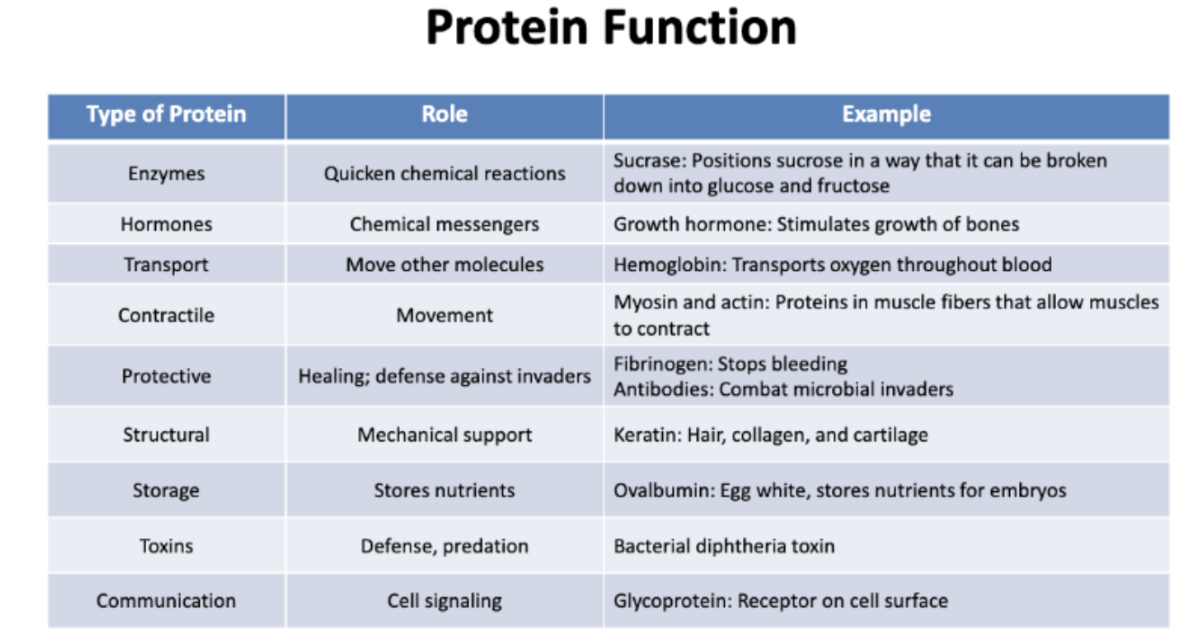
Proteins
a long, folded polypeptide.
Polypeptide = a chain of amino acids.
Amino acid = compounds consisting of an amino and carboxyl functional group, which act as the building block (monomers) of proteins.
20 different amino acids
Nine essential to humans
Essential amino acids
amino acids not produced by the body, which must be obtained through the diet.
Nine in humans.
All found in animal protein
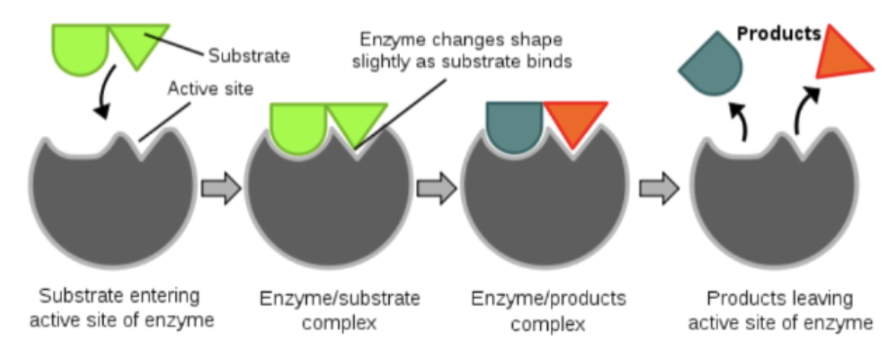
What do enzymes do?
Proteins that accelerate chemical reactions.
Catalysts: chemical agent that increases the rate of a reaction without being consumed by the reaction.
What does it mean when an enzyme has become denatured?
Protein shape can be altered, disrupting function of protein.
How can enzymes become denatured?
Denaturing: loss of protein shape due to external stress or interaction with hazardous compounds.
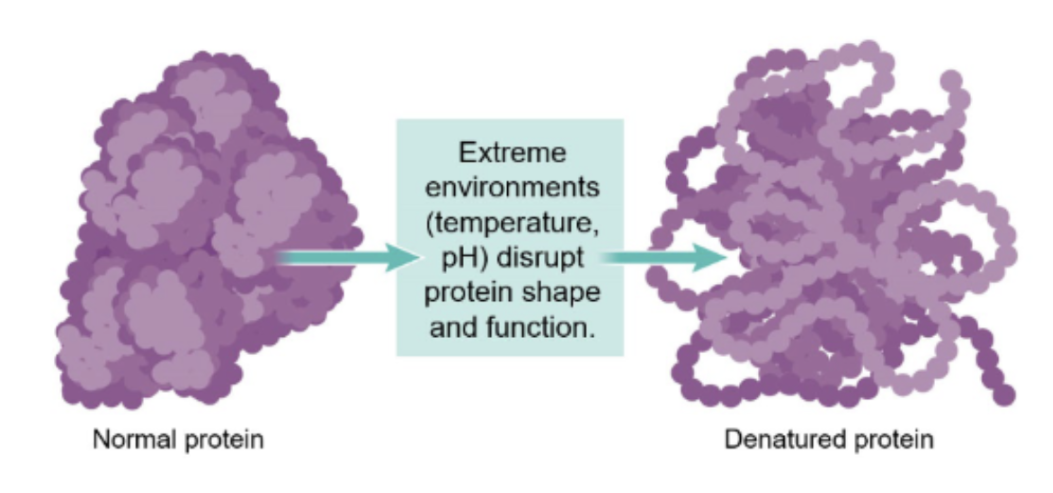
How is the function of an enzyme altered once they become denatured?
Where do substrates bind to an enzyme?
Active site
What are enzymes made up of?
Made up of a long chain of amino acids folded into complex, three-dimensional structures, which means they are classified as proteins
Protein Synthesis:
DNA is copied (transcription) and translated to make proteins
Nucleic Acids:
are large molecules made up of nucleotides.
Nucleotides
Organic molecules that serve as the building blocks (monomers) of nucleic acids, and are made up of a phosphate group, a sugar and a nitrogenous base.
DNA and RNA
Instructions for making proteins.
ATP
Energy transfer
Deoxyribonucleic acid (DNA):
primary information bearing molecule of life, composed of two linked chains of nucleotides (double helix).
Nitrogenous bases:
Adenine
Thymine
Cytosine
Guanine
Uracil (RNA)
Ribonucleic acid (RNA):
active in protein synthesis and also forms part of ribosomes.
Uracil nucleotide instead of Thymine